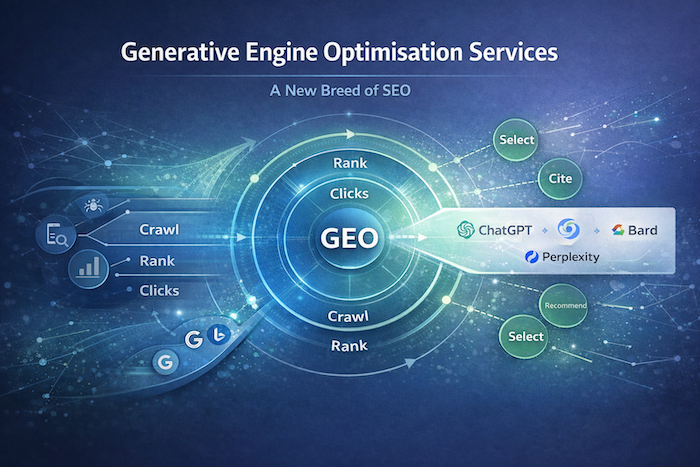
The search landscape no longer revolves solely around rankings and clicks. Large language models (LLMs) such as ChatGPT, Perplexity, Gemini and Google’s AI Overviews synthesise information from multiple sources and deliver a single conversational answer. When these systems answer a query, they decide which sources to reference, what facts to extract and how to frame the response. Traditional SEO services—built to climb SERPs and drive traffic—are therefore inadequate on their own.
Generative Engine Optimisation (GEO) services have emerged to fill this gap. Instead of chasing blue links, GEO aims to influence the answers produced by AI systems. This report explains what GEO services entail, how they differ from conventional SEO packages, and why they have become essential as generative engines become decision‑makers rather than mere referrers.
What “Generative Engine Optimisation Services” Actually Means
Generative Engine Optimisation involves shaping your content, brand and digital presence so that generative AI engines can discover, understand and reference you when generating answers. It is an evolution of SEO, not a replacement. Whereas SEO targets traditional search rankings, GEO targets AI inclusion—ensuring that your facts, comparisons and narratives appear inside AI answers. GEO optimises influence and visibility rather than raw traffic: the goal is to be selected, cited or recommended by AI systems. This requires structured content, clear entities, trustworthy sources and robust technical foundations; it cannot be achieved by simply adding more keywords.
How GEO Services Differ from Traditional SEO Packages
Traditional SEO packages focus on keywords, rankings and links. Generative engines operate differently; they synthesise answers from multiple sources and decide which voices to trust. The table below highlights key differences:
| Aspect | Traditional SEO | GEO Services |
|---|---|---|
| Target | Search engine algorithms such as Google’s PageRank | Generative AI models and answer engines (ChatGPT, Gemini, Copilot) |
| Objective | Rank pages to drive clicks | Achieve citations, mentions and favourable representation in AI answers |
| Optimisation focus | Keywords, backlinks, site structure, user experience | Clarity of information, factual accuracy, entity and context signals, citation‑worthiness |
| Output | List of links in SERPs | Synthesised answer or summary with citations |
| Metrics | Rankings, sessions, click‑through rates | Citation frequency, share of voice in AI answers, brand mentions |
| Content style | Keyword‑rich pages; long‑form content targeted at human readers | Balanced long‑form and concise sections; designed for machine parsing and answer extraction |
GEO requires knowledge‑level optimisation—creating content that is not only accurate but also structured for machine interpretation. It emphasises entity clarity, semantic depth and trust signals rather than simply ranking for keywords.
AI‑Focused Content Strategy
At the heart of GEO services is a content strategy tailored for AI retrieval and synthesis. Key elements include:
- Identifying questions AI assistants will likely answer. GEO agencies map customer journeys and build a prompt matrix covering different stages (problem discovery, solution comparison, vendor evaluation, purchase). This ensures coverage of prompts that buyers might ask ChatGPT or Perplexity.
- Designing content around explanations, comparisons and decisions. AI tools favour balanced, factual responses. Long‑form guides provide comprehensive coverage, while concise definitions and comparison tables allow AI to extract specific answers. Goodie’s guide emphasises creating citation‑worthy content—facts, statistics, original insights and third‑party references that LLMs regard as authoritative.
- Structuring pages for extraction. Content should use clear headings, question‑and‑answer sections, lists and tables so that AI can easily parse information. Entities (people, companies, products) should be defined explicitly, with consistent terminology and accurate schema markup. emphasises that entity clarity and semantic depth are more important than sheer volume; AI models rely on entity graphs and embeddings to evaluate relevance.
- Long‑form content engineered for short‑form extraction. Long‑form articles still matter because AI systems extract specific snippets from them. However, they need clearly signposted sections and summary paragraphs that answer questions directly.
Conversational Content & AEO Training
Generative engines often serve voice assistants and conversational interfaces, so content must be conversational and answer‑first:
- Answer‑first writing. Pages should open with concise answers or definitions before expanding into detail. Monday.com’s AEO framework stresses using clear headings and concise definitions so AI can extract authoritative answers.
- Neutral, explanatory tone. AI systems aim to provide balanced information. Content should avoid marketing superlatives and adopt a neutral, educational tone. Goodie warns against “optimising for rankings instead of answers” and emphasises that GEO requires facts and citations, not hype.
- FAQ and voice optimisation. Frequently Asked Questions, guides and documentation should be rewritten in conversational language, anticipating how users phrase spoken queries. This aligns with Answer Engine Optimisation (AEO), which focuses on direct answers in voice and chat interfaces.
Internal teams may require training to shift from marketing copy to answer‑focused writing. GEO agencies often provide workshops on conversational tone, question‑led headings and AI‑safe language.
Entity and Topical Authority Engineering
For AI models to understand your expertise, they must recognise your brand, products and categories. GEO services therefore include entity and topical authority engineering:
- Clarifying entities. Search Engine Land’s GEO guide notes that generative engines rely on entity clarity rather than keyword targeting. Content must consistently name the company, products and key concepts across pages and third‑party references. Schema markup such as
Organization,Product,PersonandFAQPagehelps LLMs map relationships. - Strengthening internal linking and topic hierarchies. A well‑structured site architecture signals topical depth and authority. Clarity Digital emphasises that logical information architecture and robust internal linking improve discoverability for LLMs.
- Building semantic depth. Rather than producing many thin articles, GEO encourages comprehensive coverage that explores related subtopics, supporting facts and context. Semantic depth signals expertise to AI models.
- Consistency across the web. AI systems evaluate information through entity graphs and retrieval consistency; they check whether multiple sources corroborate facts. GEO services therefore coordinate PR, content marketing and social channels to ensure consistent narratives and reduce conflicting information.
Technical GEO Setup and AI Accessibility
Without strong technical foundations, your content may never be crawled or indexed by AI models. Clarity Digital’s analysis highlights several technical elements critical for GEO:
- Crawlability and indexing. Pages must be accessible to both search engines and LLM crawlers. Misconfigured robots.txt files, broken links or JS-heavy pages can prevent AI from seeing your content.
- Machine interpretability. Structured data, logical hierarchies, comprehensive sitemaps and clear canonical tags help AI understand relationships and choose the right version of a page.
- Performance and security. Fast, mobile‑optimised and secure (HTTPS) sites send quality signals to generative algorithms. Page speed and mobile readiness influence whether AI selects your content for citation.
- AI-specific considerations. GEO audits include ensuring AI user agents are not blocked, verifying server‑side rendering for dynamic content and implementing structured data beyond basics (e.g.,
HowTo,QAPage). These elements make your content more “machine‑legible”.
AI Visibility Monitoring and Reporting
Traditional analytics measure impressions, clicks and conversions. GEO demands new metrics that capture influence and presence within AI answers:
- Answer Share of Voice (ASoV). Brand Radar defines ASoV as the percentage of prompts where your brand appears in AI answers. GEO agencies build prompt matrices by funnel stage, intent and buyer persona, and test across ChatGPT, Google AI Overviews, Copilot and Perplexity to compute this metric.
- Question-to-Quote (Q→Q) velocity. This measures the time from first AI discovery (a buyer sees your brand in an AI answer) to a sales quote or demo. AI‑assisted leads may move faster through the funnel, so tracking this velocity reveals the impact of GEO on pipeline speed.
- Prompt-level visibility and sentiment. Monitoring how AI describes your brand (e.g., “enterprise solution” vs “budget-friendly tool”) helps identify mischaracterisations. GEO services capture exact phrasing, flag gaps (queries you should win but don’t) and correct misinformation.
- Citation mix and source influence. AIs overweight high-authority third‑party sources. Monitoring which publications influence AI answers guides PR and content placement strategies.
Reporting dashboards summarise these metrics and correlate them with downstream performance (e.g., branded search spikes, form submissions) to demonstrate GEO ROI.
Competitive GEO Analysis
Understanding who dominates AI answers and why is essential. GEO services conduct competitive analysis by:
- Identifying competitor citations. Testing prompts reveals which brands appear in AI responses. This helps benchmark share of voice and identify topics where competitors are gaining mindshare.
- Reverse‑engineering success factors. Analysts examine cited passages to see why they were selected—fact density, unique insights, authoritative references or strong E‑E‑A‑T signals.
- Finding content gaps. If no strong authority exists for a query, there is an opportunity to become the definitive source. GEO agencies map these gaps and create targeted content.
Reputation and Narrative Management in AI Answers
Generative engines do not just list your brand; they summarise and frame it. Reputation management therefore becomes integral to GEO:
- Monitoring narratives. Igniyte observes that AI Overviews condense information into a “zero‑click narrative,” pulling from high‑authority sources. Damaging articles can resurface in AI summaries years later.
- Correcting misinformation. If AI misrepresents your brand, the only remedy is to supply authoritative content that sets the record straight. This may involve publishing clarifications, securing positive third‑party coverage, or updating existing content to reflect current facts.
- Strengthening third‑party validation. Igniyte notes that AI models heavily weight E‑E‑A‑T signals (Experience, Expertise, Authoritativeness, Trustworthiness), especially for “Your Money or Your Life” topics. High-authority citations, expert authorship and verified listings help counter negative narratives.
- Regional trust signals. AI localises authority; a local article may outrank national coverage in an AI summary. GEO services therefore manage regional PR and knowledge graph entries to ensure favourable local narratives.
Integration with Traditional SEO and Marketing
GEO services build upon SEO foundations rather than bypassing them. The technical SEO and content quality required for traditional rankings also feed generative engines. Improvements to structure, authority and clarity benefit both human readers and AI systems. GEO specialists work closely with PR, content and brand teams to ensure consistent narratives, coordinate third‑party references and align on messaging. A hybrid strategy that combines SEO, AEO, GEO and AIO (AI Mode optimisation) ensures visibility across search and AI channels.
Who GEO Services Are Best Suited For
Not every organisation needs GEO services immediately. They are most valuable for:
- SaaS and technology companies in crowded categories. B2B buyers have adopted AI search rapidly; nearly 8 in 10 say AI search has changed how they research, and 29 % start their research via AI tools more often than Google. GEO ensures your solution appears when buyers ask ChatGPT or Perplexity for recommendations.
- Brands affected by declining click‑through rates despite stable rankings. AI answers reduce clicks; visibility must be measured through citations and influence.
- Businesses where recommendations drive buying decisions. Enterprises selling complex solutions need to be named by AI tools to stay in consideration; early GEO adopters gain compounding advantages.
- Companies noticing competitors in AI answers. If ChatGPT or Perplexity cites your rivals but not you, GEO services can help regain visibility.
What GEO Services Do Not Promise
GEO is strategic positioning, not a quick hack. Honest providers will not:
- Guarantee AI placements. Selection depends on AI algorithms; no agency can promise inclusion in every answer.
- Offer instant results. GEO involves auditing, restructuring, content creation and technical improvements. Authority signals build over months.
- Replace credibility or expertise. AI engines favour trustworthy sources; if your company lacks expertise or third‑party validation, GEO cannot fabricate it.
How GEO Engagements Are Typically Structured
- Initial audit. Agencies assess your current AI visibility, technical setup, entity representation and content gaps. They test prompts across engines to establish baseline share of voice.
- Strategic roadmap. A prioritised plan outlines target topics, content formats, schema requirements, entity mapping and PR initiatives.
- Ongoing optimisation. Agencies implement content restructuring, technical fixes, schema, link building and PR outreach, then test results and adjust.
- Monitoring and iteration. Continuous prompt testing, citation tracking and sentiment analysis inform new opportunities. Internal teams are trained to maintain conversational, answer‑first writing.
Why GEO Services Are Emerging Now
Generative engines have quickly become influential. ChatGPT reached hundreds of millions of users faster than any previous technology. Gartner forecasts a 25 % decline in traditional search volume by 2026 as users shift to AI chat answers, and studies show AI Overviews already appear in over 13 % of Google searches. B2B buyers use AI for initial research, comparisons and ROI justification. Early adopters of GEO gain narrative control before competition intensifies.
Conclusion
Generative Engine Optimisation isn’t a buzzword; it is a response to how search now works. Traditional SEO remains necessary but insufficient. GEO services ensure that your brand stays visible when clicks decline and AI answers dominate. They combine AI‑focused content strategy, entity and authority engineering, technical accessibility, AI visibility monitoring, competitive analysis and reputation management. In a landscape where AI summarises rather than refers, the essential question is no longer “Should we do GEO?” but “Who is shaping the answers in our market?”
Want to know whether ChatGPT, Perplexity, or Google AI Overviews mention your firm? Run a free first-party visibility audit on your domain in under a minute and see exactly which queries cite you and which do not.