Ensure Your Brand is Cited in AI-Generated Answers

AI SEO and GEO: The New Search for AI Answers
AI SEO and Generative Engine Optimisation describe the same work under two names: making sure AI assistants can find, understand and cite your business. Instead of focusing solely on ranking in traditional search results, GEO ensures your brand is included, cited, and recommended in AI-generated answers from platforms like ChatGPT, Google SGE, and Perplexity. If your business isn’t part of that answer, you risk being invisible to potential customers. GEO builds authority signals, optimises content for AI comprehension, and positions your business as the trusted source AI chooses to highlight.
Why Your Business Must Be Visible in AI Answers
Users do not scroll through websites any more. They ask AI tools for instant advice, recommendations and product comparisons. If your business is missing from these AI-generated answers, you are missing customers. GEO helps your brand become the reference point AI relies on, making sure your products and services are front and centre when buyers ask questions. When AI cites your brand, it signals authority and credibility, leading directly to higher engagement, conversions, and long-term customer loyalty in an AI-driven marketplace.
Be the Answer AI Delivers
When people ask AI tools for advice or recommendations, they do not see a list of websites. They see one direct answer. If your brand isn’t included, you don’t exist in that moment of decision. We help businesses shape their content, authority, and technical signals so generative engines like ChatGPT, Google SGE, and Perplexity cite them confidently. This means your products and services become part of the answers customers trust most, securing visibility, credibility, and influence in the new search era.

Content Optimisation
We create authoritative, AI-friendly content built for generative engines as well as traditional SEO, so your brand is consistently included in the answers users see and trust.
Entity Building
We strengthen your brand’s digital footprint by connecting it with recognised topics, industries, and expertise, making AI engines more likely to treat your business as a reliable authority worth citing.
Technical SEO
From structured data to schema markup, we implement the technical foundations that help AI understand your content contextually, increasing the likelihood of accurate references in generated answers.
Citation Strategy
We secure your brand’s presence on high-authority platforms, directories, and publications frequently scanned by AI, ensuring your business is recognised across trusted sources used to form answers.
Knowledge Graphs
We align your business with entities, topics, and relationships that AI models rely on, embedding your brand directly into the networks that shape how generative engines connect information.
Data Enrichment
We enhance your site with FAQs, context, and metadata tailored to AI comprehension, making it easier for generative engines to find and recommend your products and services.
Performance Tracking
We continuously monitor how and where your brand appears in generative answers, adapting strategies over time to secure long-term visibility, accuracy, and authority across AI-driven search platforms.
See how AI compares you to your competitors
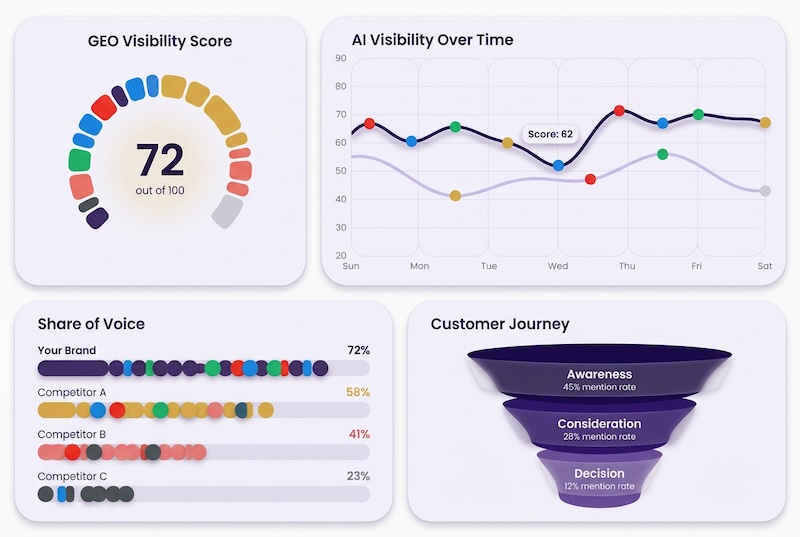
AI engines do not pick one brand and ignore the rest. They cite, summarise and contrast several at once. Our free audit shows exactly how ChatGPT, Perplexity, Gemini and Google AI Overviews position you against the brands buyers compare you with.
The free AI visibility audit
Original AIBoost methodology, free of charge, delivered as a plain-English PDF within 24 hours. No sales call needed to receive the report. If you want to discuss what to do about the gaps, we will be on the other end of the email.
Built around AI search, from day one
Most UK agencies bolted AI onto a service model designed in 2019. AIBoost was built around AI search from the start. Every audit, every campaign, every report assumes buyers are asking ChatGPT, Perplexity, Gemini or Google AI Overviews before they ever hit a classic SERP.
100
+Businesses Guided
Helped through the shift from classic search to AI visibility across UK and EU markets.
50000
Hours
Spent refining our multi-engine citation methodology and the prompts that surface real buyer intent.
90
%Of Our Strategies
Outperform traditional marketing in the first quarter, measured against pre-engagement baselines.
AI search shifts every week
AI search is not stable. ChatGPT updates its model. Perplexity adjusts its sources. Gemini changes how it picks citations. AI Overviews quietly rolls out new behaviours. The brand cited in your category last week is not always the brand cited next week, which is why GEO needs continuous attention.

Models retrain on their own schedule

Source weighting moves around

Prompts get sharper over time
First-Mover Advantage in GEO
Generative Engine Optimisation is still an emerging field, which means most businesses haven’t adapted yet. Acting early gives your brand a critical edge. By establishing presence in AI-generated answers before competitors catch on, you secure visibility, authority, and trust that compounds over time. Just as early adopters of SEO dominated Google rankings, the first brands to master GEO will set the benchmarks others struggle to displace.
- Secure Authority – Early entrants shape the AI’s “default” trusted sources.
- Lock Visibility – Get cited before competitors compete for the same space.
- Build Momentum – Become harder to overtake.

Frequently asked questions
What is Generative Engine Optimisation (GEO)?
Generative Engine Optimisation (GEO) is the process of tailoring your content and digital presence so that AI systems (like chatbots and AI-driven search engines) can easily find, trust, and incorporate your brand into the answers they generate. In simpler terms, it’s like SEO for AI: instead of aiming to rank higher on a search results page, the goal is to have your brand or content actually show up within the answers AI platforms provide to users. When you ask ChatGPT or Google’s Gemini a question, instead of showing a list of links, these engines synthesise information into a single answer. GEO ensures your brand is part of that response, either through a mention (brand name appearing) or a citation (your content being used as a source). For example, if an AI says, “Many designers use Canva for its ease of use…”, that’s GEO in action.
Is AI SEO the same as GEO?
AI SEO and GEO are two names for the same discipline. Traditional SEO aims at a high position in a list of links, where success is a ranking and a click. AI SEO, or generative engine optimisation, aims at being named inside the answer an assistant gives, where success is a citation. The technical foundations overlap heavily. What differs is what you measure.
Why is GEO becoming so important for businesses now?
GEO is gaining importance because people are shifting from traditional search engines to AI-driven tools for answers. Millions now rely on ChatGPT, Perplexity, and Google’s AI features, meaning visibility depends on whether your brand appears in those responses. Traditional SEO once guaranteed attention if you ranked high, but today over 65% of Google searches end without a click. Users trust AI summaries and recommendations, so if your brand isn’t included, you risk being invisible. Studies predict traditional search traffic will fall sharply as AI adoption grows, with Gartner estimating a 25% drop by 2026. Businesses that adapt early gain a competitive edge by establishing AI visibility before rivals. GEO also matters because organic rankings alone may no longer deliver traffic. AI overviews often sit above search results. Simply put, GEO ensures your brand remains discoverable as search evolves, protecting relevance and authority in a changing landscape.
Which AI search platforms are the most relevant for GEO ?
The most relevant AI platforms for GEO today are Google’s AI Overviews and Gemini, Microsoft’s Bing Copilot, OpenAI’s ChatGPT, and Perplexity.ai. Google remains the dominant search player, and its AI summaries often appear above organic results, making visibility there essential. ChatGPT is widely used and, when browsing is enabled, it can pull live information directly from the web. Bing integrates GPT-4 into its search results and provides citations, meaning well-optimised content has a strong chance of being referenced. Perplexity is notable because it always cites its sources, rewarding content that is clear, factual, and easy to quote. Other emerging players include Anthropic’s Claude, Meta’s assistants, and voice tools like Alexa and Siri, which are also becoming more generative. For practical GEO, businesses should focus on producing authoritative, structured, and machine-readable content that is visible in traditional search, since most AI tools still rely heavily on search indexes.
How do generative AI search engines choose what content to cite or recommend in their answers?
Generative AI search engines decide what to cite based on a mix of relevance, authority, clarity, and accessibility. They use both their training data and live web searches to construct answers, so content must be visible in search indexes and regularly updated. They favour pages that clearly match the query’s intent and that mention key entities or concepts in a structured way. Trust is critical: content backed by data, written by credible authors, or published on well-known sites is far more likely to be cited. Models also cross-check facts across multiple sources to confirm accuracy, giving preference to information that is widely repeated. Presentation matters as well, since clear headings, concise paragraphs, and schema markup make text easier for AI to parse. In short, engines cite content they can easily understand, trust, and use with confidence when assembling an authoritative and reliable answer.
What are the benefits of GEO for businesses?
GEO offers several advantages for businesses by ensuring visibility in the growing world of AI-driven answers. It expands reach by placing brands where users increasingly get information, such as ChatGPT, Bing Copilot, and Google’s AI results, even when no clicks occur. Being cited or mentioned in an AI response enhances credibility, since users tend to view AI-delivered content as curated and reliable. Early adopters gain a competitive edge by establishing authority before rivals, making it harder to be displaced later. GEO also pushes businesses to create clearer, fact-based content, which improves AI visibility and benefits human readers too. In a zero-click search environment, brand mentions still influence customer decisions, even without site visits. Finally, GEO future-proofs digital strategy by preparing businesses for the decline of traditional SEO real estate and the rise of generative search, ensuring sustained relevance and authority in an evolving landscape.
How can a brand get mentioned by name in AI-generated answers?
To achieve brand mentions in AI answers, businesses must build a strong and visible online presence. This involves publishing high-quality content that directly addresses user queries and positions the brand as a natural answer to common questions. Creating resources such as FAQs, guides, and case studies ensures that AI systems can easily associate the brand with relevant topics. Participation in online communities, reviews, and knowledge platforms also increases the likelihood of being referenced, since AI models draw on widely discussed and trusted sources. Establishing credibility through structured data, accurate company information, and citations in reputable publications further strengthens visibility. Mentions often arise when a brand is consistently discussed across the web, both by its own content and by third-party voices. In essence, the more a brand becomes part of the accepted conversation in its niche, the more likely AI will include it in its generated responses.
Are there technical steps to take so that AI engines can access and understand my website
Yes. Ensuring AI systems can properly access and interpret your site begins with allowing crawlers such as Googlebot, Bingbot, and OpenAI’s GPTBot in your robots.txt file. Submitting sitemaps to Google Search Console and Bing Webmaster Tools helps keep indexes updated, which matters because many AI platforms rely on those indexes. Clean, semantic HTML and schema markup, such as FAQ or Article schema, make content machine-readable and easier for AI to extract. Technical performance also counts: fast-loading pages, logical site structure, and avoiding hidden content all improve accessibility. Metadata, author transparency, and consistent business details support trust signals used by AI to decide what to display. Monitoring server logs for AI crawler activity ensures they are not blocked. In short, removing barriers, applying structured data, and maintaining strong technical SEO practices give AI engines clear signals and confidence to use your content in generated answers.
What are best practices to make my content easily“sourceable” by AI?
Making content sourceable means writing in a way that AI systems can easily parse, trust, and extract. Clarity is crucial: answers should be concise, direct, and unambiguous, with important points stated in plain language. Structuring text with headings, short paragraphs, and natural question–answer formats improves readability for machines. Including statistics, examples, and citations adds credibility and makes content safer for AI to quote. Using terminology and entities that relate closely to the topic, while avoiding exaggerated marketing claims, helps ensure the AI sees it as factual and relevant. Schema markup such as FAQ or HowTo signals the purpose of content, while updating pages regularly prevents information from appearing outdated. By presenting content as precise, well-supported, and easily identifiable answers, businesses increase the chance that AI will select it when forming responses, turning well-structured material into a trusted reference for generative engines.
How does schema markup and structured data influence GEO?
Schema markup strengthens GEO by making content easier for AI systems to interpret and use. By adding structured data to pages, businesses give explicit signals about the type and context of their content. For example, FAQ schema shows clear question–answer pairs that AI can lift directly into a response, while HowTo schema highlights step-by-step processes. Article and Product schema provide details such as authors, reviews, ratings, and prices, which increase trust and can appear in AI-generated shopping or overview results. Structured data also helps connect entities like organisations, authors, and products to knowledge graphs, making it easier for AI to recognise relationships and cite accurate information. In addition, schema prevents misinterpretation by clarifying that certain text is a review, event, or definition. In short, schema markup acts as a translation layer between websites and AI engines, improving visibility, accuracy, and the likelihood of citation in generative answers.
Will GEO replace SEO, or do we need both?
GEO will not replace SEO; the two work together and address different but connected aspects of online visibility. SEO remains the foundation, ensuring that content is discoverable and ranked in search results. Many AI-generated answers still draw heavily from top-ranking pages, so without SEO your site may not appear in the data pool that AIs rely on. GEO adds an extra layer by structuring content so that it can be quoted, cited, or mentioned directly within AI responses. While SEO drives clicks and traffic, GEO secures brand presence in a world where many searches end without a click. Both have distinct success metrics: SEO measures rankings, traffic, and conversions, while GEO focuses on mentions, citations, and share of voice in AI answers. Together, they provide a comprehensive strategy, keeping businesses visible both in traditional search and in the rapidly expanding AI-driven discovery space.
How can businesses measure the impact of GEO beyond clicks?
Measuring GEO requires different metrics from traditional SEO because success is not limited to clicks or traffic. One key method is tracking brand mentions and citations within AI-generated answers. This can be done manually by asking AI tools questions relevant to your industry or by using emerging GEO monitoring platforms that analyse share of voice across AI responses. Another approach is to observe shifts in brand awareness, direct searches, and referral patterns that suggest users first encountered your business through AI mentions. Tracking customer feedback and lead sources can also reveal when AI-driven visibility influences decision-making. Businesses should pay attention to how often competitors are being cited compared to their own presence. While traffic remains important, GEO performance is better measured through visibility, authority, and influence within AI answers, showing how frequently a brand becomes part of the information delivered directly to users.