See If AI Recommends Your Business. In Minutes, Free.
We run 34 real customer questions through ChatGPT and Gemini live, score your visibility out of 100, and show you the competitors AI names instead of you. Full PDF report, free, no account needed, results in minutes.
We analyse your website and work out who your customers are
We build the exact questions your customers ask AI
 ChatGPT
 Gemini
We put those questions to ChatGPT and Gemini and read every answer
Your report shows where you appear, and where your competitors beat you
Check Your AI Visibility Now
Enter your website URL and get your free AI visibility report. Takes 2-3 minutes
We query ChatGPT and Gemini across 34 questions. This takes 2-3 minutes. Please keep this page open.
Your GEO Audit Report
Scroll down to explore your results
Almost there!
Enter your details to start. Your report will be ready in 2-3 minutes
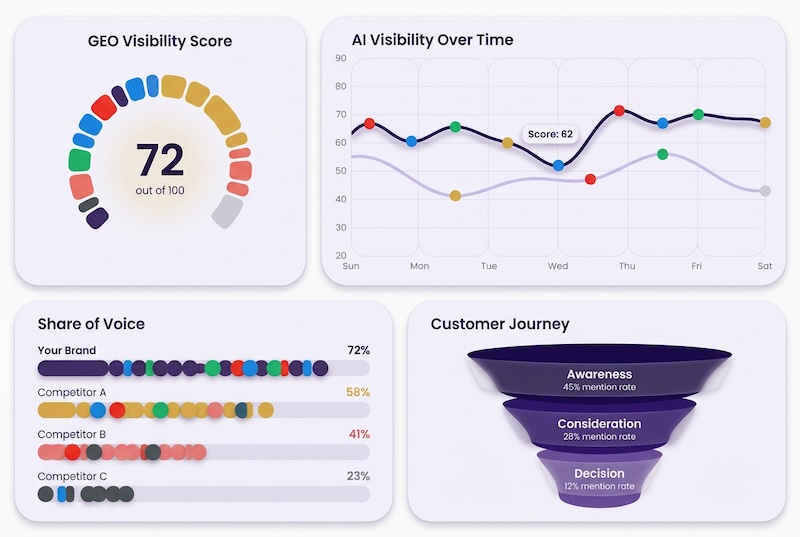
AI Brand Mentions
We check whether AI platforms like ChatGPT, Google AI Overviews, and Perplexity mention your brand when users ask questions relevant to your industry. If you're not being cited, your competitors probably are.
Query Coverage
We test real-world queries your customers are asking from awareness-stage questions to purchase-ready searches and measure how often your business appears in the AI-generated answers.
A Complete Picture of Your AI Visibility
Our GEO audit analyses how generative AI engines see your business right now. In minutes, you'll know whether AI is working for you or ignoring you completely.

Competitor Comparison
Your audit includes a direct comparison against your key competitors. You'll see who AI engines are recommending instead of you, and which brands dominate the conversation in your space.
Gap Analysis & Priority Actions
We identify the specific gaps in your AI visibility and rank them by priority. Each gap comes with a clear recommendation so you know exactly what to fix first to start appearing in AI answers.
Business Owners & Founders
You've invested in your website, your SEO, and your reputation. But AI search engines are now the first place many customers go for recommendations. If AI isn't mentioning your business, that investment isn't working as hard as it should.
Service-Based Businesses
Whether you're in legal, finance, healthcare, construction, or professional services — your potential clients are asking AI tools for recommendations before they ever open Google. This audit shows you whether you're part of those answers.
E-commerce & Product Brands
When shoppers ask AI for product recommendations, the brands that get cited win the sale. Our audit reveals whether your products are visible in AI-driven shopping conversations or being overlooked entirely.
AI Visibility Monitoring
Ongoing monitoring of your AI visibility and competitor movements, with measurable improvements tracked through our proprietary dashboard.
Personalised GEO Strategy
Content optimisation for AI comprehension and citation, with a tailored strategy based on your audit results to get your brand cited and recommended.
How our Free AI Audit Compares
Live results in minutes, free, next to what the rest of the market offers.
Minutes
Runs live while you wait, so you can re-run it after every change.
Days
Compiled by hand and returned to you after the work is scheduled.
Instant
Fast, because it reads a stored database rather than asking anything.
Free
The full report, no payment, no card, no account to create.
Paid
Sold as a one-off report, priced per audit.
Free
Free tier, with limits on checks per day and depth of reporting.
34 live AI queries
Real buyer questions generated for your business, asked with web search on.
Manual prompt testing
A consultant runs a set of prompts and writes up what they saw.
Database lookup
Counts mentions of your brand already recorded in an index.
Still useful
Shows who is named instead of you, and the sources they were pulled from.
Varies
Depends on the provider and how the prompts were chosen.
Returns zero
A blank result with nothing to act on, which is the common case.
Our team
Built and run by a UK GEO agency that can do the work with you.
The agency
Delivery available, usually quoted separately from the report.
Nobody
A software tool with no service behind it.
See the full comparison of six free AI visibility tools
Comparison based on published provider information at the time of writing.
Turn Your Results Into a Growth Strategy
Your free audit shows you where you stand. The next step is fixing it. Our GEO specialists build tailored strategies that get your brand cited, recommended, and trusted by AI search engines driving leads and sales from a channel most businesses haven't even discovered yet.
- Personalised GEO strategy based on your audit results
- Content optimisation for AI comprehension and citation
- Ongoing monitoring of your AI visibility and competitor movements
- Measurable improvements tracked through our proprietary dashboard

Frequently Asked Questions About Our Free GEO Audit
What is a GEO audit?
A GEO audit measures whether AI assistants name your business when a customer asks them for a recommendation, and explains why they do or do not.
Generative engine optimisation, or GEO, is the practice of getting a brand cited inside AI-generated answers rather than ranked in a list of blue links. It matters because the behaviour of the searcher has changed. When someone types a question into Google they see ten results and choose for themselves. When they ask ChatGPT, Gemini, Claude or Perplexity the same question, the assistant returns a handful of named businesses and most people act on that shortlist without looking further. Being absent from it is invisible in a way that a page-two ranking never was.
A GEO audit therefore looks at three things. First, presence: across a realistic set of buyer questions, how often are you named at all. Second, competitive context: which businesses are named instead of you, and how often. Third, cause: which sources the assistants pulled their answer from, since AI recommendations are assembled from retrieved pages rather than invented, and the brands that appear in those pages are the brands that get recommended.
How does the free GEO audit work?
You enter your website address and the audit runs 34 live buyer questions through ChatGPT and Gemini with web search enabled, then scores what comes back.
The questions are generated for your specific business rather than pulled from a generic template, and they are spread across the three stages of a real buying journey. Awareness questions are the ones people ask before they know who exists, such as how to solve the problem you solve. Consideration questions compare providers in your category and location. Decision questions are the direct ones, of the form which company should I hire for this. That spread matters because most businesses that are invisible at the decision stage turn out to be invisible earlier too, and the fix is different at each stage.
Every answer is then checked for whether your brand is named, which competitors are named in your place, and which sources the assistant cited to build the answer. You receive a visibility score out of 100, a gap list broken down by stage, and the competitor picture, as a PDF report.
Is the GEO audit really free?
Yes. The full report is free, there is no payment, no card and no account to create.
We ask for an email address so the report can be delivered and so you can keep it, and that is the only thing we ask for. There is no trial that converts into a subscription and no locked section of the report that requires an upgrade.
It is worth saying out loud because free is unusual in this category. Most UK providers charge for an AI visibility audit and deliver it manually over several working days. We can offer ours free because it is automated. The same engine that produces your report powers our own research, so running it costs us a small amount of compute rather than a consultant’s afternoon.
How long does the audit take?
Minutes. The audit runs live while you wait rather than being queued for a human to complete later.
This is the main practical difference between our audit and most of the UK market, where reports are compiled by hand and arrive days after you request them. Ours is generated by the same automated pipeline we use for our own research, so the queries run as soon as you submit your website and the report is compiled immediately afterwards.
Speed changes what the audit is for. A report that takes a week is something you commission once. A report that takes minutes is something you can re-run after you make changes, which is how you find out whether the changes worked.
What is the difference between a GEO audit and an SEO audit?
An SEO audit asks whether your pages can rank in a list of search results. A GEO audit asks whether AI assistants name your business inside an answer.
The two are related but they fail in different ways, and a business can pass one while failing the other completely. Traditional SEO is judged on positions, clicks and traffic, and it is won with keywords, links and technical health. GEO is judged on whether you are mentioned and cited, and it is won by being present in the sources that AI systems retrieve when they build an answer: third-party round-ups, directories, review platforms, reference pages and your own pages when they are structured to be quoted.
This is why plenty of businesses ranking on page one of Google are absent from ChatGPT entirely. The ranking signal and the citation signal are not the same signal. An SEO audit will not reveal that gap, because it is not measuring it.
Which AI platforms does the audit check?
ChatGPT and Gemini, with web search switched on, across 34 customer-style questions about your market.
Web search matters more than the choice of platform. When an assistant answers with search enabled, it retrieves live pages and builds the answer from them, which is how real customers experience it and which means the result reflects what is being said about you on the web right now rather than what a model memorised during training.
We also run a broader four-assistant study for our own research, adding Claude and Perplexity, and the results across all four converge on the same conclusion: the businesses that get recommended are the businesses that appear in the pages the assistants retrieve. If you want a specific platform covered for your business, we can extend the set on a paid engagement.
How is this different from Ahrefs or Semrush AI visibility checkers?
Those tools count mentions of your brand that already exist in a database. Ours asks the questions live, so it works even when you have no mentions at all.
The distinction matters most for exactly the businesses that need help. A mention-counting tool takes your brand name, looks it up, and reports how often it appeared. If the answer is zero, you receive a zero and no explanation, which tells you what you already suspected and nothing you can act on.
Running the questions live produces a different kind of result. Even when your brand is never named, the answers show who was named instead, how often, and which sources the assistant used to reach that conclusion. That turns an empty result into a working list: the round-ups you are missing from, the competitors occupying the answer, and the stages of the buying journey where the gap is widest.
We compared the six free tools in detail, including where the others beat ours: free AI visibility tools compared.
Why does ChatGPT recommend my competitors instead of me?
Almost always because the pages the assistant retrieved mention them and do not mention you. It is a visibility problem in the sources, not a judgement about the quality of your business.
AI assistants do not evaluate companies. When someone asks for a recommendation, the assistant searches, reads the pages it finds, and summarises the names that appear in them. Round-ups, directories, review sites, comparison pages and well-structured provider pages are the raw material. A business that appears in several of those sources looks like consensus to the model and gets named repeatedly. A business that appears in none of them cannot be recommended, however good it is or however well it ranks on Google.
Our own measurement makes the point. We put a set of real buyer questions to four different AI assistants and counted every business they named. The agencies recommended most often were not the largest or the most established. They were the ones present in the sources the assistants retrieved, including small operations with a fraction of the authority of businesses that were never mentioned once. Presence in the sources, rather than size or reputation, was what separated them.
How much does generative engine optimisation cost in the UK?
It is priced as an ongoing programme rather than a one-off purchase, and what it costs depends on how far behind the businesses currently occupying your answers you are.
A cheap report and a GEO programme are different products, and the difference matters. A report tells you where you stand on the day it was run. Nothing about your visibility changes as a result of reading it. The work that actually moves you into AI answers is a set of connected workstreams, and it runs continuously.
That work includes earning your business a place in the third-party sources assistants retrieve, which means round-ups, directories, review platforms and comparison pages, and each of those is an outreach conversation rather than a page you can publish yourself. It includes restructuring your own pages so they can be quoted, with direct answers, specific facts and consistent details about who you are and where you operate. It includes the technical layer, from structured data to making sure AI crawlers can reach and interpret your content. It includes producing original material worth citing in the first place, since assistants favour sources that say something concrete. And it includes measurement across engines, because the answers change constantly and you need to know whether what you did worked.
This is why GEO behaves like an investment rather than a purchase. Visibility in AI answers is built on accumulated presence across many sources, so the budget determines how much ground you can cover: how many placements you can pursue, how much citable content you can produce, how quickly the technical and structural work gets done. A larger commitment compounds, because every source that names you makes the next assistant more likely to name you as well. A minimal one does the reverse, covering a fraction of the surface and taking far longer to register.
Our audit is free, so you can see the size of your gap before you commit to anything. Once you know the gap, we can scope the work and quote it properly.
What should I do after I get my audit results?
Start with the gaps at the decision stage, then work backwards, and fix the sources before you rewrite your own pages.
The report ranks where you are missing across awareness, consideration and decision questions. Decision-stage gaps are the ones costing you enquiries today, because someone asking which company should I hire is ready to buy. Work outwards from there.
The order of the work matters as much as the work itself. Because AI answers are assembled from retrieved pages, the fastest movement usually comes from getting your business into the sources that assistants already cite for your category: the round-ups, directories and comparison pages that appear again and again in your report. Alongside that, your own pages need to be structured so they can be quoted, with clear answers, specific facts and consistent details about who you are and where you operate. If you would like help with either, our team can take it on, and you are free to use the report on your own.