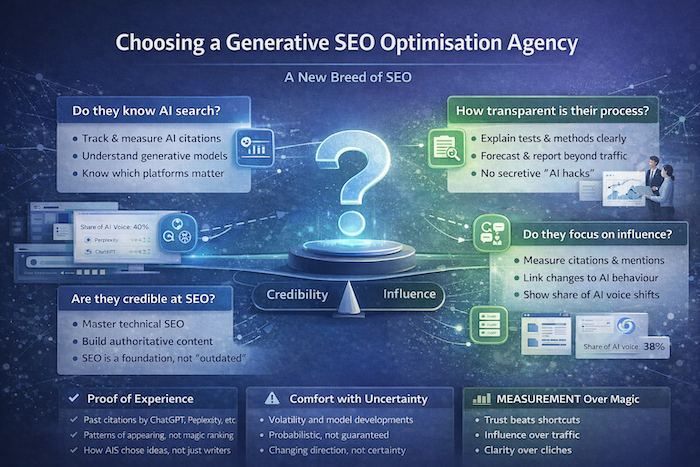
Search behaviour is changing quickly. Traditional search‑engine optimisation (SEO) still underpins online visibility, but generative search systems like Google’s AI Overviews, Perplexity and ChatGPT now assemble answers and recommendations directly from the web. This shift has prompted a wave of agencies that claim to offer “AI SEO” or generative engine optimisation (GEO) services. Many of these outfits are rebranding rather than reinventing; the challenge for businesses is to distinguish marketing hype from genuine capability. A credible generative SEO agency should help brands become visible inside AI‑generated answers, not just chase rankings and traffic.
Why Choosing the Right Agency Matters in GEO
Generative search is opaque and still evolving. Being visible in AI answers depends on how large language models (LLMs) retrieve, interpret and cite information. Traditional rankings no longer guarantee that content will be surfaced; instead, AI assistants summarise information from multiple sources and may mention only a handful of brands. Forbes notes that AI visibility means ensuring your content and brand are cited in tools such as Google AI Overviews and ChatGPT, and that this visibility involves being accurately and favourably described. Simply earning top search positions is not enough because users increasingly rely on summaries rather than clicking through to websites.
Choosing the right partner therefore has long‑term consequences. Agencies without a deep understanding of AI search signals may waste time on unproven tactics or harm brand trust. Early decisions about content structure, entity authority and measurement frameworks shape how AI systems learn about your brand. A partner that understands generative search mechanics can help you influence AI narratives; one that does not may leave you invisible while competitors shape the conversation.
What a Genuine Generative SEO Agency Should Actually Do
A generative SEO (GEO) agency focuses on optimising your visibility within AI‑driven answers. Whereas traditional SEO optimises for clicks and rankings, GEO aims to have your content selected, cited and recommended by AI systems. Forbes explains that an AI visibility agency ensures your content is discoverable and cited within AI‑generated responses, and that such agencies focus on generative search optimisation rather than simply chasing rankings. Core responsibilities of a genuine GEO agency include:
- Optimising for AI answers and citations: structuring content so that LLMs can extract concise, factual statements; ensuring that key facts, statistics and definitions are clearly presented. This may involve answer‑first paragraphs, bullet lists, tables and schema markup to enhance extractability.
- Understanding how search engines and AI models intersect: generative systems rely on traditional crawling and ranking to retrieve candidate documents. Agencies must therefore combine technical SEO (indexing, site health, authority) with AI‑specific techniques like entity optimisation and passage‑level optimisation. Forbes notes that AI visibility goes beyond keywords; it depends on semantic structure, clarity and fact density.
- Measuring influence, not just rankings: success is no longer measured solely by traffic. Instead, agencies should track AI‑specific metrics such as citation frequency, share of AI voice and the prominence of brand mentions within AI answers. Leading AI visibility firms prioritise metrics like AI mentions, share of AI voice and citation frequency.
The Foundational Requirement: Strong SEO Knowledge
Generative optimisation does not replace traditional SEO; it builds on it. GEO still depends on your pages being crawlable, indexable and authoritative. Forbes warns that top search ranks and clicks do not guarantee AI citations but emphasises that traditional SEO remains essential. Agencies should therefore respect SEO fundamentals—site speed, clean markup, internal linking, backlinks, E‑E‑A‑T signals—and integrate them with AI‑specific tactics. Red flags include any agency that dismisses traditional SEO as obsolete. AI systems retrieve information from indexed web pages; if your content is not discoverable, no amount of AI optimisation will help.
Key Questions to Ask Before Hiring
Evaluating a GEO partner requires probing their strategy, methodology and reporting. Key questions include:
- How do you measure success in AI search? A strong agency will frame success around business outcomes, not just rankings. RevvGrowth advises asking about the business outcomes they guarantee—e.g., increasing qualified leads rather than simply improving rankings—and how they tie AI visibility to conversion rates, lead quality and high‑intent keywords.
- Which clients or industries have you helped, and what were the results? Request evidence of past work in similar sectors. Ask for examples of increased citation frequency or share of AI voice. Agencies should explain their methodology and share specific results.
- What tools, data sources and AI models do you use? The right partner should articulate which AI‑powered tools they use for keyword clustering, content intelligence, SERP prediction and prompt testing, and how those tools enhance strategy and execution.
- How do you balance SEO, AEO and GEO? The GetPassionfruit guide stresses that successful agencies recognise GEO and traditional SEO work together; generative optimisation complements rather than replaces SEO.
- How do you test whether content appears in AI answers? Agencies should conduct systematic prompt testing across ChatGPT, Perplexity, Claude and other models. Without a clear prompt‑testing methodology, optimisation is guesswork.
- What metrics will you report, how often, and how do they tie to business goals? Ask for dashboards that track citation frequency, share of AI voice and the prominence of your brand within answers. Reporting should align with your commercial objectives rather than vanity metrics. Forbes recommends choosing agencies with strong reporting practices and clear explanations of what is being measured.
- How do you handle technical SEO, site health and algorithm changes? RevvGrowth notes that technical SEO remains foundational and agencies should monitor Core Web Vitals, crawlability and algorithm updates.
Proof of Experience (Without Expecting Guarantees)
Generative search is probabilistic; no agency can guarantee placement. Instead of expecting definitive results, ask for patterns. Request examples of content that has been cited in AI answers, and ask how the agency increased citation frequency over time. Forbes highlights that agencies should be able to explain how they earn more AI citations and measure AI discovery success. Look for patterns across clients rather than isolated screenshots. Genuine partners will discuss the probability and volatility inherent in generative systems and set expectations accordingly.
How Agencies Should Talk About Uncertainty
A trustworthy GEO agency acknowledges that AI models evolve rapidly. They should explain the limits of their influence and the volatility of generative answers. Rather than promising certainty, they should focus on direction and probability—identifying which strategies are more likely to improve visibility and which are not. Beware of “magical thinking”; Forbes warns that agencies promising to boost discoverability without clear deliverables or unique expertise are a red flag.
Methodology Over Tools
Tools aid execution, but methodology determines success. Grow & Convert warns that many agencies rely on random tactics—adding llms.txt files, turning headings into questions or sprinkling FAQs—without a coherent strategy. Tactics such as rewriting headings or adding content summaries are not a strategy; a real AI optimisation strategy explains why certain approaches work and why others do not, based on how LLMs gather and process information. Look for agencies that prioritise bottom‑of‑funnel topics and have a clear framework for selecting prompts and topics rather than letting tools dictate strategy. A mature agency will use AI for research and drafting but rely on human subject‑matter experts to craft unique, citation‑worthy content.
Reporting and Transparency
Transparency is critical because generative search lacks the familiar metrics of clicks and impressions. Agencies should provide dashboards showing AI citation frequency, share of voice and changes in entity authority across platforms like ChatGPT, Perplexity and Google AI Overviews. Forbes recommends choosing agencies with strong reporting practices, clear dashboards and monthly updates. The GetPassionfruit guide warns that agencies must track AI visibility separately from search rankings; if they cannot show AI citation data, they are not actually doing AI SEO. Reporting should tie metrics to business goals and demystify AI visibility tracking.
Red Flags to Avoid
When evaluating potential partners, watch for warning signs:
- Promises of guaranteed AI placement – Generative engines select sources based on complex retrieval and ranking processes; no agency controls them. GetPassionfruit cautions against agencies promising immediate AI visibility.
- Claims of insider knowledge or algorithm secrets – LLMs are black boxes. Genuine agencies rely on testing and evidence, not secret algorithms.
- Short timelines – Building entity authority takes months. Market Jar notes that realistic expectations are 60–90 days for the first citation increases and 12+ months to establish category authority. Agencies promising results in weeks should be avoided.
- Over‑use of buzzwords and vague deliverables – Forbes warns of “magical thinking” from agencies that cannot explain what distinguishes their approach or how they measure AI discovery success.
- No AI‑specific reporting or prompt testing – GetPassionfruit identifies a lack of AI‑specific dashboards and absence of systematic prompt testing as red flags.
Agency vs. Consultant vs. In‑House Support
Different situations require different types of support. Mikekhorev suggests that for many startups it is more efficient to work with an agency for a few months to set up foundational strategies, then bring SEO in‑house once content flows and processes are understood. Agencies offer scale and continuous monitoring, while specialist consultants may be preferable for focused strategy development. A hybrid approach is common: use an agency to build the framework and train internal teams, then transition to in‑house management while retaining external experts for periodic audits and strategy updates.
Commercial Reality Check
Generative optimisation is strategic and resource‑intensive. Market Jar emphasises that premium pricing (£5,000–£15,000 per month) reflects genuine platform specialisation, authority‑building efforts and continuous monitoring. Mid‑market brands typically invest £75k–£150k annually in comprehensive GEO programmes, with enterprise budgets exceeding £250k. ROI often manifests in brand demand and influence rather than immediate traffic spikes; realistic timelines involve months of audit, foundation building and optimisation. Early adopters benefit because AI‑referred traffic is growing rapidly—Market Jar reports a 527% increase in AI‑generated sessions in early 2025—and the first brands to build authority gain an enduring advantage.
Questions Agencies Should Ask You
Agencies that take a strategic approach will also ask probing questions about your business. Expect inquiries such as:
- What decisions does AI influence in your market? Understanding which buying decisions are shaped by AI assistants helps prioritise topics.
- Are you more dependent on trust or volume? Some sectors need to influence recommendations (e.g., SaaS, healthcare), while others rely more on high‑volume informational traffic.
- How do customers discover you today, and how is that changing? Mapping current discovery channels and emerging AI touchpoints informs the optimisation plan.
These questions demonstrate that the agency seeks to align GEO with your commercial objectives rather than applying generic tactics.
Decision Framework for Buyers
Use the following framework to decide when and how to engage a generative SEO partner:
- If competitors appear in AI answers – act quickly. When ChatGPT or Perplexity lists rivals but not you, it signals an influence gap. A GEO agency can help you claim share of voice.
- If SEO traffic drops but leads hold – investigate GEO. Declining click‑through rates but stable conversions may mean customers are receiving answers without clicking. Adjust your strategy to monitor AI citations and brand mentions.
- If AI recommendations matter in your category – prioritise expertise. In sectors where customers rely on comparisons and recommendations (software, consumer goods, health), being included in AI answers can shape buying decisions.
- If your content foundation is weak – delay GEO. Early‑stage businesses should first fix basic SEO issues and build authoritative content. GEO works best on top of a robust content base.
Conclusion
Generative search optimisation is not a gimmick; it is a response to how search now works. Traditional SEO remains essential, but it no longer covers the full search landscape. Choosing a generative SEO agency should involve evaluating their understanding of AI search signals, the strength of their methodology, their commitment to reporting and transparency, and their respect for SEO fundamentals. Good agencies look rigorously methodical, not magically clever; they help you adapt to AI‑driven discovery, build entity authority and influence narratives without promising guaranteed placement. Ultimately, the question isn’t whether you need GEO—it’s whether someone else is shaping the answers about your brand.
Want to know whether ChatGPT, Perplexity, or Google AI Overviews mention your firm? Run a free first-party visibility audit on your domain in under a minute and see exactly which queries cite you and which do not.