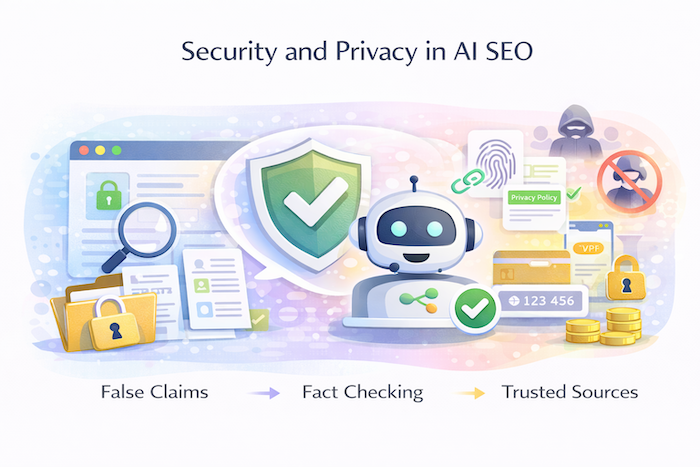
Artificial‑intelligence search engines are reshaping how people find information. Instead of sending users to individual pages via blue links, AI systems ingest, summarise and rephrase content at scale. This shifts the question of “how to rank?” to “what content should AI be allowed to see?” and introduces a tension between visibility and control. High‑profile publishers and brands have begun to weigh whether allowing AI crawlers is worth potential loss of control over intellectual property. Decisions about AI visibility now involve marketing, legal and security teams.
Why Security and Privacy Enter the AI SEO Conversation
Traditional SEO assumed that publishing content led to visits; search engines crawled and indexed pages, users clicked through, and publishers enjoyed referral traffic and brand exposure. AI search breaks this loop. Large language models (LLMs) predict language patterns rather than verify facts, so they can summarise and reuse content without sending clicks or giving explicit credit. Tech companies are training these models on vast corpora of web pages, sometimes without permission, and they produce answers that compete directly with the source material.
This environment raises two connected concerns:
- Security and intellectual property – Content used for training or retrieval may be reproduced elsewhere, undermining licensing models or subscription paywalls. AI crawlers may scour paywalled articles to build generative models that compete with the original publishers.
- Privacy and data protection – AI models ingest personal data present on publicly accessible pages. Regulators in the EU and US now require AI companies to justify a lawful basis for processing personal data and to respect purpose limitation and data minimisation principles. Even if information is public, organisations are obligated to protect user privacy.
The Opt‑Out Movement: Why Some Sites Block AI Crawlers
In 2024–2025 a wave of publishers began to block AI bots via robots.txt or custom headers. News organisations and proprietary content owners were the first to do so, driven by concerns over copyright, licensing and loss of subscription revenue. For example, The Atlantic built a scorecard to determine which AI crawlers provided value. It blocks bots that offer no referral traffic or subscriber conversions and emphasises that cooperating with AI systems without compensation “helps competitors build their models”. This selective blocking is a defensive measure; it is not about ranking manipulation but about retaining bargaining power for future licensing deals.
The opt‑out movement is broader than one publisher. A BuzzStream audit of 100 leading news sites found that 79 % block at least one AI training bot and 71 % block at least one AI retrieval bot; however, only 14 % block all AI bots and 18 % block none. Many publishers adopt a nuanced approach – blocking training bots that feed LLMs but allowing retrieval bots that generate referrals.
The Trade‑Off: What Opting Out Does (and Doesn’t Do)
Blocking AI crawlers is technically straightforward: publishers use robots.txt directives or HTTP headers to prevent specific bots from accessing content. However, the effects are nuanced:
- Prevents certain AI crawlers from directly accessing content. Robots.txt remains the first line of defence; some AI companies honour these instructions. Playwire notes that training bots make up ~80 % of AI bot activity. Blocking them does not harm search rankings since search engines use different crawlers.
- Does not guarantee secrecy or immunity. Non‑compliant crawlers may ignore robots.txt, and content may still be ingested via third‑party sources or user postings. Even if training bots are blocked, retrieval bots may summarise the same information gleaned from other sites.
- Reduces AI visibility along with exposure risk. DreamHost warns that opting out reduces visibility in AI results but does not erase a site completely. Publishers must decide whether the reduction in AI mentions is worth the increased control over intellectual property.
The Inclusion Argument: Why Many Brands Still Allow AI Access
For marketing content, visibility matters more than exclusivity. Blocking AI crawlers can make a brand invisible in emerging AI discovery layers. Playwire highlights a grey area: content used for training might later be favoured by AI search results, so blocking training crawlers could inadvertently reduce referrals. Marketing departments therefore allow AI access when the goal is to reach potential customers.
There is also a practical point. AI search engines rely on content to generate answers. If trusted sources refuse access, AI systems may use less reliable materials. Brands that provide clear, fact‑checked information increase the chance that AI summaries are accurate, reducing the risk of hallucinations about their products. In this sense, participating in AI ecosystems is a defensive act: by contributing authoritative content, brands help shape the answers users receive.
Different Content Types, Different Rules
The decision to allow or block AI crawlers should be content‑specific. Not all pages carry the same sensitivity or strategic value:
| Content Type | Recommended AI Access | Rationale |
|---|---|---|
| Public marketing pages (product overviews, FAQ, about us) | Allow | Designed for broad distribution; AI mentions can replace lost clicks and build awareness. |
| Thought leadership/blog posts | Selective | Provide access if the topic benefits from being cited by AI; consider blocking high‑value insights. |
| Premium, gated or subscription content | Block training and retrieval bots | Primary revenue driver; summaries could cannibalise subscriptions and devalue exclusivity. |
| Sensitive or regulated data (personal information, financial or medical advice) | Block, anonymise or remove from public pages | Regulatory obligations and risk of privacy breaches. |
Classifying content by commercial sensitivity, uniqueness and replaceability helps organisations apply the right policies. Information that is core intellectual property or monetised directly should be protected, whereas explanatory material can be shared widely.
Understanding AI Crawlers and Access Controls
There are two broad categories of AI crawlers:
- Training crawlers – These bots ingest data to fine‑tune or expand large language models. They typically consume vast amounts of content without sending traffic back. Playwire explains that while blocking these crawlers does not affect SEO rankings, it may reduce the likelihood of being referenced by AI systems.
- Retrieval/search crawlers – These crawl content to provide context for AI answers. They are akin to search indexers; allowing them can drive traffic when AI links to your site. Many news organisations block training bots but allow retrieval bots.
Access controls include:
- robots.txt directives – e.g.,
User-agent: GPTBotorGoogle-Extended. This file instructs compliant crawlers what to access. - HTTP headers/meta tags – Provide more granular control (e.g.,
Permission-Policy: interest-cohort=()) and can be applied at the page or server level. - TDM‑Reservation and tdmrep.json – Emerging standards that signal to AI companies that content is reserved for text and data mining under copyright law.
- Infrastructure defences – Web application firewalls, honeypots and rate limiting to detect non‑compliant scrapers.
However, enforcement is imperfect. Cloudflare notes that bots account for roughly 30 % of global web traffic, and a new category of AI crawler is emerging; some site owners are blocking these bots to protect rights. Organisations should monitor server logs and refine rules as new bots appear.
Security Considerations Beyond Crawling
Blocking bots only addresses direct access. Content can still be scraped via third‑party sites, user‑generated content, or copy‑and‑paste actions. Once information enters a training set, it can be regurgitated in different contexts. Re‑publishing and summarisation by AI may dilute a brand’s unique insights and enable competitors to learn proprietary strategies faster than legitimate users.
Organisations should therefore ensure that premium insights are not publicly accessible, use subscription walls or authentication, and clearly label confidential documents. When releasing white papers or research, consider redacting high‑sensitivity details or publishing summary versions for public consumption.
Privacy and User Data Concerns
AI search treats publicly available web content as a global resource. Personal data included in blog comments, testimonials or case studies might be ingested and reproduced. Under GDPR and similar regulations, companies must ensure that any personal data they publish has a lawful basis for processing and is necessary for the stated purpose. Cookie‑Script notes that AI companies must justify processing personal data and respect purpose limitation. Including personal user data in AI-visible pages may violate privacy laws if not handled correctly.
Best practices include:
- Remove or anonymise personal data from public marketing pages and testimonials.
- Do not include sensitive user‑generated information (e.g., support tickets, social media posts) in pages accessible to AI crawlers.
- Publish clear privacy notices and obtain consent where required.
- Treat AI search as a global audience – assume anything visible may be ingested and reproduced.
Balancing Reach and Protection Strategically
To decide whether to allow AI crawlers, organisations should ask two questions for each piece of content:
- What value do we gain if AI repeats this? Does it drive brand awareness, trust, or conversions?
- What do we lose if AI repeats this? Could it cannibalise revenue, reveal proprietary strategies, or expose sensitive data?
This approach recognises that visibility is not always the right choice. A static product description benefits from AI summarisation, whereas a premium industry report should remain behind a paywall.
Common Mistakes Companies Make
- Blanket blocking – Some organisations block all AI bots without understanding which crawlers deliver value. This can inadvertently remove your brand from AI answers and cede mindshare to competitors.
- Allowing access to sensitive or high‑value proprietary material – Without content classification, AI may summarise paid reports, diminishing revenue.
- Assuming AI exposure automatically equals theft – DreamHost notes that opting out does not eliminate you from the web; conversely, allowing AI access does not necessarily mean your content will be replicated verbatim. Context and enforcement matter.
A Practical Decision Framework for AI Content Access
- Audit your content inventory. Label each page by sensitivity (public marketing vs premium vs regulated) and uniqueness.
- Determine AI goals. Decide whether your objective is visibility (brand building) or protection (revenue preservation).
- Apply targeted robots.txt and meta directives. Use allow or disallow rules for different crawlers based on content category. Make use of emerging standards such as TDM‑Reservation to assert rights.
- Monitor logs and AI results. Track which bots access your site and how often. Look for signs of content being summarised elsewhere. Adjust policies accordingly.
- Coordinate across teams. Legal, security, marketing and product teams should align to ensure policies reflect both brand goals and regulatory obligations.
How Security and Privacy Fit Into an AI SEO Strategy
AI SEO isn’t about maximising exposure at any cost; it’s about selective visibility. Brands must decide which content should be available for AI training and retrieval and which should remain private. This requires integrating robots directives into SEO workflows, maintaining structured data to reduce ambiguity (e.g., Schema.org for organisation details), and ensuring authoritative pages exist to reduce hallucinations.
Playwire notes that while training and search crawlers are technically separate, it is unclear how one influences the other. Therefore, AI SEO strategies must adapt as platforms evolve. Cloudflare emphasises that AI crawlers are a growing portion of bot traffic and that enforcement is imperfect; continuous monitoring and refinement are essential.
Long‑Term Reality and Conclusion
AI search is here to stay. Models will continue to compress and redistribute information, and absolute control is unrealistic. However, strategic control is achievable: by classifying content, applying appropriate access controls, and monitoring AI citations, brands can balance visibility and protection. Security and privacy are now integral to SEO decision‑making. The goal is not maximum exposure but intentional exposure, ensuring that what AI learns and repeats aligns with your brand’s objectives and legal obligations. Organisations that adapt quickly will maintain influence in an AI‑driven search landscape while safeguarding their intellectual property and user data.
Want to know whether ChatGPT, Perplexity, or Google AI Overviews mention your firm? Run a free first-party visibility audit on your domain in under a minute and see exactly which queries cite you and which do not.