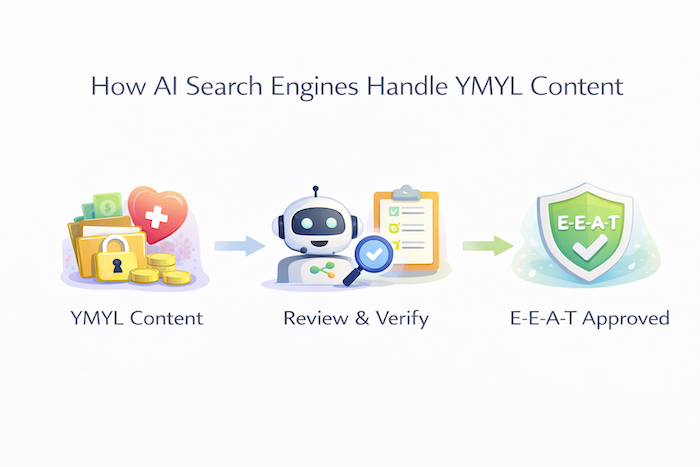
“Your Money or Your Life” (YMYL) content refers to information that can affect a person’s health, finances, safety or general well‑being. Because inaccuracies in these domains carry a high risk of harm, search engines and AI systems apply stricter standards to YMYL topics. Guidelines from Google describe YMYL pages as those that can influence major life decisions or financial stability. Recent AI‑powered search features, such as Google’s AI Overviews and chat‑style assistants like ChatGPT, not only summarize web content but also answer questions directly. This makes quality, trust and ethical responsibility paramount: a single misstatement about a medical condition or investment could mislead large numbers of users. The result is a tension between users’ desire for instant answers and platforms’ need to minimise harm.
What Counts as YMYL in an AI Context
AI search engines recognise YMYL content broadly. Guidance from specialists notes that YMYL includes topics affecting health, finance, legal rights, safety, civic processes and major life decisions. This category covers medical treatments, nutritional advice, mental health, banking and insurance products, investing, taxes, housing, immigration and other areas where misinformation could harm someone. Pages that encourage high‑risk purchases (investments or loans) or provide legal guidance also fall under YMYL. Even in less obvious areas such as parenting, employment and certain types of local information, local regulations may classify content as YMYL if errors could cause legal or financial harm. Thus, AI systems treat YMYL broadly – anything that materially influences an individual’s well‑being or that of society.
Why AI Is More Cautious with YMYL Queries
Platforms face legal and ethical exposure if their AI models provide harmful advice. The high stakes make accuracy and accountability essential. A 2026 Guardian‑led investigation revealed that Google’s AI Overviews provided incorrect liver function ranges and oncology advice; after public outcry, Google removed the AI summaries for those medical queries. This episode underscores how quickly platform trust and liability can be jeopardised. AI companies are also updating their own policies. OpenAI clarified in late‑2025 that ChatGPT and similar models may provide general information but must not deliver tailored legal or medical advice, encouraging users to consult professionals. The policy emphasises adding clear warnings and steering users toward education rather than prescriptive actions. Regulators in the EU and US are considering risk classifications and mandatory provenance labels for medical AI search, and proposed laws could require third‑party audits. In short, platforms respond to reputational risk and regulatory pressure by adopting conservative approaches for YMYL queries.
How AI Systems Handle YMYL Differently
Stricter Source Selection and Higher E‑E‑A‑T Requirements
For YMYL topics, AI search engines heavily prioritise experience, expertise, authoritativeness and trustworthiness (E‑E‑A‑T). Research on AI Overviews optimisation stresses that high E‑E‑A‑T is “non‑negotiable” for YMYL queries, requiring author bylines linked to subject‑matter experts, citations to peer‑reviewed or official sources and consistent brand recognition across the web. A case study of a healthcare publisher found that adding schema to highlight physician reviewers, securing mentions in peer‑reviewed journals and disclosing the medical review process led to AI Overview citations for chronic disease queries. In AISO’s YMYL playbook, experts recommend running readiness audits that examine content quality, authorship credentials, secure site infrastructure and off‑site reputation. These audits emphasise verifying licenses, adding reviewer bios and including clear disclosures – steps required before YMYL content is considered trustworthy by AI.
Reliance on Consensus and Established Authorities
Generative systems do not invent new facts; they synthesize existing web information. For high‑risk queries they favour government agencies, regulators and academic institutions. The LinkGraph study noted that Google’s AI prioritises sources like the NIH or CDC over commercial sites in YMYL health queries. AI Overviews often cite multiple authoritative sources in a single answer; they also look for brand consistency across third‑party publications. According to AISO, AI Overviews limit citations to sources with clear credentials and strong trust signals. Consequently, smaller or niche blogs struggle to appear in YMYL answers unless they are repeatedly cited by reputable third parties.
Avoidance of Speculative or Opinion‑Led Content
AI systems intentionally avoid speculation in high‑risk areas. The SE Ranking study found that Google produces AI Overviews for only about 51 % of YMYL queries, often declining to respond to highly sensitive financial questions. When it does respond, Google provides the briefest answers with minimal citations and the highest disclaimer rate. ChatGPT, by contrast, answers nearly all YMYL queries but prefaces them with strong warnings and concise summaries, while DeepSeek produces long explanations with more sources. In health and finance, Google is the most cautious, declining to provide answers in almost half of tested YMYL questions and favouring extremely conservative guidance.
Refusals, Disclaimers and Safe‑Completion Behaviour
AI search engines employ several mechanisms to reduce risk when responding to YMYL queries:
- Refusals and content suppression: Google has removed AI Overviews entirely for certain medical queries after evidence of inaccurate information. A report on these removals explains that the Guardian’s investigation triggered immediate removal of two dangerous summaries, although similar phrasings still generated problematic results. Tech Times confirms that Google removed AI Overviews for specific medical questions and now directs users back to traditional search results.
- Explicit warnings and steering users to professionals: OpenAI’s updated policies state that models may offer general information but cannot instruct users on what to do in legal or medical situations. Practical takeaways include adding prefaces clarifying that the model is not a lawyer or doctor, providing educational summaries rather than directives, and encouraging users to consult professionals. ChatGPT’s responses for YMYL topics often lead with such warnings.
- Safe‑completion training: Although not always publicly detailed, safe‑completion methods train models to generate helpful but non‑harmful outputs. They aim to balance helpfulness with safety by steering the model toward general education or refusing to answer when a query seeks personalised advice.
Source Selection in YMYL Answers
AI platforms place greater emphasis on authoritative sources and diverse citations. The SE Ranking study observed that Google’s AI Overviews provide the fewest words and sources but the highest percentage of unique links, indicating a focus on source diversity. DeepSeek, meanwhile, provides lengthy answers with numerous citations, while ChatGPT strikes a middle ground. For health content specifically, ChatGPT offers concise, disclaimer‑heavy responses citing medical sources; DeepSeek provides comprehensive answers but may include more opinion or bias.
The Role of Authority and E‑E‑A‑T
Experience, expertise, authoritativeness and trustworthiness remain central. SEO Sherpa explains that Google’s AI seeks sources that clearly demonstrate E‑E‑A‑T by showing visible authorship, transparent sourcing and up‑to‑date references. It encourages subject‑matter experts to highlight their credentials and use contributor bios and external references. Pages with high user engagement, backlinks and domain authority are more likely to be cited. LinkGraph’s case study shows that implementing schema types like MedicalWebPage with a reviewedBy property linked to a board‑certified physician and adding disclosures about fact‑checking improved the publisher’s visibility in AI summaries.
How Google Approaches YMYL in AI‑Powered Search
Google’s AI Overviews often avoid generating YMYL content altogether when the risk is high. An SEO Sherpa deep dive notes that AI Overviews appear for only about 5 % of finance‑related queries but 63 % of health queries because Google weighs usefulness against risk. Google argues that summarising authoritative sources can help users understand topics quickly while providing citations for verification. Nevertheless, after the Guardian’s investigation, Google removed medical AI overviews for some queries, demonstrating that risk management sometimes leads to suppression.
Why AI Double‑Checks or Narrows YMYL Answers
AI models use retrieval‑augmented generation (RAG) to ground answers in existing documents. For YMYL, the retrieval phase draws heavily from top‑ranked, authoritative documents, while the synthesis phase cross‑checks multiple sources. Google’s AI Overviews emphasise unique and diverse citations to avoid over‑reliance on a single source. AIO optimisation experts stress that structured data and entity‑relationship mapping help the model confirm relationships and reduce ambiguity. When high‑quality sources conflict, AI tends to provide general guidance or decline to answer; when consensus exists, it summarises conservatively.
Implications for Businesses in YMYL Verticals
Because of the stringent standards, YMYL websites face a higher bar for visibility. Generic “good SEO” is insufficient; businesses must invest in expert content, rigorous review processes and clear disclosures. The AISO playbook advises auditing all YMYL pages for content quality, authorship credentials, site infrastructure, compliance and off‑site reputation. It also recommends using AI to summarise sources rather than generate conclusions, adding guardrails in prompts to refuse speculative claims and requiring human review and sign‑off. Companies lacking recognised authority or relying on anonymous authors are unlikely to be included in AI answers, especially if their content conflicts with consensus or is primarily marketing driven.
Even small brands can compete by specialising in narrow topics, clearly defining scope (“educational, not medical advice”) and earning third‑party citations. YMYL visibility is earned gradually but can be lost quickly if trust signals lapse or inaccuracies appear.
What Happens if AI Gets YMYL Content Wrong
The fallout from incorrect YMYL answers can be severe. The Guardian investigation showed that a flawed liver‑enzyme summary not only misled users but also prompted immediate removal of AI results. Search‑accuracy concerns lead to calls for audits, risk classification and provenance labels. In OpenAI’s ecosystem, mis‑served advice could trigger legal challenges; thus, policies now restrict tailored advice and emphasise professional oversight. When errors occur, correction mechanisms involve removing the AI summary, updating training data, and relying on stronger signals from trusted sources.
Strategic Takeaway for YMYL SEO and GEO
YMYL optimisation is less about growth hacks and more about earning the right to be cited. AI search engines are stricter, not looser, with YMYL content. To appear in AI answers ethically:
- Provide clear author attribution and credentials. Include bios, licenses and review notes, and structure pages using schema to signal authorship.
- Cite reputable external sources. Link to government bodies, academic research and professional associations; avoid self‑referential claims.
- Use a neutral, factual tone. Avoid marketing language; answer questions directly and dispassionately.
- Include appropriate warnings and disclosures. Clarify that content is informational, not medical or legal advice; encourage readers to consult professionals.
- Keep content updated and audit regularly. Re‑evaluate pages at least quarterly and after regulatory changes; monitor AI answers for accuracy.
- Avoid shortcuts. Do not rely on AI to generate YMYL conclusions; summarise instead and always involve qualified human review.
Conclusion
AI search engines treat YMYL content with heightened caution because the stakes are high. Misinformation in health, finance or legal contexts can harm users and expose platforms to liability. Consequently, AI systems apply stricter source selection, emphasise E‑E‑A‑T signals, and often refuse or caveat responses. Businesses operating in YMYL domains must align content with professional standards, provide transparent credentials, and accept that gaining AI visibility is a long‑term process based on trust and authority. As generative AI becomes a core part of search, ethical optimisation for YMYL content is not optional — it is the entry requirement for being cited.
Pavel Uncuta is the founder of AiBoost, a UK AI marketing agency that builds visibility audit tools for professional services firms. He researches how Large Language Models cite brands across ChatGPT, Perplexity, and Google AI Overviews.
Want to know whether ChatGPT, Perplexity, or Google AI Overviews mention your firm? Run a free first-party visibility audit on your domain in under a minute and see exactly which queries cite you and which do not.