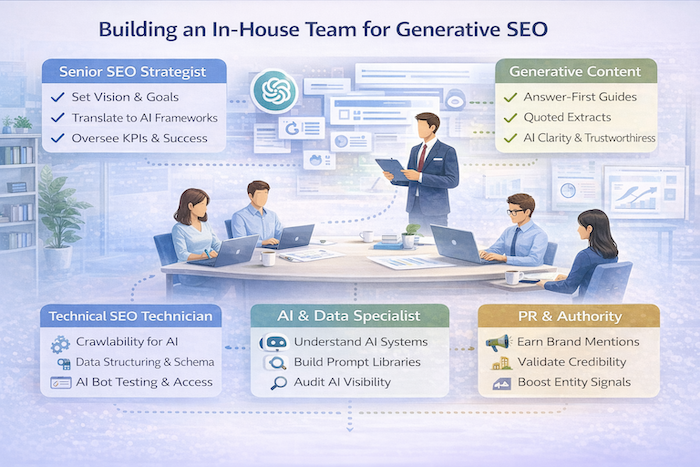
Search is evolving. Traditional SEO still matters, but large‑language‑model (LLM) assistants such as Google’s AI Overviews and ChatGPT now answer queries directly. These generative engines draw on a mix of owned content, earned coverage and community signals, so simply ranking well on Google is no longer enough. In response, organisations are moving from channel‑specific optimisation to building Generative Engine Optimisation (GEO) capability across departments. This guide explains why in‑house GEO matters, what cross‑functional skills are required, and how to develop a long‑term GEO team.
Why In‑House GEO Matters for Larger Organisations
Generative search influences brand perception, product discovery and revenue concurrently. AI assistants consume press releases, social posts, retailer pages and user‑generated content. Being cited (or omitted) affects marketing, PR, recruiting and sales. External agencies can help, but internal teams control speed, context and consistency. GEO is not a campaign; it is a capability that needs to be embedded into the organisation’s operating model.
GEO Is Cross‑Functional by Design
No single role owns generative visibility. Generative engines look for consensus across multiple sources. To succeed:
- SEO must act as the strategic quarterback. Search teams are shifting from technical specialists to cross‑channel coordinators, focusing on entity extraction and data structure rather than just keyword rankings.
- Content, PR and social media teams must collaborate. LLMs care more about what others say than what you say yourself; therefore, PR and communications must generate credible citations and brand mentions.
- Community and social teams must shape sentiment. Phase 3 of the Search Engine Land blueprint emphasises building community authority and sentiment because AI models scrape forums and reviews to gauge human preference.
- Product and data teams must prepare structured data. Accurate product data and schema markup help LLMs interpret information across retailer pages and marketplaces.
GEO success therefore requires a shared operating model where SEO, content, PR, product and data teams exchange insights and coordinate execution. BrainZ Digital similarly advises CMOs to build cross‑functional search teams and prepare product data for LLMs.
Upskilling Content and Editorial Teams
Generative engines extract concise, factual passages rather than reading entire articles. In‑house writers and editors must therefore shift their mindset:
- Write for answers, not just narratives. Pages need clear summaries, definitions and lists so that AI can quote them; this means front‑loading factual statements and breaking long content into sections with question‑based headings.
- Master conversational structure. Content should mirror the questions users ask AI assistants and provide neutral, explanatory language. Training teams to think like answer‑engineers ensures their copy is both human‑friendly and AI‑friendly.
- Gain basic schema literacy. Editors should understand schema types (FAQ, HowTo, Product) and when to apply them to clarify context for AI.
- Emphasise accuracy and neutrality. AI systems prioritise factual, unbiased information; content must cite credible sources and avoid promotional fluff.
Evolving the SEO Team’s Role
Video: AI-SEO Is Changing Everything in 2026 — Neil Patel
Traditional SEO responsibilities—crawlability, indexing, on‑page optimisation and link acquisition—remain foundational. However, in a generative search world the SEO team must:
- Move from execution to interpretation and orchestration. SEO specialists should monitor AI answer inclusion, sentiment themes and citation changes, translating these signals into priorities for content and technical teams.
- Focus on entity and structured data. Optimisation now means ensuring data structures are unambiguous for bots and that entity relationships are consistent across pages.
- Cultivate high‑value citations. Instead of chasing volume backlinks, teams should pursue authoritative mentions that build brand authority.
- Maintain SEO fundamentals. Technical excellence—clean architecture, fast performance and schema markup—remains the prerequisite for AI visibility.
Introducing an AI Visibility / GEO Lead Role
A dedicated GEO lead or AI visibility strategist is often required. This role:
- Owns the generative optimisation strategy. They act as the internal educator and set standards for answer‑first content, schema usage and citation quality.
- Coordinates cross‑team collaboration. Like a quarterback, the lead ensures each department provides the right inputs (topic expertise, product data, media coverage) and receives AI‑driven insights.
- Defines success metrics beyond rankings and clicks. They track AI answer inclusion, share of AI voice, sentiment shifts and citation authority to measure influence.
- Reports to leadership. They communicate how generative visibility affects brand perception and pipeline and advocate for resources.
The Role of Data and Analytics
Classic dashboards (impressions, rankings, clicks) are insufficient for generative search. An in‑house data analyst or analytics lead should:
- Track AI appearance metrics. Because AI platforms provide limited data, teams must monitor prompt‑based tests, AI citations and brand mentions across multiple engines.
- Correlate AI visibility with demand. Connect AI citation trends to branded search queries, conversions and revenue to demonstrate business impact.
- Interpret traffic declines. Falling CTR may be offset by improved AI influence; analysts should explain these nuances to leadership.
- Develop new dashboards. Combine traditional SEO metrics with AI‑specific indicators such as AI Presence Rate, Citation Authority and Sentiment Analysis.
Integrating PR and Brand Teams
Generative engines value third‑party validation. PR and brand teams should:
- Secure authoritative coverage and citations. Earned media, thought‑leadership articles and influencer partnerships increase AI trust.
- Align messaging across channels. Ensure press releases, social posts and retailer listings provide consistent facts so AI can validate information.
- Monitor and correct narratives. PR should track how AI describes the brand and respond with clarifications when misinformation appears.
Technical Enablement and Governance
The website must be machine‑readable and accessible:
- Enable AI crawlers. Ensure robots.txt policies allow AI agents to access relevant content and avoid blocking key sections.
- Implement robust schema. Extend beyond basic SEO markup to include product, FAQ, HowTo and organisational schemas.
- Maintain a logical link structure. Internal linking should establish topical hierarchies and avoid orphan pages.
- Establish AI usage policies. Define guidelines for AI‑generated content, review processes and risk management to ensure ethical and brand‑safe practice.
Training vs. Hiring
Building GEO capability doesn’t always require hiring a new team. Many skills can be layered onto existing roles:
- Upskilling existing staff via workshops on answer‑first writing, schema basics and AI monitoring is faster and cheaper than hiring specialists.
- Training outperforms rushed hiring. Content and SEO teams already understand the brand; training them to adapt reduces reliance on elusive “AI SEO unicorns”.
- Leverage external experts for coaching. Consultants can help design initial frameworks and training materials before gradually handing off responsibility.
When to Hire New Roles
Additional hires may be justified when workflows are defined and the need is clear. Potential roles include:
- GEO lead / AI search strategist (as described above).
- Data analyst skilled in AI visibility tracking and experimentation.
- Editorial lead focused on factual, explanatory standards across content.
- Digital PR & outreach specialist to secure credible mentions and citations.
In-house teams should hire only after pilot phases prove the value of GEO and reveal workload gaps. Discovered Labs notes that building a full AEO/GEO team requires multiple specialised roles and may cost $300k+ annually, so smaller companies might prefer agency support.
Internal GEO Playbooks and Standards
Codify your process in playbooks to ensure consistency and scalability:
- Define AI‑ready content. Document the hallmarks of AI‑friendly pages—concise summaries, question‑based headings, accurate data and schema tags.
- Standardise structure and review processes. Provide templates for answer‑first sections and checklists for fact verification and schema validation.
- Establish AI visibility testing routines. Schedule periodic prompt‑based audits to see which pages are cited and adjust accordingly.
- Align across departments. Ensure that PR, content and SEO teams all follow the same playbook for terminologies and message consistency.
Change Management Challenges
Building an in‑house GEO capability requires cultural change. Expect to:
- Overcome resistance. Some colleagues may think “SEO already works” or fear that declining traffic signals failure; education is vital.
- Avoid panic over traffic drops. Clarify that influence and citations may rise even if clicks decline; focus on brand demand and conversions.
- Align leadership on new metrics. Decision‑makers must understand AI‑specific KPIs and commit to long‑term investment.
- Maintain morale during transition. Celebrate early wins—such as first AI citations—to reinforce progress.
A Phased Adoption Model
A phased approach helps build capability without overwhelming teams:
- Phase 1 – Awareness and education: Introduce GEO concepts, run initial audits, and train teams on answer‑first writing and schema basics.
- Phase 2 – Pilot monitoring and content adjustments: Conduct prompt‑based tests, restructure high‑impact pages and monitor AI citations.
- Phase 3 – Formal roles, metrics and governance: Appoint a GEO lead, implement AI visibility dashboards and integrate PR/social efforts.
- Phase 4 – Continuous optimisation: Establish ongoing audits, refine content and data structures, and adapt to platform changes.
Search Engine Land’s blueprint emphasises similar phases for owned assets, earned assets and community signals, each with specific collaborators and goals.
What Success Looks Like In‑House
A mature in‑house GEO capability delivers:
- Organisation‑wide understanding of AI search. Teams know how generative engines retrieve and summarise information.
- Data‑informed decisions. Metrics combine traditional SEO performance with AI visibility indicators, guiding strategic choices.
- Consistent brand presence in AI answers. Pages are cited as authoritative sources across multiple AI platforms.
- Operational integration. GEO processes become part of normal workflows rather than a side project.
Conclusion
Generative SEO is not a department—it’s a capability that requires coordinated efforts across SEO, content, PR, social, product and data. Building an in‑house team involves upskilling existing staff, appointing a strategic GEO lead, and creating shared standards and metrics. Organisations that embed GEO into their operations will not only preserve search traffic but also shape how AI explains their category. Those who wait risk having competitors define the narrative.