Artificial‑intelligence tools have crept into every part of search optimisation.
Businesses now have access to AI‑assisted SEO software that automates tasks like keyword research and content planning, and AI‑visibility platforms that monitor how often brands appear in conversational engines.
This landscape can be confusing because some tools merely use AI to speed up traditional SEO processes while others help optimise for the new world of AI‑generated answers and retrieval‑augmented generation (RAG).
- AI‑assisted SEO tools leverage machine‑learning to improve classic SEO tasks such as keyword research, content scoring and technical audits.
- SEO for AI‑driven search (often labelled AEO or GEO) focuses on making content visible, trustworthy and extractable for generative engines like Google’s Search Generative Experience (SGE), Bing’s Copilot, ChatGPT and Perplexity.
Traditional ranking signals (links, metadata, crawlability) still matter, but AI models prioritise clear answers, concise summaries and trusted sources.
Understanding the difference between these two aims prevents organisations from buying hype‑driven products that don’t solve their actual problems.
How to Categorise AI SEO Tools
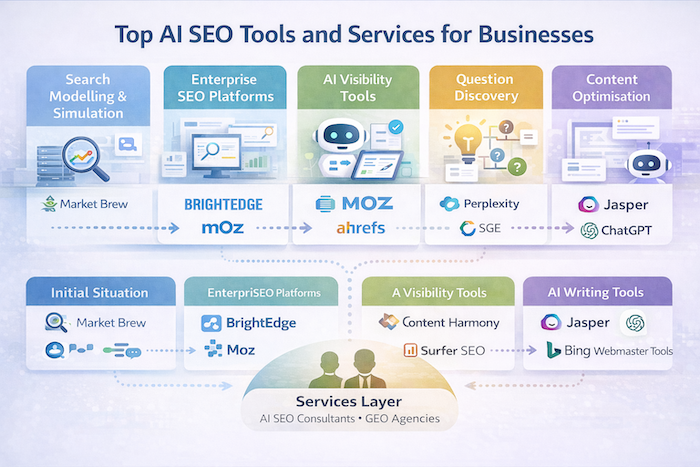
Not all AI SEO tools solve the same problem. The landscape can be organised into four broad categories:
| Category | Purpose | Examples |
|---|---|---|
| Search modelling & algorithm simulation | Simulate how search engines rank pages and test optimisation hypotheses. Useful for scenario testing but not a perfect predictor in a generative world. | MarketBrew |
| Enterprise SEO platforms with AI capabilities | Established suites that have added AI‑driven insights, AI‑search visibility tracking and content recommendations on top of traditional keyword/traffic reports. | BrightEdge (AI Catalyst), Moz Pro, Ahrefs (AI‑driven suggestions) |
| AI‑visibility & AEO/GEO tools (emerging) | New platforms designed to monitor and improve how often brands are cited, mentioned or recommended in AI‑generated answers. Provide share‑of‑voice metrics, citation detection and prompt‑level insights. | Profound, Rankscale, SE Visible, GetCito |
| AI‑assisted content & intent tools | Tools that help find user questions, build content briefs and optimise copy using AI. They improve structure and depth but still need human oversight. | AlsoAsked, AnswerThePublic, Content Harmony, Surfer SEO, Jasper |
Below we examine these categories and the services layer that supports them.
Search Modelling & Algorithm Simulation Tools
These tools attempt to model how search algorithms behave so marketers can test hypotheses before making changes.
MarketBrew
MarketBrew uses machine‑learning to build a self‑calibrating search engine model correlated to the target search engine. By simulating ranking factors, it helps users test how site changes could impact rankings and reveals which actions will likely have the highest return on investment. This “digital twin” approach is valuable for scenario testing—e.g., what happens if page speed improves or internal links are restructured.
Limitations: these models still rely on classical ranking factors and cannot fully predict generative answer selection. They provide insight into retrieval but not the generation stage where AI chooses which passages to cite.
Enterprise SEO Platforms Adding AI Capabilities
Leading SEO suites are adapting to include AI‑visibility features alongside traditional keyword and traffic tools.
BrightEdge AI Catalyst
BrightEdge’s research shows that while AI search referral traffic is growing fast, organic search still delivers most conversions. To help brands monitor AI visibility, AI Catalyst identifies where competitors appear in AI‑generated results and explains why they win—highlighting issues such as page structure, topic coverage or layout that make content easier for large‑language models (LLMs) to interpret. It also shows which sources AI engines use to form answers and provides actionable steps to improve citation potential.
Strengths: integrates AI visibility tracking into a mature SEO platform; combines traditional ranking data with generative insights.
Gaps: relies heavily on BrightEdge’s ecosystem; limited direct monitoring of non‑Google engines.
Moz & Ahrefs
Both Moz and Ahrefs have added AI‑powered insights:
- Moz offers AI‑assisted SERP analysis and content suggestions within its existing toolkit.
- Ahrefs provides question discovery and AI‑driven content recommendations.
These features help identify topics and structure content but don’t yet include full AI citation monitoring. Their strength lies in the scale of backlink and keyword data, making them useful for competitive research.
AI‑Visibility & AEO‑Focused Tooling
A new wave of platforms is emerging to measure and improve presence in AI answers. They treat AI search visibility as a distinct KPI—often called AEO (Answer Engine Optimisation) or GEO (Generative Engine Optimisation).
SE Visible & Rankscale AI
The 2026 SE Ranking review notes that SE Visible scores how often a brand appears in AI answers, benchmarks competitors and analyses prompts and topics. It also provides sentiment analysis to see whether mentions are positive or negative. The tool is built on SE Ranking’s data and suits CMOs and agencies looking to understand brand prominence.
Rankscale AI maps which third‑party sites influence AI citations, monitors visibility scores and competitor performance, and offers AI readiness audits. These audits examine schema, citation patterns and content structure to improve citation chances.
GetCito
GetCito tracks brand mentions across AI search engines and offers an AI visibility checker and AI competitor radar. Its AI crawlability clinic helps diagnose whether AI bots can access important content, while TrafficIQ measures traffic coming from AI interfaces. This transparency appeals to B2B marketers who need open‑source benchmarking.
Profound and Other Platforms
Other tools—such as Profound, Scrunch, Peec and Athena—rank brands by share of answer and provide dashboards that track citations across ChatGPT, Google AI Overviews and Perplexity. They vary in depth: Profound suits enterprises requiring rigorous governance, while Peec offers an accessible weekly workflow for small teams.
Because generative search is still new, these platforms are evolving rapidly. Buyers should expect beta features, limited coverage and frequent methodology changes.
Question & Intent Discovery Tools (Highly Relevant for GEO)
Understanding what questions people ask—and what generative engines will likely answer—is essential. Tools in this category gather real user queries so content teams can address them.
AlsoAsked
AlsoAsked collects “People Also Ask” data directly from Google and surfaces long‑tail questions that seldom appear in keyword databases. It reveals that 15 % of daily searches are new and over 70 % are long‑tail, exposing zero‑volume keywords and topics. It helps writers plan content aligned with user intent, promotes experience‑expertise‑authority‑trust (EEAT), and saves time by allowing bulk queries and API integration.
AnswerThePublic
AnswerThePublic listens to autocomplete data from search engines like Google and quickly compiles every useful phrase and question around a keyword. The tool turns search behaviours into a “search listening” wheel, enabling marketers to discover hidden niches, monitor trends and create content that answers real questions. Such insight is invaluable when designing answer‑first content for AI engines.
Content Briefing & Optimisation Tools Using AI
AI can accelerate content planning and on‑page optimisation, but human judgment remains critical. These tools assist with structure, coverage and clarity rather than writing entire articles.
Content Harmony
Content Harmony generates keyword reports, content briefs and content grading. Its workflow analyses search intent, overlaps keywords and entities, studies competitor document structure, builds outlines covering reader questions and recommends authoritative sources and visual assets. This structured approach standardises briefs and ensures writers include all necessary information.
Surfer SEO
Surfer offers a Content Editor that provides real‑time writing guidance and scoring, a Content Audit for existing pages, a SERP analyser that reverse‑engineers top results, and AI functions such as Surfer AI (an AI writer) and Auto‑Optimize. It examines over 500 on‑page signals, including content structure, word count and NLP entities, to generate actionable recommendations.
While powerful, Surfer can encourage over‑optimisation and keyword stuffing if used blindly, so teams should balance its suggestions with editorial judgment.
AI Writing & Generation Tools (Use with Care)
Large‑language‑model writing assistants can accelerate drafting but pose risks. Businesses should treat them as ideation and drafting aids, not as replacements for writers.
Jasper
Jasper positions itself as an “always‑on content engine” and emphasises brand‑consistency and marketing automation. Its 2025 review highlights agentic AI agents that plan campaigns, generate content and perform SEO audits; a knowledge base capturing tone and style; over 50 templates for blog posts and ad copy; and partnerships with Semrush for SEO optimisation. Jasper promises to automate 60 % of SEO tasks from keyword research to recommendations.
Chat‑based LLMs and Other AI Writers
Generic AI writers such as ChatGPT, Gemini or Copy.ai can draft articles quickly. However, over‑reliance leads to thin, generic or repetitive content, which lacks original insights and can trigger spam signals. AI tools often hallucinate or reproduce outdated information. To avoid damaging trust and rankings, businesses should always fact‑check AI drafts, add unique perspectives and ensure alignment with EEAT standards.
Technical SEO Tools Supporting AI Readiness
Generative engines rely on reliable crawling and extraction. Technical tools ensure that websites are accessible and structured for both traditional crawlers and AI bots.
Screaming Frog SEO Spider
Screaming Frog is a website crawler used for technical site audits. It identifies over 300 issues, including broken links, redirect chains, missing metadata and duplicate content. It can extract data via XPath or CSS selectors, review robots directives, generate XML sitemaps, integrate with Google Analytics and Search Console, crawl JavaScript sites and visualise internal link structures. These capabilities help ensure AI crawlers can access and understand pages.
Schema Markup Generators and Structured Data Testers
Structured data (JSON‑LD) helps search engines and generative models understand and classify content. A guide on structured data notes that adding schema improves visibility and plays a central role in GEO, enabling AI models to extract clear answers. Tools like the Merkle Schema Generator simplify creating Article, FAQ, LocalBusiness and Product schema while Google’s Rich Results Test validates the markup.
Analytics & Monitoring Stack (Indirect AI Signals)
Generative search reduces clicks, making traditional SEO metrics less reliable. Businesses need analytics that capture visibility and influence.
- Google Search Console & Bing Webmaster Tools: still the best way to track impressions and keywords that earn them. As AI overviews grow, impressions show brand presence even when clicks decline. Rocket55 notes that impressions remain a foundational indicator of visibility and that Search Console data, though limited to Google, is invaluable for measuring how often a site appears.
- Visibility Metrics: Modern SEO teams track visibility across all surfaces, including AI chats. Emerging tools like Scrunch and Profound provide share‑of‑answer metrics.
- Conversions & Business Impact: With click‑through rates falling by 61 % when AI Overviews are present, marketers shift focus from traffic to conversions and brand demand. Integrating Search Console, Google Analytics 4 and CRM systems helps attribute influence across channels.
Services Layer: When Tools Aren’t Enough
AI SEO tools are not a silver bullet. Many businesses pair them with AI SEO consultants or GEO‑focused agencies to interpret data and design strategies. Consultants bring deep expertise in traditional SEO, generative engines, content structure and measurement. They provide audits, training and roadmaps, leaving execution to internal teams or agencies. Earlier case studies showed how consultants moved clients from ranking‑focused content to answer‑first architecture, implemented schema and internal linking, and monitored AI visibility—leading to brand mentions and citations without a traffic spike.
Agencies and consultants also advise on tool selection and custom‑build reporting frameworks when off‑the‑shelf solutions fall short. Their value lies in diagnosis, structure and interpretation, not in selling tool access.
Common Mistakes When Buying AI SEO Tools
- Expecting automation to replace strategy: AI tools accelerate tasks but cannot replace human judgment or deep SEO foundations.
- Purchasing tools without clear success metrics: Businesses should define what they want to achieve (citations, visibility, leads) before investing.
- Confusing content generation with optimisation: Writing tools produce drafts; optimisation requires research, structure, fact‑checking and EEAT compliance.
- Ignoring data quality: Many early‑stage AI visibility tools rely on sampling or incomplete coverage; decisions should consider their limitations.
How to Choose the Right Tool Mix
- Early‑stage businesses: Focus on question research and traditional SEO fundamentals using tools like AnswerThePublic, AlsoAsked and Screaming Frog.
- Growth‑stage: Combine content briefing tools (Content Harmony, Surfer) with enterprise SEO suites (Moz, Ahrefs) to enhance content quality and competitive analysis.
- Enterprise: Invest in modelling and AI‑visibility platforms (MarketBrew, BrightEdge AI Catalyst, Profound) and consider building custom AI‑citation dashboards. Pair tools with expert consultants to design processes and measurement.
What’s Missing in the Market (For Now)
Although the tooling landscape is expanding, several gaps remain:
- Reliable AI citation dashboards: Most tools provide snapshot monitoring but lack comprehensive, standardised coverage across models.
- Real‑time AI brand alerts: Marketers want immediate notifications when a brand is mentioned or misrepresented; existing solutions are immature.
- Standardised share‑of‑voice metrics: There’s no industry‑wide framework for measuring AI visibility comparable to search rank tracking.
- Integration across engines: Many tools focus on Google or ChatGPT, leaving coverage gaps for Perplexity, Claude or emerging models.
- Actionable benchmarking: Tools can show where a brand is absent but often struggle to prescribe fixes beyond generic recommendations.
Because of these gaps, serious GEO teams often build custom monitoring systems and use a combination of off‑the‑shelf tools and manual testing.
Conclusion
The AI SEO toolkit is diverse and evolving. Businesses should distinguish between AI‑assisted SEO tools, which accelerate traditional workflows, and AI‑visibility tools, which target generative search visibility.
Effective AI optimisation requires a mix of data platforms, human judgement and experimentation. Enterprises that treat tools as decision support rather than shortcuts—and pair them with strategic expertise—will be best positioned to maintain visibility in an era where answers matter more than clicks.
Want to know whether ChatGPT, Perplexity, or Google AI Overviews mention your firm? Run a free first-party visibility audit on your domain in under a minute and see exactly which queries cite you and which do not.