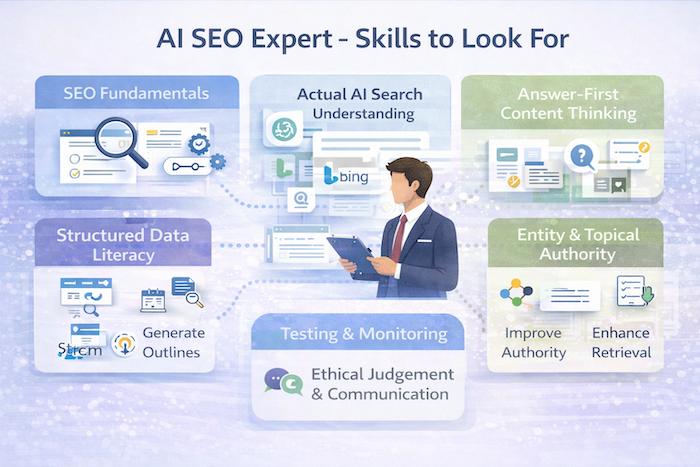
The term “AI SEO expert” began trending as AI‑assisted tools proliferated. While generative AI can help with drafts, keyword suggestions or summarising information, labelling a practitioner an AI SEO expert simply because they can use ChatGPT is misleading. Clients risk hiring someone who is adept at prompting AI tools but lacks the deep understanding of how search engines and generative models actually surface answers. The job now combines classic SEO fundamentals with a working knowledge of generative engines, retrieval‑augmented generation and answer‑first content design.
Strong SEO Fundamentals Are Non‑Negotiable
A legitimate AI SEO expert must first be an excellent SEO practitioner. That means understanding how pages are crawled, indexed and ranked, and being comfortable diagnosing classic SEO issues (e.g., site speed, mobile friendliness, crawlability). The Search Engine Land skills guide notes that future SEO specialists need to master technical SEO 2.0, including schema markup, structured data and server‑side rendering. PrimaryPosition’s definition of an AI SEO expert stresses that they combine deep knowledge of search engine algorithms with hands‑on experience using AI tools; they audit websites and tech stacks, blend legacy best practices with automation and NLP tools, and help organisations adapt to search updates.
Understanding How AI Search Actually Works
Generative search systems differ from classic ranking engines. Platforms such as ChatGPT, Google’s AI Overviews and Perplexity do not simply list the ten best pages; they expand a query into multiple variations, retrieve passages and assemble an answer probabilistically. Because these systems retrieve and cite individual passages instead of ranking full pages, visibility is volatile and depends on designing content that is extractable across a range of prompts. Backlinko’s AI‑ready team guide highlights that teams need to understand how platforms like Perplexity, ChatGPT and AI Overviews select sources: they look for clear, structured passages that directly answer the query. An expert should therefore know which AI platforms matter to the business and how each retrieves and displays information.
Answer‑First and GEO‑Ready Content Thinking
Optimising for AI answers requires designing content that can be extracted and reused in small pieces. Generative engines look for reliable, well‑structured text that is easy to summarise. MindSpace explains that AI evaluates context more than keyword repetition, favours originality, and values clear headings, bullet points and definitions. Backlinko illustrates how writing for AI extraction means structuring each section so it can stand on its own; passages should answer specific questions without relying on context. An AI SEO expert should be able to turn long articles into concise, quotable blocks, write conversationally, and prioritise quality over word count.
Structured Data and Machine Readability
Structured data helps generative engines understand entities, relationships and context. ALM Corp’s SEO trends report advises brands to implement Organisation, Product and FAQPage schema to help AI systems understand their offerings and improve entity clarity. Backlinko notes that schema markup and a clear site hierarchy provide signals that make it easier for AI systems to interpret and cite content. An expert must therefore know how to implement and validate schema types beyond basic breadcrumbs, troubleshoot markup issues, and ensure pages are formatted for clean extraction (e.g., using lists, tables and short paragraphs). This extends to technical decisions such as allowing AI crawlers in robots.txt and ensuring server‑rendered HTML.
Entity and Topical Authority Knowledge
Generative engines rely on entity relationships to determine trust and context. The ALM Corp guide emphasises that brands must provide crystal‑clear information about who they are and what they offer, and suggests creating comprehensive entity descriptions using schema markup. It also advocates developing citation‑worthy assets (original research, proprietary data) and building third‑party authority signals through digital PR and industry communities. MindSpace notes that generative engines prioritise content rich in facts and verified data, and that context, originality and topical depth matter more than word count. An AI SEO expert must therefore build topical clusters, strengthen internal linking, and ensure consistent terminology so AI systems perceive the brand as an authority on a subject.
AI Literacy (Without Hype)
AI literacy entails knowing what generative models can and cannot do. The Search Engine Land skills guide lists AI and machine‑learning literacy as a core requirement, urging SEO practitioners to learn how models like BERT, MUM and Gemini summarise, rank and cluster information. It also stresses the need for prompt‑engineering skills—designing prompts for AI content ideation and creating factually accurate, brand‑consistent outputs. Understanding retrieval‑augmented generation at a practical level helps experts anticipate how queries are expanded into sub‑queries and how citations are selected. An AI SEO expert should be familiar with the limitations of AI (e.g., hallucinations, outdated knowledge) and avoid over‑promising what generative systems can deliver.
Analytical Skills in an AI‑Distorted World
Classic metrics like rankings and traffic are insufficient for generative search. AI search visibility is probabilistic; the same query can produce different citations each time. Backlinko suggests tracking AI‑specific metrics such as citation frequency, platform breakdown (where your brand appears), mention rate and sentiment. It notes that analysts may need to manually test prompts across platforms and document patterns. An expert must therefore be comfortable interpreting falling click‑through rates without panic, recognising when conversions remain stable despite traffic drops, and explaining AI influence to stakeholders.
Monitoring and Testing AI Visibility
Because AI platforms are opaque, continuous monitoring is essential. ALM Corp advises setting up AI visibility monitoring tools to track which queries trigger citations, competitor presence, and content gaps. Backlinko describes running prompt‑based tests across AI platforms and documenting when and how a brand appears. An expert should use a combination of specialised tools (e.g., AI visibility dashboards) and manual testing to assess AI citations, brand mentions and prominence. They must focus on trends rather than one‑off appearances, and adjust strategies based on observed patterns.
Ability to Separate Signal from Noise
Generative search results are inherently variable; one AI answer does not define success or failure. The ipullrank article explains that AI search systems introduce probability at every stage—query fan‑out, embedding retrieval and passage selection—so results can differ each time. Optimising in this environment requires thinking in terms of likelihood rather than guarantees and designing content at passage level. An expert must therefore avoid overreacting to individual fluctuations, focusing instead on consistent inclusion across multiple prompts and platforms.
Ethical and Editorial Judgement
AI makes it easy to generate large volumes of text, but experts must resist the temptation to flood the web with low‑quality content. The Basaropt comparison of AI tools versus human SEO notes that AI‑generated text is grammatically sound but often lacks depth, nuance and authenticity; therefore human oversight for editing and fact‑checking is essential basaropt.com. It warns that AI cannot truly understand a business’s unique goals or audience nuances and that content produced without human judgement may be bland or misleadingbasaropt.com. The article adds that human practitioners provide creativity and ethical judgement, building trust and storytelling that resonates with readersbasaropt.com. A good AI SEO expert should champion originality, accuracy and transparency and align with Google’s E‑E‑A‑T expectations, which emphasise real experience and expertise.
Communication and Teaching Ability
The role of an AI SEO expert is increasingly advisory. PrimaryPosition notes that AI SEO consultants audit sites and tech stacks, blend legacy SEO with automation, and train teams to adopt answer‑first writing and AI‑friendly structures. Backlinko points out that not everyone on a team needs deep AI expertise; a strategist should lead, provide guidelines and educate writers on structuring content for AI extraction. An expert must therefore explain complex AI‑SEO interactions in plain language, develop playbooks and training sessions, and act as a coach rather than a mere implementer.
What an AI SEO Expert Is Not
- Not just someone who uses ChatGPT to write blogs. Tools such as ChatGPT can accelerate drafting, but everyone has access to them. Over‑reliance leads to content sameness and duplication risks. Real advantage comes from understanding how AI retrieves sources and designing content accordingly.
- Not a promise‑maker of guaranteed AI placements. Generative search is probabilistic; no one can guarantee citations. Agencies promising such results often rely on hype.
- Not a replacement for solid marketing or product value. AI optimisation cannot fix a poor product or weak brand. Traditional marketing fundamentals and valuable offerings remain necessary.
Good Questions an AI SEO Expert Should Ask You
- “Where do customers make decisions in your journey?” Understanding decision points helps identify which AI queries matter most.
- “Do AI recommendations matter in your category?” Some niches rely heavily on AI‑generated comparisons; others see little impact.
- “What happens if traffic falls but leads stay the same?” This question tests whether you are measuring influence (citations, mentions) rather than just clicks.
These questions signal strategic maturity and a focus on aligning AI visibility with business outcomes.
Red Flags When Evaluating Candidates
- Overconfidence about “cracking” AI algorithms. AI search systems are opaque and probabilistic. Anyone claiming to have inside secrets likely misunderstands how they work.
- Tool‑first, strategy‑second mindset. AI tools can assist with content drafting and analysis, but strategy and human judgement are essentialbasaropt.com.
- No explanation of success metrics beyond traffic. An expert should discuss citation frequency, brand mentions, sentiment and platform breakdown.
- Promises of guaranteed AI placements or unrealistic timelines. Such promises signal hype rather than expertise.
Conclusion
The title “AI SEO expert” should denote a professional who blends classic SEO discipline with a nuanced understanding of generative search systems. Strong SEO fundamentals remain the foundation—no amount of prompting will compensate for a site that is slow, unindexed or unclear. Above that foundation, an AI SEO expert must understand probabilistic retrieval, design content for extraction, implement structured data, build entity authority, develop AI literacy, interpret AI‑specific metrics and maintain ethical standards. Their role is analytical, strategic and interpretive, not mechanical. Businesses seeking to optimise for AI search should look beyond the label and evaluate whether the expert can teach, guide and adapt in a rapidly changing landscape.
Want to know whether ChatGPT, Perplexity, or Google AI Overviews mention your firm? Run a free first-party visibility audit on your domain in under a minute and see exactly which queries cite you and which do not.