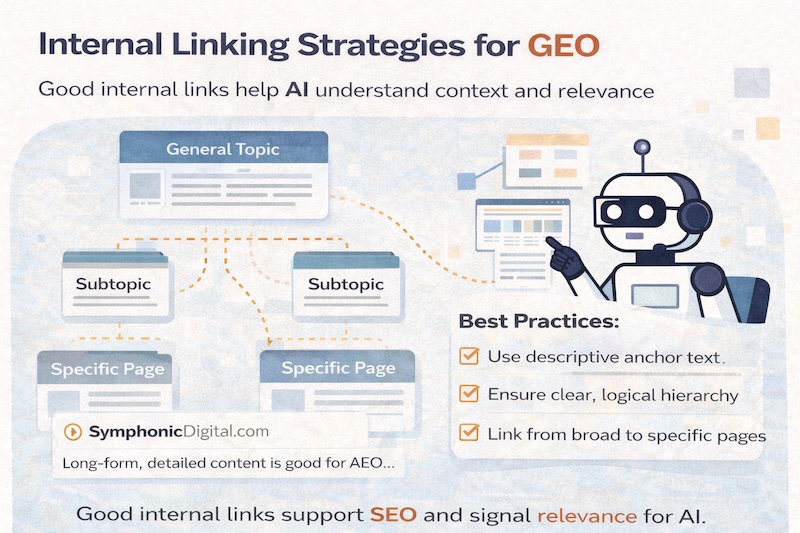
As search evolves from lists of links to single AI‑generated answers, internal linking takes on new significance. In traditional SEO, linking pages together helped users and crawlers navigate a website and distribute PageRank. In the generative engine optimization (GEO) era, where answer engines synthesise information rather than simply rank pages, internal links tell AI systems how your content relates. Each hyperlink becomes part of a knowledge graph that signals meaning, hierarchy and topical confidence. When done well, internal links make it easy for large language models and retrieval systems to crawl and interpret your site, increasing the chance that your pages will be cited in AI answers and summaries. This guide explains how generative engines interpret internal links, how to reinforce context and authority, and which practices will make your site AI‑friendly while still boosting traditional SEO.
How Generative Engines Interpret Internal Links
AI platforms don’t simply follow hyperlinks the way a human might click around a site; they infer relationships and build conceptual graphs. Unlike classic search algorithms that counted links as votes, AI systems use link patterns to understand semantic connections between topics. Parent–child relationships signal authority: a pillar page linking to detailed subpages tells the model that the hub is your definitive resource and that the supporting pages elaborate on specific angles. Likewise, a reciprocal link from a subpage back to its hub reinforces the importance of the core page and clarifies context.
Why coherent link graphs matter
Without a clear link structure, AI may treat pages as isolated nodes, increasing ambiguity. Coherent linking helps generative models trace a concept through your site, gathering context and validating facts across multiple sources. The stronger the web of connections, the more confident AI systems become in citing your content. Conversely, a flat architecture, where every page links to every other page, blurs topical boundaries and makes it difficult for AI to determine which pages are core and which are supporting. Hierarchical linking acts as a map: it signals which pages introduce a topic, which pages dive deeper, and how subtopics relate.
Internal Linking as Context Reinforcement
Internal links are one of the most powerful ways to reinforce context. By linking from broad concepts to specific explanations, you help AI understand the scope and depth of your coverage. For instance, linking a general “Digital Marketing” hub page to focused articles on SEO, paid search and email marketing signals a topical cluster and clarifies relationships. Repeated contextual linking strengthens entity understanding, encouraging AI to view your site as a comprehensive resource.
Linking definitions, comparisons and subtopics
Generative engines prefer pages that answer user questions directly and then offer supporting context. Linking a definition or FAQ page to a longer comparison or how‑to article provides both a concise answer and deeper context for AI to extract. This pattern also helps answer engines trace information from an answer block back to a more authoritative source. The Search to Sale guide notes that strong internal linking signals to Google and Bing that you have a cluster of authoritative content, guiding AI models through your site’s knowledge graph. When AI sees that a short answer is anchored within a web of related content, it can confidently cite your site knowing there is more depth behind the snippet.
Logical Hierarchy: Teaching AI Your Site Structure
A logical hierarchy is the foundation of an AI‑friendly site. Generative engines favour sites with clear information architecture and logical internal linking structures. A typical hierarchy consists of:
- Pillar pages: long‑form, comprehensive guides covering broad topics. These act as hubs or “ultimate guides.”
- Subtopic guides: detailed articles addressing specific angles of the main topic.
- Deep‑dive articles: posts that explore niche sub‑sections in depth.
Each level should be interlinked. The pillar page links to all subtopics and deep dives, while each subtopic links back to the pillar and to other relevant subtopics. This structure signals to AI which page is core and helps models decide which page to quote when constructing answers. Avoiding flat architectures, where every page links indiscriminately, prevents confusion and ensures generative models understand topical relationships.
Anchor Text as a Semantic Signal (Not a Keyword Trick)
Anchor text has evolved from a keyword tool to a semantic signal. In the GEO era, AI engines look at anchor phrases and surrounding context to infer meaning. Instead of exact‑match keywords, use descriptive, natural‑language anchors that explain why the destination page is relevant. For example, linking from a sentence about user intent to a page titled “How to Find and Use Long‑Tail Keywords” clarifies the relationship and helps AI understand that both pages belong to the same conceptual cluster. The Directive Consulting checklist emphasises aligning internal links to pillar content and keeping anchor text descriptive.
Consistency matters. When you refer to an entity or concept, use the same terminology across different pages. Repeated, varied anchor text builds a natural semantic profile that AI can use to map synonyms and related phrases. Avoid generic anchors like “click here” or “learn more”; they provide no context and waste an opportunity to reinforce meaning.
Linking for AEO and GEO Queries
Answer Engine Optimization (AEO) and GEO share a common goal: making your content extractable for AI answers. Internal links play a crucial role in connecting question‑based content to explanatory resources. For AEO queries, linking FAQs to comprehensive guides gives AI a path from a short, answer‑first section to deeper coverage. For GEO queries, linking across question clusters shows that your site thoroughly covers a topic, which increases the chances that AI will cite you for related queries. Connecting definition pages, how‑to guides and comparison pages creates a meaning pathway that generative engines can follow and summarise.
Helping AI trace an answer back to a broader hub
When an AI extracts a snippet from one of your pages, it may also look for related content to validate the information. By linking a specific answer back to a pillar page, you ensure that AI can find additional context and confirm the authority of the snippet. This back‑linking reinforces the hierarchy and provides redundancy, making it more likely that your site will be selected for citation. Search engines often list sources for generative answers; ensuring your brand appears among those sources requires a tightly linked content network.
Internal Links and Topical Depth Signals
Generative AI gauges topical depth partly by examining how many relevant internal links connect within a cluster. When many pages link to one another around a subject, AI interprets this as confidence in your coverage. Conversely, sparse linking may signal thin authority. This doesn’t mean you should link everything to everything. Instead, link intentionally between pages that share semantic or hierarchical relationships. Dense linking across a topical cluster reinforces to AI that your site is a trusted resource for that subject.
Best Practices for GEO‑Friendly Internal Linking
Drawing from SEO and AI optimisation experts, the following practices will help your internal linking support GEO:
- Link with intent, not volume: Avoid the temptation to insert links everywhere. Focus on linking pages that genuinely relate to each other.
- Keep link paths short and logical: Ensure key pages are accessible within a few clicks; long chains may confuse AI and users. Search Engine Land advises starting with your most important content and linking outward from there.
- Use consistent terminology: Repeat the same phrasing or synonyms when referring to a concept across anchors and headings.
- Ensure every important page is contextually linked: Orphan pages (those without internal links) are invisible to AI and searchers. Audit your site to find and link these pages.
- Prioritise linking to high‑value pages: Your pillar pages and high‑converting content should receive more internal links. This concentrates authority where it matters and signals importance.
- Balance anchor text diversity: Use semantically varied phrases rather than repeating the same exact anchor across multiple pages.
- Update links as content evolves: When you expand or update a page, revisit internal links to ensure they still connect logically and to prevent link rot.
- Use schema markup to enhance linking: Schema elements like
Article,mainEntityOfPage, andWebPageElementcan help AI understand the structure of your content and how pages relate. - Audit regularly: Use tools like Screaming Frog, InLinks or DefiniteSEO to identify orphan pages, broken links, and link depth. Track metrics such as crawl frequency and inlink count to measure impact.
By following these practices, you build a link architecture that acts as a roadmap for AI systems, guiding them through your content and highlighting the most authoritative sources.
Internal Linking and Traditional SEO Spillover
Although GEO requires new thinking, internal linking still offers all the traditional SEO benefits. A strong internal link structure improves crawlability and indexation, ensuring search bots can discover and rank your pages. It distributes link equity across your site, helping lower‑authority pages rank better and providing a better user experience. Because AI engines often draw from top organic results, these SEO benefits indirectly increase generative visibility. Moreover, internal links boost topical authority by signalling that your site covers a subject comprehensively. As your pages gain authority and rank higher, AI models are more likely to cite them.
Common Internal Linking Mistakes That Hurt GEO
- Orphaned pages: Pages with no internal links are effectively invisible to AI and search engines. Audit and link them to relevant clusters.
- Over‑linking unrelated pages: Random links dilute your topical clusters and confuse AI models. Links must reflect genuine semantic relationships.
- Generic anchors: Phrases like “click here” or “learn more” provide no context and waste the anchor’s semantic potential.
- Anchor repetition: Using the same exact anchor text across many pages signals artificial optimisation. AI systems prefer natural language variations.
- Ignoring deep pages: Focusing only on top‑level pages leaves valuable deep content underlinked and hidden from AI.
- Flattening your architecture: Linking every page to every other page erodes hierarchy and makes AI misinterpret relationships.
- Broken links and outdated paths: Broken internal links harm user trust and signal poor maintenance. Regularly audit and fix them.
Maintaining Internal Links Over Time
A GEO‑friendly internal linking strategy isn’t a set‑and‑forget task; it requires ongoing maintenance. As you publish new content, revisit your link structure to add connections and ensure consistent hierarchy. When updating or refreshing pages, update their internal links so that AI sees the latest context. Use version control or content management workflows to prevent outdated pages from becoming isolated. Schedule quarterly audits using crawler tools to check for broken links, duplicate anchors, and link depth issues. If you reorganise sections or add new pillar pages, update all related links to maintain clarity for AI and users.
Auditing Internal Links for AI Readiness
A comprehensive audit is the best way to ensure your internal linking strategy supports both SEO and GEO:
- Map topic clusters visually: Use a mind map or site architecture tool to illustrate how your pages connect within a topical cluster. Identify hub pages, subtopics and supporting articles.
- Check authority hubs: Ensure each cluster has a clear authoritative page that collects multiple inlinks and links out to subpages.
- Identify orphan pages and underlinked content: Tools like Screaming Frog, DefiniteSEO or InLinks can help find pages that receive few or no internal links.
- Review anchor text patterns: Look for unnatural repetition and generic anchors. Update anchors to be more descriptive and varied.
- Evaluate link paths and depth: Ensure key pages are reachable within a few clicks and that your hierarchy remains intact.
- Compare clusters to AEO and GEO prompts: Identify question-based queries your pages answer and verify that internal links connect those answers to related resources.
An audit reveals gaps and helps prioritise link updates that will strengthen your knowledge graph and improve AI citation potential.
Strategic Takeaway for GEO
Internal links do more than navigation and PageRank distribution; they are semantic bridges that define how AI understands your content. In generative search, the knowledge graph you build within your site influences whether AI engines trust you enough to include your information in answers. A clear hierarchy and topical clusters tell AI which pages are core authorities and which pages provide supporting detail. Descriptive anchor text and consistent terminology signal context and reduce ambiguity. By maintaining and auditing your internal link structure, you help AI understand, beyond individual pages, the meaning behind your site.
Conclusion
The rise of generative search means that websites must evolve from a collection of isolated posts into a cohesive knowledge system. Internal linking is the glue that binds your content into this system, guiding both humans and AI through complex topics and reinforcing your authority. As AI models synthesise answers from multiple sources, they look for semantic clues (hierarchies, context, and entity relationships) that internal links provide. A well‑planned internal linking strategy increases the likelihood that your pages will be chosen by AI as well as ranked. By focusing on intentional linking, maintaining a logical hierarchy, using descriptive anchors and regularly auditing your site, you build a network that serves both SEO and GEO. In the generative era, success depends on teaching AI the story behind your content, and internal links are your narrative guideposts.
Want to know whether ChatGPT, Perplexity, or Google AI Overviews mention your firm? Run a free first-party visibility audit on your domain in under a minute and see exactly which queries cite you and which do not.
Change log
- 2026-01-30: Initial publication.
- 2026-09-19: Copy edit: removed em dashes and tightened wording.