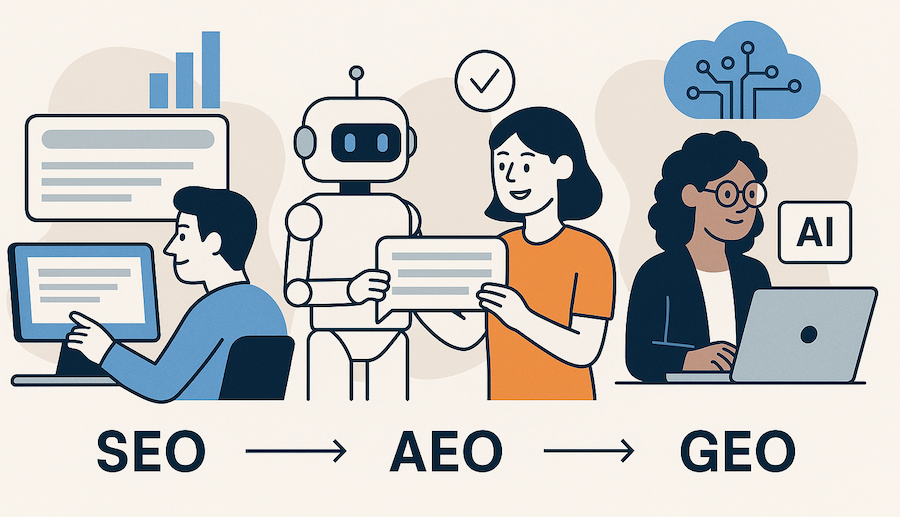
Search optimization has never been static. Since the earliest days of the web, marketers have tweaked pages to become more visible. In the 1990s, when search engines were rudimentary, those tweaks were crude; a webmaster could stuff a page with keywords, hide invisible text or build link farms, and often that was enough to leapfrog competitors. As search engines grew more sophisticated, they retaliated with ranking algorithms and penalty updates, and the industry matured around them. A quarter century later we live in a very different world. Modern search isn’t about creating pages for machines; it’s about satisfying human questions—and, increasingly, satisfying machines that answer those questions on our behalf. The shift from simple search engine optimization (SEO) through answer engine optimization (AEO) to generative engine optimization (GEO) reflects that journey. Each new era changed how people discover information, how businesses structure content and how search engines decide what appears at the top of the page. Understanding this evolution helps organizations stay visible in a landscape where chatbots, voice assistants and AI models deliver answers directly.
This article traces that transformation. We start with the Wild West of early SEO, where keyword density and backlinks dominated. We then explore the emergence of answer engines, where featured snippets and voice assistants forced marketers to think in terms of questions and concise answers. Finally, we delve into the newest frontier: generative engines that synthesize information from across the web. Along the way we highlight the strategies and challenges that define each phase, and we look ahead to a future where AI agents and multimodal search shape the next era of discoverability.
The Early Era of SEO
In the mid‑1990s, search engines like Yahoo!, AltaVista and Excite were little more than glorified directories. Their algorithms relied heavily on exact keyword matches and simple metadata. Webmasters exploited this by cramming pages with keywords. In those days, a common tactic was to place the same term dozens of times in invisible text or to load the meta keywords tag with every conceivable synonym. Another tactic involved building networks of sites that linked to each other purely to boost link counts. These “link farms” were primitive, but they worked because early algorithms treated any incoming link as a vote of confidence. There was little notion of authority or relevance; quantity outweighed quality.
Everything changed with the advent of Google’s PageRank algorithm in the late 1990s. Instead of counting all links equally, PageRank evaluated the importance of each linking page, so a link from a well‑respected site carried more weight than dozens of low‑quality links. This shifted the focus from sheer volume to quality backlinks. In the early 2000s, the SEO industry responded by pursuing link exchanges and blog networks to boost PageRank. But Google’s engineers were just as busy building updates like Florida and Panda to penalize manipulative practices and thin content. The arms race forced legitimate marketers to adopt better tactics. By the mid‑2000s, content quality and user experience began to matter more. Rather than stuffing pages with keywords, websites started to produce helpful articles that answered actual questions. This period also saw the emergence of long‑tail keyword targeting: instead of chasing high‑volume phrases, marketers targeted specific queries that aligned with user intent.
The 2010s brought another leap forward. As internet usage exploded and smartphones became ubiquitous, Google introduced algorithm updates emphasizing content quality, expertise and trustworthiness. The Panda and Penguin updates cracked down on thin content and spammy links. The “Mobilegeddon” update rewarded mobile‑friendly sites, acknowledging the shift to browsing on small screens. Machine‑learning models like RankBrain and BERT allowed search engines to interpret natural language and understand the context behind queries. Consequently, SEO evolved into a multidisciplinary field encompassing technical performance, semantic markup and user engagement. Structured data (schema markup) became essential to help search engines understand entities and relationships. Voice search started to emerge, requiring content to be conversational and mobile‑ready. By the end of the decade, effective SEO meant optimizing for user intent, not just keywords.
Yet this progress did not mean the end of optimization. It set the stage for the next shift: as search engines improved at understanding questions and delivering concise answers, the landscape pivoted toward answer engine optimization.
Transition to Answer Engine Optimization (AEO)
As users grew comfortable asking questions directly—via typed queries and through voice assistants—the nature of search changed. People no longer typed three keywords into a search box; they asked full questions like “how long does it take to roast a chicken?” or “what’s the best running shoe for flat feet?” Virtual assistants such as Siri, Alexa and Google Assistant normalized conversational queries, and smart speakers appeared in kitchens and living rooms. Meanwhile, Google introduced featured snippets and answer boxes that displayed a concise answer above the traditional list of links. This coveted “position zero” gave users an answer without forcing them to click through to a website. Research revealed that more than half of internet users now expect to ask questions aloud and get instant answers without scrolling. The launch of Google’s AI‑powered Search Generative Experience underscored this shift: search results increasingly offer direct, conversational summaries rather than blue links.
These changes signaled that traditional SEO was no longer sufficient. If a business wanted to appear in a voice response or a featured snippet, it needed to think beyond ranking. Answer engine optimization (AEO) emerged to meet this need. AEO is the practice of crafting content so that it can be selected by answer engines—those systems that power featured snippets, voice responses and AI overviews. In AEO, the goal is not simply to rank high but to have your content chosen as the answer. That means understanding exactly what questions your audience asks and providing concise, clear answers that search engines can extract easily.
AEO differs from traditional SEO in several key ways. The emphasis shifts from long‑form, keyword‑dense content to short, direct answers. Instead of focusing on broad keywords, AEO content targets specific question phrases in natural language. A page optimized for “how to change a bicycle tire” will provide a step‑by‑step answer in a few sentences, ideally in a bulleted list or numbered steps. Schema markup like FAQPage and HowTo helps search engines identify question‑answer pairs and procedural instructions. The rise of zero‑click searches—where users get what they need without visiting a website—means that businesses must view visibility through a new lens. Success metrics for AEO include featured snippet appearances, voice assistant responses and citations in AI overviews, not just organic traffic. This is both an opportunity and a challenge: you may gain brand visibility when your content is quoted, but you might receive less direct traffic. Effective AEO therefore focuses on building brand authority so that even when users don’t click through, they remember who provided the answer.
Core Strategies of AEO
Optimizing for answer engines requires a different approach to content creation. Rather than writing lengthy blog posts aimed at ranking for multiple keywords, AEO encourages creating content that directly answers specific questions. Some key strategies include:
- Structuring content for Q&A: Use clear headings and subheadings that match common question formats. Including an FAQ section on a page allows search engines to map questions to answers easily.
- Optimizing for conversational queries: Research the natural language your audience uses. Tools like “People also ask” results and customer support logs reveal how people phrase questions. Incorporate those phrases verbatim into headings and body text.
- Providing concise, fact‑based answers: When answering a question, get straight to the point in the first sentence. Follow with supporting details. Use bullet points or numbered lists for steps or lists of items. Keep paragraphs short and avoid fluff.
- Leveraging schema markup: Implement structured data types such as FAQPage, HowTo, QAPage and Speakable to signal the presence of answer content. This markup makes it easier for search engines to identify and extract answers.
- Addressing zero‑click measurement: Because many users won’t click through, monitor metrics like snippet visibility, voice answer inclusion and brand mention frequency. Evaluate whether these exposures lead to downstream brand searches or conversions.
Successful AEO also aligns content with user intent. While SEO often targets a range of informational, navigational and transactional intents, AEO focuses heavily on informational queries phrased as questions. This means identifying the exact problems your audience needs solved and crafting content that solves them succinctly. It also means updating content regularly to maintain accuracy; answer engines prioritize recent and reliable information. Finally, remember that voice assistants and AI overviews rely on concise language; avoid jargon and write at a reading level that is easily digestible.
From AEO to GEO – The AI Disruption
The rapid rise of large language models and generative AI tools introduced yet another disruption. Platforms like ChatGPT, Google’s Gemini and Microsoft’s Bing Copilot can generate full answers by synthesizing information from across the web. Instead of pulling an excerpt from one page, these models break a user’s query into multiple sub‑queries, search various sources and combine the results into a coherent response. This process, often called retrieval‑augmented generation or query fan‑out, changes the game again. The output may cite sources, but users might not see a list of links at all. They ask a question and receive a paragraph that reads like a human wrote it.
Generative engines rely on vector embeddings and semantic similarity rather than keyword matching. Content is converted into numerical vectors representing its meaning, and models retrieve passages with similar vectors. Passage‑level optimization therefore becomes critical: instead of focusing on the ranking of an entire page, you need to ensure that individual paragraphs are clear and self‑contained. If your content meanders or buries critical information deep in a page, an AI engine may ignore it. Logical flow and reasoning chains also matter. A generative system builds multi‑step answers, so passages must link concepts explicitly. For example, if you explain how to plan a hiking trip, you should clearly connect weather considerations, gear lists and safety tips rather than assuming the reader will infer those relationships.
Another distinctive element of GEO is the importance of entities and knowledge graphs. AI systems recognize entities—people, places, organizations—and their relationships. Clear subject‑predicate‑object statements help models understand who did what and when. That means naming things accurately and consistently. Instead of writing “they launched it last year,” specify “OpenAI launched ChatGPT in November 2022.” Citations and verifiable sources are also crucial. AI systems are more likely to trust information backed by reputable sources, and some platforms display citations to support answers. While your content cannot rely solely on external links, referencing known statistics or industry reports builds credibility.
In this generative context, the metrics for success shift once more. Traffic may decrease because the answer is delivered without a click. However, citations in AI responses can elevate brand authority. Early studies suggest that when users do click through from a generative engine, their engagement and conversion rates are higher because they are already primed by the synthesized answer. GEO therefore combines the disciplines of SEO and AEO while introducing new technical considerations. It requires producing high‑quality, structured, entity‑rich content that machines can parse and integrate into composite answers. At the same time, it demands an understanding of how AI systems retrieve and rank passages. Because the underlying models evolve quickly, GEO practitioners must stay agile and continuously test how their content appears in different AI interfaces.
Key Differences Across the Three Eras
To understand why content strategies must adapt, it helps to compare the focus of SEO, AEO and GEO. Below is a concise summary of their distinguishing characteristics:
| Era | Primary Focus | Platforms | Content Style | Success Signals |
|---|---|---|---|---|
| SEO | Ranking pages in traditional search results through keywords, backlinks and technical optimization | Google, Bing | Comprehensive, keyword‑rich pages with solid user experience | Organic traffic, keyword rankings, conversions |
| AEO | Providing direct answers for specific queries and securing position zero | Featured snippets, voice assistants, AI overviews | Concise, question‑oriented content, structured lists and FAQ markup | Snippet appearances, voice responses, citation frequency |
| GEO | Ensuring content passages are selected and cited by generative AI engines | ChatGPT, Perplexity, Gemini, Copilot | Conversational, entity‑rich content with clear relationships and structured data | AI citations, cross‑platform mentions, downstream brand engagement |
This table highlights the shift from optimizing entire pages for traditional algorithms to engineering individual passages for AI synthesis. Keywords still matter, but context and clarity become paramount. Metrics evolve from tangible traffic numbers to more abstract measures of visibility and authority.
Impact on Content Strategy
As the search landscape moved from lists of links to direct answers and synthesized responses, content strategies evolved accordingly. In the SEO era, long‑form blog posts targeting specific keywords and building backlinks were the norm. The goal was to cover a topic comprehensively so that the page would rank for as many related queries as possible. Writers often built 2,000‑word posts with headings, subheadings and keyword variations. While quality mattered, the emphasis was still on hitting the right terms and earning links.
With AEO, the dominance of long‑form posts waned. Instead, content creators began producing shorter articles, FAQs and how‑to guides tailored to common questions. They broke information into bite‑sized pieces and highlighted the most important facts at the top. Structured data became a priority. Marketers used FAQPage markup to signal Q&A content and HowTo markup to describe processes step by step. They also rewrote existing articles to ensure the first paragraph answered the central question clearly. Voice search influenced writing style: sentences became more conversational and mirrored natural speech patterns.
The advent of GEO pushes the strategy further. Content must now be both human‑readable and machine‑interpretable. That means balancing narrative flow with explicit entity references and context markers. Writers should assume that an AI system might extract a single paragraph out of context; therefore each paragraph should make sense on its own. It also means integrating verified facts, statistics and dates. For instance, when referencing a trend in zero‑click searches, specify that 58.5% of Google searches in the United States ended without a click in 2024, according to a study, instead of using vague phrases. This precision helps AI engines evaluate accuracy and build trust.
Another impact is the need to think in terms of user journeys rather than single queries. Generative engines often assemble answers from multiple sources, so your content might contribute to a portion of a larger narrative. Providing context about related topics increases the likelihood that more of your material will be used. For example, an article about electric cars could include sections on charging infrastructure, battery technology and government incentives. An AI system might then pull different paragraphs to answer various sub‑questions. In this way, entity‑based, context‑rich content replaces the old practice of keyword repetition.
Implications for Businesses
These shifts carry significant implications for organizations. First, visibility now depends on being chosen by platforms that may not prioritize links. Being cited in a generative answer means your brand is associated with the information, but users might never see your site. This requires building reputation and trust at a higher level. Businesses should focus on creating authoritative content that demonstrates expertise and aligns with established knowledge graphs. Having recognized experts as authors, linking to reputable studies and maintaining up‑to‑date information all contribute to being viewed as a trustworthy source.
Second, there is a measurement challenge. Traditional SEO metrics—click‑through rates, organic traffic, bounce rates—don’t capture the full impact of AEO and GEO. Instead, marketers need to monitor appearances in answer boxes, voice responses and AI citations. Tools for measuring these signals are still emerging, and results can be volatile; the same prompt may yield different answers on different days. Nonetheless, tracking these exposures is essential to understand how audiences are discovering your brand.
Third, brands that adopt GEO strategies early can gain a lasting advantage. Because generative models learn from the content they ingest, early contributions may influence how topics are described in future outputs. If your site becomes a go‑to source for well‑structured, accurate information, AI systems might cite you more often, reinforcing your authority. Conversely, if competitors dominate the initial training data, your company could struggle to break through later. This first‑mover dynamic means proactive investment in generative‑friendly content could pay dividends for years.
Finally, businesses must manage the risk of misinformation and brand exclusion. AI models sometimes hallucinate facts or conflate sources. If your information is outdated or ambiguous, the model might misrepresent it. Worse, if you are not present in the data these engines use, your brand could vanish from the conversation altogether. Maintaining accurate, high‑quality content and monitoring how AI systems mention you help mitigate these risks.
Looking Ahead
The evolution from SEO to AEO to GEO suggests that search will continue to change. Two trends stand out. The first is the move toward multimodal interaction. Future search experiences will combine text, voice, images and video seamlessly. Users may ask a question by speaking into a phone, receive a text summary, watch a related explainer video and view a chart—all within a single interface. Optimizing for this requires creating content in multiple formats and ensuring that images have descriptive alt text and captions, videos have transcripts and data can be represented in charts or tables. Generative engines may convert your content into these formats, so quality and clarity are essential.
The second trend is the integration of AI agents into search. Instead of typing queries into a box, users will interact with intelligent assistants that handle tasks, anticipate needs and deliver personalized recommendations. These agents will draw from generative search engines, personal data and context to provide answers. To remain discoverable in this environment, businesses must ensure their content can be interpreted and trusted by those agents. This may involve adhering to emerging standards for structured data, using APIs to expose information and participating in open knowledge graphs. It also involves ethical considerations: transparency about sources, avoidance of bias and respect for user privacy will become even more important.
In the long term, we may see search, chatbots and e‑commerce converge. A user might ask an assistant for vacation recommendations, receive a synthesized itinerary, then book flights and hotels via integrated services—all without leaving the assistant. Content that answers questions and drives actions will need to be both comprehensive and actionable. Businesses that embrace this reality will not only attract attention but also guide users through the entire decision process.
Conclusion
The journey from SEO through AEO to GEO is a story of adaptation. The early days of search rewarded those who could manipulate keywords and links. As engines grew smarter and users demanded direct answers, marketers learned to structure content around questions and concise explanations. Now, generative AI is rewriting the rules again, synthesizing information from across the web into single responses and elevating the importance of semantic clarity, entity recognition and authority. These changes are not optional; they are the new reality of discovery. Companies that ignore them risk becoming invisible in a world where users expect instant, accurate answers delivered by machines. By understanding the evolution, embracing structured, entity‑rich content and prioritizing credibility, businesses can thrive in the era of generative engines. The next wave of search will be conversational, multimodal and agentic. Preparing now will ensure your voice is part of the conversation tomorrow.
Want to know whether ChatGPT, Perplexity, or Google AI Overviews mention your firm? Run a free first-party visibility audit on your domain in under a minute and see exactly which queries cite you and which do not.