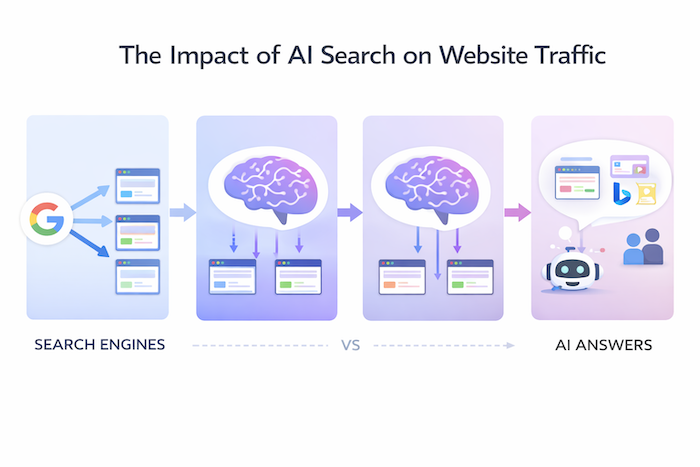
In late 2025 and early 2026 many site owners have reported significant declines in organic traffic even though their pages still rank well in traditional search results. This apparent disconnect stems from a structural change in how users get information. AI‑powered answer engines – such as Google’s AI Overviews, ChatGPT, Perplexity and Claude – summarise and synthesise answers directly within search results. The result is a growing zero‑click behaviour: people see the answer in the AI‑generated box and never click through to any website. Research shows that roughly 60 % of Google searches ended without any click by mid‑2025 and the share continues to rise. AI answers aren’t removing the need for websites – they rely on the same index and content – but they are changing the way users consume information and how success should be measured.
The Observable Trend: Declining Organic Traffic
Fewer clicks, not fewer searches
- Zero‑click searches are now the norm. The Digital Bloom report found that 60 % of Google searches ended without a click in mid‑2025, up from 58 % the year before. By early 2026 the zero‑click rate exceeded 65 %.
- AI Overviews appear increasingly often. Semrush measured Google’s AI Overviews appearing on 6.49 % of queries in January 2025, rising to 24.61 % in July and settling around 15.69 % by November 2025. Each time they appear, click‑through rates (CTR) on organic results drop sharply; Seer Interactive’s analysis found that organic CTR falls from 1.45 % to 0.52–0.70 % when an AI Overview is present.
- Zero‑click behaviour predates AI, but AI accelerates it. Google’s push toward featured snippets and knowledge panels had already raised the zero‑click rate above 50 % by 2024. AI answer boxes simply accelerate the trend; studies show that even queries without AI Overviews saw CTR decline 41 % year over year.
Informational sites are hit first
- AI targets informational queries. Early AI Overview roll‑outs focused almost exclusively on informational searches; Semrush reported that 91.3 % of queries triggering AI Overviews in January 2025 were informational, though commercial and navigational queries gradually increased later in the year. Because these answers summarise straightforward facts, many users get what they need without leaving Google.
- Publishers and B2B content sites are feeling the pain. The Digital Bloom report documented a median 10 % year‑on‑year traffic decline for publishers in the first half of 2025. News organisations such as CNN, Forbes and The Sun saw declines ranging from 27 % to 59 %. The marketing platform HubSpot reportedly lost 70–80 % of its organic traffic. A survey by Onely found that 73 % of B2B websites experienced significant traffic loss between 2024 and 2025.
- Developer Q&A forums are another high‑profile casualty. Stack Overflow’s monthly question volume fell from more than 200,000 at its peak to 3,862 questions in December 2025, a 78 % year‑on‑year drop. Many developers now rely on AI coding assistants integrated into their IDEs rather than visiting community forums.
High‑Profile Examples Everyone Points To
Stack Overflow
Stack Overflow is often cited as proof that AI answers “killed” a website. The decline in questions is dramatic, but the picture is more nuanced:
- Traffic and contributions plummeted, but revenue grew. Prosus, which owns Stack Overflow, reported that Stack Overflow and GoodHabitz increased revenue by 12 % to US$95 million during the six months ending Sept 2025. Sherwood News noted that despite engagement “falling off a cliff,” Stack Overflow’s annual revenue roughly doubled to US$115 million thanks to enterprise products and data licensing.
- The lost questions were mostly simple ones. CEO Prashanth Chandrasekar explained that declines were concentrated in simple questions; complex programming queries still require expert answers. In other words, AI replaced low‑value interactions but the community’s deep expertise remains valuable.
NerdWallet and other brands
NerdWallet’s executives openly attribute a portion of their organic search challenges to AI Overviews: in an August 2025 earnings call, CEO Tim Chen said that AI Overviews were rolling out to more queries and causing more people to get answers without clicking through. The company noted early signs of referrals from LLMs and commented that visitors arriving from AI tools have “materially higher intent to transact” even though the volume is small. This demonstrates that AI search can reduce traffic but still send higher‑quality leads.
Seer Interactive shared a similar story: their organic traffic fell 41 % in 2024, but newsletter sign‑ups increased 65 % and revenue/leads remained flat. Brands like HubSpot or CNN may lose volume but can maintain or grow revenue by capturing higher‑intent traffic and diversifying channels.
Traffic Loss ≠ Business Failure
Traffic is a proxy, not the goal
Traditional SEO treated high sessions and CTR as success, but AI search decouples impressions from clicks. Traffic declines can coexist with stable or growing revenue:
- Stack Overflow’s 78 % drop in new questions did not prevent a 12 % revenue increase.
- NerdWallet reported that AI referrals are small but come with much higher transaction intent.
- Ahrefs’ study found that AI search visitors convert 23× better than traditional organic visitors; AI search accounted for only 0.5 % of traffic but produced 12.1 % of signups. This underscores that fewer visits can still generate more value.
Counter‑examples where traffic drops but value holds
The Seer Interactive case above illustrates how traffic loss can coincide with growing brand engagement. Many publishers are shifting focus from page‑view volume to deeper relationships, subscriptions, and diversified distribution (podcasts, newsletters, social and product experiences) because AI‑referred visitors are often further along the buyer journey.
Why AI Hits Some Sites Harder Than Others
- Pure informational dependency. Sites that primarily answer common questions or provide generic information are easiest for AI to summarise. Onely’s report notes that 88.1 % of queries triggering AI Overviews are informational. When answers can be delivered in one or two sentences, there is little reason to click through.
- Lack of differentiation or brand trust. If your content is similar to competitors’, AI engines may cite someone else. Sites with strong brands or proprietary tools (e.g., NerdWallet’s calculators) retain value because users seek them out directly. The Digital Bloom analysis showed that sites like People.com and Men’s Journal actually gained traffic because they offer unique content.
- No clear conversion path. Businesses that rely solely on display advertising are more exposed. Companies selling products, generating leads or offering membership can absorb traffic declines because conversions and LTV matter more than sessions.
Where Traffic Still Matters (and Will Continue To)
AI search has not eliminated the need to click, especially for certain intents:
- Transactional and commercial queries. Concord USA notes that top‑ranking results for commercial or transactional searches can lose up to 45 % of their traffic when AI summaries are present, yet many shoppers still need to view products, compare prices or complete purchases. BrightEdge’s research found that AI search accounts for less than 1 % of referral traffic while organic search remains the primary driver of conversions.
- Complex decisions requiring depth. AI answers provide snapshots but cannot replace comprehensive reviews, instructions or sensitive advice. Users often verify information or explore options on multiple sites when decisions involve risk or significant expense.
- Trust‑sensitive journeys. Local services, legal and financial advice typically require users to evaluate providers. AI search may surface suggestions, but people still click to confirm credentials and contact businesses.
In short, AI search reduces the number of low‑intent visits but does not eliminate clicks altogether. It shifts traffic toward moments of higher intent.
How AI Search Changes User Intent, Not Demand
Users still want answers and will keep searching, but their path is compressed:
- Search volume continues to grow. Google processed between 9.1 billion and 13.6 billion searches per day in early 2025, up from 8.5 billion in 2024. Searchers still ask questions; they just don’t always click.
- Longer, more conversational queries. AI interfaces encourage natural language. People ask compound questions (“What’s the best CRM for freelancers and why?”) and expect summarised answers. Semrush found that AI Overview queries moved beyond purely informational to include more commercial and navigational intent over 2025.
- AI acts as filter and accelerator. Rather than killing demand, AI pushes it upstream. BrightEdge emphasises that major AI engines rely on traditional search indexes and need access to your content. LLMs synthesise information but cannot invent new knowledge; they still depend on high‑quality, authoritative sources.
Why Traditional KPIs Start Lying
The rise of AI‑generated answers means that sessions and CTR no longer reflect influence:
- Impression–click decoupling. Medium’s Amit Khan notes that Google’s organic CTR fell from 44.2 % to 40.3 % in the U.S. between 2024 and 2025 while zero‑click searches rose from 24.4 % to 27.2 %. A page can rank #1 yet deliver almost no traffic.
- Rankings without visibility. Even if your content appears in an AI Overview, the citation may be hidden behind an expandable section and produce no click. Perplexity citations generate only 10–15 % click‑through.
- The engagement paradox. Users might read your answer in an AI box and later convert via direct or branded search. Analytics will show “zero engagement” even though your content influenced the decision.
KPIs That Matter More in an AI Search World
- Conversion metrics and assisted conversions. Track lead quality, signup rates and revenue rather than page views. Ahrefs’ study demonstrated that even 0.5 % of traffic from AI search generated 12.1 % of sign‑ups.
- Branded search growth and direct traffic. When users see your brand in an AI answer, they may search for you directly. Monitor trends in branded keywords and type‑in traffic. An increase indicates influence even if session counts decline.
- AI citations and share of voice. Measure how often AI systems mention your brand. Seer Interactive found that being cited in an AI Overview boosted organic CTR by 35 % and paid CTR by 91 % compared with not being cited. Tools and manual prompt testing can track mentions across Google AI Overviews, ChatGPT, Perplexity and Claude.
- Unified visibility scores. Instead of ranking positions, create weighted scores that combine organic results, featured snippets, People Also Ask boxes and AI citations. This reflects your overall presence across search surfaces.
- Customer feedback signals. Listen for comments like “I heard about you from ChatGPT.” Collect data from surveys and sales conversations to attribute conversions to AI exposure.
New Signals to Watch Alongside Traffic
- Citation frequency and quality. Track how often your brand appears in AI answers and whether you’re the primary cited source or just a supporting mention. Higher‑quality citations indicate stronger authority.
- Source authority index. Evaluate the breadth of topics for which AI cites you and compare with competitors. If you dominate citations on critical subjects, your brand influence is growing.
- Time-to-convert metrics. Use analytics and CRM data to see if customers convert faster when they first encounter you via AI search. Shorter sales cycles may indicate higher intent.
- Revenue resilience. Compare revenue trends with traffic declines. If revenue holds or grows while sessions fall, you’re capturing more value per visit.
How Businesses Should Adapt Strategically
- Optimise for being referenced, not just visited. Structure content with clear headings, direct answers and concise summaries so AI engines can extract facts easily. Semrush notes that bullet points and well‑organised content improve the likelihood of being cited. Include context and unique insights to stand out from generic summaries.
- Treat AI as a discovery and trust layer. AI tools rely on authoritative sources. Invest in brand authority (expertise, bylines, backlinks and original research) so that AI models identify your site as trustworthy. BrightEdge emphasises that robust SEO optimisation delivers compound returns across traditional and AI search.
- Align SEO, GEO, PR and conversion optimisation. Traditional SEO improves crawlability and relevance; Generative Engine Optimisation (GEO) ensures your information is formatted for AI extraction; digital PR builds external mentions; conversion optimisation turns AI‑referred visitors into customers.
- Pilot and measure before scaling. Run small tests to evaluate how AI citations impact conversions. Use tools to monitor AI visibility and correlate with sales or lead metrics.
- Educate stakeholders on new KPIs. Align reporting across marketing, product and leadership teams around conversions, brand awareness and AI presence. Explain that traffic may decline while influence grows.
The Psychological Trap to Avoid
- Panic‑driven content churn. Chasing more articles or stuffing keywords into pages will not outsmart AI. Onely’s report emphasises that traffic decline is a structural market shift affecting most organisations and not necessarily a failure of execution. Over‑producing content can dilute quality and reduce citation rates.
- Chasing traffic numbers at the expense of trust. Sacrificing clarity or accuracy to inflate click counts risks losing credibility. AI engines prioritise factual reliability and expert consensus.
- Cutting investment prematurely. Some companies respond to declining traffic by cutting SEO budgets. Yet studies show that AI search visits are growing rapidly and convert at much higher rates. Early adopters who continue investing in content quality, authority and GEO have a head start when AI citations become more influential.
When Traffic Decline Is a Warning Sign
Traffic decline isn’t always benign. Warning signs include:
- Falling conversions and revenue. If sessions drop and sales or leads drop in tandem, your content may not be influential in AI or traditional search.
- Declining branded search demand. Flat or decreasing branded keyword volume suggests your brand isn’t being surfaced by AI or remembered by users.
- Competitors dominating AI answers. Monitor AI queries relevant to your industry; if rivals are cited consistently while you are absent, your influence is eroding.
Reframing Success in the AI Era
The question isn’t “How do we get more traffic?” but “How do we remain influential when AI answers the first question?” Success requires:
- Influence over volume. Focus on being the source AI engines trust and cite. Citations are digital word‑of‑mouth.
- Outcomes over visits. Measure conversions, revenue and brand lift rather than sessions and CTR.
- Visibility across surfaces. Optimise for traditional search, AI summaries, People Also Ask boxes, and third‑party AI platforms. As BrightEdge notes, optimising once helps across search and AI because all engines draw from the same index.
Conclusion
AI search is changing how people access information, but it isn’t making websites irrelevant. Google’s AI Overviews, ChatGPT, Perplexity and other engines synthesise content rather than creating it; they still depend on high‑quality pages. What changes is how users interact: zero‑click behaviour is rising and informational traffic is declining, while transactional and trust‑based queries still drive visits. Traffic is no longer the sole measure of success. Businesses that adapt their KPIs, optimise for citations and invest in authority will continue to grow—even if they see fewer clicks. Those who treat AI search as a discovery layer, not a threat, will benefit from higher‑quality leads, brand credibility and resilience in a world where answers are generated before the first click.
Want to know whether ChatGPT, Perplexity, or Google AI Overviews mention your firm? Run a free first-party visibility audit on your domain in under a minute and see exactly which queries cite you and which do not.