he rise of generative AI has created a wave of new labels in the marketing world. Within months of ChatGPT’s public debut, agencies rebranded themselves as “ChatGPT SEO experts” or “AI visibility specialists”. Some promised to “dominate AI search” for five‑figure retainers. The hype has been fuelled by headlines about the “death of SEO” and by marketers who equate using ChatGPT with optimising for it. In reality, only a tiny portion of website traffic currently comes from generative engines (less than 1 % according to mid‑2025 analytics), and ChatGPT accounts for just 0.25 % of global search volume compared with Google’s dominance. Most businesses still rely on traditional search, but ignoring AI‑driven answers entirely is risky because many users are starting to trust them. This report unpacks what “ChatGPT SEO” actually means, where genuine value lies and how to avoid expensive hype.
What Most “ChatGPT SEO Agencies” Actually Mean
Many so‑called ChatGPT SEO agencies simply use ChatGPT as a writing assistant. They prompt it to draft blog posts, generate outlines or brainstorm keywords, then package these outputs as a specialist service. Yet tools such as ChatGPT are available to everyone and the outputs are often generic. The Women Conquer Business guide notes that solopreneurs have spent thousands on AI automation without a clear strategy, leading to low‑value content. The Tortoise and Hare article warns that ChatGPT is encouraging companies to churn out large volumes of low‑quality content, and that Google has issued a “code red” internally about the surge of AI content. AI‑generated content largely remixes existing material and lacks originality, creativity and brand voice. It also carries legal risks because you cannot determine where the information comes from. Simply scaling this kind of output is not a competitive advantage; if anything, it can hurt a site’s credibility and future rankings.
The Two Very Different Interpretations of “ChatGPT SEO”
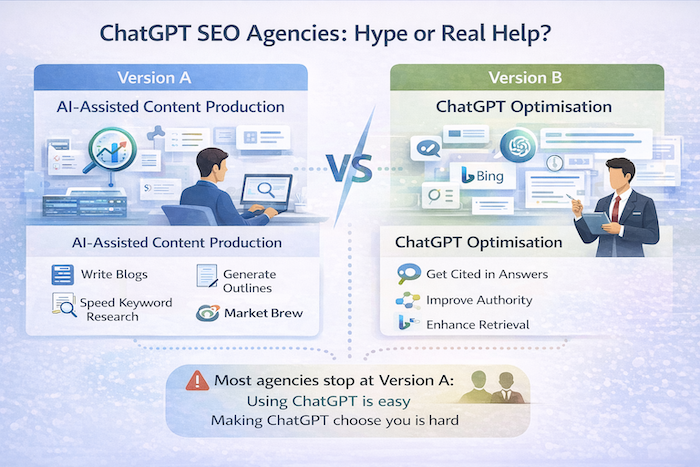
Version A – AI‑assisted content production: The majority of agencies with “ChatGPT SEO” on their websites mean they use ChatGPT to speed up internal tasks. They use it for drafting or brainstorming but continue to optimise pages using traditional SEO signals. This version does not improve visibility inside ChatGPT answers; it merely cuts writing costs. As research has shown, repetitive AI‑generated content can lead to model collapse—a degradation of AI output quality when models ingest other models’ content. Over‑reliance on AI copy also risks being flagged by future algorithm updates.
Version B – Genuine ChatGPT optimisation: A much smaller group of specialists focuses on influencing generative engines. These agencies treat ChatGPT not as a writing tool but as a distribution channel. They analyse how ChatGPT and similar models retrieve information, map queries to intents, and structure content so it is quotable and credible. Onely, which holds Microsoft Bing advisory credentials, emphasises conversation analysis rather than keyword targeting; it studies real discussions to understand how people describe their problems and then aligns content with those narratives. ChatGPT optimisation in this sense resembles Generative Engine Optimisation (GEO) and Answer Engine Optimisation (AEO) rather than content production. Few agencies offer this because it requires deep understanding of search engines and AI retrieval mechanisms.
Most agencies currently stop at Version A. They repackage AI writing as a new service and leave clients believing they’ve been optimised for ChatGPT when no such optimisation occurred. That gap is why confusion persists in the market.
Why Using ChatGPT to Write Content Is Not a Competitive Advantage
- Everyone has access: ChatGPT is public. If an agency’s only differentiator is using it to write, there is no moat. The value lies in strategic thinking, not tools.
- Content sameness and duplication: ChatGPT assembles answers by predicting the next word based on training data. The Tortoise and Hare article notes that AI content pulls from a repository of existing web content and recombines it. This leads to more of the same, not the unique insights search engines reward.
- Low factual reliability: Law‑firm guidance from Good2bSocial warns that ChatGPT often produces plausible but false responses and that large language models will always hallucinate due to statistical limits. This is particularly problematic for regulated industries.
- Lack of creativity and brand voice: AI cannot produce original ideas or capture your brand tone. It may not align with prior content, harming trust and consistency.
- Potential copyright and E‑E‑A‑T issues: You cannot verify the source of AI‑generated text, so you might unknowingly republish competitors’ work. Google can fingerprint authors and may associate AI‑generated content with the AI’s profile, diluting your own expertise signals.
Producing high‑quality, human‑authored content remains essential. AI can assist with ideation or editing, but publishing unedited output risks penalties and does not build authority. Instead of mass‑produced AI articles, experts recommend using AI to support research and then injecting unique insights.
What Real ChatGPT Optimisation Looks Like
Genuine optimisation for ChatGPT goes far beyond writing content. It involves understanding how generative engines retrieve and rank information and making your content discoverable and quotable.
- Analyse conversation data and user intent: Onely’s proprietary conversation analysis examines real discussions across forums, support tickets and sales calls to understand what triggers a search and how users phrase their problems. This allows the agency to craft content that answers the actual questions users ask, such as “Our remote team keeps missing deadlines and I don’t know if it’s a process problem or a tool problem,” rather than just targeting keywords.
- Optimise for Bing and other retrieval systems: Brown Bag Marketing notes that ChatGPT and Bing share the same search index; if your site ranks well in Bing, it’s discoverable in ChatGPT. Ranking well in Google further increases the chance of being cited across multiple assistants. Traditional ranking factors—quality content, mobile‑friendly design, fast page speed, authoritative backlinks and structured data—still form the foundation.
- Match answer formats and snippet structures: Generative engines often pull short snippets from web pages. Brown Bag Marketing advises using question‑based headers and following them with concise, factual answers to help AI select your content for snippets. Lists, tables and clear hierarchy improve readability for both humans and AI.
- Build authority and trust signals: High‑authority domains are more likely to be cited by ChatGPT. Yotpo’s guide notes that sites with over 32,000 referring domains are roughly 3.5 times more likely to be cited. AI models prefer answer blocks of 40–60 words and reward factual, well‑sourced content.
- Monitor Bing’s top results: Seer Interactive’s study of 500+ citations found that 87 % of SearchGPT’s citations matched Bing’s top organic results, usually within the top 10 positions. Google only matched 56 %. This shows that ChatGPT’s web search function draws primarily from Bing rankings.
Real optimisation therefore combines technical SEO, content structure, entity clarity and off‑page authority. Agencies focusing on these areas aim to be referenced in AI answers—not just ranked in organic search.
ChatGPT’s Dependence on Traditional SEO Infrastructure
Despite the buzz, generative engines do not create content in a vacuum. They rely on traditional search infrastructure:
- Shared indexes: ChatGPT uses Bing’s index to retrieve sources. If your site isn’t crawled and indexed by Bing (and Google), ChatGPT can’t see it. Consequently, basic SEO tasks—ensuring crawlability, fixing technical issues, and submitting sitemaps—are prerequisites.
- Classic ranking factors still matter: Brown Bag Marketing lists quality content, mobile‑friendly design, page speed, authoritative backlinks, structured data and user engagement as ranking factors that apply equally to ChatGPT SEO. When your site performs well in Google’s traditional results, you’re halfway to being optimised for AI answers.
- Citation patterns follow Bing’s top results: Seer Interactive found that nearly all citations used by SearchGPT were present in Bing’s organic results, with 87 % matching the top 20 positions. This means that focusing solely on Google rankings without tracking Bing may leave you invisible in ChatGPT.
These findings dismantle the myth that SEO is obsolete. Generative engines build on the same crawl‑index‑rank pipeline; they simply summarise the results differently. Optimising for ChatGPT therefore depends on strong SEO fundamentals.
Legitimate Uses of ChatGPT Within Agencies
While ChatGPT isn’t a magic bullet for optimisation, it can support marketing teams when used responsibly:
- Research and ideation: Agencies can use ChatGPT to brainstorm questions users might ask or to generate alternative phrasings. This supports AEO/GEO planning without replacing strategic thinking.
- Drafting under human control: AI can accelerate draft creation, but human editors must refine facts, tone and structure. The Women Conquer Business guide recommends infusing case studies, FAQs and summaries after generating AI drafts.
- Generating variant explanations for testing clarity: ChatGPT can produce multiple ways of explaining a concept, which helps identify the most digestible version for both humans and AI.
- Improving internal efficiency: AI can summarise long documents, extract bullet points or rewrite content for different audiences, freeing up time for high‑level strategic tasks.
These uses save time but do not replace expertise or guarantee AI citations. Human oversight remains crucial to ensure accuracy, originality and compliance with brand guidelines.
Red Flags in “ChatGPT SEO” Marketing Claims
The proliferation of agencies selling AI optimisation has created an environment ripe for scams. Key warning signs include:
- Guaranteed AI placements or rankings: There are no “positions” inside ChatGPT; either your content is cited or it isn’t. Figment Agency warns that any firm promising a “first position in ChatGPT” does not understand how AI search works.
- Heavy focus on keywords and ranking promises: LLM optimisation isn’t about keyword density; it’s about comprehensive topic coverage and structured content. Agencies leading with keyword strategies for ChatGPT are missing the point.
- No platform‑specific knowledge: If an agency cannot explain how ChatGPT’s source selection differs from Perplexity’s or Gemini’s, they lack the specialism needed for generative search.
- Lack of case studies: Always ask for documented examples of clients appearing in AI answers. The Figment guide stresses that without specific citations in ChatGPT or other models, an agency’s optimisation experience is theoretical.
- Overpromising timelines: Claims of being cited within weeks are unrealistic unless your domain already has strong authority. Genuine specialists set expectations based on the current state of your content and authority.
- Urgent rebranding and acronym overload: The Ad Spend exposé highlights how some consultants invent acronyms (AEO, GEO, AIO, LLMO) to create urgency, and quotes Google’s John Mueller: “The higher the urgency and the stronger the push of new acronyms, the more likely they’re just making spam and scamming.”. This urgency is often a red flag.
- Unrealistic statistics: The same exposé points out that AI search traffic still represents less than 1 % of total web traffic. Agencies exaggerating the opportunity may be overstating returns.
Questions Businesses Should Ask Potential Agencies
When evaluating a ChatGPT SEO or generative optimisation partner, ask:
- How do you measure success in AI search? Look for answers involving citation frequency, brand mentions within AI answers, share of voice and downstream impacts (e.g., qualified leads), not just keyword rankings.
- Can you show documented examples of clients appearing in AI answers? Ask for specific prompts and citations. Without evidence, the agency may still be learning.
- Which platforms do you optimise for, and how do strategies differ across ChatGPT, Perplexity and Gemini? Specialists should understand platform‑specific retrieval mechanisms.
- What’s your methodology for building credibility signals? Expect discussion of author credentials, structured data, comprehensive topic coverage and third‑party validation.
- How often do you update strategies as AI platforms evolve? Generative models change frequently; an effective partner should iterate based on new evidence.
- What happens if traditional traffic drops but brand demand rises? Agencies should be comfortable explaining how AI visibility impacts brand demand and leads even if click‑through rates decline.
These questions separate strategy‑driven specialists from those selling automation.
Where Real Value Can Exist
Despite the prevalence of hype, some agencies and consultants do provide meaningful help:
- Blending SEO, AEO and GEO: The best partners understand that generative optimisation sits on top of traditional SEO. They ensure crawlability and authority, then layer on structured data, snippet optimisation and entity management. Brown Bag Marketing emphasises that when a site ranks well in Bing and Google, ChatGPT visibility follows.
- Focusing on problems, not keywords: Onely’s conversation analysis shows that AI systems match solutions to problems, not keywords. Agencies that map user journeys and restructure content accordingly offer real strategic value.
- Educating clients and internal teams: Good agencies teach businesses how generative engines work, how to write answer‑first content and how to monitor AI visibility. Figment Agency highlights the importance of clear methodology and platform‑specific expertise.
- Admitting uncertainty: Honest experts acknowledge the probabilistic nature of AI citations and set realistic expectations. They iterate strategies based on data rather than selling certainty.
By integrating these capabilities, a partner can help a brand shape how AI explains its category rather than leaving narratives to competitors.
The Bigger Misunderstanding
Many businesses and marketers treat ChatGPT as a separate search engine to be “hacked”. In reality, ChatGPT is an interface layered on top of existing indexes and knowledge graphs. It uses Bing’s ranking signals and Google’s AI ranking systems to retrieve information, then generates summaries. AI search is still small compared with traditional search and will not replace SEO any time soon. Optimisation for ChatGPT is indirect: you cannot directly control the model, but you can influence its inputs—your site’s authority, structure and content quality. No agency or consultant can guarantee placements because generative models decide what to cite based on multiple factors.
How Businesses Should Think About “ChatGPT SEO”
- Part of a broader AI visibility strategy: Generative optimisation should complement traditional SEO, content marketing and PR. It’s about making your expertise accessible to both humans and machines.
- Not a standalone service: Without an existing content foundation and technical SEO, AI optimisation is unstable. Women Conquer Business notes that AI search optimisation is recommended for consultants who already have at least 15 high‑quality articles.
- Not a shortcut around fundamentals: Basic SEO tasks—crawlability, schema markup, page speed—remain non‑negotiable. Brown Bag Marketing lists these fundamentals as prerequisites for ChatGPT SEO.
Practical Advice for Buyers
- Focus on capability, not labels. Don’t buy “ChatGPT SEO” simply because it’s trendy. Evaluate whether an agency demonstrates a deep understanding of SEO and AI retrieval.
- Ask how they will measure AI visibility. Look for frameworks that go beyond rankings, such as citation rate and share of voice.
- Require evidence of platform‑specific expertise. Ask for examples of clients cited in ChatGPT, Gemini or Perplexity, and listen for nuanced differences between platforms.
- Favour transparency over secrecy. Agencies promising proprietary secrets or guaranteed results are likely overselling.
- Understand the costs and timelines. Real optimisation requires research, content restructuring, and ongoing monitoring; it’s not a quick fix. Be wary of low‑cost, one‑size‑fits‑all packages.
- Invest in internal capability. Even if you hire an agency, ensure your team understands answer‑first writing and AI visibility. Knowledge transfer prevents vendor lock‑in and builds resilience.
Conclusion
The “ChatGPT SEO” boom has produced a flood of agencies promising to unlock AI search. Many simply repurpose ChatGPT for content production and slap on new acronyms. The Ad Spend exposé notes that most AI optimisation tactics sold as revolutionary are in fact standard SEO techniques repackaged. True generative optimisation focuses on being cited, not just ranked. It builds on strong SEO foundations, structures content for extraction, strengthens authority signals and monitors AI answer patterns. Agencies that deliver real help resemble GEO/AEO specialists rather than content factories. Before you sign a contract, ask probing questions, look for evidence and remember that generative search is evolving. Your goal is not to hack ChatGPT, but to create content and authority that AI systems want to cite. Done well, AI visibility enhances brand influence without sacrificing trust or wasting resources.
Want to know whether ChatGPT, Perplexity, or Google AI Overviews mention your firm? Run a free first-party visibility audit on your domain in under a minute and see exactly which queries cite you and which do not.