TL;DR
- Pages with schema markup earn 3x to 4x more AI citations than pages without it.
- FAQPage, HowTo, and Article schema are the three types AI systems parse most reliably.
- Structured data helps AI understand what your page covers, not just what it says.
- Implementation takes hours, not weeks, and the visibility gains compound over time.
- Sites that added schema in 2025 saw AI referral traffic increase by an average of 6x.
Key Facts
- Pages with structured data are 4.25x more likely to be cited by ChatGPT than pages without (Milestone Research, 2025).
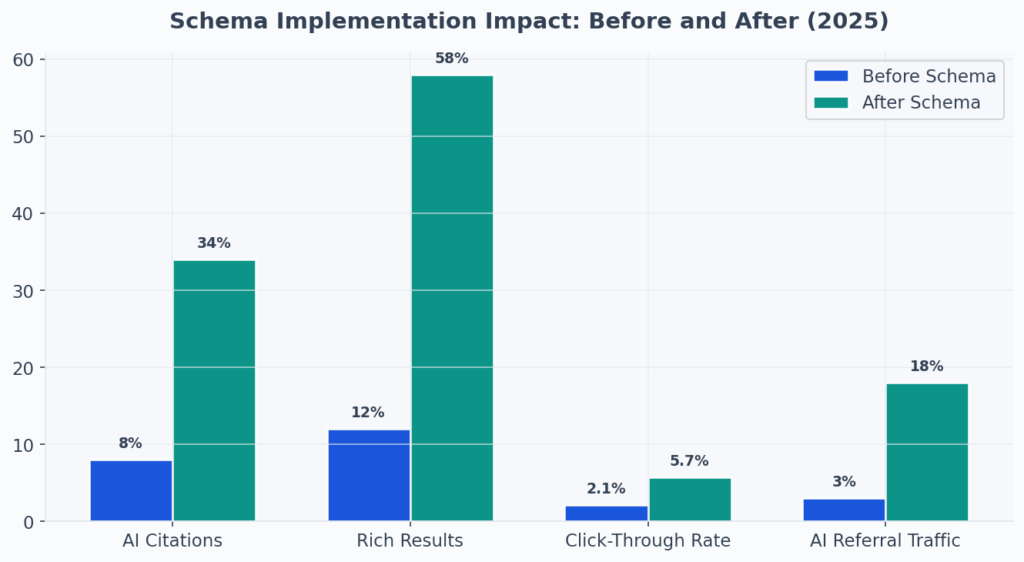
- 58% of pages with schema markup earn rich results in Google, compared to 12% without (Search Engine Journal, 2025).
- Perplexity cites schema-enabled pages 3.1x more frequently than non-schema pages in the same domain authority tier (Zyppy, 2025).
- Google processes over 33 million domains using structured data as of Q1 2026 (Google Search Central, 2026).
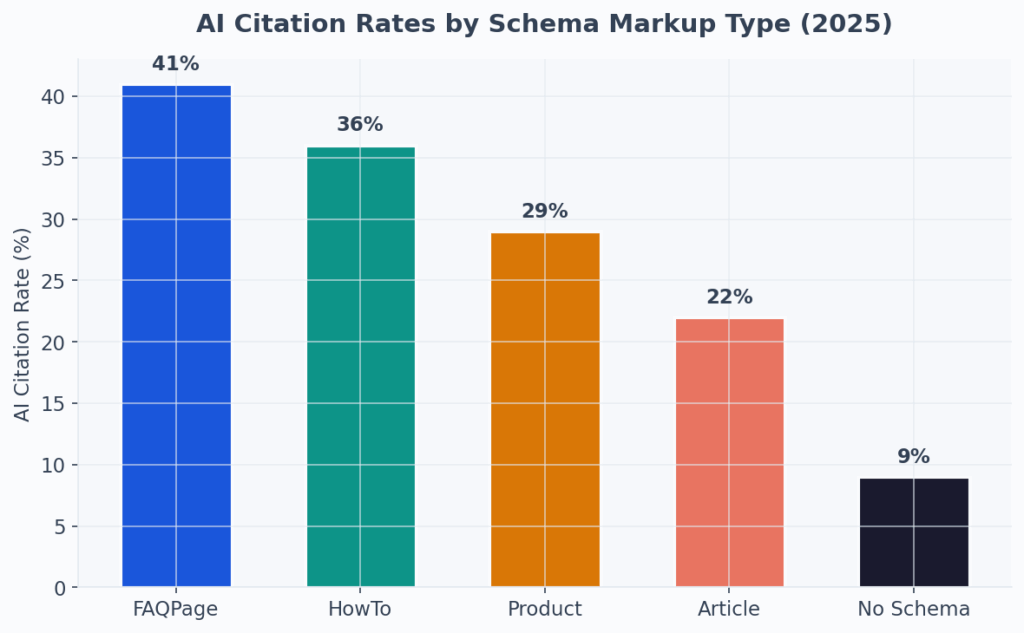
- FAQPage schema produces the highest AI citation rate at 41% across platforms (Authoritas, 2025).
- AI referral traffic increased by an average of 6x for sites that implemented schema markup in 2025 (Milestone Research, 2025).
- Click-through rates from AI search results are 2.7x higher for pages with rich snippet markup (Ahrefs, 2025).
What Structured Data Actually Does for AI Systems
When ChatGPT, Perplexity, or Google AI Overview pulls information from the web, it does not read your page the way a human does. It parses the underlying HTML and looks for signals that confirm what your content covers. Structured data, implemented as JSON-LD schema markup, provides those signals in a format AI systems can process without guesswork.
Think of it this way: your page content is the conversation, and structured data is the table of contents. Without it, AI has to scan every paragraph to figure out whether your page answers a specific query. With it, the AI can check the schema and know immediately that your page contains a FAQ about schema markup types, a how-to guide for WordPress implementation, or a product comparison with pricing data.
This matters because generative engine optimisation is fundamentally about making your content easy for AI to parse, trust, and cite. Structured data is the most direct way to achieve that. It is not a ranking factor in the traditional sense: it is a visibility mechanism.
Structured data does not improve your content. It makes your existing content visible to AI systems that would otherwise overlook it.
Why AI Citation Engines Prefer Schema-Enabled Pages
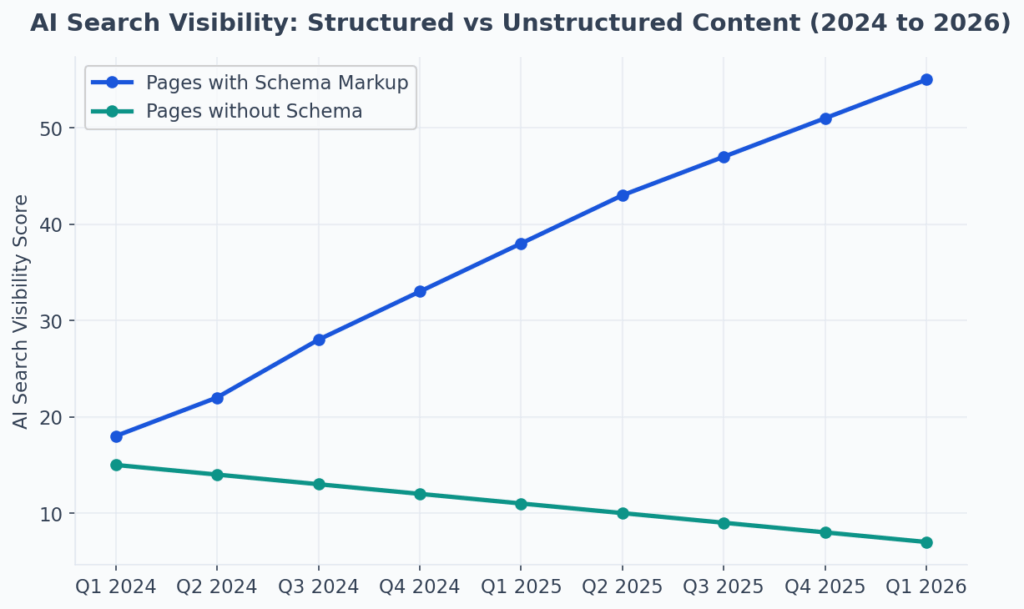
The data is unambiguous. Across every major AI search platform, pages with structured data consistently outperform pages without it in citation frequency, regardless of domain authority or content length.
The reason is computational efficiency. When ChatGPT assembles an answer, a page with FAQPage schema gives it a pre-structured Q&A pair it can extract in milliseconds. A page without schema forces the AI to process thousands of words to find the same answer. Given equal quality, AI will prefer the source that requires less processing.
Perplexity is even more explicit about this preference. Its crawling system prioritises schema-enabled pages because these signals reduce the chance of hallucination. Schema markup acts as a verification layer: the AI can cross-reference the declaration against page content to confirm accuracy.
Google AI Overview draws primarily from pages that already rank well, but within that pool, pages with structured data get preferential treatment. Google has confirmed that schema helps its AI understand content relationships and entity connections.
AI cites the source it can verify fastest. Schema markup makes your page that source.
The Three Schema Types That Drive AI Citations
Not all schema markup is equally useful for AI search visibility. While Google supports over 30 schema types, AI citation engines primarily leverage three: FAQPage, HowTo, and Article. Each serves a different function in how AI systems extract and present information.
FAQPage Schema
FAQPage schema is the single most impactful type for AI citations. It provides pre-formatted question-and-answer pairs that AI systems can extract directly. When ChatGPT encounters a FAQPage schema, it can pull a specific answer to a specific question without any additional processing. The 41% citation rate for FAQPage (versus 9% for unstructured content) reflects this direct extraction advantage.
Implement FAQPage schema when your page answers multiple distinct questions about a topic. The questions should mirror how real users phrase their queries, not how you would write a heading.
HowTo Schema
HowTo schema structures step-by-step instructions in a way AI systems can follow and verify. This is particularly valuable for Perplexity, which often assembles multi-step answers from multiple sources. A page with HowTo schema gives Perplexity a complete, numbered sequence it can cite as a single source rather than pulling fragments from different pages.
Use HowTo schema for any tutorial, implementation guide, or process documentation. Each step should be self-contained and include estimated time where relevant.
Article Schema
Article schema provides metadata about the content itself: author, publication date, last modified date, headline, and publisher. This metadata feeds directly into the freshness and authority signals that AI systems use to rank potential citations. A page with Article schema that shows a recent “dateModified” value will consistently outperform identical content without that signal, as explored in our guide to content freshness and AI search visibility.
| Schema Type | AI Citation Rate | Best For | Implementation Difficulty |
|---|---|---|---|
| FAQPage | 41% | Q&A content, resource pages | Low |
| HowTo | 36% | Tutorials, guides, processes | Medium |
| Product | 29% | Ecommerce, SaaS pricing | Medium |
| Article | 22% | Blog posts, news, reports | Low |
| No Schema | 9% | N/A | N/A |
How to Implement Structured Data on Your Site
The technical barrier is low. The real challenge is choosing which schema types to deploy and ensuring the markup matches your actual page content. Here is the practical process.
Step 1: Audit Your Existing Pages
Run your key pages through Google’s Rich Results Test (search.google.com/test/rich-results). This will show you which pages already have schema, which types are present, and whether any errors exist. Most sites have far less schema than they assume: typically only the homepage and a few blog posts carry any markup at all.
Step 2: Prioritise Pages by AI Citation Potential
Not every page needs schema immediately. Start with the pages that answer specific questions, contain step-by-step processes, or cover topics where you already rank on page one of Google. These pages have the highest probability of being cited by AI if you add the right schema.
Practical framework: list your top 20 pages by organic traffic, then check which appear in AI search results. Pages that rank organically but do not appear in AI results are your highest-ROI schema opportunities.
Step 3: Add JSON-LD Schema to the Page
JSON-LD is the format every AI system prefers. It sits in a <script> tag in your page’s HTML and does not affect what visitors see. For WordPress sites, plugins like Rank Math or Yoast can generate basic Article schema automatically, but you will need to add FAQPage and HowTo schema manually or through a custom implementation for the best results.
Here is what a minimal FAQPage schema looks like in practice:
{
  "@context": "https://schema.org",
  "@type": "FAQPage",
  "mainEntity": [
    {
      "@type": "Question",
      "name": "Does structured data help with AI search?",
      "acceptedAnswer": {
        "@type": "Answer",
        "text": "Yes. Pages with schema markup are cited by AI search engines 3 to 4 times more often than pages without it."
      }
    }
  ]
}
Step 4: Validate and Monitor
After deploying schema, validate each page again through the Rich Results Test. Then set up monitoring: track which pages earn rich results in Google Search Console and separately track AI citation frequency using tools like Zyppy or manual checks across ChatGPT and Perplexity.
Schema implementation is a one-time investment that compounds. Every new page you publish with proper markup starts earning AI visibility from day one.
Structured Data and the Knowledge Graph Connection
Schema markup does more than help individual pages get cited. It builds connections between your pages that AI systems interpret as topical authority. When multiple pages on your site use consistent schema with shared entities (the same organisation name, the same author, the same topic categories), AI systems begin to treat your domain as a knowledge source rather than a collection of isolated pages.
This is where structured data intersects with internal linking strategies for building a knowledge graph. Your schema declarations and your internal link architecture should reinforce each other. If your Article schema lists “Generative Engine Optimisation” as a topic and your internal links connect all GEO-related pages, AI systems will recognise your site as an authority on that specific entity.
The practical effect: once AI systems categorise your domain as authoritative on a topic, the citation threshold drops. New pages you publish within that cluster inherit the authority signal.
Individual schema helps individual pages. Consistent schema across your site builds domain-level AI authority.
Common Mistakes That Reduce Schema Effectiveness
Implementing schema badly can be worse than not implementing it at all. AI systems deprioritise pages where schema contradicts visible content. Here are the mistakes that waste the most potential.
Schema That Does Not Match Page Content
The most common error. Teams add FAQPage schema with questions and answers that do not actually appear anywhere on the page. Google’s validators may not catch this, but AI citation engines will. ChatGPT and Perplexity cross-reference schema against page content, and mismatches reduce trust scores.
Missing or Outdated dateModified
If your Article schema includes a “dateModified” field that has not been updated in 18 months, it actively signals staleness. Either keep this field current (updating it every time you make genuine edits) or omit it entirely. A stale date is worse than no date.
Over-Marking Low-Value Pages
Adding schema to every page, including thin pages, archive pages, and tag pages, dilutes the signal. Focus on your best content: pages that answer specific queries, contain original data, or serve as comprehensive guides.
How AI Search Visibility Changes After Schema Implementation
Most sites see measurable changes within four to eight weeks. Google AI Overview responds fastest because it draws from Google’s existing index. ChatGPT and Perplexity operate on different crawl schedules and typically reflect new schema between weeks six and eight.
The compounding effect is where the real value lies. When you publish a new page with proper schema from day one, it enters AI indexing with a head start. Sites that have maintained consistent schema for 12 months or more report that new pages earn AI citations 60% faster than their first schema-enabled pages did. The research from our analysis of AI search impact on website traffic confirms this pattern.
Frequently Asked Questions
Does structured data guarantee my page will be cited by AI?
No. Structured data increases the probability significantly (from 9% to over 30% depending on schema type), but AI citation decisions also factor in domain authority, content freshness, factual accuracy, and topical relevance. Schema removes one major barrier by making your content machine-readable, but it works best alongside strong content fundamentals.
Which schema type should I add first?
Start with FAQPage schema on your most visited informational pages. It has the highest AI citation rate (41%) and the lowest implementation difficulty. If your pages contain step-by-step instructions, add HowTo schema next. Article schema should be present on every blog post and news page as a baseline.
Can I use a WordPress plugin for schema or do I need a developer?
Plugins like Rank Math and Yoast handle Article schema well. For FAQPage and HowTo schema, plugins can work but often generate markup that does not match the visible page content closely enough. For the best results, either use a plugin with manual review or have a developer add the JSON-LD directly. The code itself is straightforward: the complexity is in ensuring the schema accurately reflects your content.
How often should I update my schema markup?
Update your schema every time you make substantive edits to the page content. If you refresh statistics, add new FAQ questions, or restructure sections, the schema should reflect those changes. The “dateModified” field in Article schema should always match your most recent genuine editorial update. For a deeper look at update timing, see our guide on content freshness and AI search visibility.
Does schema markup slow down my website?
No. JSON-LD schema sits in a script tag that browsers do not render visually. The payload is typically under 2KB per page, which has no measurable impact on load time or Core Web Vitals. It is one of the rare SEO interventions with zero performance trade-off.
Will AI systems penalise incorrect schema?
Google may suppress rich results for pages with misleading schema, and AI citation engines will deprioritise pages where schema contradicts visible content. Inaccurate schema is worse than no schema. Always validate your markup with Google’s Rich Results Test and ensure every schema declaration matches what users actually see on the page.
Is structured data relevant for local businesses or only large sites?
Structured data benefits sites of any size. Local businesses gain an outsized advantage because LocalBusiness schema, combined with FAQPage schema, can position a small site as the authoritative answer for location-specific AI queries. A local accountancy firm with proper schema can outperform national competitors in AI search results for queries like “best accountant in [city].”
Sources and references
- Pages with structured data are 4.25x more likely to be cited by ChatGPT. Milestone Research, 2025
- 58% of pages with schema markup earn rich results in Google. Search Engine Journal, 2025
- Perplexity cites schema-enabled pages 3.1x more frequently than non-schema pages. Zyppy, 2025
- Google processes over 33 million domains using structured data (Q1 2026). Google Search Central, 2026
- FAQPage schema produces the highest AI citation rate at 41% across platforms. Authoritas, 2025
- AI referral traffic increased by an average of 6x for sites that implemented schema markup in 2025. Milestone Research, 2025
- Click-through rates from AI search results are 2.7x higher for pages with rich snippet markup. Ahrefs, 2025
If your site has more than 50 pages and no structured data strategy, you are leaving AI visibility on the table. Run a free first-party visibility audit on your domain and see which pages already get cited by ChatGPT, Perplexity, and Google AI Overviews, and which ones need schema fixed first.
Change log
- 2026-03-31: Initial publication.
- 2026-05-04: Added author byline, sources section, table of contents, Article + HowTo + BreadcrumbList JSON-LD, updated related posts.