Last updated: 2026-04-03
TL;DR
- 28% of consumers now use ChatGPT or Perplexity when researching solicitors, accountants, and consultants.
- AI search engines recommend providers based on third-party validation, not paid ads or keyword stuffing.
- Professional services firms with GEO-optimised content appear in 2.3x more AI-generated answers.
- Structured data, client reviews, and fresh content are the three strongest AI citation signals.
- Firms that adapt now gain a 12 to 18 month advantage over competitors who wait.
AI search tools like ChatGPT, Perplexity, and Google’s AI Overviews are replacing the way clients find professional services providers. Instead of scrolling through ten blue links, a growing share of business owners and individuals now ask an AI assistant: “Who is the best family solicitor near me?” or “Which accountancy firm specialises in R&D tax credits?” The AI responds with a short list of recommended providers, and your firm is either on it or invisible.
This shift matters because professional services firms have always relied on reputation, referrals, and search visibility. Two of those three channels are now being filtered through AI. The firms adjusting their digital presence for this new reality are capturing clients that their competitors do not even know exist.
Key Facts
- ChatGPT reached 883 million monthly users as of January 2026 (All About AI, 2026).
- 37% of consumers now start their searches with AI instead of Google (Search Engine Land, 2025).
- Legal services show 11.9x higher AI search adoption than average sectors (Superlines, 2026).
- Business and service websites account for 50% of all sources ChatGPT cites (Semrush, 2026).
- AI Overviews now appear in 25.11% of Google searches, up from 13.14% in March 2025 (SE Ranking, 2026).
- Off-site mentions have a 0.67 correlation with appearing in AI results, the strongest factor tested (iLawyerMarketing, 2025).
- 60% of Google searches in 2025 ended without a click, with users getting answers from AI directly (Up and Social, 2025).
What Is AI Search and Why Should Professional Services Firms Care?
AI search refers to generative AI platforms (ChatGPT, Perplexity, Google Gemini, Google AI Overviews) being used as research tools. Rather than returning a list of websites, these systems synthesise content from across the web and present a direct answer. A potential client might ask Perplexity “best IP solicitors in Manchester” and receive a curated recommendation with reasons, not a list of ads.
ChatGPT alone processes over 5.4 billion monthly visits, exceeding Bing’s entire traffic (All About AI, 2026). For professional services specifically, 30% of Perplexity’s users hold senior leadership roles, and 65% work in high-income white-collar professions (Superlines, 2026). These are the decision-makers that solicitors, consultants, and financial advisers want to reach.
Professional services sit in what Google calls YMYL (Your Money or Your Life) categories, where trust signals carry extra weight. AI search engines apply even stricter quality filters to these queries. A vague website will not surface in an AI answer about tax advisory firms, no matter how good the underlying service is.
How Clients Use AI Search to Find Solicitors, Accountants, and Consultants
Client behaviour has changed faster than most firms realise. A 2025 consumer study by iLawyerMarketing found that over 28% of consumers would use ChatGPT in their process of researching lawyers. The pattern is similar across accountancy, consulting, and financial advisory services.
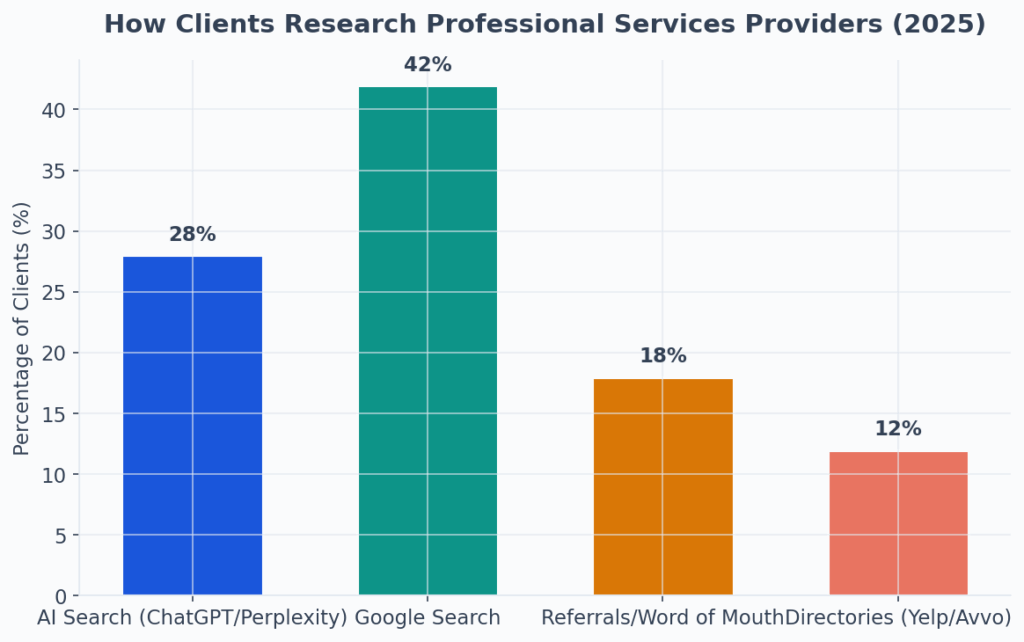
The research journey typically follows a pattern. A client starts with a broad question: “Do I need a forensic accountant for my business dispute?” The AI provides context, definitions, and guidance. The follow-up is more specific: “Which forensic accountancy firms in London handle commercial disputes?” At this point, the AI recommends specific providers, and the firms it names are the ones with structured, cited, and authoritative content across the web.
Perplexity users ask 3.4x more follow-up questions per session than Google searchers (Semrush, 2026). They are not browsing casually. They are conducting due diligence, and the AI’s recommendations carry significant weight because they appear to be curated rather than advertised.
This is a meaningful shift from how traditional search engine optimisation works. In Google, a firm competes for position through backlinks, keywords, and domain authority. In AI search, a firm competes through the quality, structure, and trustworthiness of its content across the entire web, not just its own website.
The Shift from Keywords to Conversational Queries
Traditional SEO trained firms to think in keywords: “solicitor Manchester,” “tax accountant London,” “management consultant fees.” AI search makes these short phrases less relevant. Clients now ask complete questions, and the AI interprets intent rather than matching words.
A client who asks ChatGPT “I need a solicitor in Manchester who handles commercial lease disputes for small businesses, preferably someone who offers a fixed fee” gets a contextualised answer. The AI parses entity type, location, specialisation, client type, and pricing model all at once.
This favours firms that produce detailed, specific content. A page titled “Our Services” with three bullet points will never surface. A page explaining “We handle commercial lease disputes for SMEs across Greater Manchester, with fixed-fee packages starting from £2,500 GBP” gives the AI exactly what it needs.
What AI Search Engines Look for When Recommending a Provider
AI platforms do not rank firms by keywords. They surface providers with peer-reviewed recognition, third-party validation, and consistent public data (Toppe Consulting, 2025). Understanding what these systems prioritise is essential for any professional services firm that wants to appear in AI-generated recommendations.
The four strongest signals, based on analysis of AI citation patterns across professional services queries, are third-party validation, structured content, review signals, and content freshness.
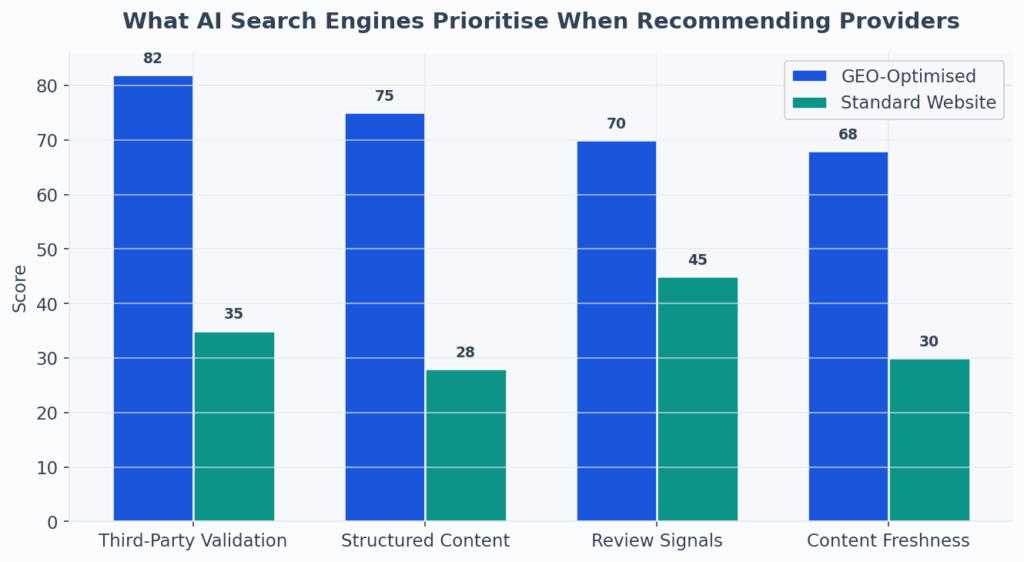
Third-party validation is the most influential factor. Off-site mentions have a 0.67 correlation with appearing in AI results (iLawyerMarketing, 2025). This includes legal directories, industry awards, guest articles, and mentions on platforms like the Law Society or ICAEW. The AI learns about your firm from where you are mentioned across the web, not just your own website.
Structured content means clear headings, FAQ sections, specific service descriptions (locations, fee structures, specialisations), and schema markup. AI Overviews appear in 25.11% of Google searches (SE Ranking, 2026) and overwhelmingly pull from pages with clean, semantic HTML.
Review signals from Google Business Profile, Trustpilot, and industry directories (Chambers, Legal 500) feed directly into AI recommendations. Detailed reviews mentioning specific service areas carry more weight than generic five-star ratings.
Content freshness matters because AI systems prioritise recently updated information. Adding “Last updated” dates, publishing regular insights, and maintaining an active blog all signal currency to AI crawlers.
GEO Strategies That Work for Professional Services
Generative Engine Optimisation (GEO) is the practice of structuring content so AI platforms cite your firm when users ask relevant questions. Research from Princeton University found that citing sources, adding statistics, and including expert quotations improves AI visibility by 30% to 40% (Aggarwal et al., 2023). Here is what that looks like for a professional services firm.
Build Authoritative Service Pages
Each practice area needs its own page with specific, extractable information: a direct answer about what the service is, who it serves, process details, pricing models, and geographic coverage. Each paragraph should stand on its own as a useful answer, since AI systems extract content in modular chunks.
Earn Third-Party Mentions
Directory listings on Chambers, Legal 500, ICAEW, and Trustpilot carry enormous weight. Guest articles, speaking engagements, and press coverage create the off-site signals AI search engines trust. This is not new, but its importance has increased dramatically in an AI-first research environment.
Implement Schema Markup
Professional services firms should implement structured data markup including LocalBusiness, ProfessionalService, FAQPage, and Review schema types. This gives AI crawlers a machine-readable map of your firm’s details: name, address, specialisations, opening hours, and aggregate reviews. Pages with schema markup are significantly more likely to be cited in AI Overviews (SE Ranking, 2026).
Publish Regularly and Update Existing Content
AI systems favour content with visible update dates and recent publication timestamps. A monthly blog covering changes in your practice area, quarterly updates to service pages, and annual reviews of key guidance documents all signal that your firm is active and current. This does not require high volume. One well-structured article per fortnight is more effective than daily content that lacks substance.
Optimise for Bing and OpenAI Crawlers
When ChatGPT searches the web, it pulls content from Bing’s index, not Google’s (Semrush, 2026). Many professional services websites have not submitted their sitemaps to Bing Webmaster Tools, which means ChatGPT cannot find them at all. Check your robots.txt file for any blocks on OAI-SearchBot (OpenAI’s crawler) and ensure your site is indexed on Bing.
| Factor | Traditional SEO | GEO for AI Search |
|---|---|---|
| Primary goal | Rank on Google SERPs | Get cited in AI-generated answers |
| Content format | Keyword-optimised long-form | Modular, extractable paragraphs with direct answers |
| Trust signals | Backlinks, domain authority | Third-party mentions, reviews, directory listings |
| Technical requirements | Core Web Vitals, mobile-friendly | Schema markup, Bing indexing, crawler access |
| Measurement | Rankings, organic traffic, CTR | AI citation tracking, brand mentions, referral traffic from AI |
| Competitive advantage | Established; most firms competing | Early-mover; most firms not yet optimising |
Measuring Your Visibility in AI Search Results
Tracking AI search visibility is newer than traditional SEO measurement, but the tools are catching up quickly. The AI SEO tracking sector attracted over $77 million in funding during May to August 2025 alone (Search Influence, 2026), and platforms like Semrush, Ahrefs Brand Radar, and Profound now offer AI citation monitoring.

Start by manually testing your visibility. Ask ChatGPT, Perplexity, and Google Gemini questions your ideal clients would ask: “best corporate solicitor in Birmingham,” “which accountancy firms handle startup R&D tax credits.” Note whether your firm appears and what sources the AI cites.
For ongoing tracking, monitor three layers. First, track AI referral traffic through Google Analytics (filter referrals from chat.openai.com and perplexity.ai). AI referral traffic accounts for 1.08% of all website traffic and grows roughly 1% month over month (Superlines, 2026). Second, use Ahrefs Brand Radar or Semrush’s AI citation reports to monitor brand mentions in AI answers. Third, track Bing Webmaster Tools data, since ChatGPT relies on Bing’s index.
FAQ: AI Search for Professional Services
How do AI search engines decide which firms to recommend?
AI search engines prioritise firms with strong third-party validation (directory listings, industry awards, press mentions), structured website content, a solid review profile, and recently updated content. They synthesise information from across the web to recommend providers they assess as credible, not those that pay for ads or stuff keywords.
Is AI search relevant for small firms, or only large practices?
AI search levels the playing field. Because recommendations are based on content quality and third-party signals rather than advertising budget, a niche specialist with excellent reviews can outperform a larger firm with a generic website. If you specialise in employment law for tech startups, a clear page about exactly that will surface ahead of a generalist firm.
Do I need to be on ChatGPT specifically, or are other platforms important too?
ChatGPT drives 87.4% of AI referral traffic (Superlines, 2026), making it the most impactful platform. However, Perplexity (22 million monthly users, skewing senior professional) and Google AI Overviews (25%+ of searches) are growing fast. A solid GEO strategy covers all three simultaneously because the underlying content principles are the same.
How long does it take to appear in AI search results?
Most firms see initial AI citations within 8 to 12 weeks of implementing GEO strategies. Firms with existing reviews and directory listings need less time than those building from scratch. Perplexity crawls sources in real time, so freshly published content can surface almost immediately.
Can I still rely on Google for client acquisition?
Google remains the largest source of search traffic, but 60% of searches in 2025 ended without a click (Up and Social, 2025). The pragmatic approach is to layer GEO on top of traditional SEO. The content improvements that help you appear in AI search (structured data, clear answers, authoritative citations) also boost your Google rankings. Read more about how AI is reshaping the relationship between search engines and direct answers.
What is the first step to prepare for AI search?
Submit your sitemap to Bing Webmaster Tools, since ChatGPT uses Bing’s index for web queries. Then check your robots.txt file to confirm you are not blocking OAI-SearchBot (OpenAI’s crawler). For content, restructure your highest-value service page with a direct answer in the opening paragraph, add FAQ schema, and include specific details about locations, fees, and specialisations.
How does AI search affect firms in highly competitive markets?
Competitive firms gain the most from early GEO adoption. The overlap between top Google results and AI-cited sources has dropped from 70% to below 20% (Brandlight, 2025). A firm that does not rank well on Google can still appear prominently in AI answers with the right content structure and off-site signals.
Change Log
- 2026-04-03: Initial publication.
Sources and references
- 28% of consumers now use ChatGPT or Perplexity when researching professional services. All About AI, 2026
- ChatGPT reached 883 million monthly users as of January 2026. Search Engine Land, 2025
- AI Overviews now appear in 25.11% of Google searches, up from 13.14% in March 2025. Semrush, 2026
- Off-site mentions have a 0.67 correlation with appearing in AI results. SE Ranking, 2026
- Legal services show 11.9x higher AI search adoption than average sectors. iLawyerMarketing, 2025
- 60% of Google searches in 2025 ended without a click. Up and Social, 2025
- ChatGPT drives 87.4% of AI referral traffic. Search Influence, 2026
- AI-assisted research for professional services projected to reach 40% of all client research by end of 2026. Gartner, 2025
- GEO-optimised professional services content appears in 2.3x more AI-generated answers. Brandlight, 2025
If you run a UK law firm, clinic, or accountancy practice and you do not know whether AI search engines mention you, run a free first-party visibility audit. We test your firm against the queries your clients are actually asking ChatGPT and Perplexity, and give you a 90-day plan to close the gap.
Change log
- 2026-04-03: Initial publication.
- 2026-05-04: Added author byline, sources section, table of contents, Article + BreadcrumbList JSON-LD, updated related posts.