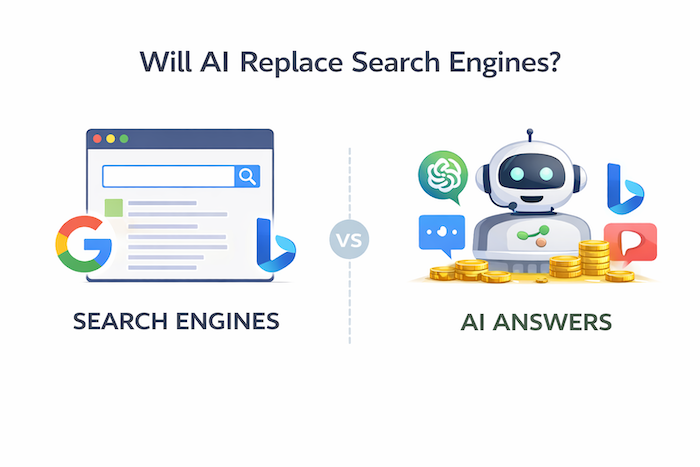
Every few months, headlines proclaim that generative AI will make search engines obsolete. Products like ChatGPT, Gemini and Perplexity instantly answer questions, summarise documents and offer recommendations without sending users to a list of links. For businesses whose traffic and revenue depend on organic search, the stakes feel existential. The truth is more nuanced. AI is transforming the way people seek information, but search engines are also evolving. Understanding where AI excels, where classic search remains vital, and how the two are converging helps brands adapt strategically instead of reacting out of fear.
Why Some Believe AI Will Replace Search
Faster, more convenient answers
Generative engines summarise content and answer questions in a conversational interface. Many users prefer not having to open multiple pages or compare sources. In a 2025 survey of over 2,000 consumers by Fractl and Search Engine Land, two–thirds of consumers (66 %) said they expect AI to replace traditional search within five years. Among Gen‑Z respondents, 66 % use ChatGPT to find information, nearly as many as use Google (69 %), and 39 % of 18‑ to 24‑year‑olds cite TikTok or Instagram as their go‑to “search engines”. AI tools provide quick definitions, comparisons and summaries that make them appealing for how‑to, informational and early‑research queries.
Reduction in clicks
Google’s AI Overviews, launched in 2024, answer questions directly at the top of search results. This has changed user behaviour: 41 % of AI‑tool users rely more on AI summaries than on links, and 13 % skip search altogether, turning to tools like ChatGPT or Perplexity. Passionfruit’s 2025 analysis notes that AI Overviews reduce clicks by 34.5 % on average, with the biggest impact on informational queries. These experiences make some observers think search engines, with their blue links and page‑ranked results, will become redundant.
Generational shifts
Younger users are accelerating this perception. Fractl’s survey found that Gen‑Z respondents move fluidly between chat prompts, social video and AI answers. For them, “search” is not a list of links but a conversation or a scroll through creator‑generated content. This shift fuels predictions that AI chat interfaces will supplant conventional search boxes, at least for a portion of queries.
Why Search Engines Are Not Going Away
Dominant usage and traffic
Despite rapid AI adoption, traditional search still dwarfs AI queries. A 2025 analysis by TTMS shows that Google processes over 15 billion searches per day and retains roughly 90 % of the global search market, whereas ChatGPT handles tens of millions of “search‑like” queries per day. In June 2025, LLM‑based search accounted for about 5.6 % of desktop search traffic. Search Engine Land’s 2025 click‑stream data found that 95 % of Americans still use search engines monthly and 87 % remain heavy Google users, up from 84 % in 2023. Only 21 % access AI tools ten or more times per month. Importantly, heavy AI users also increase their Google searches, illustrating that AI tools complement rather than cannibalise search.
Habit and trust
Information‑seeking habits are sticky. Nielsen Norman Group’s usability research shows that users default to Google because it is familiar and has delivered reliable results for years. Participants commented, “It’s always Google for me”, and even those experimenting with AI tools still used traditional search to fact‑check AI answers. These ingrained habits mean large segments of the population will continue using search engines alongside AI.
Deeper learning requires exploration
Experiments reported in the psychology journal PsyPost compared learning via AI summaries to web search. Participants who used large language model summaries spent less time learning, reported learning fewer new things and produced advice that was sparser and less original. Those who learned through web search produced richer, more unique content. The researchers conclude that because AI summaries reduce the need to discover and synthesise multiple sources, knowledge gained is shallower and users feel less ownership of the information. This suggests that for in‑depth research, decision‑makers will continue to rely on search engines to explore multiple perspectives.
AI search still drives little traffic
AI search adoption is high, but referrals are tiny. Passionfruit’s 2025 data shows that AI‑powered search drives less than 1 % of referral traffic, while Google still sends 345 times more traffic to websites than ChatGPT, Gemini and Perplexity combined. RankScience notes that Google processes 16.4 billion searches daily, whereas ChatGPT’s 2.5 billion daily prompts translate to roughly 800 million information searches, leaving AI platforms at <1 % of global web traffic. Despite this, AI visitors convert 4–5 times better than traditional search visitors because they arrive further along in the decision journey. Thus, AI search influences decisions but does not yet replace the traffic volume of classic search.
Search engines are evolving, not disappearing
Leading platforms are integrating AI into search rather than replacing search engines altogether. Google’s Search Generative Experience (SGE) and Microsoft’s Bing Chat embed AI answers within traditional search results. McKinsey reports that about 50 % of Google searches already display AI summaries, and this figure may exceed 75 % by 2028. Google and Bing are morphing into AI‑first platforms, and AI tools themselves rely on search indexes, crawlers and ranking signals to gather information. Search Engine Land emphasises that search engines aren’t going anywhere—only the interface is changing; we are moving from blue links toward answers, summaries and actions. AI systems still need reliable, crawlable content, authority signals and structured data to generate trustworthy answers. In other words, AI and search are converging rather than competing.
The Real Change: From Browsing to Decision Support
Instead of a complete replacement, AI is changing how users interact with search. Traditional search required users to open multiple pages, synthesise information and make decisions. AI acts as a filter and interpreter of the web, providing condensed answers and recommendations upfront. This results in fewer clicks but higher influence per answer. Studies show that 60 % of Google queries end without a click because AI features fulfil the intent directly on the SERP. Yet when users do click, they are often further down the buying journey, resulting in higher conversions. Brands must recognise that being visible no longer means only ranking, but also being cited or recommended by AI assistants.
Implications for Websites and Brands
Visibility and influence
- Citation vs. rank: AI answers synthesise information from many sources. McKinsey estimates that a brand’s own website contributes only 5–10 % of the sources AI uses. To appear in AI summaries, brands must ensure accurate, consistent information across multiple platforms (review sites, forums, data hubs). Search Engine Land notes that optimisation now focuses less on ranking signals and more on relevance, factual accuracy and credibility.
- New metrics: Traditional SEO metrics like clicks and rankings still matter, but AI visibility metrics such as brand mentions in AI answers, citation frequency and accuracy become equally important. Fractl argues that ranking #1 is no longer enough; success depends on being featured or cited inside Google’s AI layer.
- Structured, semantic content: AI systems extract information more reliably from well‑organised, structured content. Digital Media Trend advises using bullet points, tables, FAQs, schema markup and long‑form, intent‑rich content to help LLMs understand context. Hybrid search engines use both traditional indexing and semantic understanding, so content must be optimised for both.
Defensive strategies
- Prevent silent erosion: McKinsey warns that unprepared brands may see 20–50 % declines in traditional search traffic as AI answers replace clicks. Because AI‑powered search may draw from many non‑owned sources, brands risk “silent loss of relevance” if they do not adapt.
- Maintain brand presence: Even as click‑through rates decline, being included in AI summaries ensures that the brand remains part of the conversation. Without AI optimisation, competitors can shape the narrative about your products unchallenged.
- Diversify traffic sources: The shift also highlights the need to reduce dependency on a single channel. AI search is unlikely to replace traditional search for transactional or local queries—Passionfruit notes that transactional searches still generate strong click‑through rates—but relying solely on informational traffic increases risk.
Strategic opportunities
- Authority and trust signals: The converging ecosystem rewards brands that demonstrate expertise, experience and trustworthiness. Off‑site mentions, positive reviews and consistent data across the web help AI systems cite brands confidently.
- Align content, PR and SEO: Because AI synthesises across multiple content types, marketing, PR and SEO teams must collaborate on consistent messaging. Brands that produce high‑quality, well‑cited content across channels will be more likely to be referenced.
- Invest early: Early adopters of AI‑friendly optimisation enjoy advantages. Search Engine Land stresses that SEO fundamentals still matter and that AI search optimisation is the next evolution, not a replacement. Delaying adaptation means playing catch‑up when AI adoption accelerates.
Likely Future State of Search
The most probable outcome is a hybrid ecosystem in which AI interfaces and search engines coexist. Simple, navigational and transactional queries will continue to be served by classic search results, while informational, comparative and exploratory queries will increasingly be handled by AI assistants. Techtimes summarises that AI search engines personalise results and interpret conversational queries, whereas traditional search remains useful for straightforward factual queries. Hybrid models combining both approaches are likely to dominate. Search Engine Land dispels the myth that SEO and AI search are mutually exclusive; the same crawlability and authority signals that power SEO feed AI retrieval.
Who is most affected?
- Content‑heavy publishers and B2B/SaaS providers: These rely heavily on informational queries, which AI summaries increasingly satisfy. They must adapt to maintain visibility and influence.
- Research‑driven buyers: AI tools are already popular for complex product comparisons. McKinsey notes that consumers use AI extensively across the purchase journey for electronics, travel and financial services.
Who is least affected (for now)?
- Highly transactional e‑commerce and local services: Users often still click through to transact or confirm local details. Zero‑click impacts these queries less.
- Navigational queries: When users know exactly where they want to go, search engines remain efficient.
Strategic Mistakes to Avoid
- Waiting for certainty: The landscape is shifting quickly. McKinsey projects that by 2028, AI summaries will appear in more than 75 % of searches. Waiting until AI fully matures leaves brands scrambling to recover lost ground.
- Treating AI as a fad: AI is not a temporary feature but a structural change in information delivery. Search Engine Land argues that SEO and AI search are intertwined and that optimisation must evolve.
- Assuming rankings alone protect visibility: AI references draw from multiple sources. Without a broader content and reputation strategy, high‑ranking pages can be invisible within AI summaries.
Reframing the Question
Rather than asking whether AI will replace search engines, ask how people will access information and make decisions. The evidence suggests that:
- AI will not kill search engines – it will reshape them into assistants that deliver summaries, links, citations and actions. The core infrastructure of crawling, indexing and ranking remains essential for AI to operate.
- Search isn’t disappearing – but the measure of “visibility” is changing. Influence through AI citations and accurate representation across platforms matters more than raw click volume.
- Optimisation must evolve – brands that adapt early by producing clear, credible and structured content and cultivating a trustworthy reputation will thrive as AI and search converge.
Conclusion
Generative AI is transforming how people discover and consume information, but it does not spell the end of search engines. Traditional search retains dominant usage and remains critical for deeper learning, verification and transactional intent. AI tools offer convenience for quick answers and comparisons, particularly appealing to younger users and early‑stage queries. The real transformation is in decision support, where AI filters and synthesises information before users click. To succeed in this evolving landscape, brands must treat their information as infrastructure, ensuring it is accurate, structured and consistent across the web so that both search engines and AI models can read, trust and cite it. The winners will be those who adapt early, recognising that AI and search are partners, not replacements.
Want to know whether ChatGPT, Perplexity, or Google AI Overviews mention your firm? Run a free first-party visibility audit on your domain in under a minute and see exactly which queries cite you and which do not.