TL;DR
- Citation volatility measures how much the set of firms an AI answer cites churns from week to week for the same query.
- It is borrowed from finance and SEO position tracking, where volatility is a standard metric, and it is largely absent from marketing discourse.
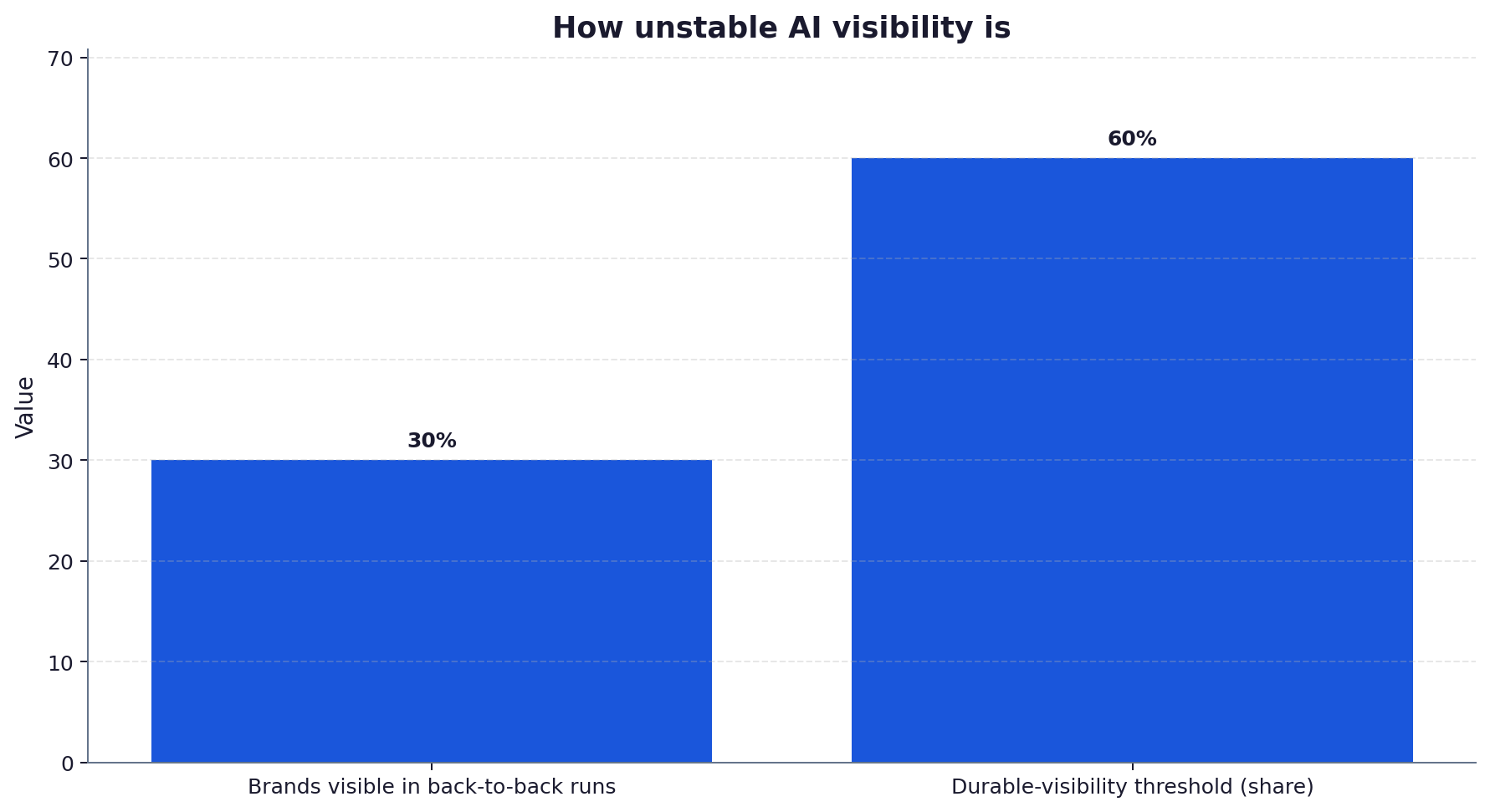
- Instability is high. Only around 30% of brands remain visible in back-to-back AI responses to the same prompt (AI visibility trackers, 2026).
- Volatility is a property of the query and vertical, not of your page. High-volatility verticals need continuous content investment, low-volatility ones reward durable assets.
- Measure it over a rolling window. Compare a 7-day or weekly reading against the prior month, because daily swings are mostly noise.
Key facts
- Only around 30% of brands remain visible in back-to-back AI responses to the same prompt (AI visibility trackers, 2026).
- A citation share above about 60% across repeat runs signals durable visibility, while under about 20% signals volatility-driven noise (AI visibility trackers, 2026).
- Week-over-week or 7-day rolling comparisons reveal trend, while day-over-day comparisons mostly show noise (AI visibility trackers, 2026).
- The AI interpretation layer over search is a primary driver of the new instability (Digital Applied, 2026).
- Volatility is an established metric in finance and SEO position tracking, not in marketing (SEO volatility trackers, 2026).
- Structured, attributed content improves the odds of a stable citation across engines (Aggarwal et al., arXiv, 2023).
A metric marketing borrowed too late
Finance has measured volatility for a century. SEO teams have watched position volatility for a decade, with rank-tracking tools that flag when the results for a keyword are churning. Marketing has been slow to bring the same lens to AI answers, and the gap shows. Most AI visibility reporting records whether a brand appeared, once, and treats that as a result. It has no way to say whether the appearance was a stable position or a flicker in a constantly reshuffling set. Citation volatility is that missing measure.
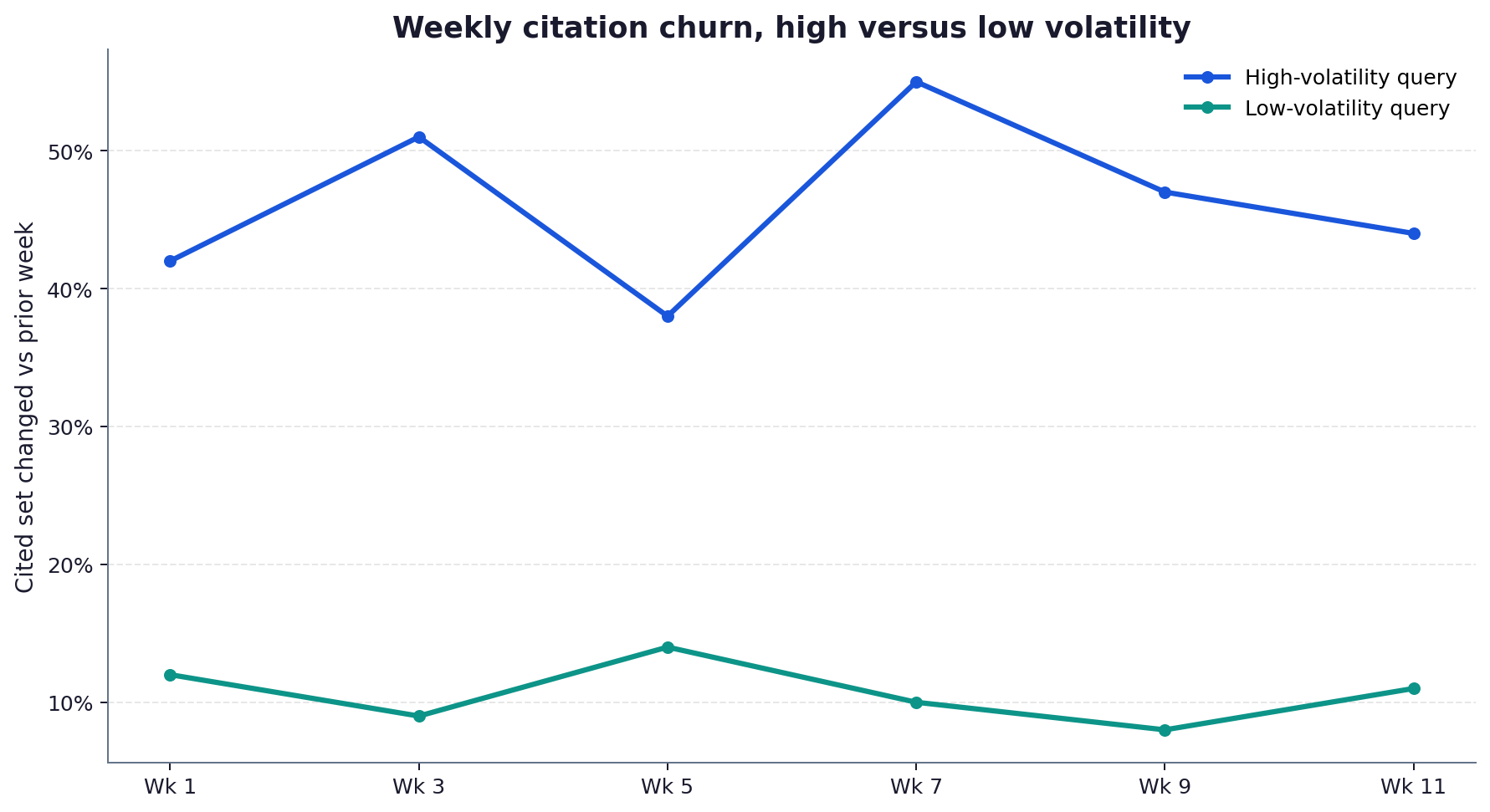
The definition is simple. For a given query, citation volatility is how much the set of cited firms changes from one reading to the next. A query where the same firms are cited week after week has low volatility. A query where the cited set turns over substantially each week has high volatility. Once you can put a number on that churn, you can tell the difference between a durable win and a lucky week, which single snapshots cannot.
Volatility belongs to the query, not your page
This is the distinction that makes the metric useful. Citation half-life, which we cover in our citation half-life by industry analysis, is a property of your page: how long it holds its citation after its last update. Cross-engine consistency, covered in our cross-engine consistency audit, is a property of measurement reliability. Volatility is different again. It is a property of the query and its vertical, the background rate at which the whole cited set churns, regardless of whose page it is. A page in a high-volatility query can do everything right and still be dropped, because the query itself is unstable.
How to measure citation volatility
The method is a panel. Take around 50 commercial UK queries, run each on your target engines once a week for 12 weeks, and record the set of firms cited each week. For each query, volatility is the average week-to-week change in that set, the share of cited firms that dropped out or entered compared with the previous week. A query where 10% of the set changes each week is stable. One where half the set turns over is highly volatile. Average across queries in a vertical and you have a volatility reading for that vertical.
The window matters. Compare weekly or 7-day rolling readings against the prior month, because day-over-day changes in AI answers are dominated by noise and will mislead you into seeing trends that are not there. Practitioners already read a related signal this way: a citation share above about 60% across repeat runs is durable, and below about 20% is noise. Volatility complements that by describing how fast the set moves, not just how often you are in it.
What high volatility means for spend
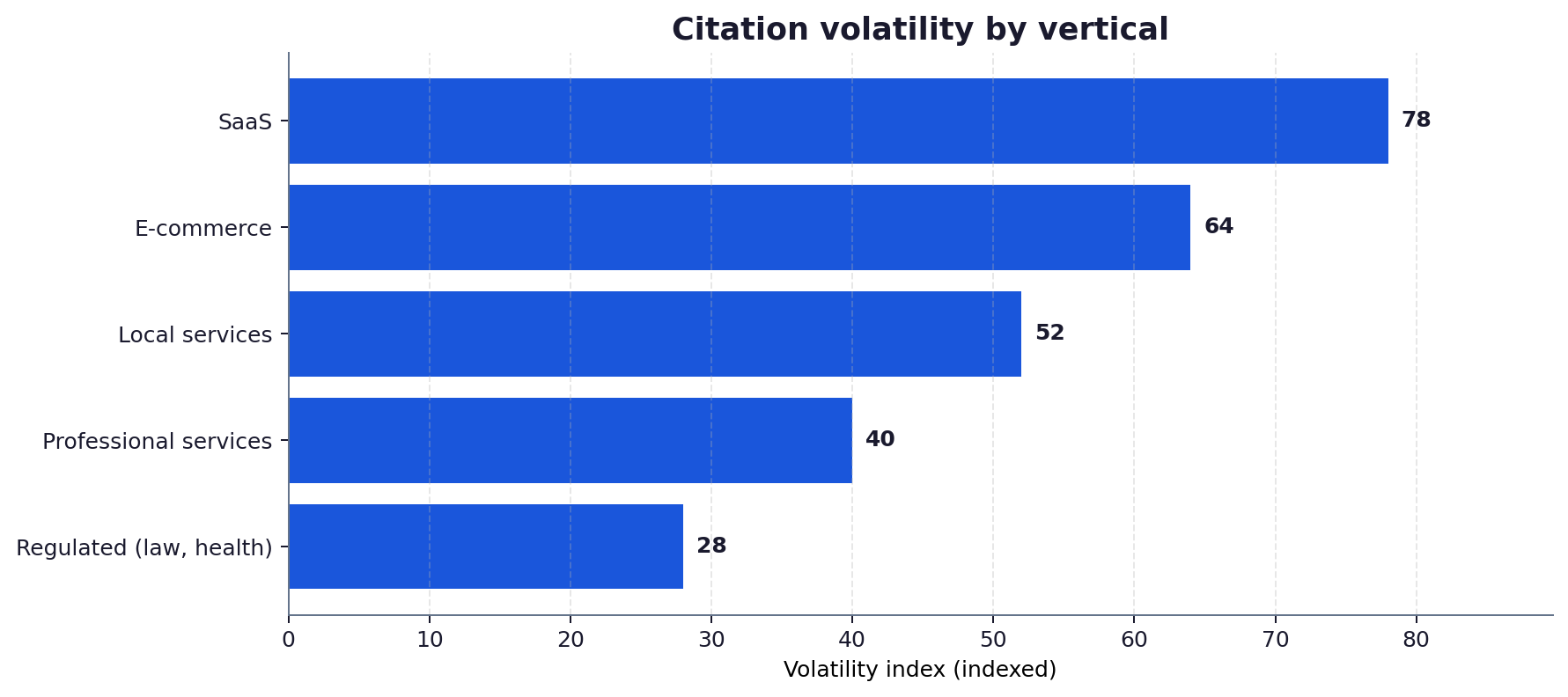
The strategic payoff is in how you allocate content investment. In a high-volatility vertical, a citation is a lease, not a purchase. The set reshuffles constantly, often because the underlying content is crowded and refreshes weekly, so holding a position requires continuous investment: frequent updates, new data, a steady publishing cadence. Treating a high-volatility query as a set-and-forget asset guarantees you lose the position you paid to win.
In a low-volatility vertical, the opposite holds. The cited set is stable, often because it anchors to durable authoritative sources, so a strong, well-structured page can hold its citation for a long time with light maintenance. Here, continuous churn-style investment is wasteful. The right move is to build a durable asset once and maintain it lightly. Knowing a query’s volatility tells you which of these two economies you are operating in, and misreading it is how content budgets get spent in exactly the wrong pattern.
Why volatility is rising
The instability is not an accident of measurement. It reflects a real change in how answers are built. The AI interpretation layer over search decides, each time, which sources are clear and trustworthy enough to summarise, and small changes in that judgement move the cited set. Add the ordinary randomness in retrieval and ranking, and the constant flow of new content into crowded topics, and you get answer sets that genuinely churn. This is why volatility is climbing across many verticals and why a metric that captures it has become necessary rather than academic.
Caveats and limitations
Two limits are worth stating plainly. First, the vertical figures and churn curves here are directional. They describe the pattern the evidence points to and are meant as a hypothesis to test on your own queries, not a measured constant, because AI answer behaviour shifts without notice. Second, volatility is a diagnostic, not a verdict on your work. A dropped citation in a high-volatility query may say more about the query than about your page, so it should change how much you invest and how often, rather than being read as a failure. Used that way, it protects a content budget from both complacency and panic.
Frequently asked questions
What is citation volatility in AI search?
Citation volatility is how much the set of firms cited in an AI answer changes from week to week for the same query. Low volatility means the same firms are cited consistently. High volatility means the cited set turns over substantially each week. It is borrowed from finance and SEO position tracking, where volatility is standard, and it fills a gap in marketing measurement by describing the stability of a position rather than just whether you appeared once.
How is volatility different from citation half-life?
Half-life is a property of your page: how long it holds its citation after its last update before that citation share halves. Volatility is a property of the query and vertical: the background rate at which the whole cited set churns, regardless of whose page it is. A page can have a long half-life in a low-volatility query, or be dropped despite doing everything right in a high-volatility one. They are complementary, and reading both gives a fuller picture than either alone.
How do I measure it?
Run a panel. Take around 50 commercial queries, run each on your target engines once a week for 12 weeks, and record the cited firms each week. Volatility for a query is the average week-to-week change in that set, the share that dropped out or entered versus the previous week. Average across queries in a vertical for a vertical reading. Compare weekly or rolling readings against the prior month, because day-over-day swings are mostly noise and will mislead you.
Why does high volatility change my content strategy?
Because in a high-volatility vertical a citation behaves like a lease, not a purchase. The set reshuffles constantly, so holding a position needs continuous investment: frequent updates, fresh data and a steady cadence. In a low-volatility vertical the cited set is stable, so a durable, well-structured page holds its citation with light maintenance and constant churn-style spend is wasteful. Knowing which economy a query sits in tells you whether to invest continuously or build once and maintain lightly.
Why are AI answers so volatile in the first place?
The AI interpretation layer over search decides each time which sources are clear and trustworthy enough to summarise, and small shifts in that judgement move the cited set. Add the ordinary randomness in retrieval and ranking, plus the steady flow of new content into crowded topics, and answer sets genuinely churn. That is why only around 30% of brands remain visible in back-to-back responses, and why volatility is rising across many verticals rather than settling down.
What window should I compare over?
Use a weekly or 7-day rolling window compared against the prior month. Day-over-day comparisons in AI answers are dominated by noise and will show you trends that are not real. A rolling weekly reading smooths that noise enough to reveal whether a position is genuinely strengthening, weakening or simply churning in place. This mirrors how careful SEO teams already read ranking volatility, and it keeps you from reacting to swings that mean nothing.
Sources and references
- Visibility volatility in AI search. Omnia, 2026
- The June 2026 SERP volatility your tracking tools missed. Digital Applied, 2026
- Why URL volatility in AI search should change your GEO strategy. Kime, 2026
- Most-cited domains and back-to-back visibility across AI answer engines. Profound, 2026
- GEO: Generative Engine Optimization. arXiv (Aggarwal et al.), 2023
- Which sources AI Overviews and chat engines cite. Search Engine Land, 2026
Take your first volatility reading: see where you are cited across engines today.
Change log
- 2026-07-14: Initial publication.