
TL;DR
- The keyword “dental seo” carries a UK cost per click of £62.16 to £86.44, the most expensive vertical click in AiBoost’s 30-vertical August 2026 scan of DataForSEO Google Ads data.
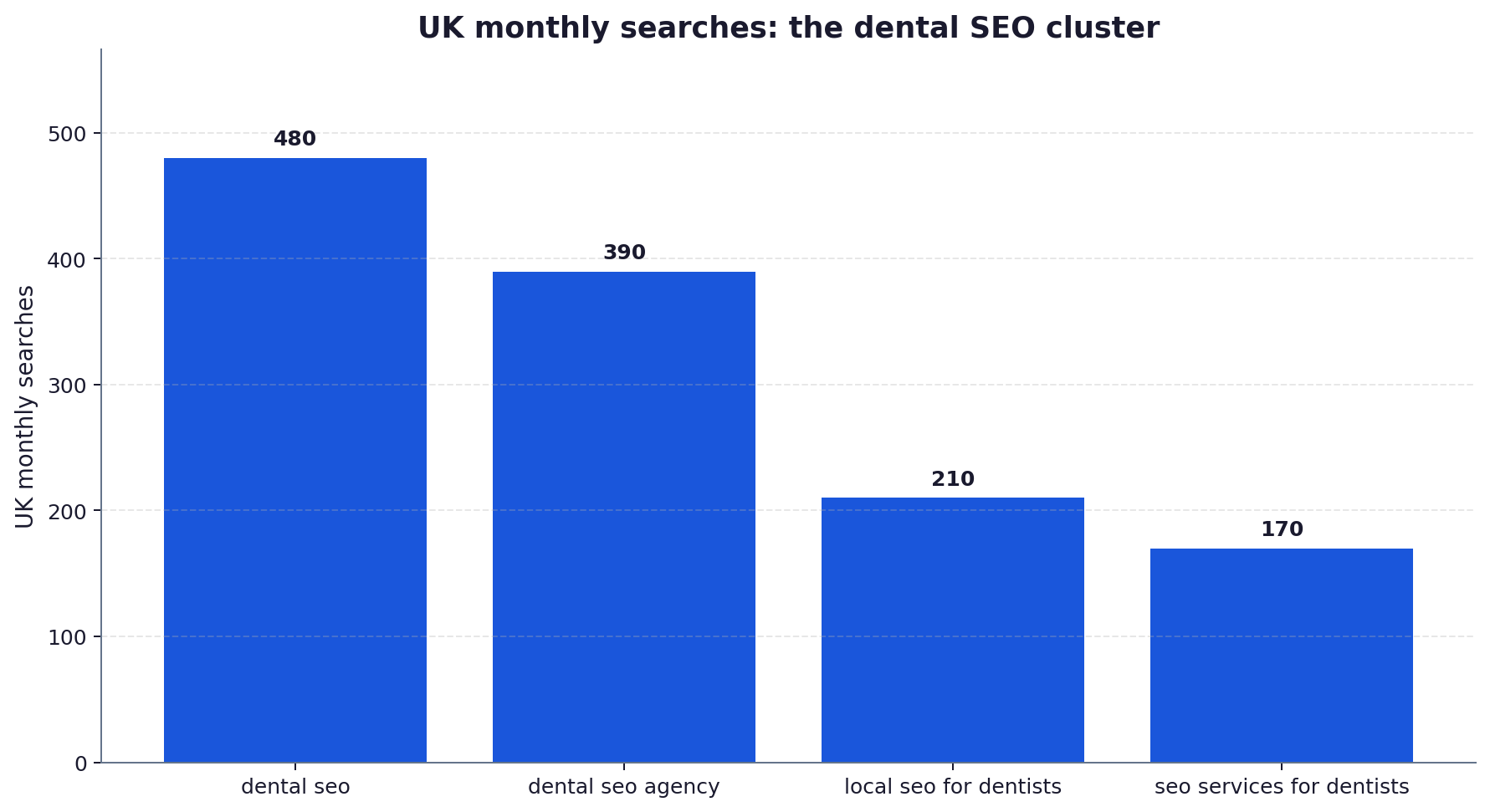
- The core dental SEO cluster totals roughly 1,250 UK searches a month across four phrasings: dental seo (480), dental seo agency (390), local seo for dentists (210) and seo services for dentists (170).
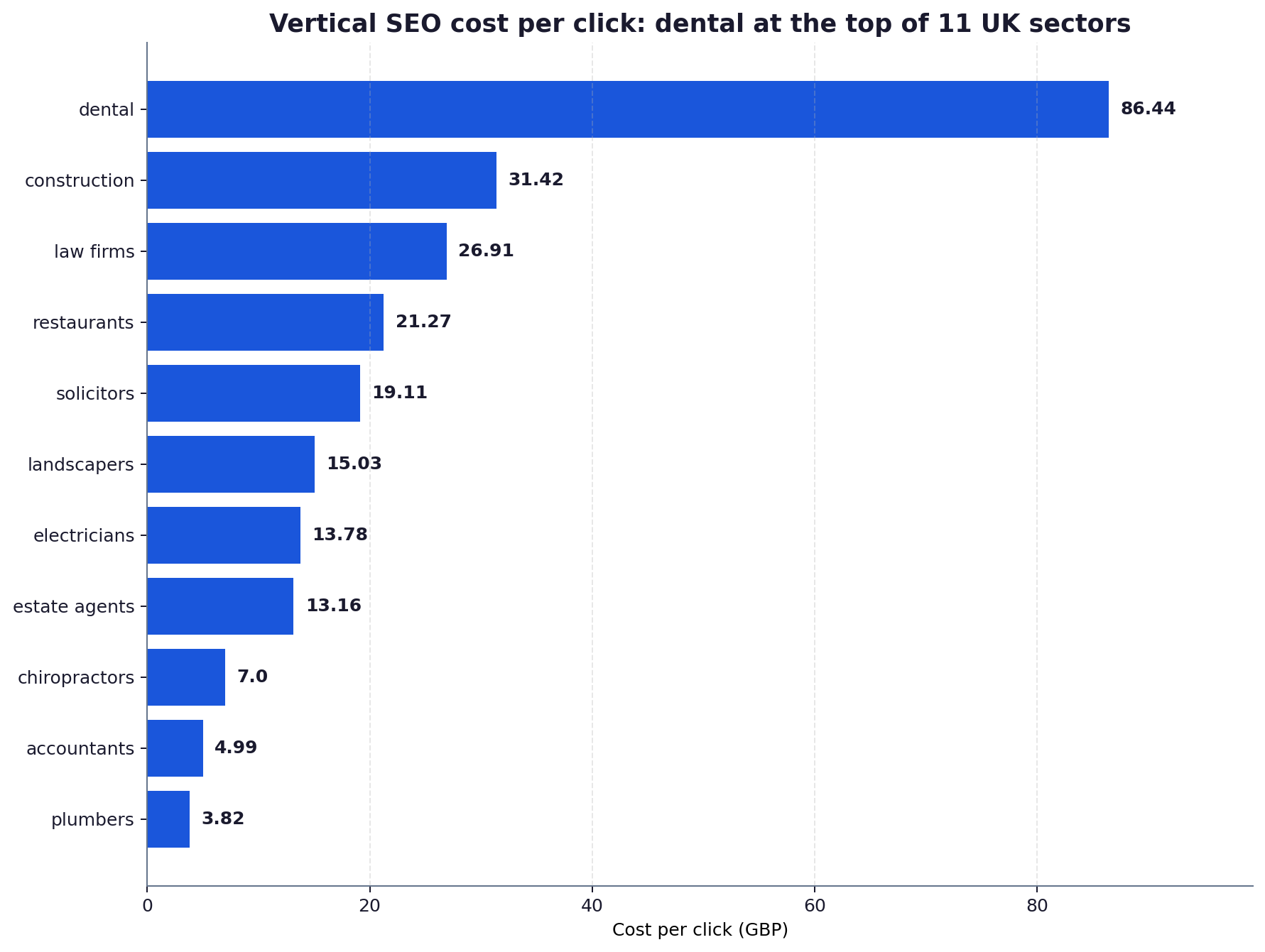
- At the top of its range, a dental SEO click costs 22.6 times a plumber SEO click (£86.44 against £3.82) and 2.8 times a construction SEO click (£31.42), computed directly from the same scan.
- Every keyword in the cluster is rated LOW competition by Google Ads data, which means expensive clicks sit alongside a comparatively open organic field.
- Provider-seeking phrasings (dental seo agency plus seo services for dentists) account for 560 of the 1,250 monthly searches, about 45%, so nearly half the cluster is a practice actively shopping for help.
Key facts
- “dental seo”: 480 UK searches a month, CPC £62.16 to £86.44, LOW competition (AiBoost keyword analysis of DataForSEO Google Ads data, August 2026).
- “dental seo agency”: 390 searches a month, CPC £47.22, LOW competition (DataForSEO, August 2026).
- “local seo for dentists”: 210 searches a month; “seo services for dentists”: 170 a month (DataForSEO, August 2026).
- Full cluster: roughly 1,250 UK searches a month across the four phrasings (DataForSEO, August 2026).
- Vertical CPC ladder from the same scan: dental £86.44, construction £31.42, law firms £26.91, solicitors £19.11, electricians £13.78, accountants £4.99, plumbers £3.82 (DataForSEO, August 2026).
- Dental is the most expensive of 30 verticals in AiBoost’s August 2026 scan; AiBoost has audited 250+ UK small businesses (AiBoost, 2026).
What 1,250 monthly searches say about dental practices
Four phrasings make up the core UK demand for dental SEO: “dental seo” at 480 searches a month, “dental seo agency” at 390, “local seo for dentists” at 210 and “seo services for dentists” at 170. That is roughly 1,250 searches every month from a profession with a fixed number of practices: a dense market by any standard.
The split matters more than the total. “Dental seo agency” and “seo services for dentists” are provider-seeking phrasings, and together they account for 560 of the 1,250 monthly searches, about 45%. Someone typing “dental seo agency” has already decided to buy and is choosing a supplier. “Local seo for dentists”, at 210 searches, shows practices correctly identifying that their fight is a local one, a theme we cover in depth in our work on local SEO for healthcare and private doctors.
Why a dental SEO click costs £86.44
The CPC on “dental seo” runs from £62.16 to £86.44. That is not the price a patient click costs a dentist; it is the price agencies pay to put an ad in front of a dental practice searching for SEO help. When suppliers bid £86 to reach one prospective client, they are telling you what a dental practice is worth as a customer, and by extension what a patient is worth to a practice.
The economics behind that bid are qualitative but visible to anyone in the sector. Dentistry combines recurring care that repeats for years with high-ticket elective treatment such as implants and clear-aligner work, so a patient acquired once can generate revenue across a decade. We have not measured patient lifetime value and we will not invent a figure for it, but the ad market has priced it: no other vertical in our 30-vertical scan comes close. Practices weighing channel options should read our analysis of why private clinics invest in Google Ads alongside this piece.
The vertical CPC ladder, with dental at the top
Placing dental against the other ten verticals we track makes the gap concrete. Construction SEO clicks cost £31.42, law firm clicks £26.91, solicitor clicks £19.11, electrician clicks £13.78, accountant clicks £4.99 and plumber clicks £3.82. All are LOW competition in Google Ads terms. Dental, at £86.44, sits 2.8 times above construction and 22.6 times above plumbing.
The ladder is a rough proxy for client value per acquisition. Verticals where one new customer is worth five figures over time cluster at the top; one-off, price-shopped trades cluster at the bottom. Practices wondering whether search marketing justifies the spend should note that their suppliers have already answered with their budgets. Our piece on whether SEO is worth it for small businesses applies the same logic across sectors.
Expensive clicks, open organic field
The most useful anomaly in the data is the pairing of very high CPCs with LOW competition ratings across the whole cluster. LOW competition in Google Ads data describes advertiser density on the keyword, and it often travels with modest organic difficulty. In plain terms: reaching dental practices through paid ads costs up to £86.44 a click, while ranking organically for the same terms is comparatively undefended.
For an agency, that argues for building organic visibility rather than renting it. For a practice, the same logic applies one level down. The patient-facing terms your practice needs (“dentist in [town]”, “invisalign [town]”, “emergency dentist near me”) behave the same way in most UK locations: commercial value concentrated in a local area, contested by a handful of nearby practices rather than national brands. Our SEO services page sets out how we approach that work, and our guide to growing a private clinic with digital marketing covers the channel mix around it.
How patients actually phrase the search
The cluster’s internal structure is a map of buyer intent. “Dental seo” (480) is the research phrasing, used early, often by a practice principal reading up before delegating. “Dental seo agency” (390) is the shortlist phrasing. “Local seo for dentists” (210) is the tactically informed phrasing, from someone who already knows the local pack decides who gets the phone call. “Seo services for dentists” (170) is procurement language.
A practice can borrow this structure for its own patient keywords. Patients also search in layers: research (“do I need a root canal”), shortlist (“best dentist in [town]”), action (“emergency dentist open now”). Content should exist for each layer, and it should be maintained; our data on how often to update content shows freshness carries measurable weight in both classic and AI search.
The local pack is the primary battlefield
For patient acquisition, most dental queries resolve locally. Google serves a map pack for “dentist near me” style searches, and the ranking inputs there (proximity, review volume and velocity, category accuracy, profile completeness) are different from blue-link SEO. A practice with a complete Google Business Profile, consistent contact data and a steady flow of genuine patient reviews will beat a technically stronger website with a neglected profile.
This is also where regulation touches marketing. UK dentists are GDC-registered professionals, and patient-facing claims should stay within the standards the General Dental Council sets for registrants. The practical consequence for SEO is positive: accurate, verifiable content about treatments and qualifications is exactly what both Google and AI engines prefer to surface. We covered the wider local shift in local SEO in the age of AI assistants.
When a prospect asks ChatGPT for a dentist
A growing slice of discovery now happens without a search results page. A patient asks ChatGPT, Perplexity or Gemini “who is the best private dentist near me for implants” and receives a short recommendation list. Whether your practice appears depends on signals classic SEO only partly covers: whether the engine recognises your practice as an entity, whether your treatment pages are structured so a model can quote them, and whether independent sources corroborate your claims. Health queries also sit in the territory AI engines treat most cautiously, which we examined in how AI search engines handle YMYL content.
We do not publish invented AI citation statistics for dentistry. Our method instead is observational: we run funnel-stage prompt panels for a practice’s real queries, record which practices each engine names, and re-test on a cadence. That methodology is the basis of our generative engine optimisation service, and any practice can see its own starting position through our free GEO audit. The pattern we saw in our 50-firm UK service benchmark holds here: most local firms have no idea whether AI engines can name them at all.
What a practice should do with these numbers
Three actions follow directly from the data. First, treat organic as the asset and paid as the bridge: with supplier-side clicks priced at up to £86.44, every patient enquiry that arrives through a ranking you own rather than an ad you rent compounds in value. Second, win the local pack before chasing national terms; the 210 monthly searches for “local seo for dentists” show your competitors are learning this too. Third, extend the same discipline to AI answers, because recommendation queries are moving there and the field is even less defended than organic. AiBoost has audited 250+ UK small businesses, and the wider shift is documented in our analysis of how AI search is changing professional services marketing.
How we measured the dental cluster
All demand and cost figures come from one AiBoost request to DataForSEO’s Google Ads data in August 2026, UK location, English language. The dental cluster was pulled alongside 30 other service verticals in the same session, which is what makes the £86.44 versus £3.82 comparison a like-for-like reading rather than two numbers from different tools or months.
Limitations
Google Ads volume bands, close-variant grouping and cross-season CPC averaging all blur precision, and the advertiser CPC is an upper-bound signal of click value rather than a measure of what an organic visit earns a practice. We did not model treatment mix; a practice weighted toward implants will value a click differently from an NHS-heavy practice, and the article’s economics reasoning stays deliberately qualitative for that reason.
Frequently asked questions
Why is dental SEO the most expensive vertical click in the UK?
Because agencies bidding on “dental seo” keywords are paying to reach dental practices, and dental practices are unusually valuable clients. In AiBoost’s 30-vertical August 2026 scan of DataForSEO Google Ads data, “dental seo” carried a CPC of £62.16 to £86.44, the highest measured, against £31.42 for construction and £3.82 for plumbers. The bid level reflects dentistry’s economics: recurring care over many years plus high-ticket elective work such as implants and clear aligners. Suppliers price their marketing to what a client is worth, so the CPC ladder doubles as a ranking of client value by sector.
How much search demand is there for dental SEO in the UK?
Roughly 1,250 searches a month across the core cluster, per AiBoost keyword analysis of DataForSEO Google Ads data from August 2026. The breakdown: “dental seo” at 480 searches a month, “dental seo agency” at 390, “local seo for dentists” at 210 and “seo services for dentists” at 170. About 45% of that volume uses provider-seeking phrasings, meaning the searcher is actively looking to hire rather than researching the concept. For a profession with a fixed number of UK practices, that is a dense, commercially mature market.
What should a dental practice target first, paid ads or organic SEO?
The data argues for organic as the long-term asset and paid as the bridge while rankings build. Every keyword in the dental cluster is rated LOW competition in Google Ads data, which pairs unusually open organic terrain with very expensive clicks. For patient-facing terms the priority is the local pack: Google Business Profile completeness, review volume and consistent practice details usually decide who gets the phone call. Paid ads still make sense for immediate coverage of high-value treatments, and the two channels share research, so running them together is common.
Do GDC rules affect dental SEO content?
Yes, in a way that helps rather than hinders. UK dentists are regulated by the General Dental Council, and patient-facing marketing should stay within the standards the GDC sets for registrants, which point towards accurate, honest, verifiable claims. That aligns with what search and AI engines reward: clear treatment pages, named clinicians with real qualifications, and content that can be corroborated by independent sources. Practices should check current guidance at gdc-uk.org rather than rely on summaries, and avoid outcome claims that cannot be substantiated.
How do patients find dentists through ChatGPT and other AI assistants?
They ask recommendation questions in natural language, such as “best private dentist near me for implants”, and the assistant returns a short named list. Inclusion depends on whether the engine recognises the practice as an entity, whether its pages are structured so a model can quote them, and whether directories and independent sources corroborate the practice’s claims. AiBoost does not publish invented citation statistics for dentistry; we measure each practice directly with funnel-stage prompt panels and repeat testing, which is the methodology behind our free GEO audit.
Is dental SEO worth it for a single-site practice?
The ad market suggests it is. Suppliers pay up to £86.44 per click to reach dental practices, 22.6 times the plumber equivalent, because one acquired patient can generate revenue for years. A single-site practice does not need national rankings; it needs to win one local pack and a handful of treatment terms in its catchment, which is a bounded, achievable project. The realistic comparison is not SEO against nothing but SEO against perpetually rented clicks, and the arithmetic favours owning the ranking.
Sources and references
- DataForSEO Google Ads search volume and CPC data. DataForSEO, 2026
- Google Ads Help. Google, 2026
- General Dental Council. GDC, 2026
- Google Search Central documentation. Google, 2026
Want a dental SEO plan built from your own local pack, your patient keywords and your competitors’ actual positions? Request a proposal and we will map your fastest wins.
Change log
- 2026-08-10: Initial publication.