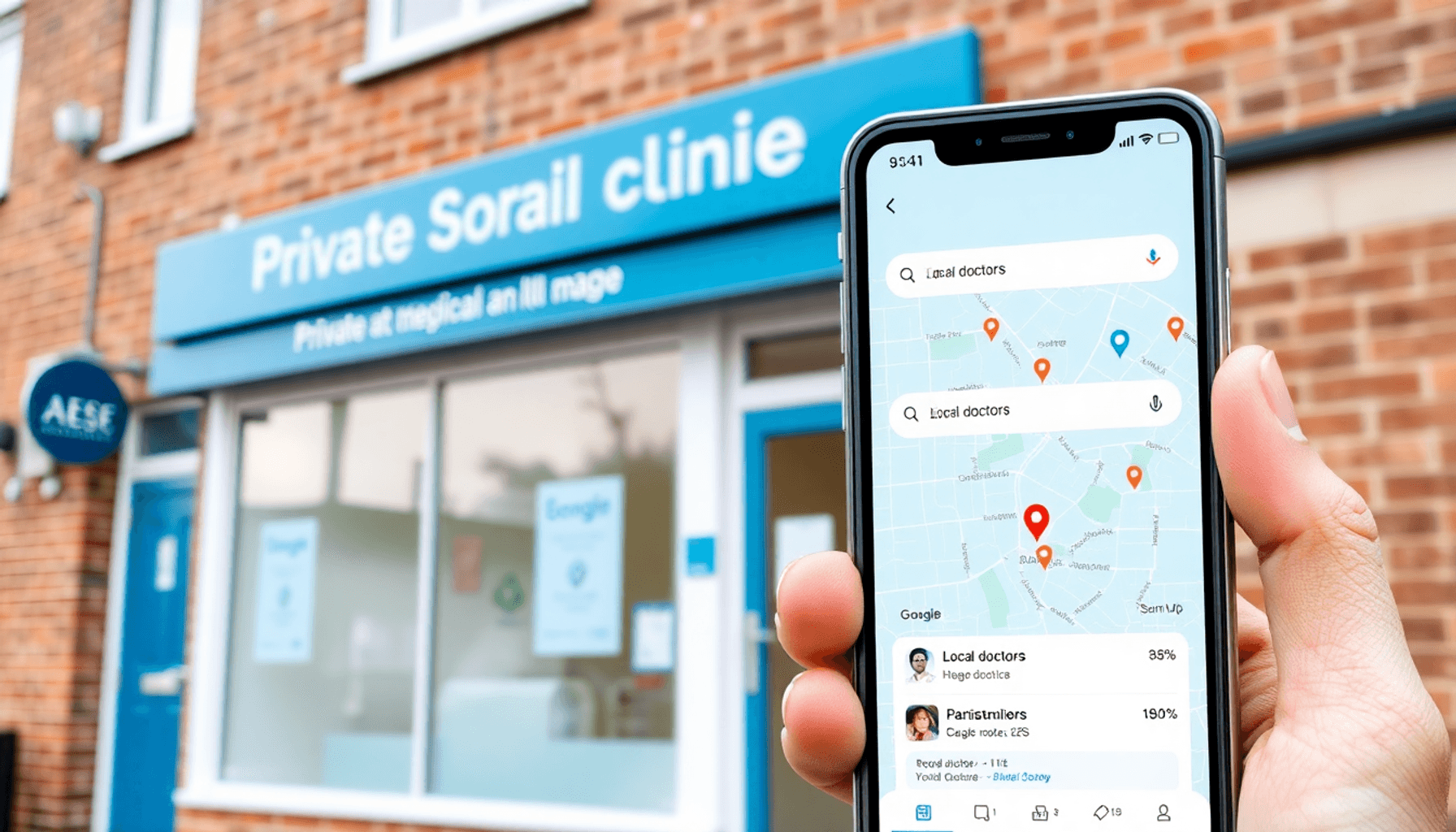
Healthcare local SEO is the work that makes a practice the obvious choice when someone nearby searches for a private GP, a consultant or a clinic. For UK practices in 2026 it rests on three assets: an accurate Google Business Profile, consistent entries on the directories patients and insurers use, and pages that answer the questions patients type before they book.
This guide splits the work by buyer rather than by tactic, because a single-handed private GP and a five-site clinic group solve different problems with the same toolkit. It also uses UK search figures from an August 2026 SEO data pull, described below.
Healthcare local SEO in 2026: what decides who ranks
Local rankings turn on three inputs Google has described consistently for years: proximity to the searcher, relevance to what was typed, and prominence across the wider web. Healthcare adds a fourth pressure. Health queries sit in the category search engines treat most cautiously, so pages naming the treating clinician, stating their registration and showing a real address tend to hold position better than anonymous service copy. Our post on how AI search engines handle YMYL content goes deeper.
Medical local SEO therefore rewards specificity. A page titled “Private GP appointments in Clapham” with named clinicians, hours and fees will usually beat a page titled “Our services” that could belong to any practice in the country. Most practices lose position to their own vagueness rather than to a stronger competitor.
Local SEO for private doctors: the single-handed practice
A private consultant or single-handed GP is selling a person, not an organisation. Patients search the name, then the specialty plus the town, and often arrive via an insurer directory before seeing the website. SEO for private doctors should follow that order.
Start with a clinician page carrying the full name, specialty, GMC number, the hospitals or clinics where sessions are held, languages spoken and conditions seen, and point every other listing back to it. If sessions run from a room inside a larger clinic, a separate Google Business Profile is justified only where there is a distinct, staffed presence at that address.
Insurer and specialist directories carry real weight here, because patients with cover often start there. Keep the entry, the website and the profile in exact agreement on name, address and phone number. A doctor listed as “Dr J Smith” in one place and “Doctor John Smith FRCS” in another gives search engines two entities to reconcile.
SEO for private clinics: groups and specialist centres
SEO for private clinics is a different job. A group with three or more sites has enough pages to rank across many treatment and location combinations, and enough internal duplication to sink itself. The usual failure is a location page template where only the town name changes, leaving near-identical pages competing for the same result.
The fix is one genuinely distinct page per site, carrying that site’s clinicians, parking and transport details, the treatments actually offered there and the reviews left about that location. Each site gets its own Google Business Profile with a primary category matched to what happens there, so a dermatology centre and a general clinic in the same group are not filed identically.
Treatment pages should sit above location pages and link down to the sites offering them, giving the group a hub for treatment searches while location pages handle “near me” demand. Groups running paid campaigns should also read our note on whether private clinics should invest in Google Ads.
Local SEO for medical practices UK: what the search data shows
In August 2026 AiBoost pulled UK Google Ads figures for 30 professional service verticals in one session. The healthcare rows say something about who competes for this work.
| Search term (UK) | Monthly searches |
|---|---|
| seo for dentists | 480 |
| local seo for small business | 210 |
| seo for medical practice | 70 |
| seo for doctors | 50 |
Two things stand out. Dentistry dominates practice-owner demand, at roughly seven times the volume of “seo for doctors”. And “seo for dentists” carried an advertiser cost per click of £86.44, the most expensive click of the 30 verticals in the pull. That figure measures how hard agencies bid to reach dental practice owners, and it explains why so much UK healthcare marketing content is written for dentists then reworded for doctors.
For a private practice that is an opening. The agency market has concentrated where buyer demand is, leaving results for doctor and clinic terms thinner than the dental equivalent. Local SEO for medical practices UK-wide still rests on unglamorous work most practices have not finished: one accurate profile per site, listings that agree, and a page for each thing a patient might book.
SEO services for doctors: what to ask before you sign
SEO services for doctors are sold on ranking promises far more often than on booked appointments. Five questions separate a serious proposal from a template.
- Which locations get their own profile? The answer should map to staffed addresses, not to towns you would like patients in.
- Who writes clinical wording, and who signs it off? A named clinician should review anything describing a treatment.
- How will reviews be requested? A plain post-appointment invitation, with nothing offered in exchange.
- What does the monthly report count? Enquiries, calls and bookings by source. Ranking screenshots tell you little about revenue.
- Is AI assistant visibility measured? A proposal silent on ChatGPT, Perplexity and Gemini is describing the search landscape of several years ago.
AiBoost has audited more than 250 UK small businesses, and the pattern is consistent: the practices that win local search are rarely those with the largest budget. They are the ones whose basic information is correct everywhere a machine can read it.
When a patient asks ChatGPT, Perplexity or Gemini for a recommendation
More of the research that used to happen on a results page now happens in a conversation. Someone types “I need a private GP in Bristol who can see me this week” and gets a short answer with a few sources attached.
The method we use is simple enough for any practice to repeat. Write down the five questions a patient would realistically ask about your specialty and area, and put each to ChatGPT, Perplexity and Gemini in a fresh session with no prior context. Record three things per answer: whether your practice is named, which sources are cited, and what it says about you when it does.
What we observe repeatedly is that assistants fall back on directories when a practice website gives them little to work with. If clinician names, locations, conditions treated and fees exist only inside images, booking widgets or PDF downloads, the assistant has nothing quotable. Practices stating these things in plain text, on pages matching the question asked, appear in answers more often. That is the core of generative engine optimisation, which builds on the local SEO work above rather than replacing it, and our guide to local SEO in the age of AI assistants covers retrieval in more detail. To see your current position before doing the manual version, take a free GEO audit on your practice domain.
Foundations: profile, listings and structured data
Google Business Profile
Claim and verify every staffed address, choose the most specific primary category available, and add secondary categories for other services offered there. Fill in hours including bank holidays, add photographs of the actual premises, and describe the service in the language patients use. Our walkthrough on getting more from your Google Business Profile covers the settings most practices skip.
Directories and NAP consistency
List the practice on NHS service search where eligible, the insurer finders you accept such as Bupa and AXA Health, and specialist directories including Doctify and TopDoctors. Where a service is registered with the Care Quality Commission, the public registration record is another source machines can read, so those details should match the website. Audit every listing quarterly.
Structured data
Mark up each location with MedicalClinic or LocalBusiness including address, telephone and hours, describe clinicians with Physician, and add FAQPage markup to pages answering patient questions. Structured data creates no authority; it removes ambiguity, which matters more as structured data feeds AI search visibility.
Your first 30 days: a local SEO checklist
At a single-site practice starting from scratch, this is a realistic first month, with no developer needed.
| Week | Focus | Tasks |
|---|---|---|
| Week 1 | Google Business Profile | Claim or verify, set the most specific primary category, add hours, premises photographs and a plain-English description. |
| Week 2 | Directories and NAP | Correct entries on NHS service search where eligible, insurer finders and specialist directories. Check name, address and phone match the website. |
| Week 3 | Website pages | Give each core service a page with a location-specific title, named clinicians, fee information and an obvious booking route. |
| Week 4 | Reviews and measurement | Set up a post-appointment review invitation, reply to existing reviews, and connect Search Console and GA4 to see which queries bring patients in. |
Repeat the listings and review checks monthly.
How we compiled the numbers
The search volume and cost per click figures here come from a single DataForSEO pull against Google Ads keyword data, run in August 2026 with the location set to the United Kingdom and the language to English. Thirty professional service verticals were queried in one session, so every figure was gathered under identical settings on the same day, including the healthcare and dental terms above. Nothing has been averaged, projected or combined with other sources or months.
The observations about AI assistants come from AiBoost’s work across more than 250 UK small businesses, and from repeating the five-question method described earlier against ChatGPT, Perplexity and Gemini.
Limitations
- Volume banding. Google reports monthly searches in bands, so a figure of 50 is an order of magnitude, not a precise total.
- Close-variant grouping. Related phrasings are grouped upstream, so one reported term can cover several ways of asking the same thing.
- Cost per click measures bidding pressure. The £86.44 dental figure reflects what advertisers will pay to reach practice owners, not the value of an organic visit.
- Practice economics vary. The value of a new patient depends on treatment mix, insurer arrangements and follow-up rates. Keyword data cannot show that, so no figure here is a return on investment estimate.
Frequently asked questions
What does healthcare local SEO actually involve for a UK practice?
Healthcare local SEO covers three connected jobs. First, a Google Business Profile for each staffed address, with the most specific category available, accurate hours and real photographs. Second, listings on the directories patients and insurers use, with name, address and phone matching your website exactly. Third, pages answering the questions patients ask before booking, each naming the clinicians involved and where the appointment happens.
How long does local SEO for private doctors take to work?
Profile and directory corrections often show in Maps within a few weeks, because you are fixing data rather than building authority. Rankings for competitive service pages usually build over three to six months, and longer in cities where established clinics hold years of reviews. The realistic sequence is listings first, then movement in map results, then gradual improvement on service pages.
What do SEO services for doctors usually cost in the UK?
Most UK agencies price this as a monthly retainer, sometimes with a one-off audit or site build at the start. Compare that retainer against the paid alternative. Our August 2026 UK data put the advertiser cost per click for “seo for dentists” at £86.44, which shows how expensive attention is in healthcare. Ask any agency to quote against enquiries and bookings rather than rankings.
Is SEO for private clinics different from SEO for a single private doctor?
Yes, and treating them the same is a common mistake. A single-handed doctor is ranking a person, so the work centres on one clinician page, insurer directory entries and consistency wherever they are named. A clinic group is ranking a structure: distinct pages per site, one profile per location with matched categories, and treatment pages linking down to the sites offering them. The tactics overlap; the priorities do not.
Does local SEO for medical practices in the UK still work now AI assistants answer health questions?
The signals that decide local rankings are also the signals assistants read. When we ask ChatGPT, Perplexity or Gemini to recommend a practice, the answers lean on the same profiles, directories and clearly written service pages Google uses. What changes is the format and the weight on plain text, since an assistant cannot quote information locked inside images or booking widgets. Local SEO remains the foundation.
Which directories matter most for medical local SEO in the UK?
Start with the ones your patients already use: NHS service search where eligible, the finders run by insurers you accept such as Bupa and AXA Health, and specialist directories including Doctify and TopDoctors. Where a service is CQC registered, the public registration record is another entry machines can read. Accuracy matters far more than volume, and five listings that agree are worth more than thirty that contradict your website.
Want to know whether ChatGPT, Perplexity, or Google AI Overviews mention your practice? Run a free first-party visibility audit on your domain in under a minute and see exactly which queries cite you and which do not.