TL;DR
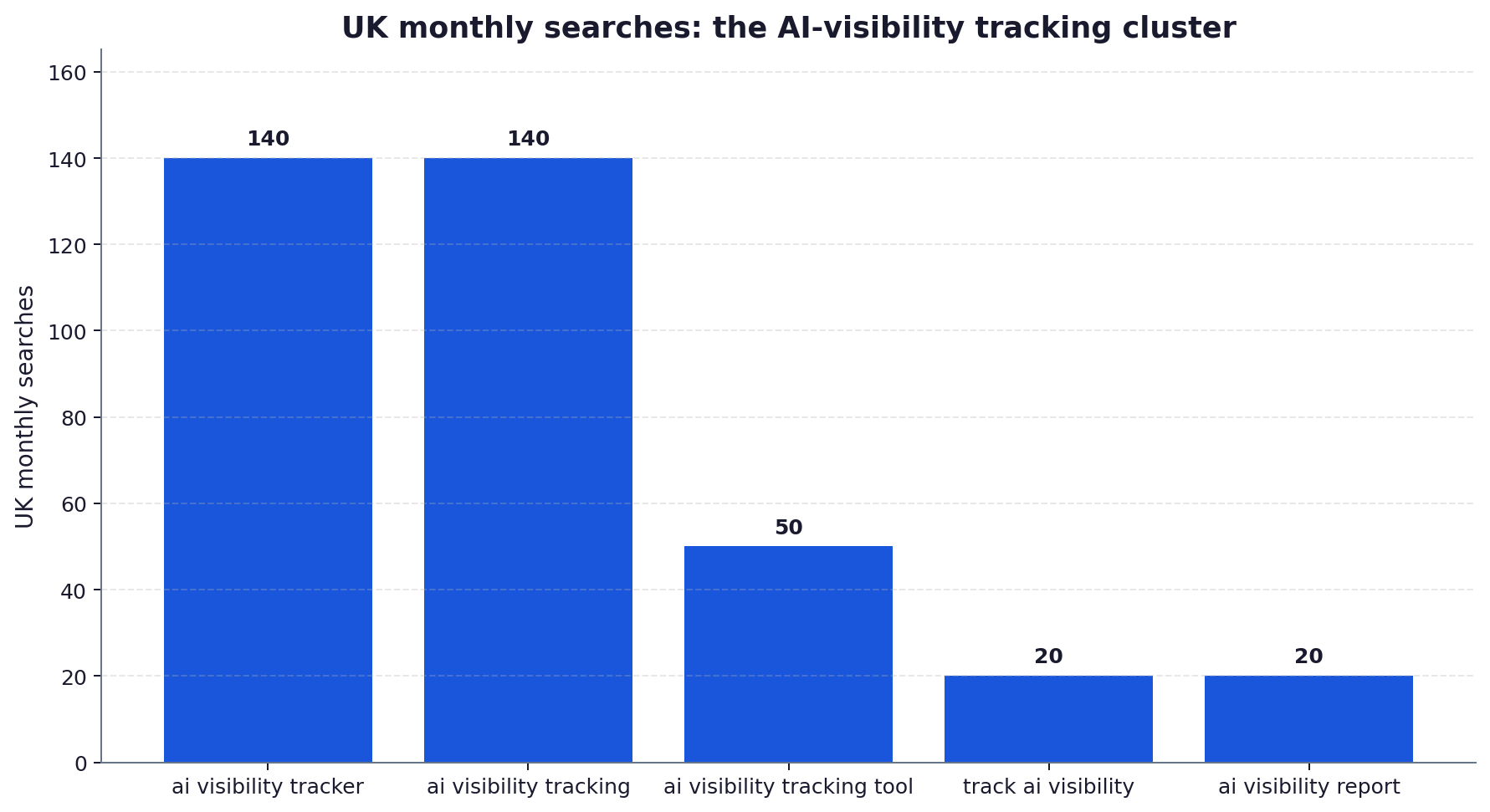
- UK demand for AI-visibility tracking sits at roughly 370 searches a month across a 5-term cluster, led by “ai visibility tracker” and “ai visibility tracking” at 140 each (AiBoost keyword analysis of DataForSEO Google Ads data, August 2026).
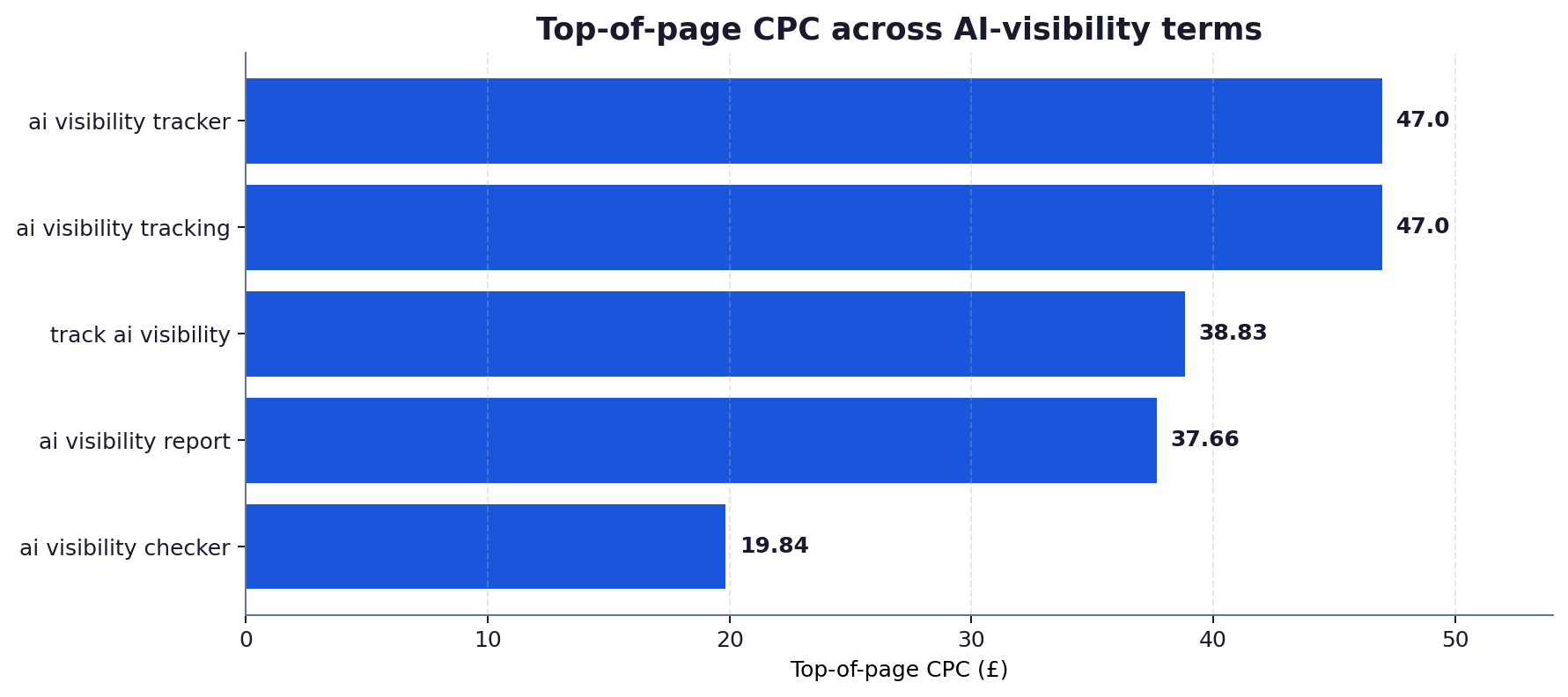
- The top-of-page CPC for “ai visibility tracker” is £47.00, which is higher than “ppc agency” (£40.23) and half again the cost of “seo agency” (£30.41). Vendors are paying enterprise-software prices for a 140-search term.
- The broader interest signal is rising: average monthly searches for “ai visibility” grew from 117 to 243 across 12 months in the same DataForSEO dataset.
- A tracker that earns its keep must capture 7 things: a fixed prompt panel, per-prompt citations, raw answer evidence, competitor mention share, week-over-week deltas, multi-engine coverage, and a cadence with alerting.
- AiBoost built GEO Pulse, its own weekly per-client tracker, after testing the buy route; the decision came down to prompt-panel control and per-client cost.
Key facts
- “ai visibility tracker”: 140 UK monthly searches, KD 35, £47.00 top-of-page CPC (AiBoost keyword analysis of DataForSEO Google Ads data, August 2026).
- “ai visibility tracking”: 140 monthly searches at the same £47.00 CPC; “ai visibility tracking tool” adds 50 (DataForSEO, August 2026).
- “track ai visibility” (20 searches, £38.83) and “ai visibility report” (20 searches, £37.66) complete the roughly 370-search cluster (DataForSEO, August 2026).
- “ai visibility checker” carries a £19.84 CPC, less than half the tracker CPC, marking the price gap between one-off checks and continuous tracking (DataForSEO, August 2026).
- Average monthly searches for “ai visibility” rose from 117 to 243 over 12 months, comparing the first 3 months of the window with the last 3 (DataForSEO, August 2026).
- The foundational GEO research (Aggarwal et al., arXiv, 2024) measured citation visibility per query, still the unit a credible tracker reports in 2026.
- AiBoost has audited 250+ UK small businesses and runs GEO Pulse, a weekly per-client AI-visibility tracker, as first-party infrastructure.
The market data: 370 searches a month, priced like enterprise software
The AI-visibility tracking cluster is small and specific. “ai visibility tracker” and “ai visibility tracking” carry 140 UK monthly searches each, “ai visibility tracking tool” adds 50, and “track ai visibility” and “ai visibility report” contribute 20 apiece. Call it 370 searches a month for the whole intent (AiBoost keyword analysis of DataForSEO Google Ads data, August 2026). For context, “seo agency” alone carries 6,600.
Small does not mean unimportant. The parent term “ai visibility” grew from an average of 117 monthly searches to 243 across the 12-month DataForSEO window, and adjacent vocabulary such as “geo audit” and “ai citations” is rising on the same curve. The tracking cluster is the commercial sharp end of that vocabulary shift: someone typing “ai visibility tracker” has already accepted that generative engine optimisation needs measurement, and is now shopping for the instrument.
What a £47 click says about who is bidding
The revealing number is not the volume, it is the price. At £47.00, a click on “ai visibility tracker” costs more than a click on “ppc agency” (£40.23) and far more than “seo agency” (£30.41), terms with 20 to 45 times the search volume. “track ai visibility” clears £38.83 and “ai visibility report” £37.66. Meanwhile “ai visibility checker”, the one-off diagnostic phrasing, sits at £19.84. Advertisers are paying more than double for the searcher who wants continuous measurement over the searcher who wants a single check.
That price structure is the fingerprint of enterprise software marketing. SaaS vendors with annual contracts can justify £47 clicks on 140-search terms because a single closed deal repays thousands of clicks. It also tells the practitioner something useful: the paid channel for this category is already expensive, so organic visibility for tracking-related queries, and honest educational content around them, is the cheaper route to the same buyer. We covered the wider tool landscape in our review of AI citation tracking tools and dashboards.
The 7 things any tracker must capture
Strip the category back to first principles and a weekly AI-visibility tracker has 7 non-negotiable capture requirements. This list is drawn from building and running GEO Pulse, AiBoost’s own weekly per-client tracker, and it applies whether you build, buy or run a spreadsheet.
First, a fixed prompt panel organised by funnel stage: awareness, consideration and decision prompts, held constant week to week so that change in the answers means change in the market rather than change in your questions. Second, per-prompt citation capture, recording which domains each engine cites for each prompt, because citation per query is the unit the original GEO research measured and it remains the unit that moves. Third, raw answer storage. Summaries rot; the verbatim answer text is the evidence you will need when a client asks why a number changed. Fourth, competitor mention share, since which sources AI engines prefer is a zero-sum contest and your brand’s absence is only meaningful next to a rival’s presence.
Fifth, week-over-week deltas as the headline output, not raw scores. Sixth, multi-engine coverage, because engines disagree with each other far more than most buyers expect, and a single-engine tracker will misreport your position. Seventh, a cadence with alerting: a tracker nobody reads on a schedule is a log file, not a measurement system.
Why weekly is the honest cadence
AI answers are unstable. The same prompt, asked a week apart, returns different citation sets often enough that we treat citation volatility as a first-class metric rather than noise to be smoothed away. That instability sets the measurement rules. A monthly snapshot cannot distinguish a genuine visibility loss from a bad sampling day, and a daily run mostly measures the engines’ own churn while tripling your API bill.
Weekly hits the practical middle. It is frequent enough to catch a real shift within a fortnight and to build the run history that separates trend from wobble, and cheap enough to sustain per client indefinitely. It also matches how the work gets done: content changes ship on weekly rhythms, so a weekly measure closes the loop between content updates and visibility movement.
How AiBoost built GEO Pulse, and what the build taught us
GEO Pulse is AiBoost’s weekly per-client AI-visibility tracker. We evaluated third-party platforms first, and the buy route failed on two specific points rather than on price alone. The first was prompt-panel control: our audit methodology is built on funnel-stage prompt panels tailored to each client’s buying journey, and rented dashboards wanted to impose their own generic prompt sets. The second was per-client economics: platform pricing is typically per-seat or per-brand at rates designed for in-house teams, which multiplies badly across an agency book.
Building forced decisions that a purchased dashboard would have hidden. We store every raw answer verbatim, because the first time a week-over-week delta surprised us, the stored text was the only way to establish whether the engine had changed its answer or our extraction had changed its reading. We track competitor mentions in the same run as brand mentions, so the two numbers are always sampled under identical conditions. And we report deltas against a rolling baseline rather than a single launch-week figure, so one unusual week cannot distort every later comparison. These choices echo our framework for generative appearance score and share of AI voice: the score matters less than the sampling consistency behind it.
When a spreadsheet is enough
The honest answer the £47-CPC vendors will not give you: for a meaningful share of businesses, a spreadsheet is the right tracker. If you are measuring one brand, in one market, across one or two engines, with a prompt panel under about 20 prompts, a monthly manual run recorded in a sheet with columns for prompt, engine, date, brand mentioned, competitors mentioned and citation URLs will capture the trend that matters. The discipline is the product; the software is optional. Our 10-step audit methodology describes a prompt-panel structure you can copy into exactly that sheet.
The spreadsheet stops being enough at three thresholds. Multiple brands or clients, because manual runs scale linearly with panel size and your Saturday disappears. Weekly cadence, because volatility analysis needs run history that manual collection rarely sustains. And competitor mention share, because extracting every rival mention by hand from long answers is where manual accuracy collapses first. Cross two of the three and you are in build-or-buy territory.
Build vs buy: the decision criteria
Buy when tracking is an input to someone else’s job: one brand, a marketing manager who needs a number for the monthly report, no appetite for maintenance. The rented dashboard’s generic prompt panel is a real limitation, but it is a tolerable one at single-brand scale, and the vendor absorbs the engine-API churn that breaks home-built scrapers. Weigh vendors against the capture list above, and treat any tool that cannot show you raw answer text as a brand-mention monitor, not a tracker.
Build when tracking is your product or your proof. Agencies reporting to clients, in-house teams running GEO programmes with real budgets, anyone whose prompt panel is a competitive asset. The build is smaller than it looks: the hard part is not the code, it is the measurement discipline, the fixed panels, the stored evidence, the rolling baselines. Get those right and the tracker becomes the backbone of reporting, the thing that turns citation share into a KPI a client can hold you to. Get them wrong and no purchase price fixes it.
How we ground this analysis
The demand and cost figures for tracker-related terms come from a single AiBoost pull of DataForSEO’s Google Ads data in August 2026, UK location, English. The capture requirements come from building and operating GEO Pulse, AiBoost’s weekly per-client AI-visibility tracker: each requirement listed is one the production system implements, and none is speculative. No performance statistics from client tracking are quoted anywhere in this article.
Limitations
The £47 CPC reads advertiser bidding in one month and one market; it evidences commercial interest in this category, and nothing more precise than that. Google’s volume banding applies to every demand figure, and at these small volumes the bands are wide relative to the numbers. Build-versus-buy economics depend on engineering time you already pay for, which no market data can price for you.
Frequently asked questions
What is an AI visibility tracker?
An AI visibility tracker is a system that measures whether AI engines such as ChatGPT, Perplexity and Gemini mention or cite your brand when users ask questions in your category. A credible tracker runs a fixed panel of prompts on a schedule, records which brands and domains each engine cites per prompt, stores the raw answers as evidence, and reports change over time. It differs from a one-off checker, which tells you where you stand today but cannot separate a real trend from the normal week-to-week instability of AI answers.
What should an AI visibility tracker measure?
Seven things: a fixed funnel-stage prompt panel, per-prompt citations, raw answer text stored verbatim, competitor mention share sampled in the same run, week-over-week deltas against a rolling baseline, coverage of more than one engine, and a regular cadence with alerts. The common failure is tracking a raw score without the evidence underneath it. When a score moves, you need the stored answers to establish whether the engine changed its behaviour, your extraction misread an answer, or the market genuinely shifted.
How often should you check AI visibility?
Weekly, for any brand actively investing in AI search visibility. AI answers are volatile enough that a single monthly snapshot can misread a bad sampling day as a genuine loss, while daily runs mostly measure engine churn at three times the cost. A weekly cadence builds the run history needed to tell trend from noise, catches real shifts within a fortnight, and matches the weekly rhythm most teams use to ship content changes. Brands not yet investing can re-test monthly or quarterly with a consistent prompt panel.
Can a spreadsheet work as an AI visibility tracker?
Yes, within limits. One brand, one market, one or two engines, a prompt panel under about 20 prompts and a monthly cadence can all be handled in a sheet with columns for prompt, engine, date, brand mentions, competitor mentions and citation URLs. The discipline of a fixed panel matters more than the software. The spreadsheet stops working when you add multiple brands, move to weekly runs, or need competitor mention share extracted from long answers, which is where manual accuracy breaks down first.
Why do clicks on ai visibility tracker cost £47?
Because the bidders are software vendors with enterprise economics. At £47.00, the “ai visibility tracker” CPC exceeds “ppc agency” (£40.23) and “seo agency” (£30.41) despite carrying only 140 UK monthly searches (AiBoost keyword analysis of DataForSEO Google Ads data, August 2026). A vendor selling annual contracts can repay thousands of expensive clicks with one closed deal. The practical lesson for everyone else is that paid acquisition in this category is costly, so organic and educational routes to the same buyer are comparatively cheap.
Should I build or buy an AI visibility tracker?
Buy if you track one brand and need a number for a monthly report; a rented dashboard with a generic prompt panel is tolerable at that scale and the vendor handles maintenance. Build if tracking is your product or your proof: agencies reporting to clients, or in-house teams whose prompt panel is a competitive asset. AiBoost built GEO Pulse, its weekly per-client tracker, because rented tools would not accept custom funnel-stage prompt panels and priced badly across an agency client book. Judge either route against the seven capture requirements.
Sources and references
- DataForSEO Google Ads search volume and CPC data. DataForSEO, 2026
- GEO: Generative Engine Optimization. arXiv (Aggarwal et al.), 2024
- Google Search Central documentation. Google, 2026
Before you commit to a tracker, establish the baseline. Our free GEO audit runs a funnel-stage prompt panel against your brand and your competitors and shows where you stand in AI answers today.
Change log
- 2026-08-10: Initial publication.