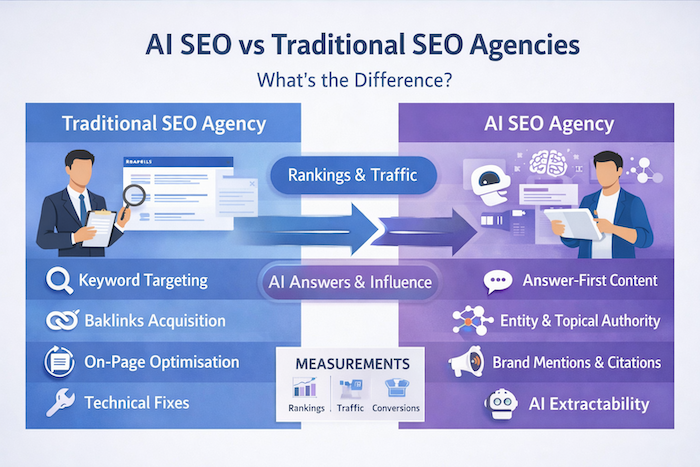
Over the past two years the search landscape has splintered. Traditional search engines continue to drive billions of visits, but answer engines like Google’s AI Overviews, ChatGPT, Bing Copilot and Perplexity summarise information for users without requiring clicks. The rise of these generative engines has spawned a new label—“AI SEO agency”—which often confuses decision‑makers. Some marketers rebrand their existing services, while others build genuine capabilities to help brands appear in AI‑generated answers. To decide whether you need an AI‑focused agency or a traditional SEO partner, you must understand how the goals, tactics, metrics and deliverables differ.
The Core Goal: What Each Type of Agency Optimises For
| Agency type | Primary objective | How success is measured |
|---|---|---|
| Traditional SEO agency | Improve rankings on search‑engine results pages (SERPs) and grow organic traffic through clicks | Rankings, organic visits, click‑through rate and conversions. SEO aims to appear in the top results for specific keywords. |
| AI SEO (GEO/AEO) agency | Get a brand or page included in AI‑generated answers, cited as a trusted source or recommended by chat assistants | Presence in AI answers, citation frequency, share of voice in AI narratives and influence metrics rather than clicks. |
In other words, traditional SEO success is still about rankings and traffic, whereas AI SEO success is about influence and representation within generative systems. Rankings remain a prerequisite because AI search tools often retrieve from top‑ranked pages, but they are no longer sufficient.
Primary Focus Areas Compared
Traditional SEO focus
- Keyword targeting and on‑page relevance – aligning titles, headings and content with search queries and ensuring pages satisfy user intent.
- Backlink acquisition – earning links from authoritative websites to build page and domain authority.
- Technical optimisation – improving site speed, mobile friendliness, crawlability and indexation.
- Content depth and user experience – producing comprehensive articles that keep visitors on site.
AI SEO focus
- Answer‑first content restructuring – presenting the conclusion or key facts up front in the first paragraph, using bulleted lists and tables so models can extract snippets easily. AI search engines retrieve passages and synthesise answers; long, fluffy paragraphs reduce citation odds.
- Entity clarity and topical authority – defining who you are and what you do via clear language, schema and consistent internal linking. Lasso Up notes that GEO depends on entity clarity and strong brand mentions across the web.
- Brand mentions and third‑party validation – generative models often prefer earned media (independent reviews, trade publications and directories) over brand‑owned content. Citations from credible sources and high‑trust brand mentions therefore become new authority signals.
- AI readability and extractability – using schema markup, FAQs and well‑structured headings so AI crawlers can parse content and select relevant passages. LLMs favour machine‑readable evidence over keyword density.
Content Strategy Differences
A traditional SEO agency maps content to keywords and produces blog posts or landing pages that target search volume. However, AI SEO agencies design content around questions and comparisons. They write in a conversational tone and aim to answer queries succinctly, provide definitions, pros and cons or step‑by‑step instructions. Lasso Up notes that Answer Engine Optimisation (AEO) requires clear structure, natural language and concise answers so AI systems can extract them, while Generative Engine Optimisation (GEO) emphasises trustworthy, well‑structured content with up‑to‑date data.
AI‑focused agencies also prioritise long‑form pages engineered for short‑form extraction—they include detailed comparisons and context but front‑load the main answer for machines and voice assistants. Traditional SEO often buries key insights deep in the article to keep readers engaged longer, which generative models may ignore.
Role of PR and Brand Mentions
Traditional SEO treats backlinks as a primary ranking signal; the more authoritative links pointing to a page, the more likely it is to rank. In AI search, mentions on credible sites and citations in news, reviews or round‑ups become more important than raw link volume. Forbes explains that AI search engines often favour earned media and review platforms over brand‑owned pages. This shift means PR, digital PR and content placements that establish reputation and authority matter as much as technical SEO.
Platforms and Surfaces Each Agency Cares About
| Agency type | Primary surfaces | Key examples |
|---|---|---|
| Traditional SEO | Search engine results pages (Google, Bing, Yahoo) and sometimes local packs or map results | Google SERPs, Google Maps, Bing results . |
| AI SEO | Generative search experiences and chat‑based interfaces | Google SGE (AI Overviews), Bing Copilot, ChatGPT with web browsing, Perplexity, voice assistants like Siri and Alexa. |
Rather than asking “Where do we rank?”, AI SEO agencies ask “Where are we cited and which AI platforms mention us?” They monitor multiple LLM‑powered tools for brand presence.
Technical Work: Same Foundation, Different Emphasis
Both agency types depend on strong technical SEO: crawlable site architecture, clean HTML, canonical tags and structured data help search engines and AI crawlers access and interpret content. However, AI SEO adds extra layers:
- AI crawler access decisions – ensuring generative models can fetch the right pages while protecting sensitive content via robots.txt or page‑level permissions.
- Content extraction readiness – designing markup and clean HTML to improve tokenisation and passage retrieval.
- Schema beyond basic SEO – implementing advanced schema types (FAQPage, HowTo, QAPage) to signal structured information for AI answers.
- Entity recognition and knowledge‑graph alignment – labelling entities consistently so AI systems associate your brand with specific topics.
Traditional technical SEO remains necessary, but without AI‑oriented structure your content may never be selected.
Measurement and Reporting
Traditional SEO reporting revolves around keyword rankings, organic traffic, click‑through rates and conversions. In contrast, AI SEO agencies monitor:
- Presence in AI answers – how often a brand or page is cited or summarised by different AI platforms.
- Citation frequency and share of voice – the percentage of AI answers mentioning your brand versus competitors.
- Narrative accuracy – whether AI describes your brand correctly and uses canonical facts.
- Influence metrics beyond clicks – tracking how AI exposure correlates with brand searches or conversions even when no click occurs.
AI SEO agencies also conduct prompt‑based testing: they query AI tools with relevant questions, measure which sources appear and adjust strategies accordingly. Traditional agencies rarely examine AI answers because their metrics stop at the click.
How Each Agency Handles Declining CTR
Zero‑click behaviour is increasing. Studies cited by Lasso Up and Arc Intermedia show that nearly 60 % of Google searches end without a click, and the adoption of AI Overviews has dramatically lowered click‑through rates. Traditional SEO agencies treat falling CTR as a performance problem and may focus on additional keywords or conversion optimisation. AI SEO agencies interpret it as a distribution shift: users are consuming answers directly from AI, so visibility must be measured inside those answers. They optimise for representation rather than expecting traffic recovery.
Deliverables Compared
| Deliverable category | Traditional SEO agency | AI SEO agency |
|---|---|---|
| Research | Keyword lists, search‑volume analysis | Prompt research: identifying the questions AI tools respond to and the entities they prioritise. |
| On‑page | Content outlines based on keywords, meta‑tag optimisation, content creation | Answer‑first frameworks, page restructuring, fact‑density improvements and information‑gain audits to ensure content is quotable. |
| Off‑page | Link‑building campaigns and digital PR aimed at acquiring backlinks | Subject‑level reputation building: getting the brand mentioned in trusted directories, reviews, or media that AI models favour. |
| Technical | Site audits, indexing fixes, speed improvements | AI crawler access audits, advanced schema, and entity alignment. |
| Reporting | Keyword rankings, traffic and conversion reports | AI visibility audits, citation tracking dashboards and share‑of‑voice reports. |
| Training & playbooks | Usually limited to general SEO best practices | Internal training on writing for AI—teaching teams to structure content for extraction and avoid misuse of AI tools. |
An AI SEO agency may also provide competitive AI analysis—examining which competitors dominate AI answers and where gaps exist—something few traditional agencies currently offer.
Where Good Agencies Overlap
Both types of agency must excel at core SEO fundamentals—crawlability, indexation, page speed and logical site structure remain prerequisites for any form of optimisation. High‑quality, relevant content and a coherent user experience benefit both human readers and AI. Likewise, both may advocate for schema implementation and digital PR. The best agencies blend classic SEO with AI‑aware strategy, ensuring that pages can rank and be selected..
Where the Approaches Diverge Most
- Traffic vs influence mindset – Traditional SEO seeks to maximise visits; AI SEO seeks to maximise share of voice in AI answers, even if traffic declines.
- Page optimisation vs knowledge optimisation – Traditional agencies optimise individual pages; AI agencies optimise chunks of information and entity representations across the web.
- Ranking competition vs narrative competition – Traditional SEO competes for keyword rankings; AI SEO competes for inclusion in narratives generated by models.
Which One Is Right for Your Business?
Traditional SEO remains crucial when rankings and traffic are the main growth lever. Businesses reliant on e‑commerce, local search or click‑driven advertising still need an agency that specialises in technical SEO and keyword optimisation. AI SEO becomes important when:
- Competitors appear in AI answers while your brand does not.
- CTR is falling but leads or conversions remain stable, indicating users are getting answers without visiting you.
- Buying decisions are driven by recommendations and trust signals rather than simple discovery.
- Your industry is regulated or high‑trust, where being cited as an authority influences purchase (e.g., financial services or health care).
Most modern businesses benefit from integrating both approaches. Ignoring SEO fundamentals can leave AI models unable to find your content, while ignoring AI optimisation risks invisibility in answer engines. The label matters less than the capability; strong partners understand both worlds and know when to prioritise each.
A Practical Reality Check
“AI SEO” without solid SEO fundamentals is risky. Retrieval pipelines still use traditional indices and ranking algorithms. On the other hand, sticking solely with traditional SEO may cause you to miss the surfaces where customers now get answers. Forbes warns that the citation economy is replacing click‑based visibility. Technology Magazine highlights that generative engine optimisation is poised to eclipse SEO and emphasises that relevance engineering, combining AI, information retrieval, content strategy and digital PR, will define the new era. Arc Intermedia summarises the reality: SEO drives discovery, AEO fuels trust and visibility, and GEO sustains long‑term relevance. Blending these layers is the safest strategy for 2026 and beyond.
Conclusion
AI search doesn’t replace SEO—it expands it. Traditional SEO agencies focus on ranking pages and driving traffic. AI SEO agencies adapt those foundations to generative systems, optimising content so it can be extracted, cited and trusted by models. The real difference lies not in the label, but in what the agency ultimately optimises for: traffic or influence. As search behaviour continues to shift towards zero‑click answers and conversational interfaces, the most effective partners will be those who master both disciplines and help brands remain visible in every layer of the search ecosystem.
Want to know whether ChatGPT, Perplexity, or Google AI Overviews mention your firm? Run a free first-party visibility audit on your domain in under a minute and see exactly which queries cite you and which do not.