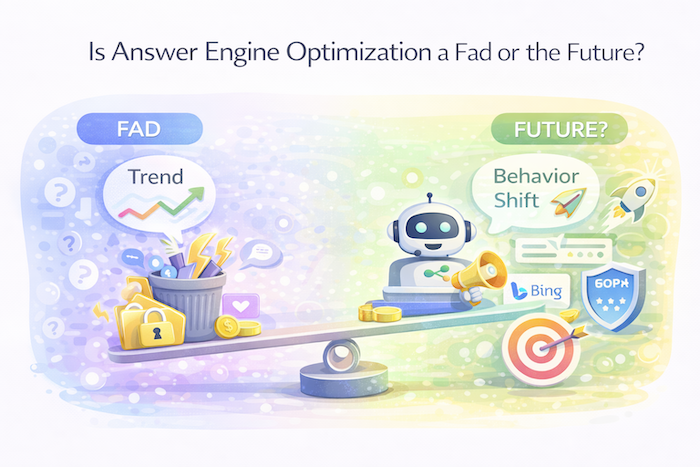
Answer Engine Optimisation (AEO) and its cousin, Generative Engine Optimisation (GEO), entered the SEO lexicon in 2024–2025 as AI assistants and generative engines such as ChatGPT, Bard/Gemini, Bing Copilot and Perplexity began to answer questions directly. Instead of serving ten blue links, these systems summarise content and cite sources. Marketers responded with new tactics designed to make content answer‑ready rather than just rank‑worthy. At first glance AEO/GEO may look like another marketing buzzword. This report examines whether AEO is merely a fad or part of search’s long‑term evolution.
Where the Scepticism Comes From
Buzzword fatigue. SEO has a long history of faddish acronyms. Critics point out that AEO and GEO can feel like rebranding, since they build on established SEO practices. A Search Engine Journal column warns that many predictions about AI search supplanting traditional search are overstated: generative chatbots are expensive and not yet ready to replace search engines. Because search still drives enormous traffic, some assume there is no urgent need for new optimisation strategies.
Unclear metrics. Unlike keyword rankings or organic traffic, there is no consensus on how to measure answer visibility. Many AI platforms do not expose citation metrics, and early AEO tools are evolving. Consequently, sceptics argue that marketers should wait until measurement is clearer.
Rebranding concerns. Early AEO proponents emphasise structured content, clear headings and FAQ schema. Skeptics note that these have always been good SEO practices and wonder if “answer optimisation” is simply SEO under a new name.
What AEO Actually Claims (and What It Doesn’t)
AEO does not claim to replace SEO or to “hack” AI models. The CMSWire article SEO Sidekick explains that AEO is a natural evolution: traditional SEO focuses on keywords, while AEO focuses on providing direct answers in a conversational format so that AI systems can cite them【916973652207203†L146-L144】. Neil Patel describes AEO as a subset of SEO—both aim to increase visibility but AEO demands more sophisticated structured data and question‑based content. AEO therefore builds on crawlability, authority and relevance; it adds answer‑first structure and schema markup to help AI select and cite content.
Importantly, AEO is not a separate algorithm you can game. AI engines synthesise information from multiple sources, and visibility comes from being a trusted citation, not from manipulating keywords. Good AEO practices overlap with Geo (generative engine optimisation) and revolve around content clarity, authority, structured data and consistent factual signals.
User Behaviour Is the Strongest Signal
Evidence of changing search behaviour is abundant:
- Rise of answer platforms. ChatGPT visits surged to 5.14 billion in April 2025, a 182 % year‑over‑year increase, overtaking Wikipedia. Per HubSpot’s consumer trends report, AI overviews reduce organic clicks but increase the value of citations.
- Zero‑click dominance. Data from several sources show that the majority of searches now end without a click. KLA Group notes that nearly 60 % of Google searches end without any click and over half of all queries are “zero‑click”. Apollo Technical’s guide reports that over 60 % of searches now end without a click, meaning users receive answers directly.
- Conversational queries. Cube Creative highlights that over 58 % of queries are now full sentences and voice‑style questions. Users increasingly ask AI assistants instead of typing keyword strings. The CMSWire article notes that 27 % of Americans have replaced search engines with AI chatbots, and the percentage is even higher among younger and tech‑savvy demographics.
- Adoption statistics. Menlo Ventures reports that 61 % of American adults have used AI in the past six months, and 500–600 million people worldwide use AI daily. KLA Group emphasises that clients now ask ChatGPT who they should trust; if your business isn’t picked as the answer, you’re invisible.
These trends show that people are shifting from browsing to asking. Search is still critical, but AI‑generated answers increasingly influence perception and decisions before a click occurs.
Momentum Behind Answer Engines
AEO is gaining real momentum from both users and investors. CMSWire notes that there have been about 30 AEO product launches in recent months, all attempting to do for AI search what SEO did for traditional search. A recent study found 27 % of Americans have replaced search engines with AI chatbots. AI companies attracted 58 % of global venture‑capital funding in Q1 2025, and VC firms are funding AEO‑focused startups, signalling that the shift toward AI‑driven discovery is not a fad.
AEO case studies also show tangible gains. Enaks Marketing reported that after pivoting to an AEO strategy, they achieved 92 % increased visibility, 84 % more organic traffic, 345 % growth in AI answer traffic and 240 % more impressions. These results suggest that answer‑ready content can boost both AI citations and traditional traffic.
Why This Is Not a Temporary Trend
Sceptics often view AEO as a short‑lived gimmick, yet several factors suggest otherwise:
- Structural shift in information retrieval. Apollo Technical’s article argues that “the transition to answer engines is not a fad; it is the inevitable evolution of information retrieval,” comparing the change to moving from a library model (finding a book) to an oracle model (asking a sage). It warns that “the blue links are fading” and urges brands to structure content to feed AI.
- AI overviews and zero‑click realities. Gartner predicts that up to 25 % of organic search traffic will shift towards AI assistants by 2026. With AI overviews now appearing in about 13 % of U.S. desktop queries and over half of Google searches ending without a click, ignoring AEO risks losing visibility.
- User experience and convenience. Once users experience direct answers, they rarely revert to lists of links. The Midas Creative article notes that tools like ChatGPT, Perplexity and Copilot are “becoming the new way users get information,” often bypassing search engines. It concludes bluntly that AEO is “not a fad; it is a structural change in how information is delivered online”.
- Investment and product integration. Google, Microsoft and OpenAI continue to integrate AI answers into search results. The CMSWire article emphasises that search engines are embedding AI rather than resisting it; the shift demands a complete rethinking of content strategy. AI overviews are already influencing click‑through rates—only 8 % of sessions with AI overviews result in clicks versus 15 % without, according to data cited by StackAdapt and Business Insider (as referenced in the advertising report).
How Search Engines Are Responding (Not Resisting)
Search engines are not being replaced; they are evolving into AI‑powered assistants. Nearly 99 % of URLs shown in Google’s AI Mode still come from the top 20 organic results, indicating a strong connection between SEO and AI answers. Google’s AI overviews, Bing’s Copilot and OpenAI’s ChatGPT all integrate links and citations, not standalone answers. The CMSWire article notes that AI platforms like ChatGPT have added clickable links, maps and other search tools, leading to increased referral traffic from AI. Instead of separate ecosystems, search and answer engines are converging into a hybrid system, and visibility depends on satisfying both algorithms.
AEO as an Extension of SEO, Not a Rival
AEO builds upon, rather than replaces, SEO. The iCrossing team writes that traditional SEO is built for search engines whereas AEO is built for people asking AI tools; visibility is about being referenced within the answer. They stress that AEO is not a hack but a strategic advantage, and success depends on credibility and relevance. Cube Creative underscores that AEO stands on SEO’s technical foundation—crawlability, schema and authority—but adds structured, conversational content that AI can parse instantly. KLA Group explicitly states that AEO “complements traditional SEO” and is designed for how buyers now search using AI and voice assistants.
Why “Normal SEO” Alone Is Becoming Insufficient
Ranking highly in search results no longer guarantees visibility in AI answers. Bounteous’ report points out that generative search may cause a 15.5 % drop in click‑through rates, even when rankings hold. CMSWire emphasises that AEO demands a rethinking of content strategy—sprinkling conversational phrases onto existing pages is not enough. Without structured answers, content may rank but remain invisible to AI. Furthermore, AEO metrics such as total prompt runs and brand mentions are emerging, signalling that new indicators will complement rankings.
What AEO/GEO Adds to Traditional SEO
AEO adds layers that enable AI engines to select, summarise and cite your content:
- Answer‑first content structure. AEO uses the “inverted pyramid” approach—directly answering the question in the first 40–60 words, then adding context and detail. This ensures that AI can extract a concise answer.
- Structured data and schema markup. FAQ schema, how‑to markup and award schema help AI platforms understand the information hierarchy. KLA Group notes that bullet points and clear headers allow AI to identify answers.
- Conversational query targeting. AEO optimises for complete questions and natural language phrases rather than isolated keywords. Cube Creative emphasises that conversational queries dominate and voice searches require concise, structured responses.
- Cross‑platform visibility. AEO prepares content to be cited across AI tools—Google AI overviews, Bing Copilot, ChatGPT, Perplexity and voice assistants. Visibility in these answer surfaces can drive high‑quality traffic and conversions.
- Entity and trust signals. AI engines prioritise credible, authoritative sources. AEO emphasises consistent facts across your website, PR, and third‑party listings. Misinformation or conflicting information reduces trust.
Historical Parallels in SEO
Search history shows that major shifts labelled as “fads” often became permanent:
- Mobile‑first indexing: Initially dismissed as a niche concern, mobile optimisation became mandatory after Google shifted to mobile‑first indexing.
- Featured snippets and zero‑click searches: When featured snippets first appeared, they were considered an experiment; now they account for a significant share of search results and have conditioned users to accept answers without clicks.
- Local packs and voice search: Local results and voice assistants changed how local businesses optimise content, yet these are now standard.
AEO follows this pattern. As iCrossing notes, search has never stood still; each disruption separates brands that adapt from those that fall behind.
Why AEO Feels “Vague” Right Now
AEO is still maturing, so uncertainty is natural. Platform rules are evolving, and AI models update frequently. Many AI engines do not reveal exactly how they select citations. New metrics such as AI prompt runs, brand mention rate, total citations and conversion from AI referrals are still being defined. Early experimentation often involves trial and error, which can feel nebulous compared to the more established world of SEO.
Who Can Safely Ignore AEO (for Now)
Not every business needs to prioritise AEO immediately. Hyper‑local services with minimal informational demand (e.g., emergency plumbers, restaurants with strong local presence) may continue to thrive through local SEO, map packs and traditional advertising. Very small or new businesses still building basic SEO hygiene should focus on technical health, on‑page optimisation and trust signals before investing heavily in AEO. Purely navigational or branded queries (users searching directly for a known company) are less influenced by AI answers.
Who Cannot Afford to Ignore It
Content‑heavy brands, SaaS companies, B2B providers and trust‑sensitive industries (finance, health, legal) rely on being referenced when users research complex topics. For these businesses, AEO is crucial. KLA Group stresses that B2B companies that adopt AEO early are more likely to earn visibility and trust from AI‑driven platforms. HubSpot’s article notes that brands that neglect AEO risk losing control of the narrative and missing out on high‑intent prospects. The iCrossing piece cautions that if your brand isn’t part of the answer, you’re invisible in an AI‑first discovery experience.
The Strategic Mistake Sceptics Make
Waiting for absolute proof of AEO’s impact is risky because behaviour is already changing. By the time metrics are standardised, competitors may have built strong answer presence. As CMSWire notes, content creators migrating early are capturing valuable traffic while others hesitate. Similar to past SEO shifts (mobile‑first, snippets), early adopters often pay less to adapt than latecomers. Instead of treating AEO as optional, consider it a directional shift that will integrate with SEO.
Reframing the Debate
The question is not “Is AEO real?” but “Are people still discovering information the same way?” Evidence shows the answer is no. Users now expect direct answers, AI assistants summarise content, and zero‑click searches dominate. AEO is simply SEO adapting to these realities. Cube Creative argues that AEO is an evolution, not a replacement, and those who master the fusion of traditional SEO and answer‑ready content will own the next wave of visibility. Midas Creative echoes that answer engines are not a passing trend but the next frontier..
Conclusion
Answer Engine Optimisation is not a fleeting fad; it represents a structural evolution in how information is retrieved and consumed. AI assistants and generative engines already influence millions of queries, and users increasingly prefer direct answers over lists of links. Traditional SEO remains foundational, but on its own it no longer guarantees visibility in AI‑powered answer surfaces. AEO/GEO adds answer‑first content structure, robust schema markup, conversational query optimisation and cross‑platform consistency. Brands that adapt early will stop calling it AEO; they will simply call it modern SEO. Those who wait risk being invisible to the next generation of search.
Pavel Uncuta is the founder of AiBoost, a UK AI marketing agency that builds visibility audit tools for professional services firms. He researches how Large Language Models cite brands across ChatGPT, Perplexity, and Google AI Overviews.
Want to know whether ChatGPT, Perplexity, or Google AI Overviews mention your firm? Run a free first-party visibility audit on your domain in under a minute and see exactly which queries cite you and which do not.