
TL;DR
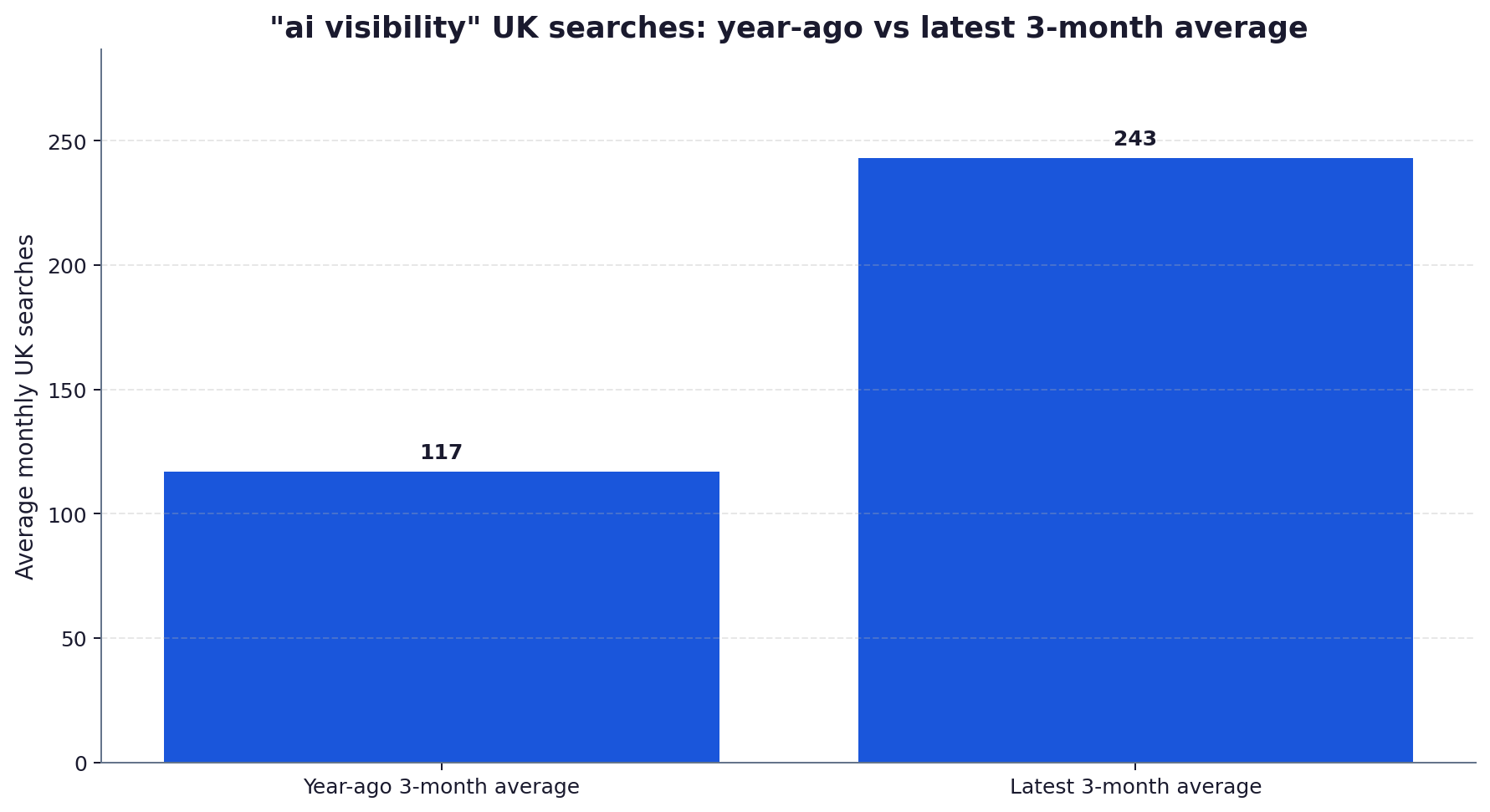
- UK searches for “ai visibility” averaged 117 a month a year ago and 243 a month in the most recent three months, a 108% rise (AiBoost keyword analysis of DataForSEO Google Ads data, August 2026).
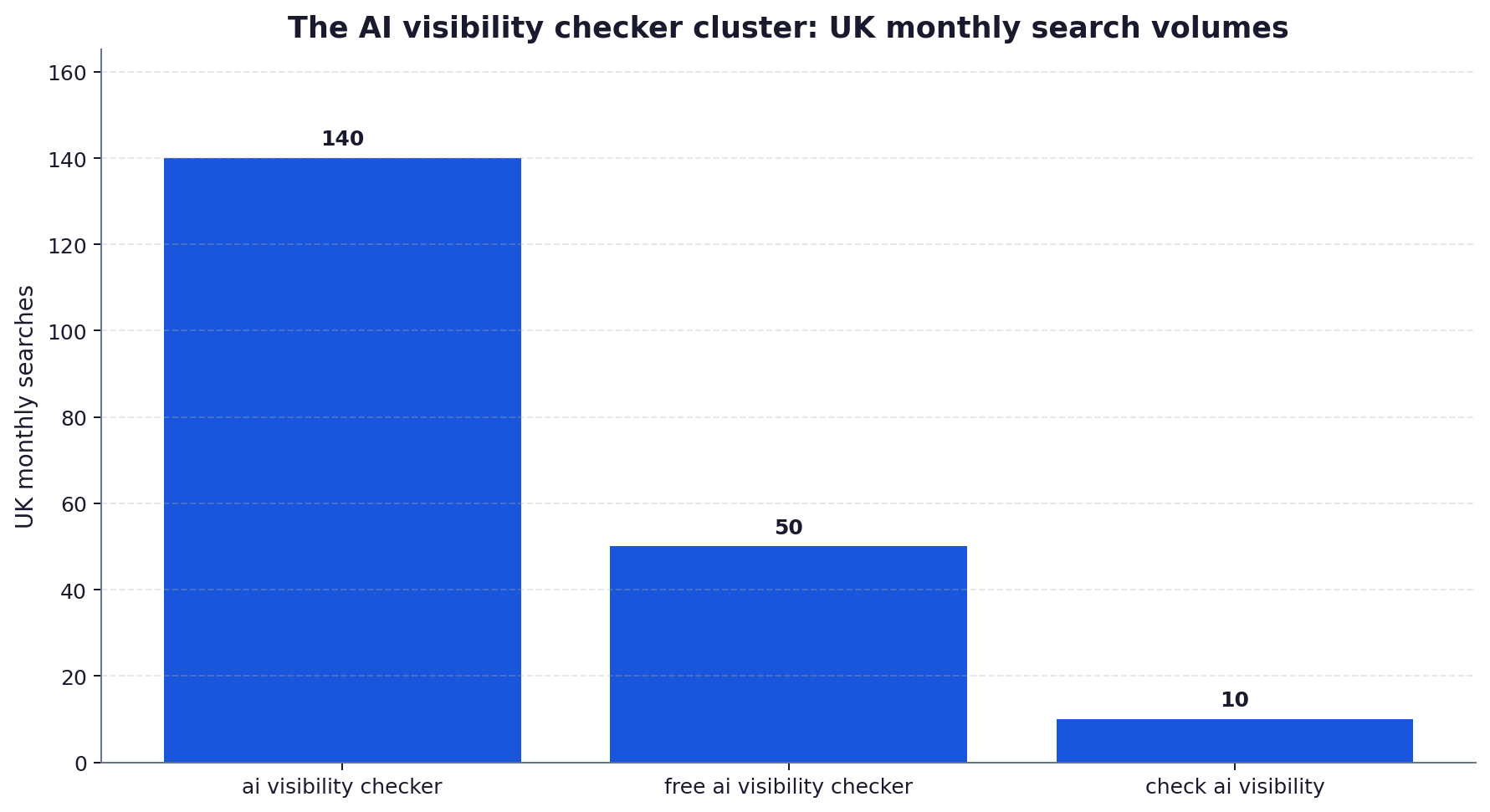
- The tool-seeking cluster is small but precise: “ai visibility checker” draws 140 UK searches a month at a keyword difficulty of 0 to 10, “free ai visibility checker” 50, and “check ai visibility” 10.
- “ai visibility check” itself registers between 140 and up to 390 monthly searches depending on the data source; we treat 140 as the floor.
- No paid tool is needed for a first check: 15 prompts across 3 funnel stages, run on 3 engines, with 8 fields recorded per run, takes roughly 90 minutes.
- Re-test the same panel monthly at minimum. AiBoost’s GEO Pulse tracker re-runs client panels weekly because AI answer sets move between runs.
- The method below mirrors the free GEO audit AiBoost has now run for 250+ UK small businesses.
Key facts
- “ai visibility” rose from a 117 to a 243 average monthly UK search volume across 12 months (AiBoost analysis of DataForSEO Google Ads data, 2026).
- “ai visibility checker” draws 140 UK searches a month at a keyword difficulty of 0 to 10 (DataForSEO, 2026).
- “free ai visibility checker” draws 50 UK searches a month and “check ai visibility” 10 (DataForSEO, 2026).
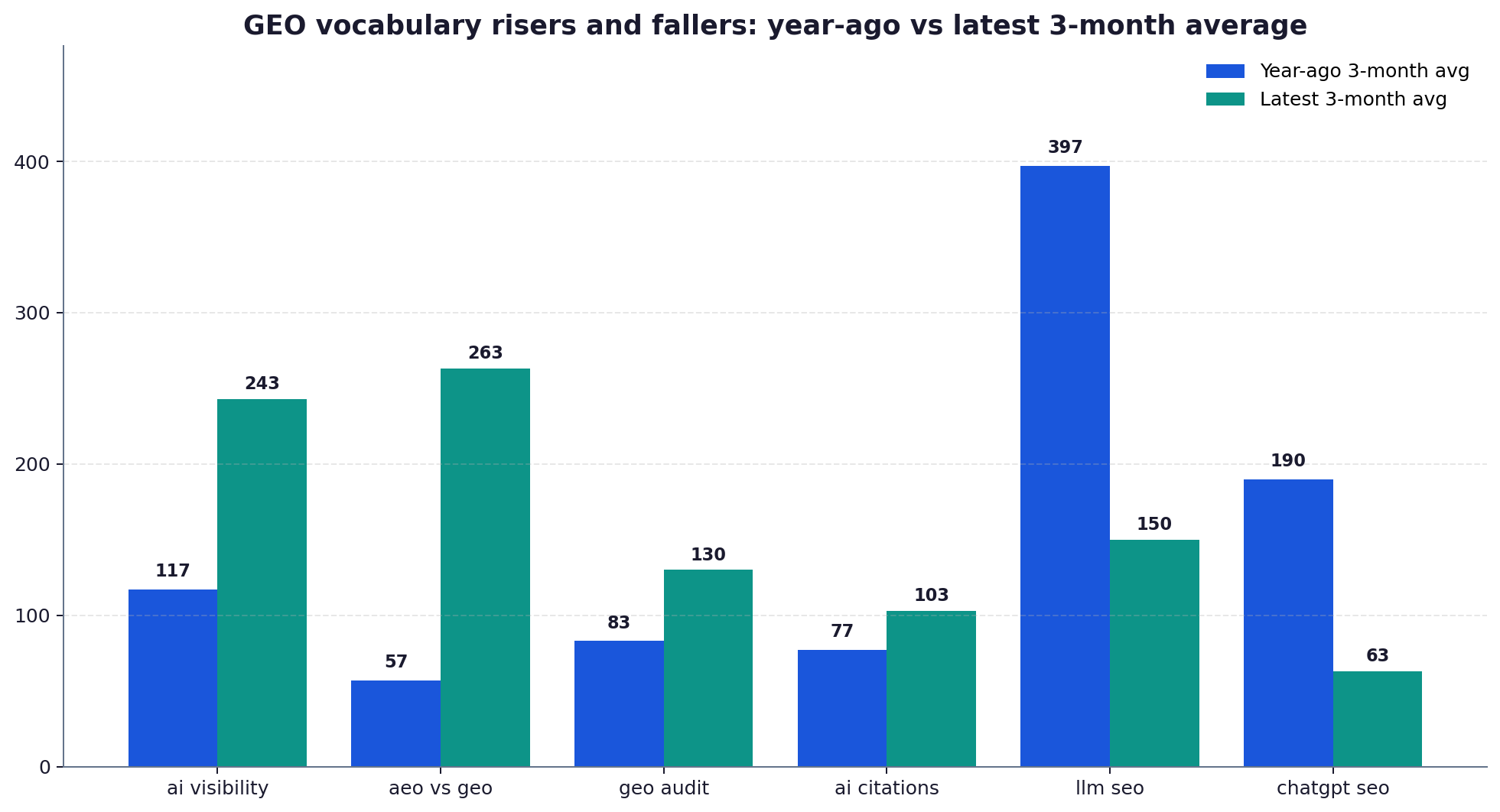
- “aeo vs geo” rose from 57 to 263 average monthly searches over the same 12 months, the sharpest relative riser in AiBoost’s GEO vocabulary set (DataForSEO, 2026).
- chatgpt seo” fell from 190 to 63 and “llm seo” from 397 to 150 across the same period (DataForSEO, 2026).
- The arXiv GEO paper (Aggarwal et al., 2024) established that content-side changes measurably shift how often generative engines cite a source.
- AiBoost has audited 250+ UK small businesses through its free GEO audit (AiBoost, 2026).
Demand for AI visibility checking has doubled in a year
The clearest signal in our August 2026 keyword scan is the trajectory of the parent term. “ai visibility” averaged 117 UK searches a month across the first three months of the 12-month window and 243 across the last three, a 108% rise. It happened while the older tactical vocabulary collapsed: “chatgpt seo” fell from 190 to 63 monthly searches and “llm seo” from 397 to 150. Business owners are no longer searching for engine-specific tricks. They are searching for a way to measure where they stand, which is where generative engine optimisation programmes begin.
The volumes are modest against head terms, and that is the point. A term that doubles from a low base while its neighbours halve tells you where attention is moving, and it rewards businesses that build the measurement habit before their competitors do.
What the checker cluster reveals about intent
The action-oriented cluster sits underneath the parent term. “ai visibility checker” draws 140 UK searches a month, “free ai visibility checker” 50 and “check ai visibility” 10, roughly 200 monthly searches of direct tool-seeking intent. “ai visibility check” itself shows between 140 and up to 390 monthly searches across data sources; we quote the floor because cross-source ranges deserve caution, not headline treatment.
Two details matter. First, the keyword difficulty on “ai visibility checker” measures 0 to 10, so almost nobody has built content that answers it properly yet. Second, one in four cluster searches specifies “free”. The market wants a method it can run itself before it pays anyone. This article is that method, structured the same way as the 10-step audit framework we published for agencies.
Step 1: build a 15-prompt panel across three funnel stages
A visibility check is only as good as its prompts. Write 15, five per funnel stage, before you open any AI engine, and keep them fixed so every future re-test measures change rather than prompt drift. This is the same panel structure AiBoost uses in its free GEO audit and in the 50-firm UK service benchmark.
Awareness prompts test whether engines surface your category at all: “What is [your service category] and when does a business need it?” or “How do I choose a [category] provider in the UK?” Consideration prompts test whether you enter the shortlist: “Which [category] providers work with small businesses in [your city]?” or “Compare the main approaches to [problem you solve].” Decision prompts test brand knowledge directly: “Is [your brand] a good choice for [service]?” and “What does [your brand] do and who are its typical clients?”
Substitute your own category, city and brand, and resist writing prompts your site would obviously win. The panel should read like a real prospect typed it.
Step 2: run the panel on ChatGPT, Perplexity and Gemini
Run all 15 prompts on each of the three engines, 45 runs in total. Use a fresh session per engine so earlier answers cannot contaminate later ones, and use a clean profile where possible, because personalisation skews results. Where an engine offers web search or grounding, leave it on; that is the mode where citations appear and the closest to what prospects see.
Expect disagreement between engines. Our cross-engine consistency audit found the same UK query routinely produces different brand sets on different engines, which is why a single-engine check gives false comfort. Watch for a subtler failure too: an engine that describes your brand confidently but wrongly. We cover the repair process in our guide to AI hallucinations about your brand.
Step 3: record eight fields per run
A check you cannot compare against next month is a curiosity, not a measurement. Record every run in a spreadsheet with eight fields: date, engine, prompt text, funnel stage, whether your brand was mentioned, whether your site was cited with a URL, which competitors were named, and the sentiment of any mention (positive, neutral, wrong). Keep screenshots of anything surprising.
The competitor column earns its place quickly. Knowing that one rival appears in 8 of 15 ChatGPT answers while you appear in 2 turns a vague worry into a specific gap. When you outgrow the spreadsheet, we have compared the paid options in our review of AI citation tracking tools and dashboards and the lighter-weight brand-mention monitoring tools.
Step 4: score mention rate and citation rate
Two numbers summarise the whole exercise. Mention rate is the share of prompts where your brand appears in the answer, calculated per engine: 3 mentions across 15 prompts on ChatGPT is a 20% mention rate. Citation rate is the share of prompts where your own site is linked as a source, which is always the lower and harder number, for reasons our analysis of which sources AI engines prefer sets out in detail.
Score the funnel stages separately. Most small businesses we audit score zero at awareness, near zero at consideration and respectably at decision, because engines can usually describe a brand once named but rarely volunteer it. That shape is normal. A composite measure such as a generative appearance score can come later; for a first check, two percentages per engine are enough.
Step 5: re-test the same panel on a fixed cadence
AI answer sets are unstable in a way search rankings are not. Our tracking work on citation volatility shows week-by-week movement in which brands appear for identical prompts, so a single check is a photograph of a moving object. Re-run the identical 15-prompt panel monthly at minimum. GEO Pulse, AiBoost’s weekly per-client tracker, exists because monthly sampling proved too coarse for active programmes.
Keep the prompts frozen between runs. The discipline feels pedantic and it is the entire basis of the measurement. Pair the cadence with a content routine, because visibility responds to freshness; our guidance on how often to update content for AI search gives sensible intervals by page type.
The vocabulary is consolidating around visibility
The wider keyword set confirms this is a durable shift rather than a spike. Every measurement-flavoured term in our GEO vocabulary scan rose over the 12 months: “aeo vs geo” from 57 to 263, “geo audit” from 83 to 130, “ai citations” from 77 to 103, alongside the “ai visibility” doubling. Every engine-trick term fell: “generative engine optimization” from 1,400 to 720, “llm seo” from 397 to 150, “chatgpt seo” from 190 to 63.
Read together, the market is moving from “how do I game one engine” to “how do I measure and improve my standing across all of them”. That is the correct question, and it is the one an AI visibility audit answers.
What to do with a low score
Most first checks come back low, and a low baseline is useful rather than embarrassing: it means improvements show up in the very next re-test. The levers are the substance of generative engine optimisation: entity-clear copy stating plainly what you do and where, structured data machines can parse, presence on the third-party sources engines actually cite, and a cadence that keeps pages fresh. The arXiv GEO paper (Aggarwal et al., 2024) demonstrated that changes of this kind measurably shift citation behaviour, which is why the check is worth running before and after the work.
Start with the decision-stage failures, because a brand the engines cannot describe accurately loses prospects who were already convinced. Then work upward through consideration prompts, where the competitor column of your spreadsheet tells you exactly whose presence you need to match.
How we test AI visibility
The five-step method is the same procedure AiBoost runs inside its free GEO audit and its weekly GEO Pulse tracking: a fixed prompt panel split across awareness, consideration and decision stages, run against ChatGPT, Perplexity and Gemini, with mentions, citations and competitor names recorded per prompt. Keyword demand figures come from one DataForSEO Google Ads pull, August 2026, UK location; the trend chart compares two labelled three-month averages from the same source.
Limitations
AI answers are non-deterministic, so a single run of any prompt proves little; the method controls for that with repeat runs and a fixed panel, but small samples still wobble. Engine behaviour changes without notice, and a check made today describes today. The demand figures carry Google’s usual volume banding, and the two sources we cite disagree on one term’s volume, which the article reports as a range rather than resolving artificially.
Frequently asked questions
What is an AI visibility check?
An AI visibility check is a structured test of whether AI engines such as ChatGPT, Perplexity and Gemini mention, describe or cite your brand when asked questions a real prospect would ask. It differs from a rankings check because there are no positions to track, only presence, accuracy and citations within generated answers. A usable check fixes a prompt panel in advance, runs it across several engines in fresh sessions, and records the results in a comparable format so the same test can be repeated later and the movement measured.
How much does an AI visibility check cost?
Nothing, if you run it yourself. The method in this article needs free-tier access to ChatGPT, Perplexity and Gemini, a spreadsheet and roughly 90 minutes for 45 prompt runs. Paid trackers add scale, scheduling and competitor dashboards, and the ad market around terms like “ai visibility tracker” shows serious vendor spend, but none of that is necessary for a first baseline. AiBoost also runs a free GEO audit that applies this panel methodology with grounding checks and a competitor citation table included.
Which AI engines should I test?
Test ChatGPT, Perplexity and Gemini as the minimum set. They use different retrieval systems and different source preferences, so they routinely disagree about which brands to mention for the same UK query; our cross-engine consistency work found single-engine checks give false comfort. Run each engine with web search or grounding enabled where offered, because grounded answers are where citations appear and they best reflect what a prospect sees. Add Copilot or Claude later if your audience uses them, but three engines cover most UK buyer behaviour.
How many prompts do I need?
Fifteen is the practical floor: five awareness, five consideration and five decision prompts. Fewer than that and a single odd answer swings your mention rate by double digits; many more and manual testing stops being sustainable, which matters because the panel must be re-run on the same wording every time. AiBoost uses the same three-stage panel structure in its free GEO audit, and scales the prompt count up only when a client’s services span several distinct categories or locations.
How often should I re-run the check?
Monthly at minimum, using the identical prompt panel each time. AI answer sets are volatile; our citation-volatility tracking shows the brands cited for identical prompts change week by week, so a single check is only a snapshot. AiBoost’s GEO Pulse tracker re-tests client panels weekly because monthly sampling proved too coarse to separate genuine trends from noise once optimisation work was underway. For a business not yet investing in GEO, monthly re-tests are enough to catch material shifts.
What should I do if ChatGPT does not mention my brand at all?
Treat it as a baseline, not a verdict. Zero mentions at awareness and consideration stages is the most common result we see across the 250+ UK small businesses AiBoost has audited. Start where the damage is largest: make sure decision-stage prompts return an accurate description of your business by tightening entity-clear copy, structured data and your presence on the third-party sources engines cite. Then target consideration prompts using the competitor column from your check, which shows exactly which rivals the engines prefer and where they are being found.
Sources and references
- DataForSEO Google Ads search volume data. DataForSEO, 2026
- GEO: Generative Engine Optimization. arXiv (Aggarwal et al.), 2024
- Google Search Central documentation. Google, 2026
Want your baseline done properly first time? AiBoost runs this exact panel methodology, plus grounding checks, structured data review and a competitor citation share table, as a free GEO audit with a scored PDF report.
Change log
- 2026-08-10: Initial publication.