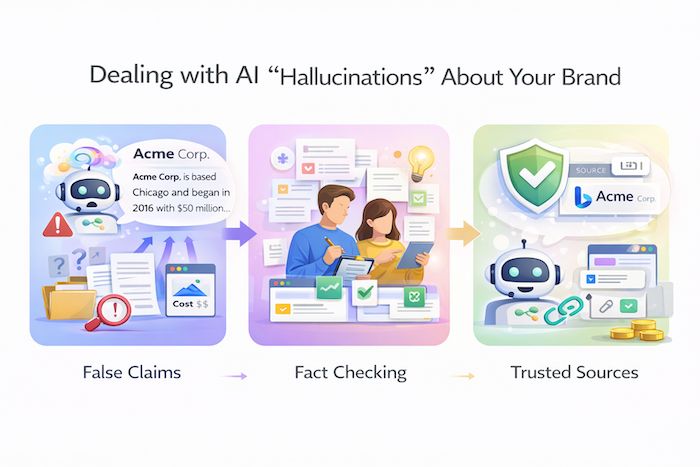
In a digital landscape increasingly mediated by generative search and chat assistants, AI hallucinations—outputs that sound plausible but are factually incorrect—have become a serious reputation risk. When models like ChatGPT or Gemini provide incorrect descriptions, pricing, or ownership information about a company, users often treat those answers as authoritative. This report explains why AI hallucinations happen, the types of brand‑related misinformation being generated, and practical steps brands can take to detect, mitigate and prevent these errors.
Why AI Hallucinations Happen
Generative models produce language by predicting the next likely word based on statistical patterns, not by verifying facts. As a result, gaps in training data, conflicting sources or ambiguous prompts invite fabrication. Models cannot evaluate truth; they rely on whichever sources appear most plausible. Ambiguous questions give them more room to improvise. Lesser‑known brands with sparse or inconsistent online data are especially vulnerable because the model has little reliable information to draw upon.
Common Types of Brand‑Related Hallucinations
- Incorrect descriptions or services – AI may describe your company as offering products or services you do not provide. This happens when it blends you with similarly named organisations or pulls outdated information.
- Wrong pricing, features or locations – LLMs sometimes average conflicting data (e.g., founding dates or headquarters) and present a value “in between”.
- Fabricated controversies or lawsuits – Models can hallucinate scandals or legal disputes when they conflate your brand with others that have such issues.
- Confusion with similarly named entities – Weak entity links cause AI to reference the wrong company, especially if your brand name is generic or shared by others.
Why Hallucinations Are a Serious Brand Risk
Users Trust AI Answers
Generative search tools are integrated into major platforms; 46 % of Americans use AI tools for information seeking and may assume they operate like reliable encyclopaedias. Customers rarely distinguish between “the AI got it wrong” and “the brand lied”; a misstatement becomes your credibility problem.
Rapid Spread of Errors
Hallucinated facts are cited in blogs, social posts and other AI systems, creating a misinformation snowball. A single wrong sentence can influence trust, leads or purchasing decisions before you even notice the error.
Legal and Financial Consequences
Recent cases show that brands can be held accountable for AI‑generated misinformation. For example, an Air Canada chatbot misinformed a customer about bereavement fares, and the tribunal ruled the airline responsible for negligent misrepresentation. Experts warn that false product recommendations or legal citations can lead to significant financial loss and reputational damage.
Early Detection: Knowing When AI Is Getting It Wrong
Run Regular Brand‑Related Prompts
Ask major AI platforms questions that users might ask (“Who is [Brand]?,” “What does [Brand] do?”). Document the responses and watch for shifts in tone or facts. In the Am I Cited framework, a structured prompt audit across models allows you to spot mismatches and measure semantic similarity to your verified brand descriptions.
Cross‑Check With Traditional Search
Compare AI answers with standard search results and your official materials. If AI misrepresents you, look for the source (e.g., outdated directories or misattributed reviews).
Track AI Mentions and Sentiment
Tools such as Semrush’s AI Visibility Toolkit and third‑party services like Yoast’s AI Brand Insights allow you to measure how often and in what context AI systems mention your brand. Monitoring these metrics helps identify negative narratives early.
First Response: Do Not Panic or “Fight” the AI
AI outputs cannot be edited directly by brands, and public arguments often backfire. Instead, treat hallucinations as signals that your data environment needs improvement. Document the error and focus on strengthening your data foundation.
Proactive Defence: Publish Clear, Authoritative Content
Maintain an Unambiguous About Page
Create a factual “About” section and FAQs with essential details (founding date, headquarters, services) in neutral language. Detailed answer‑shaped responses are more likely to be used by AI than vague marketing copy. Studies show that when conflicting information exists, AI chooses the most detailed story, regardless of truth.
Use Structured Data and Schema Markup
Implement JSON‑LD Organization, Person and Product schemas on your site to label names, founders, locations and products. Structured data tells AI exactly what each fact means, reducing misattribution. Include sameAs links to your official LinkedIn, Crunchbase, Wikipedia and Wikidata profiles to unify fragmented mentions.
Strengthen External Validation Signals
Third‑party confirmation carries more weight than self‑claims. Ensure reputable sites list consistent facts about your brand, and align press releases, business directories and social profiles. Cross‑links across platforms help AI consolidate your entity.
Monitor and Update Consistently
Hallucinations reappear because models retrain frequently. Perform quarterly audits—retesting prompts after major model updates—to catch new errors. Coordinate updates across SEO, PR and communications teams whenever leadership or product details change.
Correcting the Narrative Over Time
Provide Repeated, Consistent Signals
Models adjust their outputs based on repeated exposure to authoritative information. Publish correction content (blogs, press releases) and update structured data across all your channels. One correction is not enough; clarity and repetition matter more than urgency.
Use Platform Feedback and Reporting Tools
Many AI search interfaces include user feedback loops that allow you to report incorrect answers. Submit feedback directly through ChatGPT, Gemini or Google AI Overviews when you find errors. While feedback won’t fix the issue immediately, it contributes to model improvement.
When Legal or PR Escalation Is Appropriate
If an AI hallucination defames your brand or causes material harm, legal action or formal PR responses may be necessary. However, use these measures sparingly; differentiate between harmful misinformation and benign inaccuracies. In most cases, improving your data foundations will be more effective than litigation.
Preventive Content Strategy Going Forward
- Anticipate Questions – Identify the questions users and AI are likely to ask about your brand and create specific, answer‑shaped content to address them.
- Publish Boring but Clear Explanations – Factual, unambiguous content is more useful to AI than promotional copy.
- Treat Accuracy as an SEO and GEO Priority – Optimisation now includes ensuring your brand is represented correctly in AI outputs. Invest in Generative Engine Optimisation (GEO) alongside traditional SEO to secure mentions and citations.
Internal Ownership and Process
Assign responsibility for AI brand monitoring to a dedicated team or individual. Document known hallucination risks, maintain a log of brand facts, and build AI reputation checks into your quarterly marketing workflow. Collaboration between SEO, PR and communications teams is essential for timely updates.
What Not to Do
- Do not flood the web with low‑quality corrective content; duplication can confuse AI systems and hurt your GEO efforts.
- Do not copy competitors or Wikipedia; such tactics may violate intellectual property and are ineffective.
- Do not attempt to “trick” AI models; manipulation leads to long‑term penalties and brand damage.
Long‑Term Reality Check
Hallucinations are an inherent limitation of generative AI, not a reflection of your brand’s quality. Experts note that the problem is not fully fixable. Brands that invest in clarity and data consistency recover faster; those that remain ambiguous see hallucinations persist. The goal is not to control AI outputs directly but to influence what AI learns by providing consistent, authoritative information.
Conclusion
AI hallucinations pose real reputational, financial and legal risks. However, brands can mitigate these risks through proactive monitoring, structured data, clear content and cross‑platform consistency. You can’t control AI answers, but you can control the information AI has to work with. By treating accuracy as part of modern SEO and GEO strategies, companies can protect their reputation in an AI‑search world.
Want to know whether ChatGPT, Perplexity, or Google AI Overviews mention your firm? Run a free first-party visibility audit on your domain in under a minute and see exactly which queries cite you and which do not.