TL;DR
- Diners find restaurants through local search: “restaurants near me” draws around 11.1 million UK searches a month in Google Ads data.
- That makes your Google Business Profile (menu, photos, hours, reviews) the most important marketing asset most restaurants have.
- Google’s menu editor lets food and drink businesses list dishes and prices, and dish names you add take precedence over names added by customers.
- Google’s Gemini now writes review summaries for places, available in the UK in English, so what reviewers say shapes how AI describes you.
- Paid social fills quiet nights and launches; paid search matters most for bookings, events and private dining.
Key facts
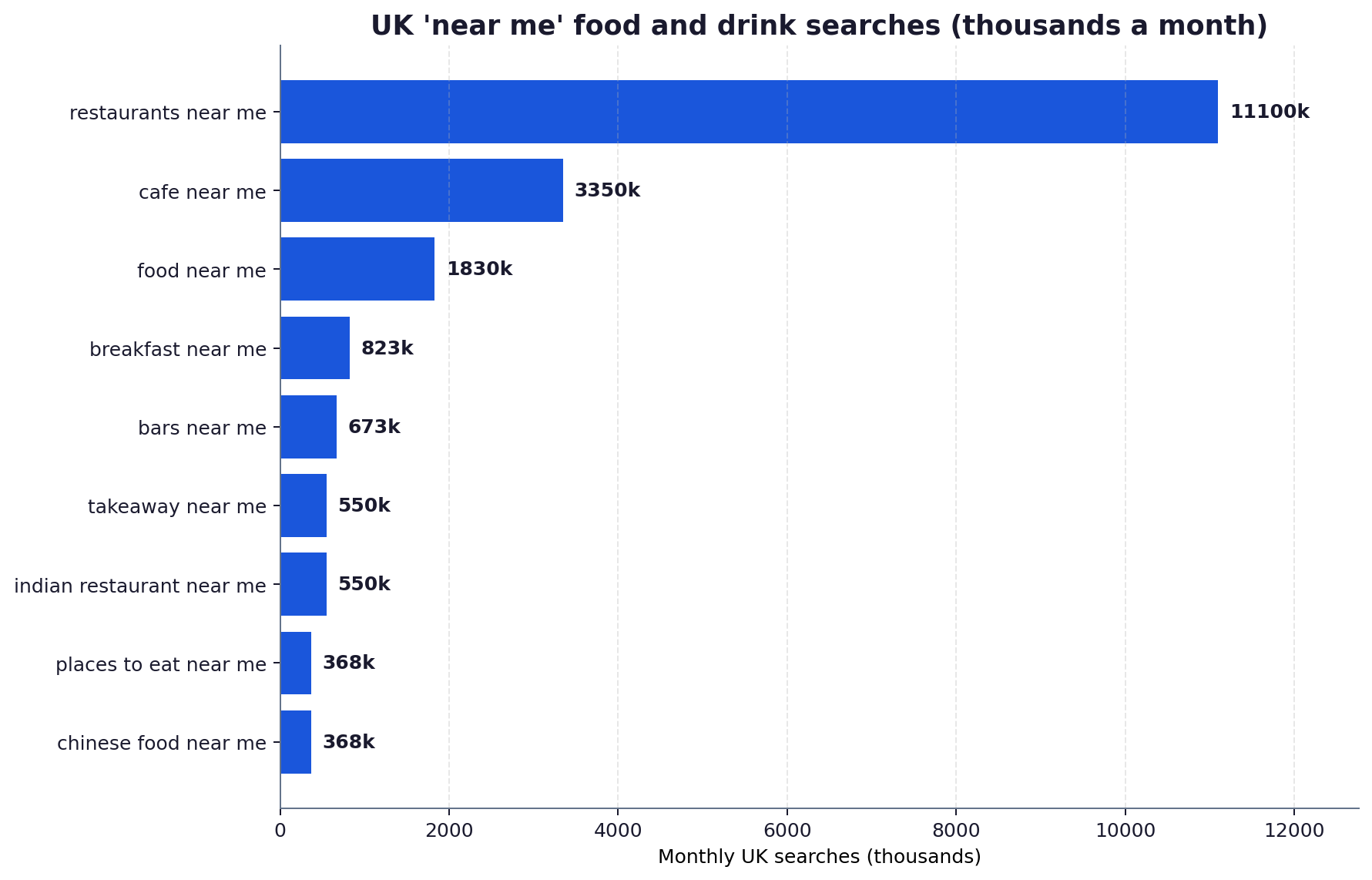
- “restaurants near me” has around 11.1 million UK searches a month; “takeaway near me” around 550,000 and “places to eat near me” around 368,000 (keyword.com, Google Ads data, October 2026).
- Restaurant owners search too: “restaurant marketing” around 320 a month, “restaurant marketing agency” 260 and “restaurant advertising” 170 (keyword.com, October 2026).
- Google’s menu editor is “available to food and drink businesses”, and changes “can take 24 to 48 hours” to show on Maps and Search (Google Business Profile Help, 2026).
- Dish names added by the business “will get precedence over dish names added by customers” (Google Business Profile Help, 2026).
- Google says more reviews and positive ratings “can help your business’s local ranking” (Google Business Profile Help, 2026).
- Gemini-powered review summaries in Google Maps Platform are available in the UK in English (Google Maps Platform, 2025).
Restaurant marketing advice often starts with social media, but search data tells a different story. When people decide where to eat, millions of them simply search “near me” and pick from what Google shows. This guide uses UK search demand and Google’s own documentation to set out where restaurant marketing effort pays back first, and how AI is changing the way diners choose.
How diners find restaurants: the search data
Short answer (October 2026): through local search. “Near me” searches for restaurants, cafes, takeaways and specific cuisines run into the millions every month in the UK.
| Search | UK searches a month |
|---|---|
| restaurants near me | 11,100,000 |
| cafe near me | 3,350,000 |
| food near me | 1,830,000 |
| breakfast near me | 823,000 |
| bars near me | 673,000 |
| takeaway near me | 550,000 |
| indian restaurant near me | 550,000 |
| places to eat near me | 368,000 |
Two lessons follow. First, the search happens at the moment of decision, often on a phone, often within walking distance. Second, cuisine matters: “indian restaurant near me” alone draws around 550,000 searches a month, so your Business Profile categories and menu need to say clearly what you serve.
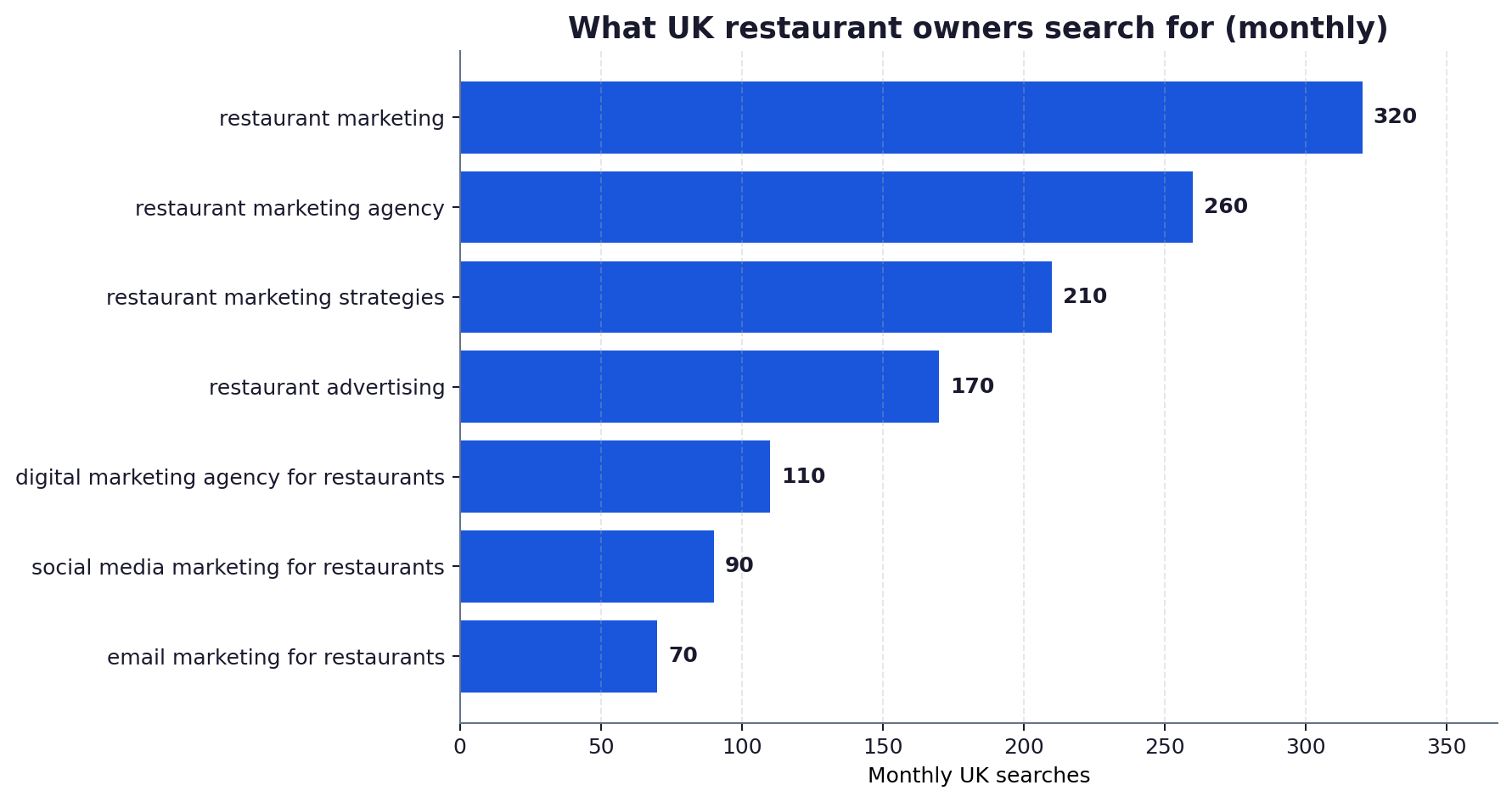
Restaurant owners are searching for help as well, with “restaurant marketing”, “restaurant marketing agency” and “restaurant marketing strategies” each drawing a few hundred searches a month. The rest of this guide answers what those owners are asking.
Google Business Profile: the restaurant’s shop window
Short answer: for most restaurants, a complete and current Google Business Profile does more than any other single marketing task, because it is what appears for “near me” searches.
Google says local results depend on relevance, distance and prominence. You cannot change your distance from the diner, but you control relevance (categories, menu, descriptions) and influence prominence (reviews, photos, links).
Your menu on Google
Google’s menu editor is “available to food and drink businesses”. You can add items with descriptions and prices, grouped into sections such as starters, mains and desserts. Changes “can take 24 to 48 hours” to appear on Maps and Search, so update before a new menu launches, not on the day.
Google also shows popular dishes, and both you and your customers can add dish names and photos. Google states that “dish names added by you will get precedence over dish names added by customers”, so name your signature dishes yourself rather than leaving it to diners. If Google transcribes your menu from your website, check the result: Google provides an opt-out for menu transcription if it gets things wrong.
The profile checklist
- Primary category that matches your cuisine, plus relevant secondary categories.
- Accurate opening hours, including bank holidays and seasonal changes.
- Current photos of dishes, the dining room and the exterior, so people recognise you on the street.
- A booking link or phone number that is answered during service.
- Menu with prices, kept current.
Our guide to Google Business Profile for local SEO covers setup and verification in more detail.
Reviews: what diners read and what AI repeats
Short answer: reviews influence both your local ranking and the summary Google’s AI now writes about your restaurant, so build a steady flow of genuine ones.
Google says “more reviews and positive ratings can help your business’s local ranking”. Reviews now matter in a second way too. Google Maps Platform made Gemini-powered summaries of places and reviews generally available, with review summaries available in the UK in English. A model condenses what diners say into a few lines, and that summary is often read before anyone opens your full profile.
That makes the words in reviews matter as much as the star rating. If diners consistently mention your Sunday roast or your service, that is what the summary is likely to highlight. Practical steps:
- Ask for reviews at the right moment, for example a small card with the bill or a follow-up message after a booking.
- Ask every diner, never only the ones who seemed happy. Google bans selectively soliciting positive reviews.
- Never offer a discount or free item in exchange. Google prohibits incentives, and UK law bans concealed incentivised reviews.
- Reply to every review, briefly and personally, including critical ones.
Our full guide to getting more Google reviews sets out exactly what is allowed.
Instagram and Facebook ads for restaurants
Short answer: use paid social to fill specific gaps, such as quiet midweek evenings, a new menu or an event, aimed at people within a short travel time.
Organic social posts reach mainly existing followers. Paid social lets you put a dish or an offer in front of local people who have never heard of you. What tends to work for restaurants:
- Short video of real dishes being plated or served, filmed in your kitchen.
- A tight radius around the restaurant, sized to realistic travel time.
- Time-specific offers tied to quiet periods, such as a midweek set menu, rather than permanent discounts.
- Event promotion for tasting evenings, live music, festive menus and private hire.
Our Meta ads management service plans and runs local campaigns like these. Restaurant owners searching “social media marketing for restaurants” (around 90 a month) are usually looking for exactly this kind of paid, local approach.
Google Ads for restaurants: when paid search pays
Short answer: paid search rarely beats a strong Business Profile for everyday “near me” diners, but it can pay for high-value bookings such as private dining, Christmas parties and events.
Clicks on “restaurants near me” are cheap but competitive, and much of that demand is already served by Google’s local results. Search ads earn their keep on bookings worth more than a single cover:
- private dining rooms and group bookings;
- Christmas and office party menus;
- weddings, christenings and celebrations;
- event nights and tasting menus.
Point each campaign at a page built for that booking, with capacity, sample menus and prices. Our Google Ads management page explains how we run search campaigns, and our guide to Google Ads pricing in the UK covers budgets.
Restaurants in AI recommendations
Short answer: diners increasingly ask AI assistants where to eat, and those assistants draw on the same reviews, menus and listings described above.
Someone asking ChatGPT, Gemini or Google’s AI Mode for “a good place for a family Sunday lunch near Islington” gets a short list, not ten results. The restaurants named tend to have clear, consistent information across their Business Profile, website and reviews. Our guide to Google AI Mode explains how Google’s AI chooses its sources, and you can check whether AI assistants mention your restaurant with our free AI visibility audit.
How to measure restaurant marketing
Short answer: track bookings and covers by source, plus the actions on your Google Business Profile, rather than likes or impressions.
| Metric | Where to find it | What it tells you |
|---|---|---|
| Calls, direction requests and website clicks | Google Business Profile performance | Whether local search is producing intent |
| Bookings by source | Your booking system | Which channels fill tables |
| Review count and rating trend | Google Business Profile | Local prominence over time |
| Cost per booking from ads | Ad platform spend divided by tracked bookings | Whether paid campaigns pay back |
If you already run ads and cannot see which ones fill tables, our paid ads audit reviews your accounts against the bookings they produce.
Frequently asked questions
What is the best marketing for a restaurant?
A complete, current Google Business Profile with an accurate menu, good photos and a steady flow of genuine reviews, because most diners find restaurants through “near me” searches. Paid social and search ads then fill specific gaps and high-value bookings.
How do restaurants get more customers?
Be easy to find and easy to choose: appear in local results, show your menu and prices, keep reviews recent, and make booking simple. Use targeted ads for quiet periods and events.
Should restaurants advertise on Instagram and Facebook?
Yes, for reaching local people who do not know you yet. Short videos of real dishes, a tight radius and time-specific offers for quiet periods tend to work better than permanent discounts.
How do I add my menu to Google?
Use the menu editor in your Google Business Profile, available to food and drink businesses. Add items with descriptions and prices grouped into sections. Changes can take 24 to 48 hours to appear on Maps and Search.
Do Google reviews affect restaurant rankings?
Yes. Google says more reviews and positive ratings can help local ranking. Reviews also feed the Gemini-written review summaries that Google now shows for places in the UK.
How do AI assistants choose which restaurants to recommend?
They rely on information they can find and trust, such as listings, menus, reviews and websites. Restaurants with clear, consistent details across those sources are easier for assistants to recommend.
Sources and references
- About the menu editor. Google Business Profile Help, 2026
- Manage your restaurant’s popular dish names. Google Business Profile Help, 2026
- Tips to improve your local ranking on Google. Google Business Profile Help, 2026
- AI-powered summaries for places, areas, and reviews are now Generally Available. Google Maps Platform, 2025
- Prohibited and restricted content. Maps User Contributed Content Policy Help, 2026
When someone asks ChatGPT or Google’s AI where to eat nearby, is your restaurant named? Our free audit runs real customer questions through the AI assistants and shows who they recommend instead.
Change log
- 2026-11-11: Initial publication.