TL;DR
- Google AI Mode answers longer, conversational questions with an AI-written response and a set of supporting links.
- Google says there are no extra requirements to appear in AI Mode. A page must be indexed and eligible to show with a snippet, and normal SEO best practice applies.
- AI Mode may use “query fan-out”: several related searches run behind the scenes to build one answer.
- AI Mode traffic is counted in Search Console’s Performance report under the “Web” search type, mixed in with ordinary results.
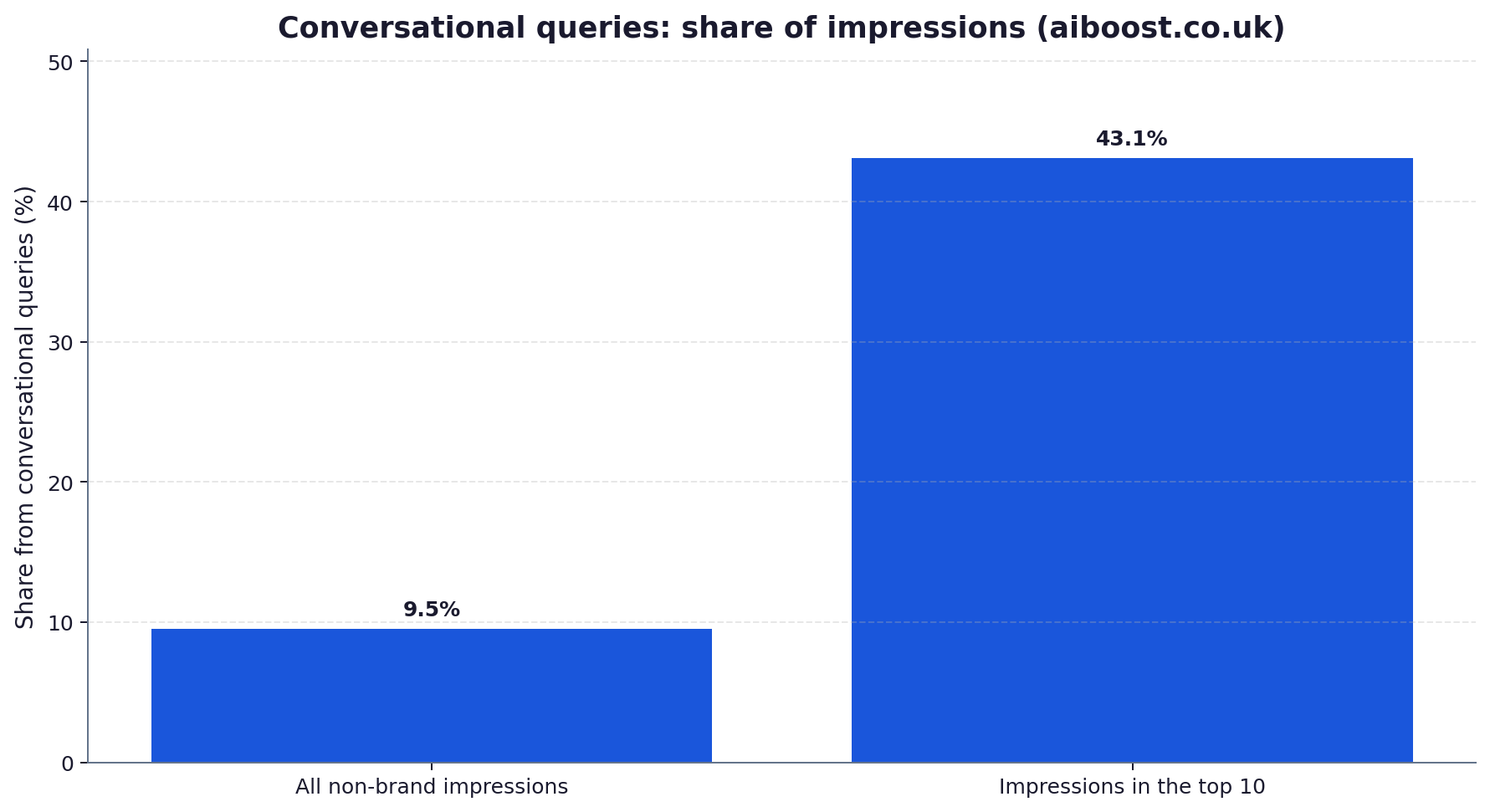
- On our own site, conversational queries were 9.5% of non-brand impressions overall but 43% of top-10 impressions, and earned no clicks in 90 days.
Key facts
- “There are no additional requirements to appear in AI Overviews or AI Mode, nor other special optimizations necessary” (Google Search Central, 2026).
- Both AI Overviews and AI Mode “may use a ‘query fan-out’ technique”, issuing multiple related searches across subtopics and data sources (Google Search Central, 2026).
- To be eligible as a supporting link, a page “must be indexed and eligible to be shown in Google Search with a snippet” (Google Search Central, 2026).
- Sites appearing in AI features are reported in Search Console’s Performance report, “within the ‘Web’ search type” (Google Search Central, 2026).
- google ai mode” has around 33,100 UK searches a month (keyword.com, Google Ads data, October 2026).
- aiboost.co.uk, 13 July to 10 October 2026: conversational queries were 43.1% of non-brand impressions at an average position of 10 or better, and earned 0 clicks (Google Search Console).
Google AI Mode changes what “ranking” means for a small business website. People ask full questions, Google runs its own background searches, and the result is an answer with a handful of links rather than ten blue ones. This guide explains how AI Mode works using Google’s own documentation, what it takes for your pages to be cited, and what our own Search Console data shows about the kind of visibility it creates.
What is Google AI Mode?
Short answer (October 2026): AI Mode is Google’s conversational search. You ask a detailed question, it writes an answer, and it links to pages that support the answer.
Google describes AI Mode and AI Overviews as features that “surface relevant links to help people find the information they’re looking for”. The difference is the type of question. Google notes that people can ask “nuanced questions that might have previously taken multiple searches”, from exploring a new concept to comparing options.
| Classic results | AI Overviews | AI Mode | |
|---|---|---|---|
| Where it appears | Standard results page | Top of some results pages | A separate conversational mode |
| When it shows | Every search | Only when Google judges it “additive to classic Search” | When the user switches to AI Mode |
| Query style | Short keywords | Mixed | Longer, detailed questions |
| Links shown | Ranked list | Supporting links | Supporting links |
| Reported in Search Console | Web search type | Web search type | Web search type |
Google adds that AI Mode and AI Overviews “may use different models and techniques, so the set of responses and links they show will vary.” Being cited in one does not guarantee a citation in the other.
How Google AI Mode chooses its sources
Short answer: it searches for you, several times. Google’s “query fan-out” runs related searches across subtopics, then picks pages that support each part of the answer.
In Google’s words, both features “may use a ‘query fan-out’ technique, issuing multiple related searches across subtopics and data sources, to develop a response.” While the answer is being generated, Google’s models “identify more supporting web pages”, which lets them show “a wider and more diverse set of helpful links”.
The practical consequence is that one question can pull in pages that rank for its sub-questions. A user asking “which accountant in Leeds is best for contractors who might fall under IR35?” might trigger background searches about IR35 rules, contractor accounting fees and Leeds accountants. A clear page that answers one of those sub-questions well has a route into the answer, even if it would never rank for the full question.
The eligibility rules
- The page must be indexed and eligible to show with a snippet. A
nosnippetornoindextag removes it. - Crawling must be allowed in robots.txt and by your hosting or CDN.
- Google says you “don’t need to create new machine readable files, AI text files, or markup”, and there is “no special schema.org structured data” required.
That last point is worth repeating, because many AI search pitches sell special files. Our guide to llms.txt covers the most common of them, and our notes on robots.txt and AI crawler settings cover access control.
What our Search Console data shows about AI Mode
Short answer: long conversational questions make up a small share of our impressions overall, but a large share of our top-10 appearances, and they produce almost no clicks.
Search Console does not separate AI Mode from other results. Google reports it inside the “Web” search type. What we can see is the shape of the queries. We split our non-brand queries from 13 July to 10 October 2026 into two groups: conversational (eight words or more, or ending in a question mark) and everything else.
| Group | Impressions at position 10 or better | Clicks |
|---|---|---|
| Conversational queries | 5,426 | 0 |
| Shorter queries | 7,154 | 20 |
| Total | 12,580 | 20 |
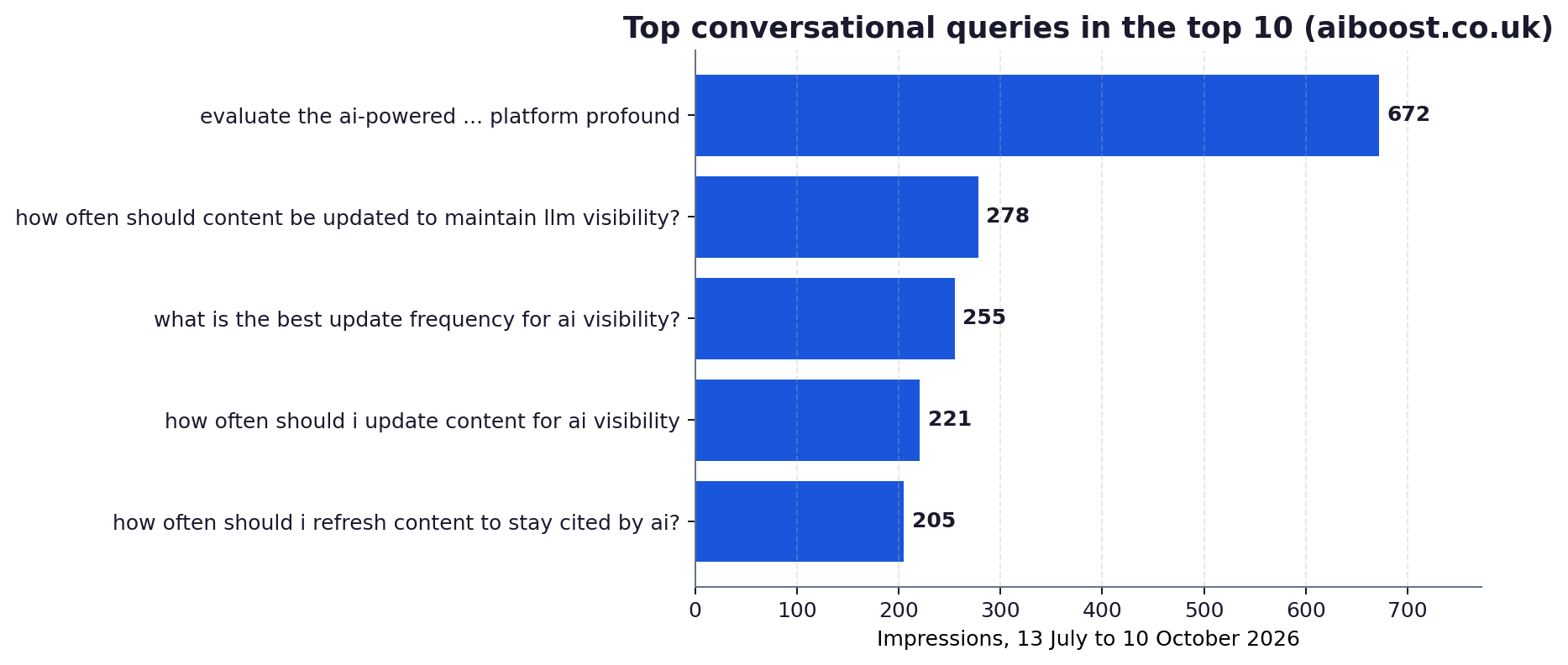
Conversational queries were only 9.5% of all our non-brand impressions, but 43.1% of the impressions where we sat in the top ten. They look like prompts typed into an AI interface, for example “how often should I refresh content to stay cited by AI?” (average position 3.4) and “what is the best update frequency for AI visibility?” (position 3.5). Our post on how often to update content for AI search visibility collects many of these.
Two readings follow. First, citation in AI answers is real visibility even when nobody clicks: your business is named or linked in front of a person asking a detailed question. Second, if you judge AI Mode by clicks alone, you will undervalue it. Google itself says that when people do click from results pages with AI Overviews, “these clicks are higher quality”, meaning visitors spend more time on the site.
How to get your business cited in Google AI Mode
Short answer: answer the sub-questions your buyers ask, clearly and in self-contained passages, on pages Google can crawl, index and snippet.
- List the real questions. Write down the 20 to 30 detailed questions customers ask before buying: prices, comparisons, suitability, timescales, local options. These are your fan-out targets.
- Give each question a home. A heading that matches the question and a direct 40 to 70 word answer underneath it, followed by detail.
- Keep business facts consistent. Google lists “checking that your Merchant Center and Business Profile information is up-to-date” among its best practices for AI features.
- Show evidence. Original numbers, named sources and real examples give an answer something to cite. Google recommends “supporting your textual content with high-quality images and videos” where relevant.
- Make it findable. Link to these pages internally. Google lists “making your content easily findable through internal links” as a fundamental.
- Keep important content in text. Key information should be “available in textual form”, not locked in images or scripts.
If you want a structured check of where you stand, our free AI visibility audit asks 34 real customer questions across ChatGPT and Gemini and scores the result. The method is explained in what a GEO audit checks.
How to track Google AI Mode visibility
Short answer: use Search Console’s Performance report, filter for long or question-style queries, and track citations directly with repeated checks.
- Search Console. AI Mode is inside the “Web” search type. Use a regex query filter such as
^(\S+\s+){7,}\S+for eight words or more, or\?$for questions, and watch impressions and average position over time. - Analytics. Google suggests tracking conversions and time on site in tools such as Google Analytics alongside Search Console.
- Direct checks. Ask AI Mode your key questions monthly and record whether you are cited. Our guide to AI citation tracking tools compares software that automates this.
For a step-by-step way to check visibility across assistants without paying for software, see our half-day AI search check.
Can you stop your content appearing in AI Mode?
Short answer: yes, but only with the same controls that limit ordinary snippets, which also reduce your normal search visibility.
Google says robots.txt directives for Googlebot are the control for crawling, and that “to limit the information shown from your pages in Search, use nosnippet, data-nosnippet, max-snippet, or noindex controls.” A separate control, Google-Extended, applies to AI training and grounding in some of Google’s other systems. For most businesses that want customers, opting out costs more than it protects.
Methodology
We exported Google Search Console query and page data for aiboost.co.uk for the 90 days from 13 July to 10 October 2026 (Web search type). We removed branded queries and site: searches, combined rows by query, and computed an impression-weighted average position for each query. A query counted as conversational if it had eight or more words or ended in a question mark. “Top-10” means an impression-weighted average position of 10 or better. Search demand comes from keyword.com, which uses Google Ads data. Google’s statements are quoted from its Search Central page “AI features and your website”.
Limitations
Search Console does not label which impressions came from AI Mode, AI Overviews or classic results, so conversational query shape is a proxy, not proof. Some long queries are typed into classic search, and some AI Mode traffic will use short queries. The data covers one website, an AI marketing agency whose content naturally attracts AI-related questions, so other sites will see different proportions. Search Console also withholds some low-volume queries for privacy, so totals undercount.
Frequently asked questions
What is Google AI Mode?
It is Google’s conversational search experience. It answers detailed questions with an AI-generated response and links to supporting web pages.
How do I get my website into Google AI Mode?
Make sure the page is indexed and eligible to show with a snippet, then answer specific customer questions clearly. Google says no special files, markup or optimisations are needed beyond normal SEO best practice.
Does AI Mode use the same ranking as normal Google search?
It draws on the same index and eligibility rules, but it may run several related searches (query fan-out) and use different models from AI Overviews, so the links shown can differ from classic results.
Can I see AI Mode traffic in Google Search Console?
It is included in the Performance report under the “Web” search type, combined with other results. Search Console does not separate it, so filter for long or question-style queries to approximate it.
Do I need schema markup or an llms.txt file for AI Mode?
No. Google states that you do not need new machine-readable files, AI text files or special schema.org structured data. Any structured data you use should match the visible text on the page.
Does being cited in AI Mode bring clicks?
Often very few. On our own site, conversational queries in the top ten earned no clicks over 90 days. The value is being named in front of someone researching a decision. Google reports that clicks from results pages with AI Overviews tend to be higher quality.
Is AI Mode the same as AI Overviews?
No. AI Overviews appear at the top of some normal results pages when Google judges them useful. AI Mode is a separate conversational experience. Google says they may use different models, so citations vary between them. If you want help getting cited in both, see our generative engine optimisation service.
Sources and references
- AI features and your website. Google Search Central, 2026
- Creating helpful, reliable, people-first content. Google Search Central, 2026
- Introduction to structured data markup in Google Search. Google Search Central, 2026
Want to know whether Google’s AI features and ChatGPT mention your business for the questions your buyers ask? Our free audit runs 34 real customer questions and shows where you appear and who is named instead.
Change log
- 2026-10-28: Initial publication.