
TL;DR
- UK small businesses got a free first-party number in 2026. Google Search Console’s Search generative AI performance report, announced on 3 June 2026, shows how often your URLs appeared in AI Overviews, AI Mode and Discover’s generative features.
- The rollout started with a subset of UK website owners before going global, so a UK business was among the first able to see this at all.
- The report gives impressions, pages, countries, devices and dates. It does not give clicks, and it does not give the prompts people typed.
- That gap is why a manual prompt check still matters. Run the questions a customer would actually ask, not your own brand name, and run each one more than once.
- Three checks cover most of it: what Search Console reports, what the engines say when asked, and whether the engines can fetch and read your pages at all.
- Most small-business failures are not exotic. They are a blocked or thin page, inconsistent business details across the web, and no page that answers the question the customer asked.
- None of this needs a subscription. The paid tools earn their place when you need tracking over time across several engines, not for a first look.
Key facts
- Google announced Search generative AI performance reports in Search Console on 3 June 2026, covering AI Overviews, AI Mode and generative features in Discover.
- The report includes impressions, pages, countries, devices and dates. Click data is excluded, and Google said it is still working out which insights help site owners most.
- Rollout began with a subset of UK website owners, then expanded globally alongside a control letting owners keep their content out of generative AI features in Search.
- Google Search Central states there are “no additional requirements to appear in AI Overviews or AI Mode”, and that you do not need to create new machine readable files or AI text files.
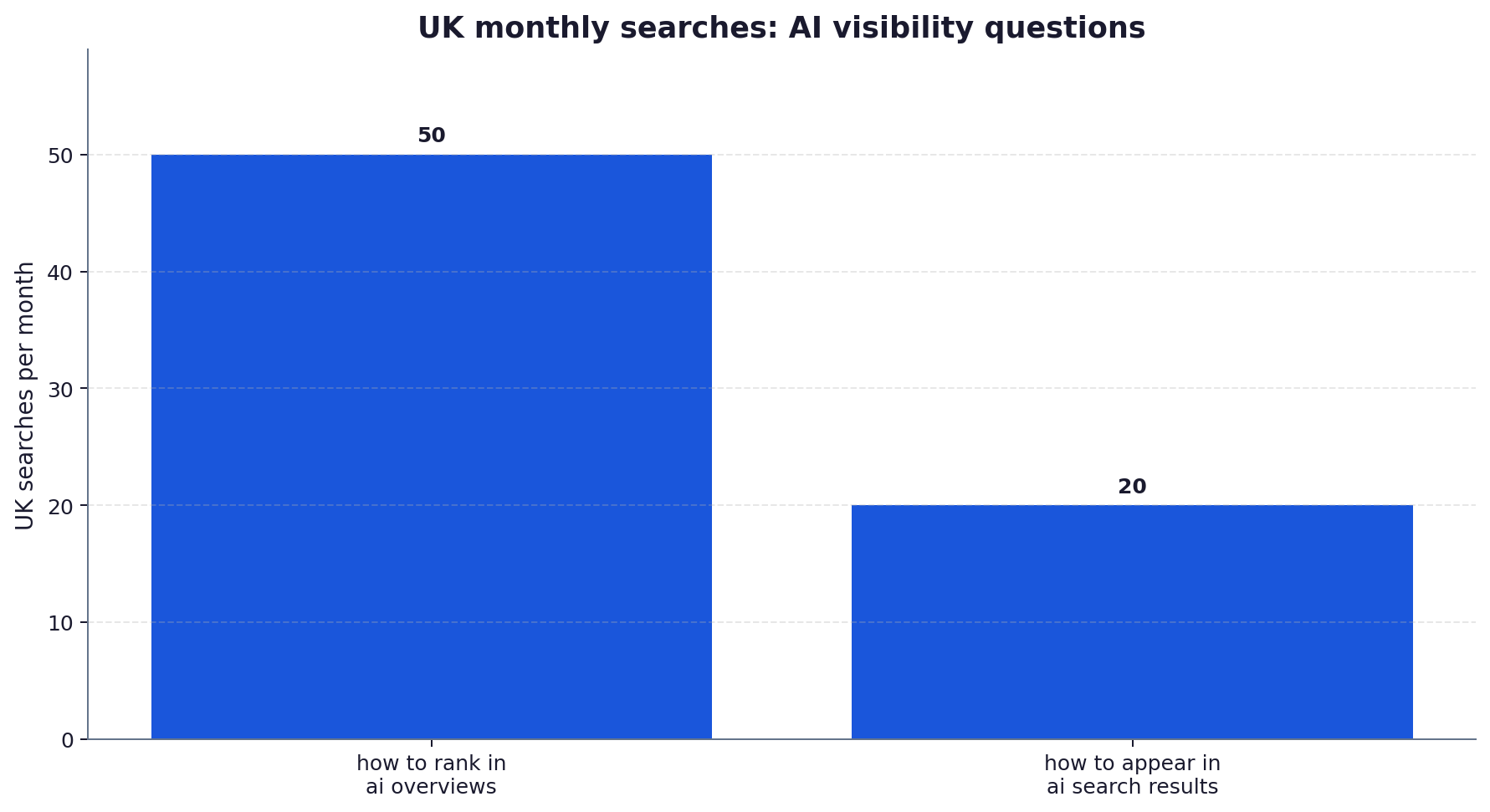
- UK demand for the underlying questions is small but rising: “how to rank in ai overviews” draws 50 searches a month and “how to appear in ai search results” draws 20, both at LOW competition (Google Ads search volume data, UK, 12 September 2026).
- AiBoost has audited 250+ UK small businesses and publishes the prompt framework it uses.
The free number a UK small business now has
Until the middle of 2026, a business asking how to appear in AI search results had to rely on asking the engines by hand and guessing at the rest. That changed on 3 June 2026, when Google announced Search generative AI performance reports inside Search Console. The report gives you a dedicated view of impressions in generative AI features on Search, meaning AI Overviews and AI Mode, plus the generative features in Discover, separated from ordinary organic data for the first time.
It rolled out first to a subset of UK website owners before expanding globally, alongside a separate control that lets an owner keep their site out of those features entirely. If you have Search Console verified for your domain, the data is already there and it costs nothing. If you do not have Search Console verified, that is the first job on the list, and it takes about ten minutes.
What the number actually means is narrower than it sounds. An impression records that a URL from your site appeared in a generative AI feature. It does not record that a person read your name, followed a link, or came away trusting you. Treat it as a presence signal, not a performance one, and read it next to the rest of your GEO measurement beyond clicks and rankings.
What the Search Console report will not tell you
Three absences matter, and knowing them in advance stops you drawing the wrong conclusion from a flat chart.
There are no clicks. Google publishes impressions for generative AI features and has said it is still working with site owners to understand which insights would be most helpful. So you can see that you appeared, and you cannot see whether appearing sent anyone to you. There are no prompts either. The ordinary performance report shows queries. This one does not surface the question a person actually asked, so you cannot work backwards from a rise in impressions to the topic that caused it.
And there is no Bing, no ChatGPT, no Perplexity, no Gemini outside Google Search. Search Console is Google’s own instrument, measuring Google’s own surfaces. A UK plumber who is quoted confidently by ChatGPT and invisible in AI Overviews will see nothing of the first half of that sentence here. That is the reason the manual check below has not gone away, and the reason tools that monitor brand mentions across engines exist at all.
The prompt check, done so the answer means something
Asking an assistant “do you know my business” is close to useless. It invites a polite yes, and it tests recall of a name rather than the moment that matters, which is a stranger asking for a recommendation without knowing you exist.
Write ten questions a customer would type, in their words, with your town in them. A domestic electrician in Leeds asks about a consumer unit replacement and a landlord certificate, not about “electrical services”. Split them across the funnel: a few awareness questions about the problem, a few consideration questions comparing options, and two or three decision questions that ask outright who to use in your area. Then run the same list through ChatGPT, Gemini, Perplexity and Google AI Mode, and write down what each one names.
Run each question at least three times, in a fresh session, ideally on different days. Answers move. The same prompt can produce different sources on consecutive runs, which is a property of these systems rather than a fault in your test, and it is the reason answer instability has to be designed into any check you take seriously. One run tells you almost nothing. Three runs across four engines gives you twelve data points per question, which is enough to see a pattern.
Record three things for each run: whether you were named, what the engine said about you, and which competitors it named instead. The third column is usually the most useful, because it tells you which businesses the engines currently treat as the safe answer in your area. This is the same structure behind AiBoost’s free GEO audit and the cross-sector benchmark of 50 UK service firms. If you would rather work from a list of methods than from a scenario, the companion piece on free ways to check AI visibility sets those out tool by tool.
Check the engines can fetch and read the page
A surprising share of small-business invisibility is mechanical. The content exists, the engines cannot use it.
Start with robots.txt. Confirm it allows the AI user agents you want, and blocks the ones you do not, deliberately rather than by accident. OpenAI documents GPTBot, OAI-SearchBot, OAI-AdsBot and ChatGPT-User; Anthropic documents ClaudeBot, Claude-User and Claude-SearchBot; Perplexity documents PerplexityBot and Perplexity-User. A blanket block copied from a template in 2024 is a common and quietly expensive mistake, and the detail is in our guide to robots.txt, GPTBot and crawler settings for AI.
Then check the page itself. Google’s own guidance for AI features asks for the obvious things: the page indexed and eligible for a snippet, crawling allowed, important content available in textual form, internal links that make pages findable. Prices buried in an image, opening hours rendered only by a script, and service descriptions living inside a slider are all invisible in the way that matters. Structured data helps the engines parse what is there, and it does not rescue content that is not.
What you do not need is a new file format. Google states plainly that you do not need to create machine readable files or AI text files to appear in these features, which is why llms.txt is optional housekeeping rather than a fix.
Check the facts the engines repeat about you
When an assistant does describe a small business, the description comes from whatever the web agrees on. Where the web disagrees, the engine either hedges or picks a competitor it can describe confidently.
Go and read your own details as a stranger would. Company name, trading name, address, phone number and opening hours across your site, Google Business Profile, Companies House, the trade directories and any membership bodies. A business that is Smith & Sons Plumbing in one place, Smith and Sons Ltd in another and Smith Plumbing Leeds in a third is three weak entities instead of one clear one, which is what entity linking is really about. The same consistency work underpins local SEO in the age of AI assistants.
Check the claims too. Accreditations, years trading, service areas and any numbers you quote should appear in at least one place you do not control. An engine summarising you will reach for the source that looks independent, and if nothing independent exists it will reach for a competitor who has one.
What to fix first when the check comes back thin
Most small businesses finish this exercise with the same three findings, in the same order of value.
First, there is no page that answers the question. The engines named competitors because a competitor published a page about the exact job the customer asked for, and you published a services page listing eight things. One page per real question, written plainly, beats a broad page every time, and it is the least glamorous and most reliable fix in SEO for small business.
Second, the details disagree. Fix the name, address and phone number everywhere before you write anything new, because consistency raises the confidence of every answer that follows.
Third, nothing is dated or attributable. Add a named author, a publication date and a last-updated date, and keep them honest. Freshness signals affect which sources get pulled into an answer, which is why update cadence earns a place in the plan. Once those three are done, the tactical work of ranking in ChatGPT has something to stand on.
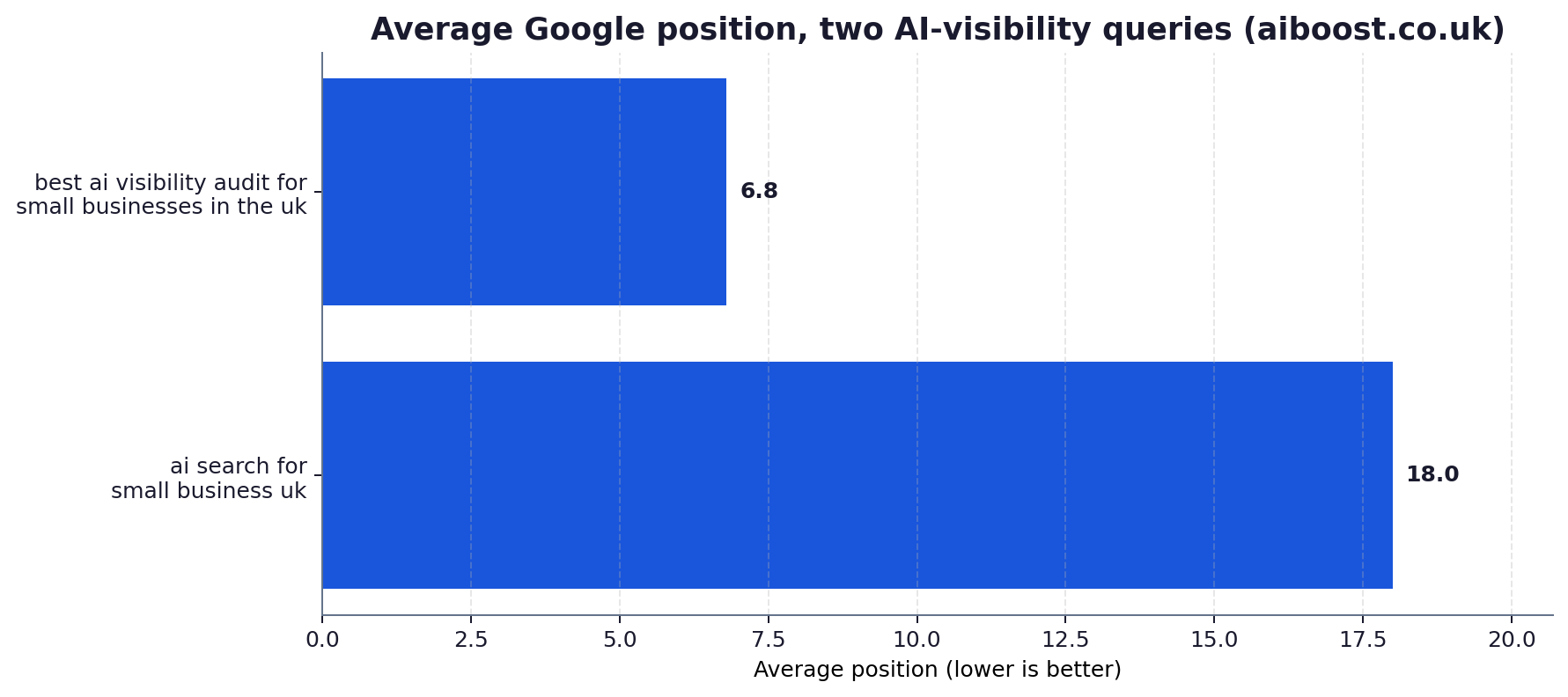
It is worth saying plainly that appearing is not the same as being chosen, and we can show that on our own data. Our research page on the state of AI search visibility for UK small businesses sits at position 6.8 on one AI-visibility question and 18.0 on another. Across the same five weeks, both returned zero clicks. Page-one presence on a low-volume question is a starting position, not a result, which is exactly how to read your own Search Console impressions when they arrive.
When it is worth paying someone
The checks above cost time and nothing else, and for a business with one location and a handful of services they are usually enough to find the problem. Paying makes sense at three points.
When you need the same measurement repeated. A one-off snapshot cannot show whether a change worked, and doing twelve prompts across four engines three times each, monthly, is several hours you probably do not have. When you operate across several towns or several services, because the number of prompt and location combinations multiplies fast. And when the answer you get is wrong rather than absent, because correcting what the engines believe about a business is slower and more delicate than filling a gap. The economics of that decision are the same ones that decide whether SEO is worth it for a smaller firm, and the underlying discipline is generative engine optimisation rather than anything new.
Frequently asked questions
How do I see whether my site appears in Google’s AI Overviews?
Use the Search generative AI performance report in Google Search Console, announced on 3 June 2026. It shows how often URLs from your site appeared in generative AI features on Search and Discover, broken down by page, country, device and date. You need Search Console verified for your domain, which is free and takes about ten minutes. The report shows impressions only, so it tells you that you appeared, not how many people clicked or what they had asked.
Does Search Console show ChatGPT or Perplexity visibility?
No. Search Console reports on Google’s own surfaces. Visibility in ChatGPT, Perplexity, Claude or Copilot has to be checked directly, by running customer-style prompts in each engine and recording what is named. That is why the manual prompt check remains part of any honest AI visibility review for a small business, and why the results should be recorded rather than remembered.
How many times should I run the same prompt?
At least three, in fresh sessions, preferably on different days. AI answers are unstable by design, and the same question can surface different sources on consecutive runs. A single run that names you proves nothing, and a single run that ignores you proves nothing either. Three runs across three or four engines gives you enough repetition to tell a pattern from noise.
Do I need an llms.txt file to appear in AI search?
No. Google’s Search Central documentation states that you do not need to create new machine readable files, AI text files, or markup to appear in AI Overviews or AI Mode, and no major AI search engine documents reading llms.txt from third-party sites. Publishing one is harmless and takes twenty minutes, so treat it as optional housekeeping once the indexed, readable, consistent basics are done.
What does it cost a UK small business to check this properly?
Nothing but time if you do it yourself. Search Console is free, and every engine can be queried on a free tier. Budget roughly half a day for a first pass: ten questions, three runs, three or four engines, plus an hour reading your own robots.txt, page content and business listings. Paid tools start to earn their keep when you need the same measurement repeated monthly across several services or locations.
My business is named by ChatGPT but not by Google AI Overviews. Why?
The engines draw on different indexes and different source preferences, so divergence is normal rather than a sign something is broken. Google’s AI features draw on the Google Search index, so eligibility follows ordinary indexing and snippet rules. Other assistants weigh their own crawls, licensed data and live retrieval differently. The practical reading is that whatever is working for one engine is worth strengthening, and the gap is usually a page that Google has not indexed or cannot read.
How long before a fix shows up in the reports?
Expect weeks rather than days, and measure in both places. A new page has to be crawled and indexed before it can be eligible for a generative feature, and impressions in the Search Console report accumulate slowly at small volumes. Re-run the prompt check monthly on the same questions so you have a like-for-like comparison, and do not read a single week of impression data as a trend.
Sources and references
- Introducing Search Generative AI performance reports in Search Console. Google Search Central Blog, 2026
- AI features and your website. Google Search Central, 2025
- OpenAI bots and crawler controls. OpenAI, 2026
- Does Anthropic crawl data from the web, and how can site owners block the crawler?. Anthropic, 2026
- Google Ads search volume data, UK keyword pull. DataForSEO, 2026
If you would rather see the result than run the check yourself, AiBoost’s free GEO audit tests awareness, consideration and decision prompts across the main engines and reports what they say about your business, what they get wrong, and who they name instead of you.
Change log
- 2026-10-05: Initial publication.