
TL;DR
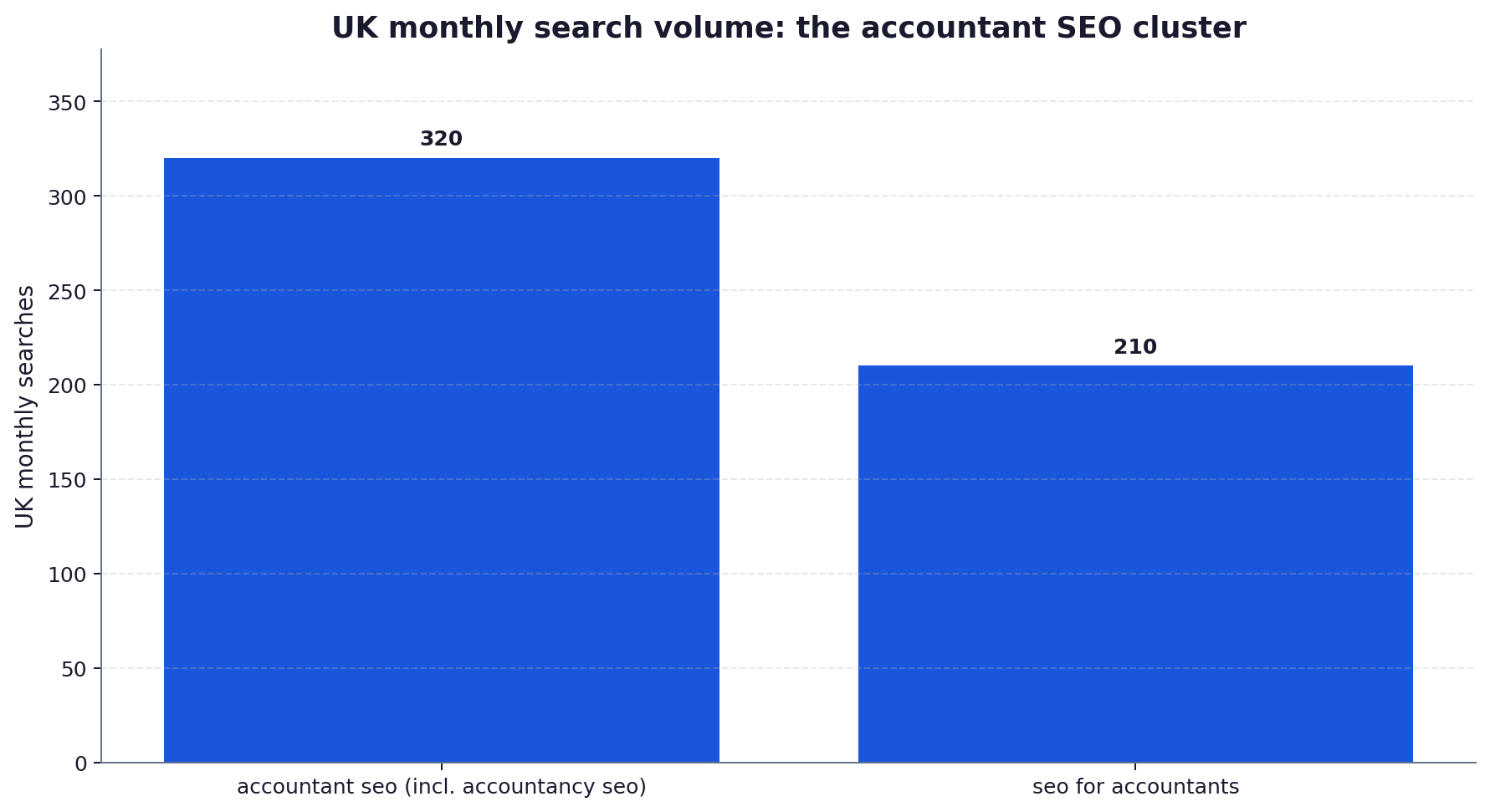
- The UK accountant SEO cluster runs at roughly 530 searches a month: accountant seo at 320 (accountancy seo sits in the same cluster) plus seo for accountants at 210, per AiBoost keyword analysis of DataForSEO Google Ads data, August 2026.
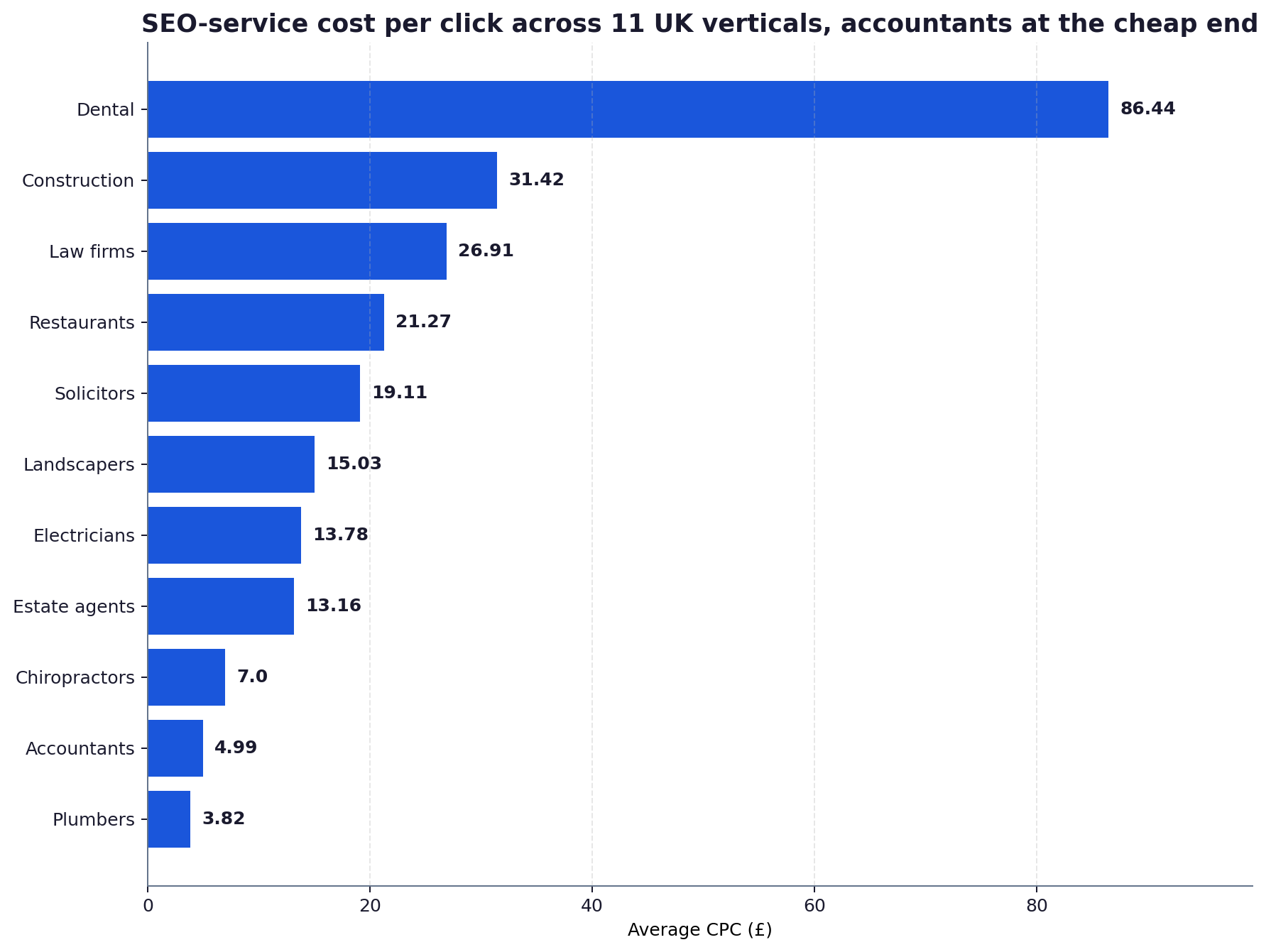
- A click on seo for accountants costs £4.99, the second cheapest of the 11 vertical service clicks in our August 2026 scan. Only plumbers, at £3.82, cost less.
- Dental SEO clicks cost £86.44 in the same scan, around 17x the accountant figure. Law firm clicks cost £26.91, around 5x.
- Advertiser competition on both accountant head terms is LOW, which means the organic market is winnable for an individual practice, without a national brand budget.
- At £4.99 a click, £1,000 of test media buys roughly 200 visits (simple arithmetic from the CPC table), so paid search and SEO can be validated side by side on a small-practice budget.
- Prospects have started asking ChatGPT and similar assistants to recommend an accountant, so the visibility question now extends past Google. AiBoost has audited 250+ UK small businesses on exactly this.
Key facts
- accountant seo: 320 UK monthly searches, LOW competition, with accountancy seo counted in the same cluster (AiBoost keyword analysis of DataForSEO Google Ads data, August 2026).
- seo for accountants: 210 UK monthly searches at a £4.99 average CPC (DataForSEO, August 2026).
- The combined accountant cluster is roughly 530 searches a month (DataForSEO, August 2026).
- Accountants sit tenth of 11 verticals on click price in the AiBoost August 2026 CPC scan: dental leads at £86.44, construction £31.42, law firms £26.91, and only plumbers at £3.82 sit below accountants.
- Every vertical in the scan, accountants included, showed LOW advertiser competition (DataForSEO, August 2026).
- AiBoost has audited 250+ UK small businesses for search and AI visibility (AiBoost, 2026).
- The generative engine optimisation methods referenced in the AI section trace to the arXiv GEO paper (Aggarwal et al., 2024).
A 530-search market with two distinct phrasings
The core demand for accountant SEO splits across two phrasings. Practice owners and practice managers who think of SEO as a product category type accountant seo, which carries 320 searches a month, with accountancy seo rolled into the same cluster. Buyers who frame the problem from their own side of the desk type seo for accountants, which adds 210. Together that is roughly 530 monthly UK searches, per AiBoost keyword analysis of DataForSEO Google Ads data, August 2026.
The split matters for anyone selling to accountants and for accountants assessing suppliers. The “for accountants” phrasing signals a buyer looking for sector understanding rather than a generic retainer, and the pages that win it are the ones that talk about self assessment season, practice software and client onboarding rather than generic ranking promises. For practices weighing up whether any of this deserves budget, our analysis of whether SEO is worth it for small businesses covers the decision maths that sits underneath this post.
Why an accountant click costs £4.99 when a dental click costs £86.44
In AiBoost’s August 2026 scan of 11 UK service verticals, accountants recorded the second cheapest SEO-service click at £4.99. The ladder above them is steep: dental at £86.44, construction at £31.42, law firms at £26.91, restaurants at £21.27, solicitors at £19.11, landscapers at £15.03, electricians at £13.78, estate agents at £13.16 and chiropractors at £7.00. Only plumbers, at £3.82, paid less per click.
Click prices in a functioning ad auction are a proxy for what advertisers believe a new client is worth relative to how many rivals are bidding. Dental sits at the top because a single high-value patient can justify an £86 click many times over. The accountant price points the other way: the UK has a dense supply of practices competing for recurring but modest fees, and the agencies selling to them price their bids accordingly. Cheap clicks do not mean low-quality demand. They mean the market has not yet bid the demand up, which is precisely the condition an early mover wants.
Cheap clicks are an argument for acting, not for waiting
The arithmetic is worth doing in the open. At £4.99 a click, a £1,000 test budget buys roughly 200 visits (1,000 divided by 4.99). The same £1,000 buys about 11 dental clicks at £86.44. That means an accountancy practice can run a meaningful paid-search validation experiment for the price of a single month of most software subscriptions, learn which terms convert, and then invest in an SEO programme that captures the same demand without paying per visit.
LOW competition on the head terms compounds the case. Every vertical in our scan showed LOW advertiser competition, and in organic search the accountant cluster behaves the same way: the firms ranking today are rarely there because of deliberate, sustained optimisation. A practice that commits to 6 to 12 months of focused work on winnable terms enters a market where most incumbents are not actually competing.
The compliance calendar is the content calendar
Accountancy demand is cyclical in a way most service verticals are not, because the deadlines are statutory and identical for everyone. Self assessment filing peaks into 31 January. VAT returns recur quarterly under Making Tax Digital. Company accounts fall due on a rhythm set by each company’s year end. We treat this as a qualitative planning fact rather than a volume forecast, and the practical rule is simple: pages aimed at a deadline need to be published, indexed and earning links well before the deadline month, because search engines and AI assistants both favour established pages over freshly published ones.
The working pattern we recommend is to build the deadline pages once, then refresh them on a fixed schedule rather than rewriting annually. Our guide on how often to update content for AI search visibility covers the refresh cadence; for a practice, the short version is that a dated, visibly maintained “self assessment deadline” page beats a new one published every December.
Local practice and national firm are different keyword games
The 530-search cluster is the national, category-level demand. Most accountancy practices should not fight for it first. A high-street or regional practice wins faster on “accountant in [town]” and service-plus-place terms, where the competition is a handful of local rivals rather than every marketing agency’s client list. That is a Google Business Profile, review velocity and location-page game, and we have set out the playbook in our local SEO strategies for UK accountants guide and, for the wider mechanics, in Local SEO in the Age of AI Assistants.
Remote-first and national firms play the opposite game: niche-plus-service terms such as contractor, e-commerce or landlord accounting, where the buyer’s location does not constrain the engagement. For these firms the category cluster analysed here is the realistic 12-month target, and the site itself carries more weight, since there is no map pack to compensate for a weak one. If the practice website cannot support either game, that is the first fix; our websites service exists for exactly this situation.
When a prospect asks ChatGPT for an accountant
A growing share of buyers now skips the search results page and asks an assistant directly: “recommend an accountant for a limited company in Leeds” or “best accountant for contractors UK”. We do not publish invented citation percentages for this behaviour, because the honest answer is methodological. What we can say is how we measure it: AiBoost runs the same funnel-stage prompt panels (awareness, consideration, decision) against ChatGPT, Perplexity and Gemini for every audited firm, records which practices are named and cited, and tracks the answers week by week through GEO Pulse. Across the 250+ UK small businesses we have audited, most firms discover their AI visibility for the first time inside that report, and the pattern in our 50-firm cross-sector benchmark is that professional-services firms cluster at the low end until they do deliberate work.
The work itself is generative engine optimisation: entity-clear copy, structured data, directory and register presence, and citable first-party pages, with the method tracing back to the arXiv GEO paper (Aggarwal et al., 2024). For accountants the stakes are structural rather than optional, a shift we unpack in how AI search is changing professional services marketing. The zero-cost starting point is a free GEO audit, which shows what the assistants currently say when a prospect asks about your market.
Where this leaves the accountant SEO playbook
This post consolidates and updates two earlier AiBoost accountant guides: the local SEO playbook and how accountants get more clients online. The August 2026 data sharpens both. The sequence that follows from the numbers is: fix the site, win the local or niche terms where competition is thinnest, build the compliance-deadline pages ahead of season, and add AI-assistant visibility as a measured workstream rather than an afterthought.
The £4.99 click is the summary statistic worth remembering. It says the accountancy market’s attention is still cheap, in paid and organic alike, and cheap attention in a LOW-competition cluster is the best entry condition a practice will get. The firms that act while the ladder still prices accountants below chiropractors will be the ones the next scan finds at the top of their local results, and named in the assistants’ answers.
How we compiled the numbers
Demand and cost figures come from one AiBoost pull of DataForSEO’s Google Ads data in August 2026, UK location, English, captured in the same session as 30 other service verticals. That shared snapshot is what allows the accountant cluster’s £4.99 click to be read directly against dental’s £86.44 rather than across tools or months. Cluster totals sum the phrasings Google reports separately.
Limitations
Volume banding, close-variant grouping and CPC averaging apply to every figure, and advertiser CPC measures bidding pressure rather than the value of an organic enquiry to a practice. Seasonality matters more in accountancy than most verticals; a January snapshot would look different from this August one, and the article flags rather than quantifies that cycle. Client lifetime values are discussed qualitatively only.
Frequently asked questions
How many people search for accountant SEO in the UK each month?
Roughly 530 a month across the core cluster. The term accountant seo carries 320 monthly searches, with accountancy seo counted inside the same cluster, and seo for accountants adds a further 210. The figures come from AiBoost keyword analysis of DataForSEO Google Ads data, August 2026. Both head terms show LOW advertiser competition, which is unusual for commercial-intent professional-services keywords and makes the cluster a realistic target for an individual practice rather than a market reserved for national brands.
Why do accountant SEO clicks cost only £4.99?
Because the ad auction prices clicks on what advertisers will pay to win a client, relative to how many rivals bid. The UK has a dense supply of accountancy practices competing for recurring but modest fees, so agencies bidding on seo for accountants pay £4.99 per click, against £86.44 for dental and £26.91 for law firms in the same AiBoost August 2026 scan. The low price signals an underbid market rather than weak demand, which favours practices that invest before competitors do.
Should my practice target local or national keywords first?
Local first, for almost every high-street or regional practice. Terms built on “accountant in [town]” pit you against a handful of local rivals instead of the national field, and Google Business Profile plus review velocity carry much of the weight. National, category-level terms in the 530-search cluster suit remote-first and niche firms, such as contractor or e-commerce specialists, where the client’s location does not constrain the engagement. Most practices should treat national terms as a 12-month goal, entered after local positions are secured.
How should accountants plan content around compliance season?
Publish ahead of the deadline, then maintain the page rather than replacing it. Self assessment peaks into 31 January, VAT recurs quarterly under Making Tax Digital, and company accounts follow each company’s year end, so the calendar is known in advance. Search engines and AI assistants both favour established, visibly maintained pages over freshly published ones, so a deadline page that has been live and refreshed for two seasons will normally beat a new page written in the deadline month.
Do prospects really ask ChatGPT to recommend an accountant?
Yes, and the honest way to assess your exposure is measurement rather than assumed percentages. AiBoost runs funnel-stage prompt panels, covering awareness, consideration and decision questions, against ChatGPT, Perplexity and Gemini for every audited firm, and tracks the answers weekly through GEO Pulse. Across the 250+ UK small businesses we have audited, professional-services firms typically start with little or no assistant visibility. A free GEO audit shows what the assistants currently say when a prospect asks about accountants in your market.
Is SEO worth the investment for a small accountancy practice?
The numbers in this post argue yes, provided the practice targets winnable terms. At £4.99 a click, £1,000 of paid media buys roughly 200 visits, which makes validating demand inexpensive, and LOW competition across the cluster means organic positions are genuinely available to firms that commit for 6 to 12 months. The recurring nature of accountancy fees also means one won client keeps paying back the acquisition cost year after year, which most other local-service verticals cannot claim.
Sources and references
- DataForSEO Google Ads search volume and CPC data. DataForSEO, 2026
- About ad auction and cost-per-click pricing. Google Ads Help, 2026
- Google Search Central documentation. Google Search Central, 2026
- GEO: Generative Engine Optimization. arXiv (Aggarwal et al.), 2024
Want the demand data in this post turned into a keyword-by-keyword plan for your practice? Request an SEO proposal and we will map your winnable terms from your actual market, town and service mix.
Change log
- 2026-08-10: Initial publication.