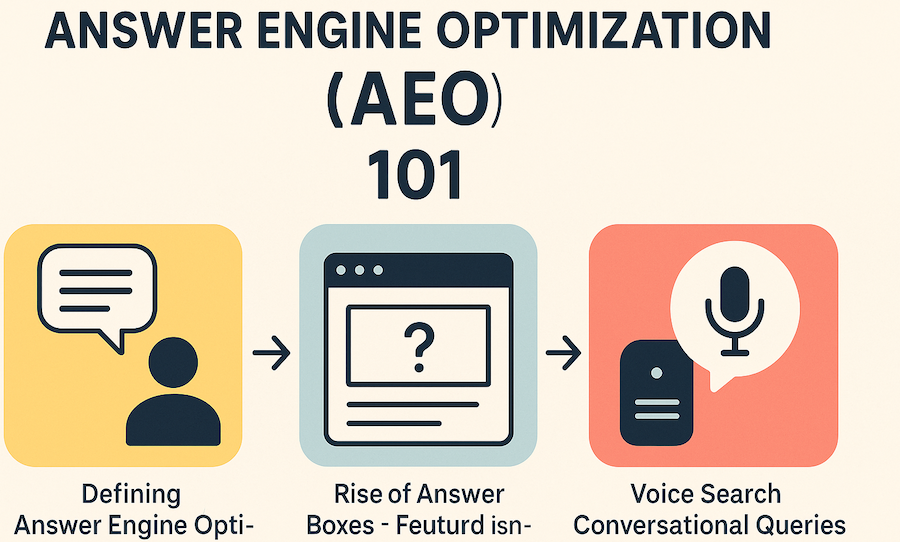
Search has never stood still. In the early days of the web, search engine optimisation (SEO) revolved around stuffing pages with keywords, building links and hoping to rise above competitors. As algorithms matured, SEOs learned that quality mattered more than quantity: well‑structured pages and trusted backlinks replaced keyword hacks. Today another shift is underway. Searchers often get what they need without leaving the results page or even looking at a screen. They ask their phones for restaurant recommendations, query smart speakers for the score of last night’s match and expect instant clarity. This move from links to answers has given rise to Answer Engine Optimisation (AEO)—the practice of structuring content so that search platforms can extract and deliver it as the answer to a question. AEO isn’t a replacement for SEO; it’s an evolution that prepares businesses for an era where visibility depends on being the answer, not just having a link.
The rise of answer boxes & featured snippets
Around 2014–2015 Google began reshaping results pages. It introduced the Knowledge Graph—a database of facts about people, places and things—and rolled out featured snippets at the top of the search results. These “position zero” boxes display concise answers, lists or tables drawn from websites. Ask “What is the capital of Scotland?” and you’ll see “Edinburgh” in a bold, framed box. Search for “2+2” or “currency converter” and calculators appear directly on the page. Sports scores, weather forecasts and factual definitions are all delivered before any traditional result. These answer boxes satisfy many queries in seconds, which means users often skip visiting a site at all. Research shows that more than half of searches now end without a click. For brands, that change is profound: winning visibility no longer means ranking first but being the source quoted in the answer box.
Voice search and conversational queries
The rise of voice assistants has accelerated this trend. By 2025, roughly 153 million people in the United States rely on voice assistants, and over one‑fifth of internet users worldwide conduct voice searches each quarter. Smart speakers sit on kitchen counters, and voice interfaces are built into phones, cars and televisions. Google Assistant counts more than 92 million U.S. users, followed by Siri at 87 million and Alexa at around 78 million. Voice commerce is booming too: global sales driven by voice are forecast to reach about $82 billion, reflecting the comfort people have with ordering via speech. Unlike typed searches, spoken queries are longer and more conversational. People ask “How do I reset my Nest thermostat?” instead of typing “Nest thermostat reset.” Words like who, what, where, when and how dominate. Voice searches are typically performed on the go, often with local intent—about three‑quarters of them relate to nearby businesses or services. The convenience of hands‑free interaction makes voice three times faster than typing and especially useful while driving, cooking or multitasking.
Modern voice search relies on natural language processing (NLP). AI models such as BERT and MUM help systems interpret the context and intent behind a question rather than matching exact keywords. They understand that “How do I start a garden?” may involve many subtasks, or that “What is the weather like in London tomorrow?” should yield a forecast. These models draw on huge datasets and knowledge graphs, mapping entities and relationships so that the correct answer can be synthesised. Recognising this shift from keywords to meaning is at the heart of AEO.
Comparing typed and voice queries
| Aspect | Typed search | Voice search |
|---|---|---|
| Query length | 1–3 keywords | Full conversational questions |
| Language style | Concise, keyword‑based | Natural, conversational phrases |
| User intent | Broad or exploratory | Specific, often local and immediate |
| Example | “weather tomorrow London” | “What’s the weather like in London tomorrow?” |
Voice queries reveal the intent clearly and require content that answers questions in the way people speak. The technical foundation behind voice search also demands that sites load quickly, are mobile‑friendly and use secure, crawlable architecture so that voice assistants can extract the right snippet.
How AEO works in practice
Answer engines act like three‑stage pipelines. First a user expresses intent through a query—typed or spoken. Next, the system interprets the query using NLP to understand the meaning and context. It then retrieves and synthesises information from multiple sources, combining structured facts, authoritative pages and knowledge graphs. Finally it delivers a concise response that might include a definition, a list, a table or a short paragraph. For your content to be pulled into this pipeline, it needs to be easy for machines to parse and trust.
Effective AEO starts with question research. Identify the specific questions your audience asks by analysing “People Also Ask” boxes, voice search suggestions and your own site’s search queries. Structure your pages so that each question is clearly stated as a heading (using H2 or H3) followed immediately by a succinct answer. A 40–60‑word summary is often ideal; it provides enough detail to satisfy a snippet while leaving room for deeper content below. Use lists, tables and step‑by‑step instructions where appropriate—these formats are favoured by answer boxes and are easy for voice assistants to read aloud.
Technical implementation matters. Schema markup—structured data written in JSON‑LD or Microdata—tells search engines how to interpret your content. For AEO, the most useful types are FAQPage, HowTo and Article schema, which define question‑answer pairs, procedures and key information. Speakable schema highlights sections of text that work well as audio, signalling to voice assistants which sentences to read verbatim. LocalBusiness schema ensures your address, hours and contact details are correctly surfaced for nearby searches. Beyond markup, classic technical SEO fundamentals remain essential: ensure your site is crawlable, loads quickly and offers a secure connection (HTTPS). Mobile‑responsive design is critical because most voice queries come from mobile devices.
Examples of AEO in action
You encounter the results of AEO every day. When you ask Google for the weather, a multi‑day forecast appears at the top of the results page. Type “NBA finals score” and a scoreboard with the latest results appears, often accompanied by a win‑probability chart. Search for simple maths equations or unit conversions and an interactive calculator emerges on the results page. Definitions—from dictionaries or encyclopaedia entries—are presented in a clean box with the term, its meaning and often its origin. These are all examples of answer boxes drawing from structured data and authoritative sources.
Outside of built‑in tools, publishers have also mastered AEO. Wikipedia appears regularly in definition and knowledge panels because its articles are well‑structured with clear headings, concise introductions and tables of facts. Recipe sites that begin with a two‑sentence summary (“To make sourdough bread, mix flour and water, ferment the dough, shape and bake until golden”) followed by ingredients and step‑by‑step instructions often earn position zero for “how to make sourdough bread.” Health portals structure articles so that common questions like “What causes high blood pressure?” or “What are the symptoms of diabetes?” are answered immediately, with deeper explanations below. Travel guides publish lists such as “Top attractions in London” or “Things to do in Tokyo,” which often appear as numbered items or bullet points in answer boxes. These formats not only help readers but also make it simple for answer engines to extract and present key information.
Key strategies for businesses
To harness AEO, businesses should integrate it into their content strategy rather than treat it as a separate discipline. Here are practical steps:
- Research conversational queries. Use tools like Google’s People Also Ask, Answer the Public or Semrush to discover common questions related to your products or services. Group them by intent (informational, navigational, transactional) and create content that addresses each one.
- Adopt a question‑and‑answer format. Structure your pages around actual questions using clear headings. Answer directly in a short paragraph before expanding. For long‑form articles, include a summary at the top that can stand alone as an answer.
- Create FAQ sections. At the bottom of product pages or blog posts, add a list of frequently asked questions marked up with FAQPage schema. Each answer should be concise—under 25 words—so that it can be quoted verbatim.
- Use lists, tables and step‑by‑step instructions. These formats signal structure to answer engines. For example, a recipe should include ingredients as a bulleted list and preparation steps as numbered items.
- Implement schema markup. Add FAQPage, HowTo, Article, Speakable and LocalBusiness schema where appropriate. Test your markup using search engine tools to ensure it’s error‑free.
- Optimise for local and mobile. Complete your Google Business Profile and ensure your name, address and phone number are consistent across the web. Voice queries often include “near me,” so local optimisation helps you appear in relevant results. Ensure your site is mobile‑friendly and loads quickly.
- Monitor voice and AI results. Perform searches on different devices (smart speakers, smartphones, desktops) to see how your content surfaces. Track brand mentions in featured snippets, voice responses and AI chat answers. Use analytics to measure engagement beyond clicks, such as branded search volume and conversions attributed to voice.
- Maintain accuracy and authority. Answer engines favour content that is correct, up‑to‑date and trustworthy. Regularly audit and update your answers. Cite original research and authoritative sources to build expertise and trustworthiness, even if those citations aren’t visible to users.
Benefits of AEO
Adopting AEO offers several advantages. Visibility without clicks is the most obvious: your brand can appear at the top of results and on voice assistants even if users don’t visit your site. This builds brand recognition and authority, positioning your organisation as the go‑to resource for common questions. Businesses that optimise for voice can capture high‑intent traffic: when someone asks “best Italian restaurant near me,” they’re ready to dine. For e‑commerce, voice search offers a frictionless purchase channel that’s growing rapidly. AEO also future‑proofs your content for AI‑driven search. As chat interfaces and generative engines become more prevalent, content structured for AEO is more likely to be cited in AI‑generated summaries, ensuring your expertise remains visible.
Limitations of AEO
Despite its benefits, AEO has constraints. Zero‑click results reduce direct traffic. When searchers find answers on the results page or via voice, they may never visit your site. This can hurt traditional metrics like click‑through rate and time on site, making it harder to attribute conversions. Competition is fierce for position zero. Only one or two snippets are shown for most queries, so winning and retaining that spot requires constant optimisation. Algorithm changes are frequent. Voice assistants and AI systems refine their ranking criteria regularly, and best practices can become outdated quickly. Measurement tools are limited. Many analytics platforms don’t clearly report traffic from voice assistants or AI citations. Businesses must rely on indirect metrics such as branded search volume or surveys. Finally, resources and skills pose a challenge. Crafting concise answers, implementing schema, and keeping content updated demand coordination across marketing, product and technical teams.
How AEO laid the groundwork for GEO
Generative Engine Optimisation (GEO) builds on the principles established by AEO. Where AEO focuses on placing your content in answer boxes and voice results, GEO aims to ensure your information is cited within AI‑generated responses from tools like ChatGPT, Google’s Search Generative Experience and Bing Copilot. These generative engines don’t just extract a snippet; they synthesise answers using large language models trained on vast corpuses and vector embeddings that encode the relationships between concepts. The content they generate is shaped by semantic meaning, contextual authority and entity clarity, all hallmarks of AEO.
AEO prepared the ground by emphasising concise, factual summaries, robust schema markup and topical authority. These elements make it easier for AI to understand and trust your content. By prioritising structured data, you align your site with knowledge graphs, which are a key input for generative models. AEO’s focus on conversational queries and voice search mirrors the natural language prompts users give to AI chatbots. Businesses that have implemented AEO therefore enjoy a head start: their content is more likely to be recognised and cited when generative engines compose answers. In this way, AEO is the bridge between the keyword‑driven era of SEO and the semantic, AI‑driven future represented by GEO.
Evolution of search optimisation
| Era | Primary focus | Typical query style | Key goal |
|---|---|---|---|
| SEO | Ranking web pages | Short keywords | Drive clicks to your website |
| AEO | Answering questions | Conversational questions | Provide direct answers in snippets and voice |
| GEO | Generative AI answers | Natural language across modes | Be cited as an authoritative source in AI summaries |
Conclusion
The journey from SEO to AEO and now towards GEO shows how search has evolved from a list of links to a dynamic, answer‑driven experience and ultimately to generative, conversational assistants. Answer Engine Optimisation isn’t merely a buzzword—it’s a crucial step in adapting to a world where people expect immediate, accurate information through text, voice and chat. By structuring your content around clear questions and concise answers, using schema markup to signal meaning, and maintaining authority and accuracy, you ensure your brand remains discoverable even as clicks decline. AEO also lays the foundation for success in the generative future, where AI will weave information from many sources into coherent responses. Businesses that embrace AEO today will be better positioned to thrive tomorrow, no matter how users choose to search.
Want to know whether ChatGPT, Perplexity, or Google AI Overviews mention your firm? Run a free first-party visibility audit on your domain in under a minute and see exactly which queries cite you and which do not.