Introduction
Generative search experiences from Google, Bing and chat‑based assistants like ChatGPT have fundamentally changed how people discover information. These platforms use large language models (LLMs) that retrieve documents from search indices, weigh their relevance and authority, and then generate single, aggregated answers. In this environment, being visible in traditional search engine results is necessary but not sufficient; businesses need to be selected, cited or recommended by AI tools. These trends have fuelled the rise of the AI SEO agency—a specialist consultancy that focuses on making brands visible inside AI‑powered search and answer engines. This report explains what these agencies do, how they differ from traditional SEO firms, who should consider hiring one, and what to expect.
What an AI SEO Agency Actually Is
An AI SEO agency (often called a Generative Engine Optimisation (GEO) agency) is not simply a traditional SEO agency using AI tools. Its remit is broader: it helps brands become discoverable, credible and repeatedly cited by generative systems such as Google’s AI Overviews, Microsoft Copilot and ChatGPT. These agencies understand how retrieval‑augmented generation works. They optimise content so LLMs can find it during the retrieval phase, extract clear facts and context during ranking, and quote or summarise it in generated answers. In other words, an AI SEO agency focuses on answer‑layer visibility, not just ranking positions. Their work encompasses:
- AEO (Answer Engine Optimisation) – structuring content so that it answers specific questions directly and can appear in featured snippets, People Also Ask, voice assistants and AI Overviews. AEO emphasises clarity, concise intros, question‑based keywords, FAQ schema and lists.
- GEO (Generative Engine Optimisation) – ensuring that generative systems select and cite your content when producing long‑form answers. This requires fact‑dense passages, unique insights, structured data, strong topical authority and third‑party citations.
- AI‑accessibility audits – checking robots.txt settings, site performance and structured data so LLMs can crawl and understand content.
How AI SEO Agencies Differ from Traditional SEO Agencies
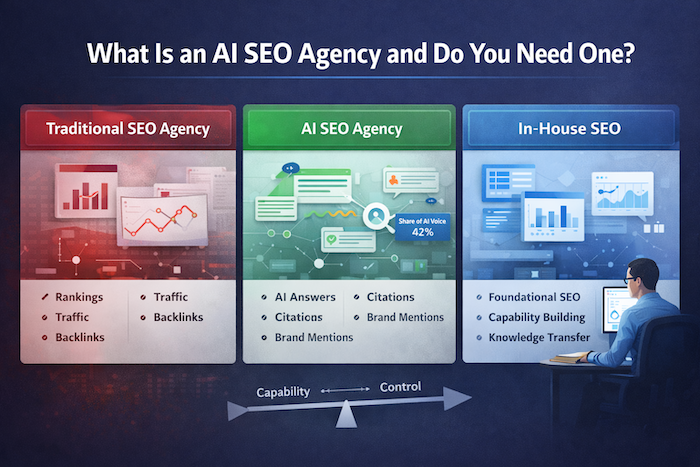
Traditional SEO agencies optimise sites for ranking on search engine results pages (SERPs). Their success metrics revolve around keyword rankings, organic traffic, backlinks and click‑through rates. In contrast, AI SEO agencies optimise content for selection and influence within AI answers. The key differences are summarised below:
| Aspect | Traditional SEO | AI SEO (GEO/AEO) |
|---|---|---|
| Target platforms | Google and Bing SERPs | AI Overviews, chat assistants (ChatGPT, Perplexity) |
| Result type | Multiple ranked links; users click to visit a page | Single aggregated answer; limited citations |
| Optimisation focus | Keyword targeting, link building, meta tags, page‑level optimisation | Concept and entity clarity, structured data, passage‑level fact density, authority signals |
| Success metrics | Rankings, sessions, click‑through rate | Citation rate, share‑of‑voice in AI answers, brand mentions |
| Content approach | Optimise individual pages; keyword research | Optimise passages & entities; prompt research and topic modelling |
| Traffic generation | Drives visitors to website | Creates brand awareness and demand; may not deliver clicks |
AI search engines summarise answers instead of presenting dozens of links. They typically cite only two or three sources per query. Ranking well in traditional SERPs remains important because LLMs use the search index to retrieve candidates, but success also depends on content structure, clarity, authority and external reputation.
Core Services Offered by AI SEO Agencies
An effective AI SEO agency will provide services that adapt classic SEO fundamentals to the needs of generative engines:
- AEO/GEO content optimisation. Agencies restructure existing content into answer‑first formats, ensuring that critical facts and definitions appear early. They use question‑based headings, lists and tables, and embed FAQ or HowTo schema to help LLMs extract information. For GEO, they increase fact density and include unique statistics or quotations because generative systems favour authoritative passages.
- Schema and structured data. They implement advanced schema (e.g., FAQ, HowTo, Q&A, Product) beyond basic meta tags. Structured data signals help LLMs understand the relationship between entities and attributes.
- Internal linking and topical authority engineering. AI models prefer sites with comprehensive coverage of a subject. Agencies build content clusters, cross‑link related articles and ensure consistent terminology so that the site becomes a trusted source on specific entities.
- Monitoring AI answers, citations and brand mentions. Mature agencies track when a client is quoted in ChatGPT, Perplexity, Copilot or Google AI Overviews. They calculate share‑of‑voice (the proportion of AI answers that cite the client versus competitors) and citation rate (how often content is quoted).
- Technical controls and AI accessibility. They audit robots.txt, ensure pages are crawlable by AI‑specific user agents, optimise site speed and implement canonical tags so that LLMs access the correct version of content.
- Data feed optimisation. For e‑commerce or local businesses, they manage merchant feeds, Google Business Profiles and review aggregators so that products and locations appear in AI answers.
Advanced or Mature AI SEO Capabilities
Leading AI SEO agencies go beyond foundational services and invest in capabilities that require R&D:
- Prompt‑based visibility testing. They run simulated queries across ChatGPT, Claude, Perplexity and Google AI Overviews to see whether and how often the client is referenced. The insights feed content updates and identify query patterns that matter to buyers.
- Competitive analysis in AI answers. Agencies examine which competitors appear in AI answers and why. They evaluate competitor citations, fact density and underlying sources to uncover gaps.
- AI citation tracking and reporting. Beyond monitoring, they maintain dashboards showing citation frequency, answer positioning, sentiment and conversion metrics. They also attribute leads or sales influenced by AI exposure.
- GEO measurement frameworks. These frameworks combine citation rate, share‑of‑voice, AI‑generated impressions and downstream metrics (e.g., branded search, demo requests) to assess ROI. Because AI results reduce clicks, agencies emphasise influence metrics instead of traffic.
- Early adoption of new AI platforms. Mature agencies experiment with new LLMs (Gemini, Ernie, Anthropic) and adapt to their distinct retrieval and ranking algorithms.
What an AI SEO Agency Is Not
The term “AI SEO agency” has been appropriated by companies that simply use AI tools to generate copy or automate workflows. A genuine AI SEO agency:
- Is not a content factory. Success in AI search does not come from mass‑produced, AI‑written articles. Generative engines prioritise factual accuracy, clarity and authority. Agencies therefore focus on expert‑driven content and rigorous editing.
- Does not promise guaranteed placement. No agency can guarantee that ChatGPT or Google AI Overviews will cite a particular page. LLMs make selection decisions based on relevance and authority; claiming guaranteed inclusion is a red flag.
- Does not replace core SEO fundamentals. Crawling, indexing and ranking still underpin AI answers. Without strong technical SEO, high‑quality backlinks and relevant content, AI optimisation fails.
Who Actually Needs an AI SEO Agency
Some organisations have moved beyond awareness and now require specialised AI optimisation to maintain or grow visibility. They include:
- SaaS and tech companies in competitive categories. Where multiple vendors offer similar products, being the chosen answer in AI tools directly influences pipeline. B2B buyers are adopting AI‑powered search at triple the rate of consumers; nearly 8 in 10 say AI search has changed how they research, and 29 % begin research via AI more often than Google.
- Brands experiencing declining click‑through rates despite stable rankings. AI Overviews and chat‑based answers reduce clicks; if impressions are rising but traffic is flat or falling, you need to ensure AI citations still drive awareness.
- Businesses where being recommended matters more than raw traffic. In enterprise sales, being recognised as a trusted vendor is critical. Marketri reports that companies leveraging AI search saw conversion rates increase by up to 78 %.
- Companies noticing competitors appear in AI answers. If competitors are cited by ChatGPT or Perplexity, they are gaining mindshare. Hiring an AI SEO agency helps reclaim visibility.
Who Probably Doesn’t (Yet)
An AI SEO agency may not be necessary for every organisation. You might not need one if:
- You are early‑stage with little content. Building a strong content foundation and basic technical SEO should come first.
- Your site has unresolved SEO issues (indexing problems, poor site architecture or thin content). AI optimisation cannot compensate for fundamental shortcomings.
- You operate in a low‑competition niche with minimal AI exposure. If customers rarely ask AI about your services, investing heavily in AI optimisation may yield limited returns today. However, monitoring the landscape remains prudent.
Signals That You Might Need One
Some signals indicate that AI search is affecting your visibility:
- AI assistants mention competitors, not you. Running prompts for your category reveals competitor citations but not your brand.
- Rising impressions with falling clicks in Google Search Console. This may signal that AI Overviews or answer boxes are satisfying queries without visits.
- Customer feedback (“we saw you on ChatGPT/AI”)—or lack thereof. If prospects mention competitors discovered via AI, you are invisible.
- SEO traffic is flat but brand demand shifts. If referrals, demos or direct searches change without corresponding traffic, AI answers may be influencing perception.
What to Look for in an AI SEO Agency
When evaluating agencies, consider:
- Demonstrable understanding of AI search. Can they explain how LLMs retrieve and rank documents? Do they understand the interplay between SEO, AEO and GEO? PBJ Marketing emphasises that AI SEO rests on SEO foundations yet requires different priorities: concept/entity clarity, structured data and fact density.
- Ability to communicate without jargon. The agency should articulate strategies clearly, teaching you how AEO/GEO works and why certain tactics matter.
- Clear methodology for testing and measuring AI visibility. Ask how they perform prompt research, track citations and calculate share‑of‑voice. Mature agencies provide dashboards and predictive models.
- Comfort with uncertainty and evolution. AI algorithms change quickly. Look for agencies investing in R&D and adapting processes accordingly.
- Grounding in technical SEO fundamentals. Avoid agencies that ignore crawling, indexing and link building; these remain necessary for AI retrieval.
Red Flags to Watch Out For
Be cautious of agencies that:
- Guarantee AI placements or rankings. AI citations cannot be guaranteed; algorithms choose sources based on relevance and authority.
- Make vague claims without measurement frameworks. Insist on clear KPIs (citation rate, share‑of‑voice, brand demand) and regular reporting.
- Over‑focus on AI tools, under‑focus on strategy. Generating thousands of AI‑written articles without a plan will harm credibility.
- Have no track record in traditional SEO. Technical competence is essential for AI optimisation.
Questions to Ask Before Hiring
- How do you measure AI visibility today? Request examples of citation tracking and share‑of‑voice reports.
- How do you test whether content is being used by AI? Seek details about prompt research, retrieval testing and competitor analysis.
- How do you balance SEO, AEO and GEO? Ensure the agency integrates classic SEO with answer‑ and generative‑engine optimisation.
- What happens if traffic drops but brand demand rises? The agency should shift metrics from clicks to brand lift and lead quality.
Agency vs In‑House: A Practical View
Many organisations start with an agency to build the AI optimisation framework and transfer knowledge internally over time. AI SEO requires cross‑disciplinary skills—content strategy, technical SEO, data analytics and prompt engineering—which may not exist in‑house. Agencies accelerate implementation and share emerging best practices. Long term, companies may integrate AI search optimisation into existing marketing teams to avoid dependency.
Cost Expectations and ROI Reality
Pricing for AI SEO services varies widely by scope and agency. A review of Top GEO Agencies for 2026 shows that:
- Rock The Rankings lists transparent pricing with SEO consulting starting at US$5 k per month, done‑for‑you SEO management at US$10 k per month and AI search optimisation available within custom or bundled programmes.
- The SEO Works, a UK agency, offers SEO retainers starting at US$3 k per month for foundational support, rising to US$5 k–US$6 k+ per month for advanced SEO and GEO campaigns.
- Animalz, a premium content agency, charges US$15 k+ per month for comprehensive content programmes that support GEO.
These prices reflect the strategic nature of AI optimisation; it is not commoditised. Organisations should budget several thousand dollars monthly or reallocate ~10–15 % of their content budget toward AI discoverability. ROI rarely appears as immediate traffic; instead, companies see improved conversion rates and brand authority. For example, Marketri notes that companies leveraging AI search have achieved conversion rates up to 78 % higher and that traditional search volume may drop 25 % by 2026. AI‑generated traffic is growing at more than 40 % per month and is projected to account for 20 % or more of organic traffic by the end of 2025. These shifts highlight why focusing solely on clicks misses the bigger picture: AI search influences brand perception and buyer intent long before a visit occurs.
The Bigger Picture
AI SEO agencies emerged because search behaviour changed. LLM‑based search now shapes decisions for both consumers and professionals; 72 % of B2B buyers encounter AI‑generated responses during research. Being absent from those answers erodes market share. AI SEO sits at the intersection of classic SEO, content strategy and AI systems. Done well, it reinforces rather than replaces traditional SEO. The most effective agencies help clients adapt to evolving algorithms, build topical authority and measure influence, not chase vanity metrics.
Conclusion
AI SEO agencies are not mandatory for every business, but ignoring AI search is risky. The question is not whether you need an AI SEO agency but who currently shapes the answers in your space. If competitors appear in AI‑generated responses while you do not, optimisation is possible and essential. Select agencies that understand both search fundamentals and generative systems, invest in content quality and structured data, and focus on measurable influence. In an AI‑first world, those who adapt early will shape the narratives that buyers trust.
Want to know whether ChatGPT, Perplexity, or Google AI Overviews mention your firm? Run a free first-party visibility audit on your domain in under a minute and see exactly which queries cite you and which do not.