
The way people discover information online has always followed the technology of the day. In the 1990s, simple keyword matching delivered a list of blue links. By the mid‑2000s, algorithms weighed backlinks and PageRank, giving rise to Search Engine Optimization (SEO). In the 2020s the pattern is shifting again. Generative models—systems such as ChatGPT, Google AI Overviews (SGE), Bing Copilot and Perplexity—no longer return a page of links; they synthesize answers from multiple sources and quote them inline. This change demands a new discipline: Generative Engine Optimization (GEO). GEO focuses on ensuring that your brand’s content becomes part of AI‑generated answers and maintains context and credibility when a user never leaves the conversation.
SEO is still relevant. High‑quality pages, sensible internal linking, mobile performance and schema markup remain essential to ranking well. However, GEO extends SEO by preparing content so it can be extracted, summarized and cited by large language models (LLMs). As the O8 agency notes, GEO is “the process of optimizing content to be selected and cited by LLMs like ChatGPT, Google’s AI Overviews, Perplexity and Bing Copilot”. Instead of chasing clicks on the results page, GEO aims to train AI engines to pull your content into their responses, thereby making your brand visible even in zero‑click experiences. In this blog we will explore how GEO evolved from SEO, why generative AI reshapes search, and how businesses can adapt their content to remain discoverable in the AI era.
From Search Engines to Generative Engines
How SEO Evolved into GEO
Traditional SEO is built on a model of discovery: crawlers index pages, algorithms rank them according to relevance and authority, and users click through. While core SEO factors like quality content, link authority and site speed still matter, generative interfaces have changed what happens after the query. ChatGPT, Perplexity and SGE now answer questions directly, quoting and summarizing sources without requiring a click. Walker Sands observes that GEO ensures that AI systems “understand the broader context of the content” and include accurate brand information in their responses. The O8 guide goes further: GEO isn’t about replacing SEO but about learning how LLMs think—what patterns they follow, which sources they trust and what formats they understand. In other words, GEO is a strategic response to changing search behavior; it complements SEO rather than supersedes it.
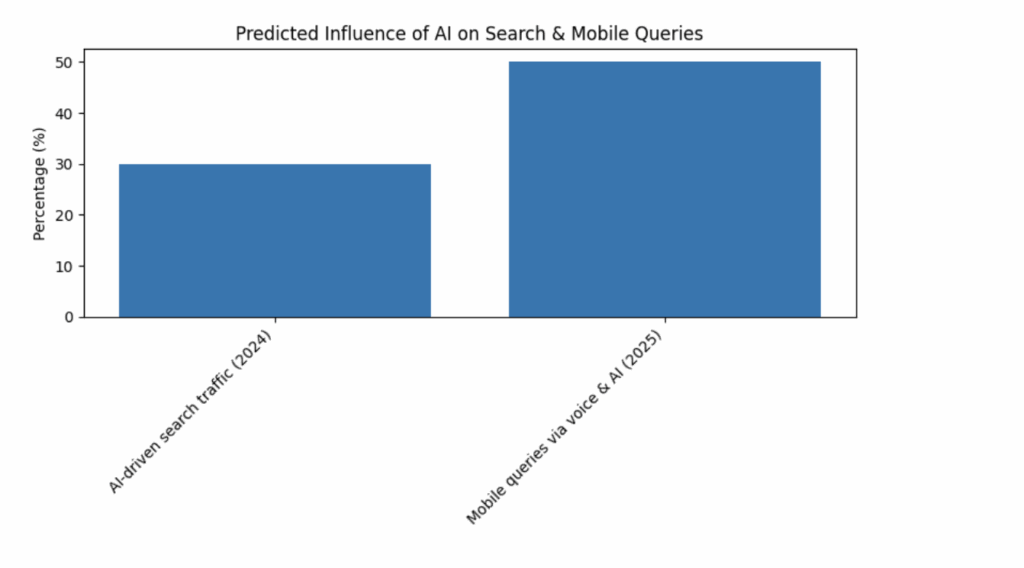
The need for GEO becomes clear when looking at user behavior. E‑intelligence cites a 2024 Gartner study estimating that over 30 % of search traffic is influenced by AI‑generated search results, and Statista projects that voice and AI‑powered search experiences will account for more than 50 % of mobile queries by 2025. People increasingly ask questions rather than enter keywords; they expect complete answers within the interface As a result, generative engines prioritize conversational queries, context and intent over keyword strings. A brand that still optimizes solely for short queries like “best CRM software” may miss opportunities when users ask “Which CRM platform is easiest for a growing SaaS start‑up in 2025?” GEO addresses this by focusing on long‑tail, intent‑rich questions and by ensuring that AI can interpret and assemble the right passages from your content.
Why Generative AI Reshapes Search Results
Generative engines differ from traditional search in both architecture and user experience. Search engines index documents and rank them based on relevance and authority; generative engines perform retrieval‑augmented generation (RAG). According to the AI Search Manual, when a user submits a query in Google AI Mode, the system performs a query fan‑out, exploding the input into multiple subqueries that target various data sources such as the web index, Knowledge Graph, YouTube transcripts and shopping feeds. Each subquery retrieves candidate passages via both lexical (keyword‑matching) and semantic (vector‑embedding) search. Results are aggregated, deduplicated and filtered for E‑E‑A‑T (Experience, Expertise, Authoritativeness and Trustworthiness) and snippet extractability. The top passages are then fed into an LLM for synthesis. This pipeline underscores why GEO content must be both retrievable (indexed and semantically meaningful) and extractable (structured into self‑contained passages and lists).
Zero‑click behavior amplifies the importance of GEO. SparkToro reports that nearly 65 % of Google searches in 2023 ended without a click ChatGPT and other LLM‑based services also provide complete answers that diminish the incentive to visit a site. Brands that rely on search referrals risk invisibility unless their information is included in the synthesized response. In this new landscape, visibility is measured not only by ranking but by the frequency and quality of AI citations.
Search‑Based Results vs. Answer Generation
The distinction between search results and AI answers is fundamental:
| Aspect | Traditional Search | Generative AI Answer |
|---|---|---|
| Goal | Deliver ranked list of pages | Generate a synthesized answer citing sources |
| User Experience | Users click links to explore | Users receive summary directly, often with citations and follow‑up suggestions |
| Content Style | Keyword‑optimized pages with backlinks | Intent‑driven, conversational, fact‑rich passages |
| Metrics | Click‑through rates, rankings, on‑site conversions | Citations, brand mentions, engagement in AI interfaces |
In traditional SEO a business fights for position one; in GEO the brand’s objective is to be quoted when the AI answers the question. The differences go beyond the interface: generative systems rely heavily on vector embeddings to match semantically related concepts rather than exact keywords. They also factor in passage‑level relevance, meaning that smaller snippets of your content must stand on their own. GEO therefore requires writers to think like information architects: break complex topics into discrete, answerable pieces; phrase them in natural language; and ensure each passage contains complete context.
Core Principles of Generative Engine Optimization
Prioritize Semantic Meaning over Keyword Density
Traditional SEO often measures success by keyword density and backlinks. Generative engines, however, interpret the semantic meaning of content. KAAS Digital explains that vector embeddings convert text into high‑dimensional vectors, allowing models to evaluate semantic proximity rather than simple word matches This means that synonyms, related phrases and topic clusters all map to similar areas in the vector space. Content optimized for GEO should therefore use natural language and variations of key terms while maintaining a clear focus on the underlying concept. For example, instead of repeating “cheap CRM,” include phrases like “affordable customer relationship platform” and “budget‑friendly CRM” to capture semantic breadth.
Contextual Authority and E‑E‑A‑T
Generative engines filter candidate passages based on authority and trust. Google’s AI Overviews apply E‑E‑A‑T to evaluate whether a passage is trustworthy. KAAS Digital stresses that content must demonstrate Experience, Expertise, Authoritativeness and Trustworthiness through author bios, citations to reputable sources and transparent contact information. Walker Sands similarly notes that GEO involves ensuring that AI systems understand the broader context and relation of a piece of content to the brand. Building contextual authority involves maintaining consistency across owned channels, earning third‑party mentions in credible publications and establishing authorship. Unlike SEO link‑building, GEO favors third‑party credibility and entity recognition over raw backlink counts.
Verifiable Sources and Citations
Generative engines cite sources to justify their synthesis. If your content lacks verifiable facts, data points or references, the AI may choose a competitor’s passage. The O8 guide recommends incorporating specific facts or data points, such as “92 % of users found our platform easy to set up,” to give AI a concrete snippet to cite. E‑intelligence highlights the importance of aligning with E‑E‑A‑T and adding author bios, references and citations to build trust. When citing external research (e.g., industry surveys, studies), use credible sources and attribute them. Clear citations not only serve users but also help LLMs decide that your passage is grounded and trustworthy.
How GEO Works in Practice
The Pipeline: User Intent → AI Interpretation → Synthesized Response
Understanding the mechanics of generative engines clarifies why GEO tactics work. Most AI search platforms employ a retrieval‑augmented generation pipeline:
- . Google AI Mode explodes the query into multiple subqueries covering latent intents. Each subquery targets data sources such as the web index, the Knowledge Graph or YouTube transcripts.
- Retrieval. For each subquery the system runs both keyword and vector searches across indices. Vector search uses embeddings to find semantically related passages even when keywords differ. Retrieval also covers non‑web sources like knowledge graphs.
- Aggregation and Filtering. Candidate passages are aggregated, deduplicated and filtered for quality. Filters include E‑E‑A‑T, content safety and snippet extractability—AI prefers passages that can be lifted cleanly into an answer
- LLM Synthesis. The top passages are passed to an LLM (e.g., Gemini, GPT). The LLM synthesizes a coherent response and inserts citations. In conversational modes like ChatGPT, the system can fetch more evidence mid‑conversation.
Example: A Business Query in Action
Imagine a user asks: “What is the best CRM software for a small SaaS start‑up in 2025?” In a traditional search engine, the user would see a list of pages from HubSpot, Salesforce and blogs. In a generative engine like Perplexity or SGE, the engine will first parse the query and generate subquestions such as “best CRM for small businesses,” “CRM for SaaS start‑up 2025” and “CRM pricing comparisons.” It will retrieve passages from credible articles comparing CRM platforms, product documentation, user reviews and possibly forums. Content that clearly states benefits, pricing and user personas in a structured format (e.g., bullet lists) has a higher chance of being selected. The synthesized answer may read:
“For small SaaS start‑ups in 2025, HubSpot CRM offers an intuitive interface, a generous free tier and integration with popular tools, making it ideal for growth. Monday.com CRM is praised for its customization and project management capabilities. According to a 2024 study, 92 % of users found these platforms easy to set up”
Notice that the answer cites specific statistics and names well‑known brands. If your company’s CRM platform is described in a similar passage on your site—complete with headings like “Why our CRM is ideal for small SaaS businesses,” bullet points summarizing benefits and credible statistics—the AI has a reason to include it.
Content Strategies for GEO
Structure Content to Be AI‑Consumable
Generative models prefer content that is easy to parse and reuse. The O8 guide suggests using question‑based headings, clear summaries, bullet‑point lists and structured data to format information. E‑intelligence recommends adopting modular content that can be easily quoted or visualized by AI systems, including tables, infographics and concise Q&A sections The KAAS Digital article adds that clear headings and subheadings, short summaries and highlighted quotable phrases make content more extractable. Writers should design each section to answer a specific question; this helps generative engines map your content to multiple latent intents.
Write with Entity Clarity and Factual Grounding
. Write sentences that explicitly connect your product or idea to actions or benefits (“Our CRM integrates with Salesforce via native API connectors and provides unlimited contacts on its free tier”). Avoid ambiguous pronouns that may confuse the AI. Support claims with data from reputable sources and include citations or references on the page. Content grounded in verifiable facts stands out in retrieval and reduces the risk of hallucination.
Balance Human Readability with Machine Interpretability
Successful GEO content must serve two audiences: humans and machines. The BOL Agency explains that GEO content should support AI reasoning processes while remaining engaging for human readers. Achieving this balance involves writing natural, conversational paragraphs (not robotic strings of keywords) while embedding structured elements (lists, tables, schema). Use transitional phrases and varied sentence structures for readability, but keep paragraphs concise (3–5 sentences) to aid passage‑level extraction. Where appropriate, include visuals such as infographics or charts; generative models like MUM are multimodal and may reference images.
Technical Elements Behind GEO
Schema Markup, Structured Data and llms.txt
Technical optimization plays a vital role in GEO. Structured data—JSON‑LD markup using schema.org vocabulary—helps AI interpret the context of a page. KAAS Digital highlights that schema removes ambiguity (e.g., whether “Avatar” refers to a movie or a profile picture) and enhances a brand’s presence in the Knowledge Graph. O8 recommends using schema types like FAQPage, HowTo and Product to give content semantic clarity and states that an llms.txt file at the root of your domain guides LLM crawlers to your most important pages. Think of llms.txt as an index for generative crawlers; it complements robots.txt by explicitly listing the AI‑friendly pages you want models to ingest. Ensure your pages are accessible without heavy JavaScript; generative systems may not parse scripts, so rely on clean HTML.
Aligning with Knowledge Graphs and Vector Embeddings
Generative engines rely on knowledge graphs to disambiguate entities and on vector embeddings to retrieve semantically related information. The AI Search Manual notes that Google’s AI Mode uses semantic parsing to produce multiple representations of a query—including lexical, embedding and entity forms—and matches against the Knowledge Graph. Content that includes proper names, dates, locations and clear relationships helps AI connect your brand to relevant entities. For example, adding structured data that identifies your company as a “SoftwareOrganization,” listing founders, headquarters and product categories can increase the likelihood that an AI recognizes you in a certain context.
Vector embeddings power semantic search. KAAS Digital describes embeddings as numerical representations that allow AI to retrieve conceptually similar content. BOL Agency emphasises passage‑level optimization and query fan‑out compatibility, recommending that content address multiple related queries so it remains relevant when AI splits a question into subquestions. To align with vector retrieval, use varied phrasing and synonyms around your target topics; create content clusters linking to deeper articles; and ensure each passage is self‑contained and semantically rich.
Clean Data and Multimodal Inputs
Provide clean metadata (alt text, captions, transcripts) for images and videos so AI can index them. For audio or video content, supply transcripts and structured time stamps. E‑intelligence underscores the growing importance of first‑party analytics and user behavior signals like dwell time and scroll depth to inform AI about content quality. Monitoring these signals helps identify which passages resonate with users and may therefore be favored by AI.
Benefits of GEO for Businesses
Increased Brand Visibility and Authority
When your content is included in AI‑generated answers, your brand reaches users at the moment of inquiry. Mangools notes that GEO improves content visibility in LLMs and enhances user experience because users receive comprehensive answers. The O8 guide explains that generative models cite brands that are consistently mentioned across multiple platforms, so GEO efforts often involve building a consistent digital footprint. By appearing in AI summaries, your brand can achieve implicit endorsements and thought leadership without requiring clicks.
Trust‑Building Through Authoritative Mentions
Being cited by an AI engine signals trust. When a generative answer references your article alongside authoritative sources like government agencies or academic journals, it demonstrates that your content meets rigorous quality criteria. E‑intelligence explains that AI platforms prioritize clarity, depth and semantic richness. Content that meets these standards conveys expertise and can improve brand reputation. Moreover, GEO encourages transparency through citations and author bios, reinforcing trust with readers and AI systems.
Long‑Term Competitive Advantage
Adopting GEO early provides a strategic advantage. Walker Sands notes that generative engines like ChatGPT have already surpassed Bing in visitor volume, handling more than 10 million queries per day in 2024. Brands that optimize for generative interfaces today will accumulate more mentions and context in training data and retrieval indices, making them more likely to appear in future AI models. As AI systems continue to refine their content sources, being part of their early citation pool can result in durable visibility.
Challenges & Risks
Lack of Transparency and Evolving Algorithms
Generative engines offer limited insight into why certain passages are chosen or how often results update. BOL Agency warns that GEO systems are volatile: the same prompt can yield different results for different users and there is limited historical data to measure success. The measurement challenge is compounded by the lack of keyword data; AI platforms often mask user prompts, leaving marketers to guess which queries generated a citation. Companies must adopt new analytics approaches—such as AI citation tracking tools—and remain flexible as algorithms evolve.
Risk of Misinformation and Brand Exclusion
Because LLMs synthesize from multiple sources, there is a risk that they cite outdated, incorrect or even harmful information. If your content contains inaccuracies, AI systems may discard it. Conversely, if competitors or unverified sources misrepresent your brand, generative engines could propagate those errors. Maintaining a robust PR strategy, monitoring brand mentions across AI platforms and correcting misinformation becomes essential. Additionally, not all queries trigger AI answers (e.g., high‑stakes topics or those with sparse authoritative coverage, so some opportunities may not be reachable through GEO alone.
Rapidly Changing Landscape and Measurement Difficulties
Algorithms and models evolve quickly. New generative platforms appear regularly, each with its own retrieval pipeline and weighting criteria. Keeping pace requires continuous testing, updating llms.txt files, refreshing schema markup and refining content structure. The O8 checklist recommends monitoring AI citations, staying active in forums and adjusting strategies as sourcing behavior changeso8.agency. Marketers should treat GEO as an ongoing process rather than a one‑time optimization.
The Future of GEO
Integration with Multimodal Search
Google’s MUM and similar models process text, images and video simultaneouslykaas-digital.com. Future generative search interfaces will likely include multimodal elements—voice commands, image uploads and interactive graphics. E‑intelligence notes that mobile, voice and multimodal inputs are acceleratingeintelligenceweb.com. Businesses should prepare by diversifying content formats: produce videos with transcripts, optimize images with descriptive alt text and create audio snippets. Local search will also be reshaped: AI summaries may display opening hours, reviews and location details without clickskaas-digital.com. GEO strategies must therefore align with local SEO practices, using structured data to ensure accurate business information.
Role of AI Agents in Surfacing Optimized Content
AI agents—autonomous systems that perform tasks on behalf of users—are becoming more prevalent. They may use generative search to research topics, evaluate products and make recommendations. By optimizing content for AI interpretability, brands position themselves as trusted sources for these agents. For example, an AI assistant helping a user choose a CRM might synthesize information from product pages, pricing tables and user reviews. If your content is structured, semantically rich and backed by credible evidence, the agent is more likely to include it in its reasoning chain.
Early Adopters Gain Market Share
Generative engine optimization is still in its infancy, but early adopters are already benefiting. Walker Sands stresses that GEO complements SEO, content and PR to provide a comprehensive approach to digital visibilitywalkersands.com. Companies that invest now—by training their teams, adapting content strategy and implementing technical enhancements—will secure a foothold in AI training datasets and retrieval indices. As generative search continues to expand into voice assistants, automotive infotainment and wearable devices, being recognized as an authoritative source will yield compounding returns.
Conclusion
Generative Engine Optimization represents the next evolution of search visibility. While Search Engine Optimization remains vital for traditional rankings, GEO addresses the reality that more users now receive answers directly from AI systems. It requires content creators to think beyond keywords and links: to prioritize semantic richness, contextual authority and verifiable facts; to structure information in extractable passages; to embed schema markup and maintain clean HTML; and to engage in consistent, authoritative conversation across the web. GEO is not a replacement for SEO but a complementary discipline that ensures your brand remains visible when the user never leaves the AI interface. By embracing the strategies outlined here—investing in research, structuring content for AI, aligning with knowledge graphs, and monitoring citations—businesses can stay ahead of the curve and thrive in the era of AI‑driven discovery.
To accompany the report, here’s the bar chart illustrating the predicted influence of AI on search and mobile queries:
Want to know whether ChatGPT, Perplexity, or Google AI Overviews mention your firm? Run a free first-party visibility audit on your domain in under a minute and see exactly which queries cite you and which do not.