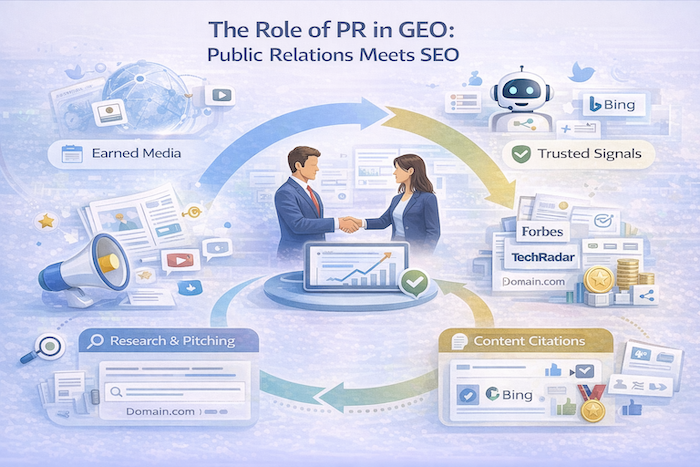
In the traditional search era, public relations (PR) and search‑engine optimisation (SEO) were adjacent disciplines: PR generated coverage and backlinks to drive awareness, while SEO optimised on‑site content and technical factors to capture traffic. Generative search changes this relationship. AI answers rely heavily on third‑party sources, so the lines between PR and SEO are collapsing. Today, earning high‑quality coverage is not just about awareness — it is about shaping how large language models (LLMs) understand and describe your brand. As more than two billion people view AI‑generated search overviews each month, organisations must treat PR as a core input into generative engine optimisation (GEO).
Why PR Suddenly Matters More in a Generative Search World
Third‑party sources drive AI answers
Generative engines (e.g., Google’s Search Generative Experience, Bing Copilot, ChatGPT browsing) synthesise information from earned media, industry publications, thought‑leadership content and knowledge bases. RepTrak notes that AI synthesises earned, owned and public conversations into narratives that act as a stakeholder. TrizCom PR observes that AI platforms prioritise trusted third‑party validation (news articles, expert bylines, reviews, industry databases) over self‑published claims. Therefore, PR coverage directly influences how AI explains your company, product and leadership.
Trust signals outweigh self‑published claims
Axia PR explains that generative AI extracts data from high‑authority news sites, Wikipedia‑like content, government data and brand pages. Without accurate, consistent representation across those sources, AI outputs can be incomplete or incorrect. Because LLMs are designed to reduce risk by citing authoritative sources, a company’s own marketing copy carries less weight than independent validation. As a result, mentions in reputable media—even without backlinks—become critical signals of credibility.
AI compresses narratives
Forbes notes that generative AI summarises everything about a brand into a cohesive digital image. If PR coverage emphasises the wrong aspects or uses vague buzzwords, AI may misinterpret the company’s positioning. Conversely, consistent and clear messaging across press coverage compounds over time; repeated descriptions teach AI how to characterise your brand.
The Shift: From Backlinks to Credible Mentions
Traditional SEO treated backlinks as primary ranking signals. GEO still values authority, but the emphasis has shifted from link quantity to mention quality. TrizCom PR highlights that generative engines evaluate who talks about you and how. Mentions without links — such as quotes in a respected industry journal — can still boost AI credibility because LLMs recognise repeated names and descriptions across trusted sources. This shift means PR teams must focus on story placement and message accuracy rather than simply securing link‑rich coverage.
How Generative Engines Use PR Content
News articles, interviews and features become trusted inputs for AI models. When multiple outlets describe a company in similar terms, the AI is more likely to adopt that phrasing. Axia PR notes that PR professionals should publish earned media across credible outlets and update public profiles using reputation‑strengthening keywords. Structured content — clear headlines, bullet lists, fact boxes — helps AI extract and reuse snippets. Because AI often retrieves only sections of text, consistent terminology and repeated messaging across articles are essential.
PR as an Authority Accelerator for GEO
Reinforcing expertise and legitimacy
Generative engines prefer sources with external validation. TrizCom’s AI‑search visibility framework emphasises that earned media, expert bylines and authoritative publications fill the authority gaps that on‑site SEO cannot. Media coverage reinforces a brand’s expertise and category relevance, providing credible citations that AI models trust.
Filling gaps in entity relationships
LLMs build knowledge graphs by connecting entities (people, brands, products) with attributes and relationships. PR coverage can clarify these relationships by stating what the company does, who it serves and why it is credible. Without such signals, AI may miscategorise a brand or fail to mention it at all.
Aligning PR Goals with GEO Objectives
Beyond awareness to AI‑ready outcomes
The historic metrics for PR — impressions, share of voice and reach — must evolve. PR campaigns should be evaluated on GEO‑aligned outcomes: accurate brand descriptions, clear category positioning, and association with expert themes. Reptrak emphasises that AI should be intentionally integrated into reputation strategies and that stakeholders must consider how AI synthesises earned and owned data. Instead of chasing headlines for vanity, PR teams should prioritise placements that clearly explain the company’s mission and expertise.
Treating PR as input, not just amplification
Generative engines do not read nuance; they extract direct statements. Messaging must be engineered for AI pickup: avoid vague buzzwords and emphasise specifics. Repetition of core descriptors across press coverage teaches AI to associate the brand with those attributes. For example, consistently referring to a fintech start‑up as “a British payments platform for small businesses” will anchor that description in AI responses.
Message Engineering for AI Pickup
PR teams should craft coverage that answers three fundamental questions: what the company does, who it’s for and why it’s credible. Axia PR recommends using clear headlines and data‑rich profiles. Rather than jargon‑filled narratives, lean on explanatory language and facts. Include quotes from executives that emphasise key differentiators. Ensure that product names, founder names and category terms are spelt consistently across all pieces — AI uses string matching to map entities.
Choosing the Right Media for GEO Impact
Not all coverage has equal weight in AI systems. Niche, authoritative publications — trade journals, industry blogs, professional associations — often have more influence than mass consumer outlets because AI algorithms recognise them as credible domain experts. TrizCom’s visibility framework stresses the importance of high‑value third‑party sources. Repeated mentions in niche publications also help build topical authority and enable the brand to become the default citation for specific queries.
PR Content Types That Perform Well in AI Systems
- Founder and expert interviews: Provide insights into the company’s mission and leadership; humanise executives and supply quotable statements.
- Explainer articles and contributed thought leadership: Offer neutral, in‑depth explanations of technology, processes or industry challenges; AI often reuses definitions and summaries.
- Data‑driven commentary and original research: Present statistics and findings that can be cited as facts.
- Neutral, factual reporting: Straight news stories or backgrounders that describe the organisation without hype; generative engines prefer to reuse content that appears objective.
- Avoid overly promotional press releases — AI models tend to ignore content with overt marketing language.
Integrating PR Teams with SEO and Content Teams
Breaking silos
Successful GEO requires cross‑functional coordination. U of Digital notes that AI optimisation hinges on merging SEO, PR, content and social strategies. PR teams need to understand keyword and entity research from SEO specialists, while SEO teams must incorporate insights from PR coverage into on‑site content. Shared playbooks and joint planning sessions ensure consistent messaging and avoid duplication.
Feeding PR insights into content strategy
Press coverage can reveal which topics resonate with journalists and audiences. Those themes should inform blog posts, FAQ pages and product copy. Conversely, SEO topic clusters can guide PR pitches towards areas where the brand wants to build authority.
PR’s Role in AI Reputation Management
Generative search platforms not only answer factual queries; they also answer trust‑based questions like “Is [Company] reliable?” Terakeet warns that AI can become a rival storyteller, capable of reshaping narratives at scale and creating negativity loops if left unaddressed. PR professionals can counterbalance outdated or negative AI narratives by securing new coverage that emphasises current achievements and by clarifying misconceptions through factual content. Building and maintaining credible executive profiles ensures that AI mentions leadership accurately.
Monitoring PR Impact Beyond Links and Traffic
Traditional PR metrics (placements, domain authority, referral traffic) do not capture AI influence. Modern GEO requires monitoring:
- Brand mentions and citations in AI answers – using prompt‑testing across platforms to see where and how the brand is referenced.
- Changes in tone and framing – logging whether AI descriptions become more accurate or positive over time.
- Correlation with branded search demand – watching for increases in direct brand queries or lead quality after PR campaigns.
TrizCom suggests success metrics such as increased AI presence, stronger message consistency and reduced reliance on last‑click discovery.
Common PR–GEO Misalignments
- Press coverage that sounds impressive but says nothing concrete. AI cannot interpret vague slogans; it needs facts.
- Over‑promotional language that reads like advertising; generative engines prefer neutral, factual phrasing.
- One‑off coverage without narrative consistency. A single article using a unique descriptor can confuse AI; repetition across outlets is vital.
- Siloed campaigns where PR and SEO target different themes; this dilutes signals.
Working with PR Agencies in a GEO Context
When engaging external agencies, brands should brief them on generative search objectives. Key questions include:
- How will the agency ensure message consistency across placements?
- Can the agency explain how AI consumes content?
- What publications do they prioritise for domain authority and topical relevance?
Agencies should be evaluated on their ability to secure credibly framed coverage rather than volume of placements. Britopian argues that generative search is a massive challenge and that PR teams must take the lead. An agency that treats PR as mere promotion will not succeed in the AI era.
A Practical Collaboration Model
- SEO defines core entities and positioning. Keyword research and topic clustering identify the terms AI should associate with the brand.
- PR amplifies those entities through earned media. Press releases, thought‑leadership articles and interviews reinforce the definitions and relationships.
- Content teams reinforce messages on‑site. Web pages, blogs and FAQs mirror the language used in media coverage and supply structured information. Clear headings and schema markup help AI extract the right snippets.
- AI systems learn through repetition and trust. Over time, consistent signals from multiple high‑quality sources teach the models to cite the brand correctly and favourably.
Conclusion
Generative search has redefined the relationship between PR and SEO. AI engines treat PR outputs as trusted inputs, collapsing the wall between awareness and search visibility. Traditional link‑building strategies are no longer enough; credible mentions and consistent narratives now drive GEO success. PR professionals must engineer messages for AI pickup, prioritise authoritative publications and collaborate with SEO and content teams. Brands that align PR, SEO and content around clear, factual storytelling will shape how AI explains their category. Those who continue to chase vanity metrics or silo their efforts risk having AI tell their story for them — and not always accurately.
Want to know whether ChatGPT, Perplexity, or Google AI Overviews mention your firm? Run a free first-party visibility audit on your domain in under a minute and see exactly which queries cite you and which do not.