
TL;DR
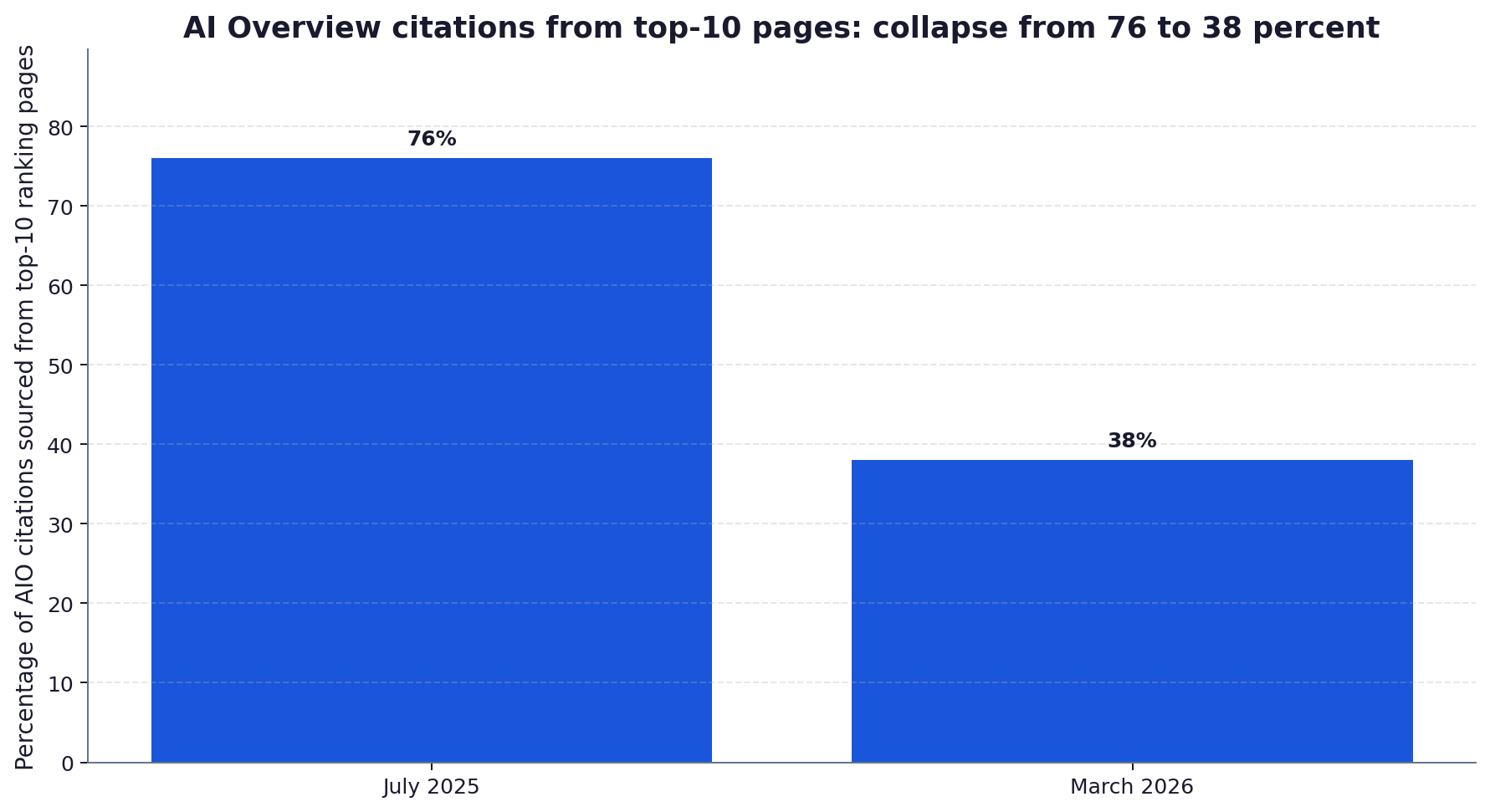
- The percentage of Google AI Overview citations sourced from the original top-10 SERP collapsed from 76 percent in July 2025 to 38 percent in February 2026 (Ahrefs, 863,000-keyword study).
- Across all AI surfaces, only 12 percent of cited URLs rank in the top 10 of Google for the original prompt. Rank position has lost most of its predictive power for AI citation.
- Microsoft introduced citation share as a metric inside Bing Webmaster Tools at SEO Week, 27 April 2026. It is the first AI-specific KPI shipped by a major engine.
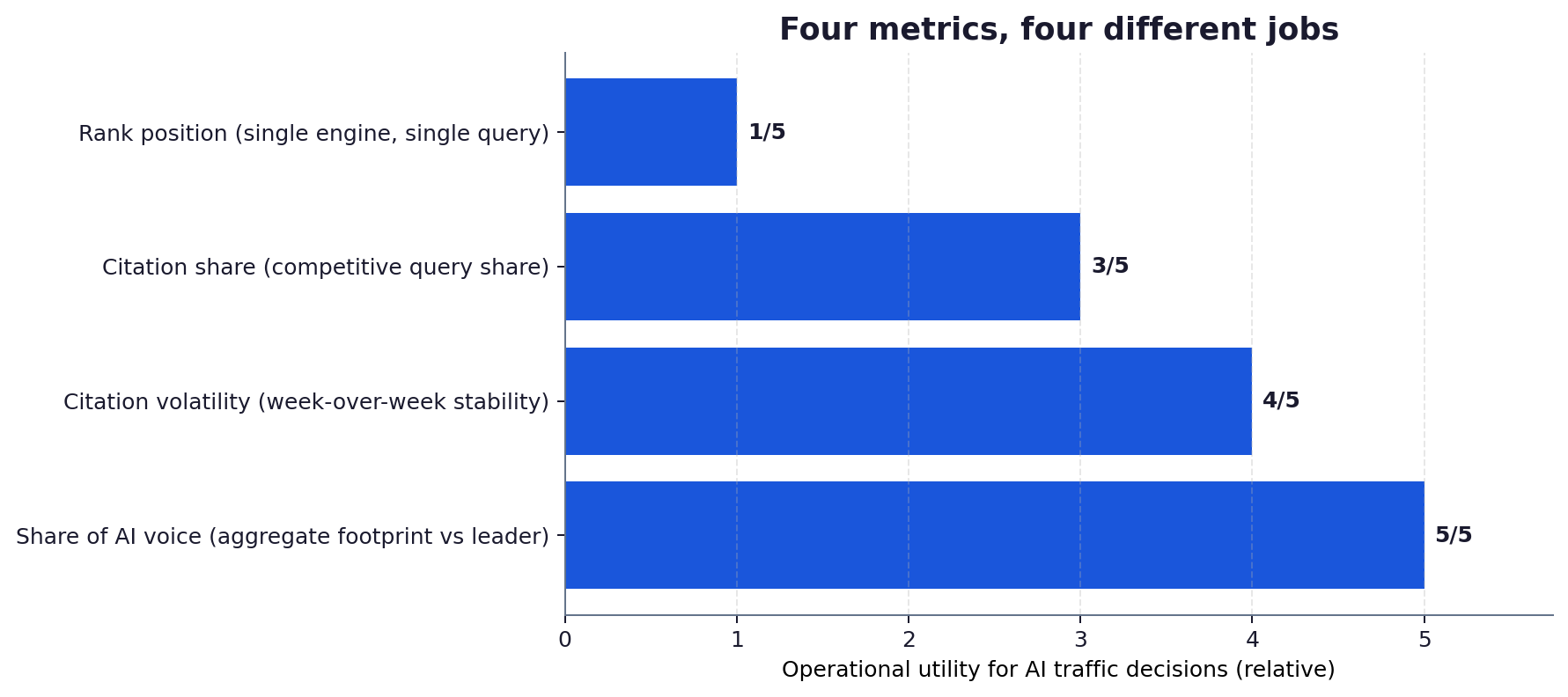
- The KPI framework below replaces rank position with three new metrics: citation share, citation volatility, and share of AI voice. Each has an operational threshold and a measurement cadence.
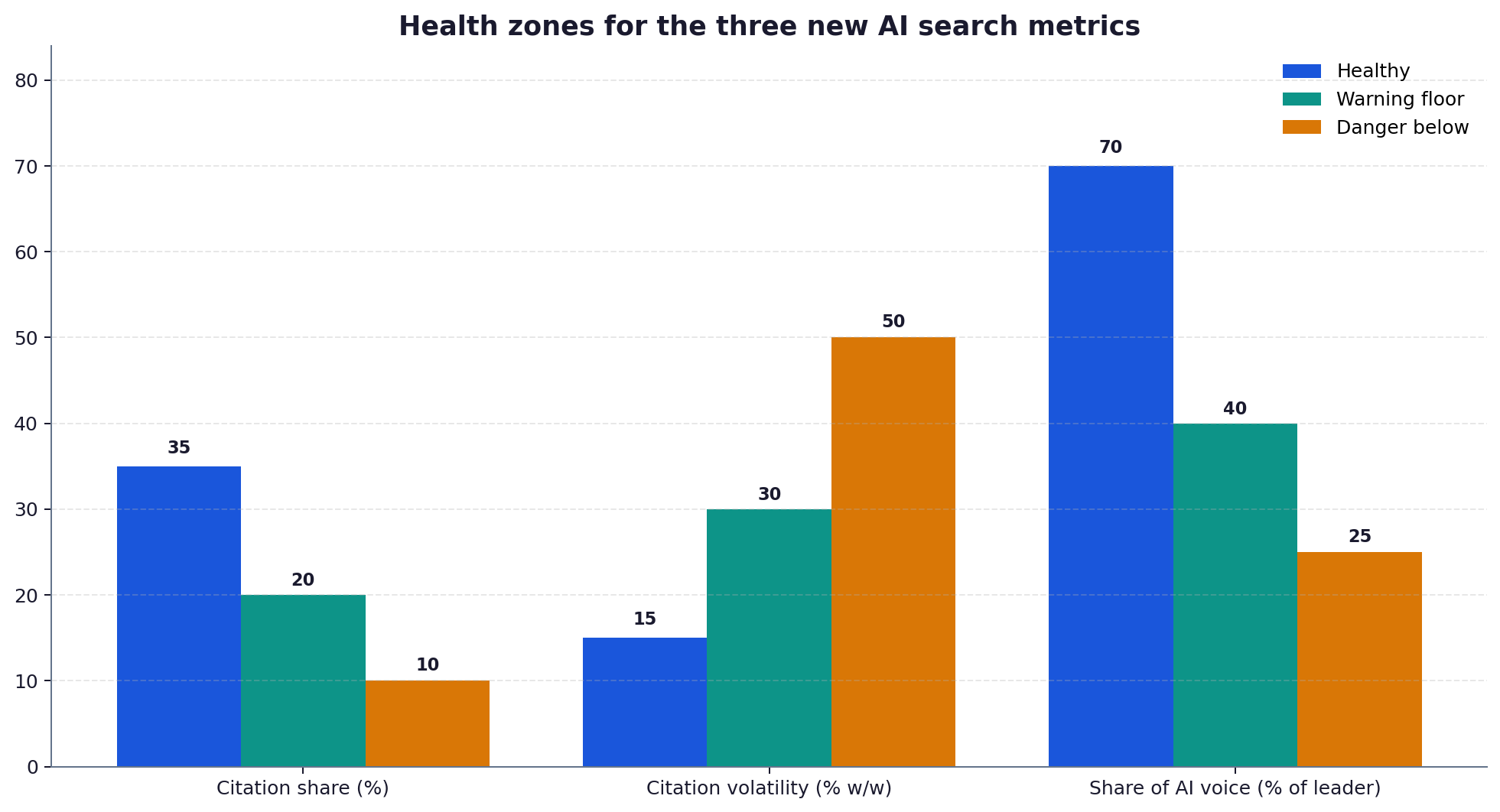
- Tier 1 commercial pages should aim for citation share above 35 percent, weekly volatility below 15 percent, and share of AI voice above 70 percent of the category leader.
Key facts
- Top-10 sourcing for Google AI Overview citations dropped from 76 percent (July 2025) to 38 percent (February 2026), an absolute drop of 38 points in 7 months. Source: Ahrefs analysis of 863K keywords and 4M AIO URLs.
- Only 12 percent of AI-cited URLs rank in Google’s top 10 for the original prompt across the major AI surfaces. Rank-position correlation is approximately 0.347, a moderate-but-weak predictor.
- Microsoft previewed citation share, grounding query intent, and GEO recommendations in Bing Webmaster Tools on 27 April 2026 at SEO Week.
- Citation share is a competitive metric: percentage of all citations a query produces that came to your domain. Citation frequency alone is non-comparative.
- Average AI-cited URL is 25.7 percent fresher than the average Google SERP URL (Ahrefs, July 2025), which means rank-rewarded backlink-aged content gets less AI citation share.
The collapse: rank position no longer predicts AI citation
In July 2025, Ahrefs found that around 76 percent of pages cited in Google AI Overviews also ranked in the top 10 of Google for the same query. By March 2026, the figure had fallen to 38 percent. The methodology covered 863,000 keyword SERPs and 4 million AIO URLs, more than double the dataset of the original July 2025 study.
The drop is not noise. Google made Gemini 3 the global default model powering AI Overviews on 27 January 2026. Gemini 3 sources approximately 32 percent more URLs per AIO response and replaced approximately 42 percent of the previously cited domains. The shift is structural, not seasonal.
Why the correlation broke
Three forces converged. First, AI engines now run query expansion (or “fan-out”) that decomposes a single user prompt into multiple sub-queries. Each sub-query produces its own retrieval set, much of which is not in the original top-10 SERP. Second, the engines weight freshness and entity density more heavily than backlink-aggregation, which is what most pages get to top-10 by. Third, schema-rich pages get parsed faster and cited more readily, which is a different optimisation game from rank.
The remaining 62 percent of AIO citations come from pages ranking 11 to 100 (roughly 31 percent) and pages outside the top 100 entirely (roughly 31 percent). YouTube alone accounts for about 18 percent of citations sourced from outside the top 100. A rank-tracker dashboard for AI traffic now misses two-thirds of the action.
Citation share: definition and operational threshold
Citation share is the percentage of total citations a query produces that come to your domain. If a query produces 12 cited URLs across ChatGPT, Perplexity, Copilot, Gemini, and AIO over a measurement window, and 3 of those came to your domain, your citation share for that query is 25 percent. Microsoft’s Bing Webmaster Tools shipped this metric on 27 April 2026, making it the first AI-specific KPI standardised by a major engine.
The metric works at three levels: per query (what is your share for “best UK family law solicitors”), per query bundle (what is your share across all 30 commercial-intent queries you target), and per category (what is your share across all queries an AI engine has classified into your category). Operational threshold for tier 1 commercial pages: target citation share above 35 percent. Below 20 percent is a problem signal; below 10 percent the page is non-competitive.
Citation volatility: definition and operational threshold
Citation volatility is the week-over-week change in citation share for the same query. A 12 percent share this week and 14 percent next week is a 17 percent change relative to the prior period. Stable pages and stable categories show low volatility. Unstable pages, fresh competitor entries, and engine-update tremors show high volatility.
Volatility matters because it tells you whether to act. A page with 20 percent citation share that does not move is healthy. A page with the same 20 percent share that swings between 10 and 30 percent week-over-week is unstable, and the average masks the risk. Operational threshold for tier 1 pages: target weekly volatility below 15 percent. Above 30 percent volatility, the page is in a contested category and needs investigation.
Share of AI voice: definition and operational threshold
Share of AI voice is your domain’s aggregate citation footprint across all tracked queries, normalised to the category leader. If the leader has 280 citations across 100 queries over a month and your domain has 168, your share of AI voice is 60 percent. The metric tells you how big a gap there is to close, not how dominant any single page is.
Share of AI voice is the strategic metric. Citation share and volatility tell you about specific pages and queries. Share of AI voice tells you about the agency or in-house team’s overall progress against the most-cited competitor. Operational threshold: tier 1 commercial categories should reach 70 percent of leader within 9 to 12 months. Below 40 percent indicates the team is operating at content-only level when the work needs PR placements and entity injection too.
The dashboard: three metrics, six thresholds
Combine the three new metrics with their operational thresholds and you get a dashboard that fits on one screen.
- Citation share, healthy zone above 35 percent, warning zone 20 to 35, danger zone below 20.
- Citation volatility, healthy zone below 15 percent week-over-week, warning zone 15 to 30, danger zone above 30.
- Share of AI voice, healthy zone above 70 percent of leader, warning zone 40 to 70, danger zone below 40.
Three metrics, three thresholds, six zones in total. The team’s weekly review is one screen of cell colours. Anything in danger or warning gets a paragraph in the weekly note explaining what changed and what action is queued.
Migration: how to phase out rank tracking for AI traffic
Most teams have a rank-tracker subscription, a weekly rank report, and someone who maintains both. The cleanest migration is parallel rather than abrupt.
- Week 1. Add a citation-share panel alongside the existing rank report. 30 to 50 commercial queries, three engines minimum, weekly cadence.
- Week 4. Add citation volatility (week-over-week delta) to the same panel.
- Week 8. Compute share of AI voice once you have 8 weeks of data and a competitor list.
- Week 12. Remove the rank report from the weekly review meeting. Keep the rank tracker on for paid-search planning if you run one.
- Month 6. Cancel the rank-tracker subscription if it is not feeding paid-search work. The line item is now a citation tracker.
Common mistakes when adopting the new metrics
- Tracking citation count instead of citation share. Count is non-comparative. A page with 100 citations across an uncompetitive query bundle is doing worse than a page with 30 citations across a contested bundle. Use share, not count.
- Setting share-of-AI-voice targets without a defined leader. If the leader keeps changing, the metric drifts. Pick a leader at the start of the quarter, lock it for that quarter, evaluate next quarter.
- Ignoring volatility on healthy-share pages. A page sitting at 35 percent share with 40 percent weekly volatility is one engine update away from a crash. Investigate now, not after the crash.
- Using a single engine. ChatGPT, Perplexity, AIO, Copilot, and Gemini have different citation logic. Single-engine tracking will mislead you.
- Reporting averages without distributions. A weekly average of 25 percent share hides whether all pages sit at 25 or whether half are at 5 and half at 45. Show the distribution to the team.
What this framework does not cover
It does not cover conversion attribution. AI citation share predicts visibility, not closed business. The path from citation to revenue still needs the usual analytics work (UTMs, pipeline tracking, lead-source field hygiene). The framework above tells you whether you are visible. Conversion tells you whether visibility is paying.
It does not cover engine-specific schema priority. The schema priority hierarchy varies by engine and matters for rank-of-appearance within a citation block. Treat it as a separate optimisation layer underneath the citation-share metric.
Frequently asked questions
Should I cancel my rank tracker today?
No. Run rank tracking and citation tracking in parallel for at least 12 weeks. The migration period lets the team see how the new metrics move and whether the rank report is still telling them anything that the citation panel does not.
Where do I get citation data if I cannot afford an enterprise tracker?
Manual weekly query panels work. 30 commercial queries × 3 engines × manual logging = roughly 4 hours of one person’s week. The data quality is worse than a paid tracker but it is real first-party data, and the operational discipline is what matters in the first quarter.
Why three metrics and not five or seven?
Three metrics is the smallest set that covers per-query competition (citation share), stability over time (volatility), and aggregate progress (share of AI voice). Adding a fourth (citation diversity, click-through, citation depth) is useful for analysts but introduces noise into operational decisions. Three is the floor, not the ceiling.
Does this work for a B2B SaaS with under 20 commercial queries?
Yes, with one adjustment. With fewer than 20 queries, citation share volatility week-over-week is naturally higher because each query carries more weight. Smooth the volatility metric over a 4-week trailing window instead of a single-week comparison. The threshold stays at 15 percent.
What about brand mentions vs citations?
Brand mentions and citations are different things and the ratio is diagnostic. The framework above tracks citations only because mentions without citation indicate the brand is referenced but not used as a primary source, which is a content-depth or authority-signal issue rather than a competitive-citation issue.
How does this map to existing OKRs?
Most marketing OKRs use traffic, leads, or pipeline. Citation share, volatility, and share of AI voice are leading indicators that move 6 to 12 weeks before traffic does. Map them as the leading-indicator section of the existing OKR, not as a replacement for the lagging traffic and pipeline metrics.
Sources and references
- Update: 38 percent of AI Overview Citations Pull From The Top 10 (down from 76 percent). Ahrefs (Louise Linehan and Xibeijia Guan), 2026
- 76 percent of AI Overview Citations Pull From the Top 10 (the prior baseline). Ahrefs, 2025
- Only 12 percent of AI Cited URLs Rank in Google’s Top 10 for the Original Prompt. Ahrefs, 2026
- Bing Webmaster Tools introduces citation share, grounding query intent, and GEO recommendations. Bing / Microsoft, announced at SEO Week 27 April 2026, 2026
- How to track AI citations and measure GEO success: the 2026 metrics guide. Averi, 2026
- New Study: AI Assistants Prefer to Cite Fresher Content (17 Million Citations Analyzed). Ahrefs (Ryan Law and Xibeijia Guan), 2025
Want to see your citation share, volatility, and share of AI voice for your top 30 commercial queries? The free GEO audit returns all three in 60 seconds with no signup required.
Change log
- 2026-05-11: Initial publication.