TL;DR
- Answer engine optimisation (AEO) began as optimising for direct answers like featured snippets and voice; generative engine optimisation (GEO) began as optimising to be cited inside AI-generated answers.
- By 2026 the two have largely converged, because the answer surface and the generative surface are now the same place.
- The practical distinction that survives: AEO is about being the answer, GEO is about being a cited source within the answer, and SEO is still about being the link that gets clicked.
- UK search demand is moving towards the AEO vocabulary. Across a single AiBoost pull of Google Ads data in August 2026, “aeo vs geo” rose from 57 to 263 monthly searches while “generative engine optimization” fell from 1,400 to 720.
- Some agencies still mis-sell one as the other, or rebadge old featured-snippet work as GEO at a premium.
- A three-question audit, covering surface, metric and method, tells you whether a provider understands the difference or is repackaging.
Key facts
- The GEO concept was formalised in academic work measuring visibility inside generative answers across many queries (Aggarwal et al., 2024).
- Answer engine optimisation predates GEO and grew out of featured snippet and voice search optimisation (Search Engine Journal, 2026).
- AI answer surfaces such as Google AI Overviews and ChatGPT now occupy the position featured snippets once held, collapsing the two surfaces (Search Engine Land, 2026).
- In UK search-volume data pulled by AiBoost in August 2026, the AEO vocabulary is rising and the 2025 coinages are falling: “aeo vs geo” 57 to 263 monthly searches, “aeo seo” 183 to 250, against “generative engine optimization” 1,400 to 720 and “llm seo” 397 to 150 (AiBoost, DataForSEO, 2026).
- Structured data underpins all three disciplines, which is part of why they look similar (Schema.org, 2026).
- Citation share, the GEO metric, differs from answer ownership, the AEO metric, even when the surface is shared (Profound, 2026).
Where AEO and GEO came from
Answer engine optimisation is the older term. It grew up around Google’s featured snippets, the People Also Ask box and voice assistants, where the goal was to have your content lifted as the single direct answer to a question. The craft was concise answers, clean structure and schema that made a passage easy to extract. Success meant owning the answer box.
Generative engine optimisation arrived with large language model answer engines. The academic work that named it measured something different: how often a source is cited inside a generated answer that the model composes from many sources. The unit was not the answer itself, it was your presence as a referenced source within it. That difference in unit is the root of everything that follows.
Both terms sit on top of search engine optimisation, which never went anywhere. SEO still governs whether a page can be crawled, indexed, understood and ranked, and every AI answer engine draws on an index that SEO work feeds. The three disciplines are best read as layers rather than rivals, which is the frame the rest of this piece uses.
The vocabulary is shifting, and the search data shows it
Something changed in the language over the past year, and it is visible in search demand rather than in commentary. We pulled UK Google Ads volume data through DataForSEO in August 2026 and compared the average of the first three months in the twelve-month window against the average of the latest three months. The 2025 coinages are shrinking. The AEO vocabulary is growing.
| Search term | First 3 months (avg/mo) | Latest 3 months (avg/mo) | Direction |
|---|---|---|---|
| aeo vs geo | 57 | 263 | Up 4.6x |
| aeo seo | 183 | 250 | Up |
| ai visibility | 117 | 243 | Up |
| geo audit | 83 | 130 | Up |
| generative engine optimization | 1,400 | 720 | Down 49% |
| llm seo | 397 | 150 | Down 62% |
| chatgpt seo | 190 | 63 | Down 67% |
UK search volumes, English, single DataForSEO pull by AiBoost, August 2026. Method and caveats are set out below.
Read the two halves of that table together and a pattern appears. The terms that are falling are the ones invented in 2025 to name a new thing: generative engine optimization, llm seo, chatgpt seo. The terms that are rising are the ones people use once they have accepted the thing exists and want to compare their options: “aeo vs geo”, “aeo seo”, “ai visibility”, “geo audit”. Curiosity language is giving way to comparison and procurement language.
That has a practical consequence for anyone writing about this. Through 2025 the safe assumption was that “generative engine optimization” was the growth term and everything should be optimised around it. On this data that assumption has expired. GEO still carries the larger absolute volume in the UK, and “geo vs seo” at around 590 searches a month and “geo agency” at around 320 remain the bigger commercial queries. But the direction of travel belongs to AEO, and the comparison queries are where the competition is thinnest. “aeo vs geo” sits at roughly 140 searches a month on Google’s rolling twelve-month average with low advertiser competition, which is an unusual combination of rising interest and open ground.
The vocabulary churn also tells you something about buyers. A market that has settled on its terminology asks “how much” and “which supplier”. A market still choosing its terminology asks “what is the difference”. The rise of comparison queries alongside the fall of definitional ones suggests UK buyers have moved past the what and are now on the which, which is exactly the moment mis-selling gets easiest.
Why the two converged in 2026
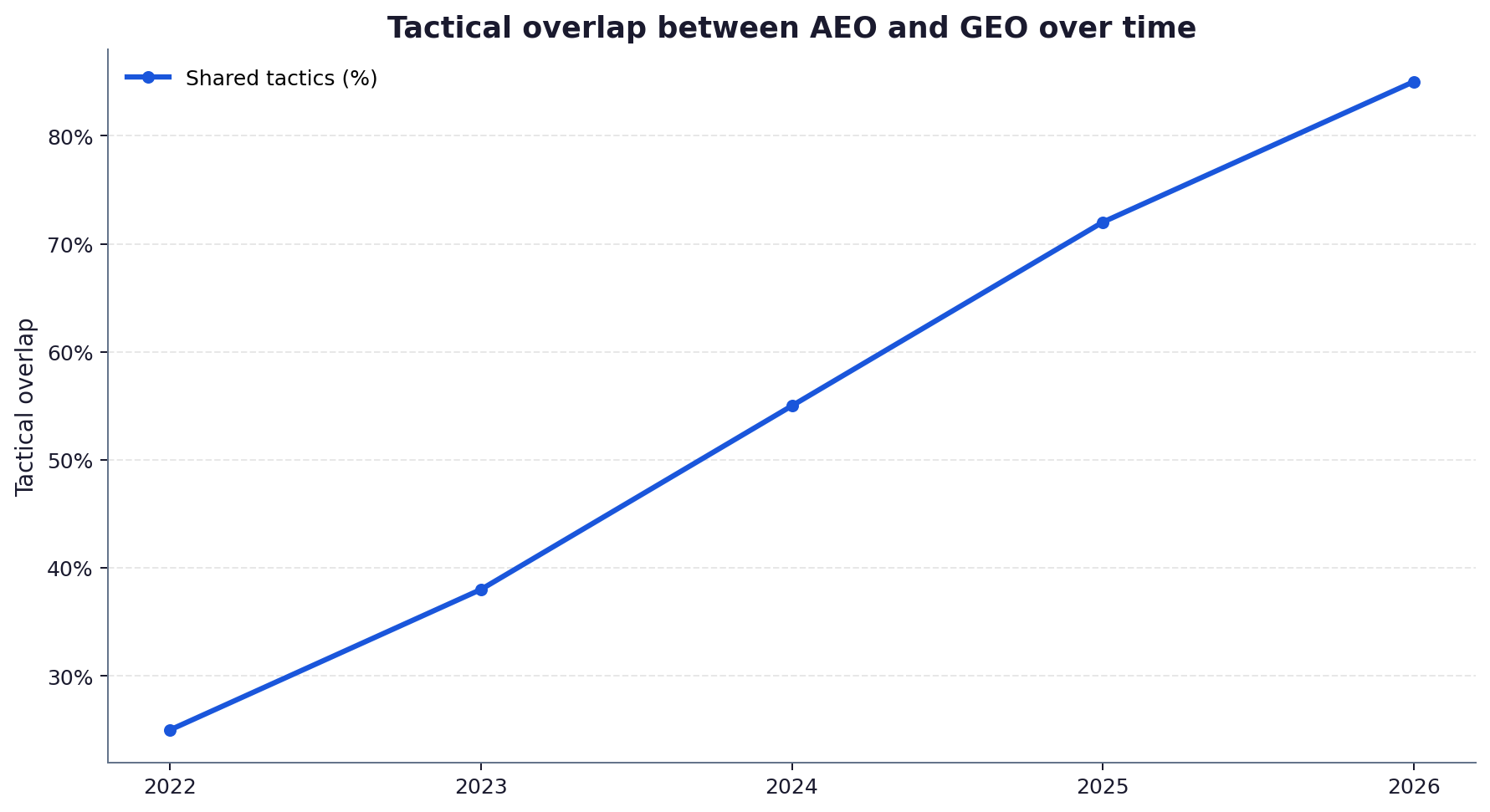
The reason the terms now blur is simple: the surfaces merged. The place a user once saw a featured snippet is increasingly an AI Overview or a chat answer. When the answer surface became a generative surface, the AEO craft and the GEO craft started pointing at the same screen. Structured data, concise direct answers and clean extraction help on both. So at the level of tactics, the overlap is real and large.
This is why a content team that spent years optimising for featured snippets often finds its work already half-fit for AI answers. The habits transfer: lead with a concise answer, structure the page so a single passage stands alone, mark it up so a machine can read it. What changed is not the craft but the destination. The same passage that once won a snippet now competes to be one of several sources an engine weaves into a longer answer, which raises the bar from being clear to being clearly attributable.
SEO, AEO and GEO compared
Treating this as a two-way argument between AEO and GEO leaves out the discipline that pays for both. Here is what each one actually optimises for, and where they stop being the same job.
| Dimension | SEO | AEO | GEO |
|---|---|---|---|
| Optimises for | Being the link that gets clicked | Being the answer that gets shown | Being the source that gets cited |
| Where the result appears | The ten blue links and their modern equivalents | Snippets, People Also Ask, voice, and the top of AI answers | Inside a composed answer in ChatGPT, Perplexity or AI Overviews |
| Unit of success | Position and click | Answer ownership | Citation share and recommendation |
| Headline metric | Rankings, organic sessions, conversions | Share of target questions where you are the shown answer | Share of relevant AI answers that name or link you |
| Core work | Crawlability, site architecture, topical coverage, links | Question mapping, concise standalone passages, schema | Entity clarity, verifiable facts, third-party corroboration |
| Fails when | The query resolves without a click | The question has no single correct answer | Nothing outside your own site confirms what you claim |
Where the three overlap
The overlap is larger than most pricing implies. Clean HTML, accurate schema, a page that loads and can be crawled, and content organised around real questions serve all three. Entity work sits in the middle of AEO and GEO, because an engine that cannot tell which company you are will neither quote you nor cite you. Authority signals sit in the middle of SEO and GEO, because the sources an engine trusts enough to cite tend to be the ones the index already rates. Roughly speaking, the shared foundation covers the majority of the work, and the discipline-specific portion is where the emphasis and the measurement diverge.
What does not overlap is what you are trying to own. A page can rank first, lose the click to an AI Overview, and still be cited inside that Overview. On the SEO scoreboard that looks like a loss, on the GEO scoreboard it is a win. Reporting that measures one and sells the other is the source of most of the confusion in this market, and it is why our GEO vs SEO signal transferability map separates the signals that carry across from the ones that do not.
Which one to invest in first
The order matters more than the labels. In almost every case the sequence runs SEO, then AEO, then GEO, because each layer depends on the one beneath it.
Start with SEO if your pages are slow, thin, badly structured or not indexed at all. No amount of answer formatting rescues a page an engine cannot read, and AI answer engines draw heavily on the same index. This is unglamorous work and it is still the highest-return first move for most UK service firms. Our SEO services exist for exactly this layer.
Move to AEO when the technical base is sound and you have a defined set of questions your buyers ask. The work is cheap relative to its return: identify the questions, answer each one in forty to sixty words at the top of the relevant page, structure the rest of the page so that passage stands alone, and mark it up. This is where the phrase “aeo seo” comes from, and the pairing is accurate, because AEO is essentially SEO discipline applied at the passage level rather than the page level.
Move to GEO when your category involves comparison, evaluation or recommendation, and buyers ask engines which provider to use rather than what a term means. GEO work is slower and more expensive because a meaningful share of it happens off your own site: getting your facts corroborated in places an engine already trusts, keeping entity details consistent everywhere they appear, and earning mentions you do not control. A generative engine optimisation programme that promises fast results without touching anything beyond your own pages is describing AEO with a GEO price tag.
There is one exception to the sequence. If your queries are already answered by AI engines today, and those answers name your competitors and not you, the GEO gap is costing you money now and waiting for the SEO backlog to clear is expensive. Run a geo audit first in that situation, then decide, because the audit tells you whether you are absent, mentioned or recommended and those three states need different budgets.
The distinction that still matters
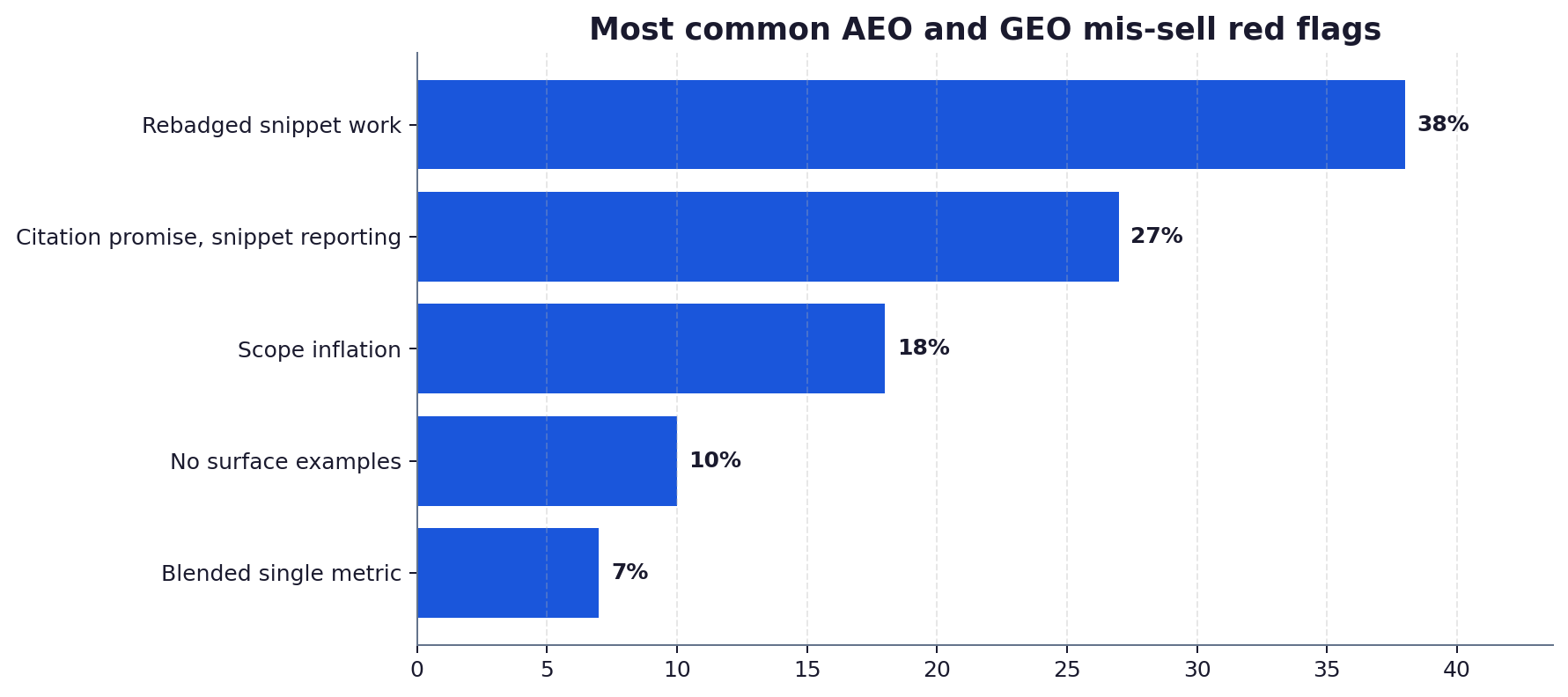
Convergence at the tactic level does not erase the difference in intent, and the difference in intent changes how you measure success. AEO asks: am I the answer. GEO asks: am I cited within the answer. On a generative surface you can be cited without being the headline recommendation, or recommended without a formal citation, and those are different outcomes that need different work. Treating them as one is how reporting goes wrong.
How the convergence is mis-sold
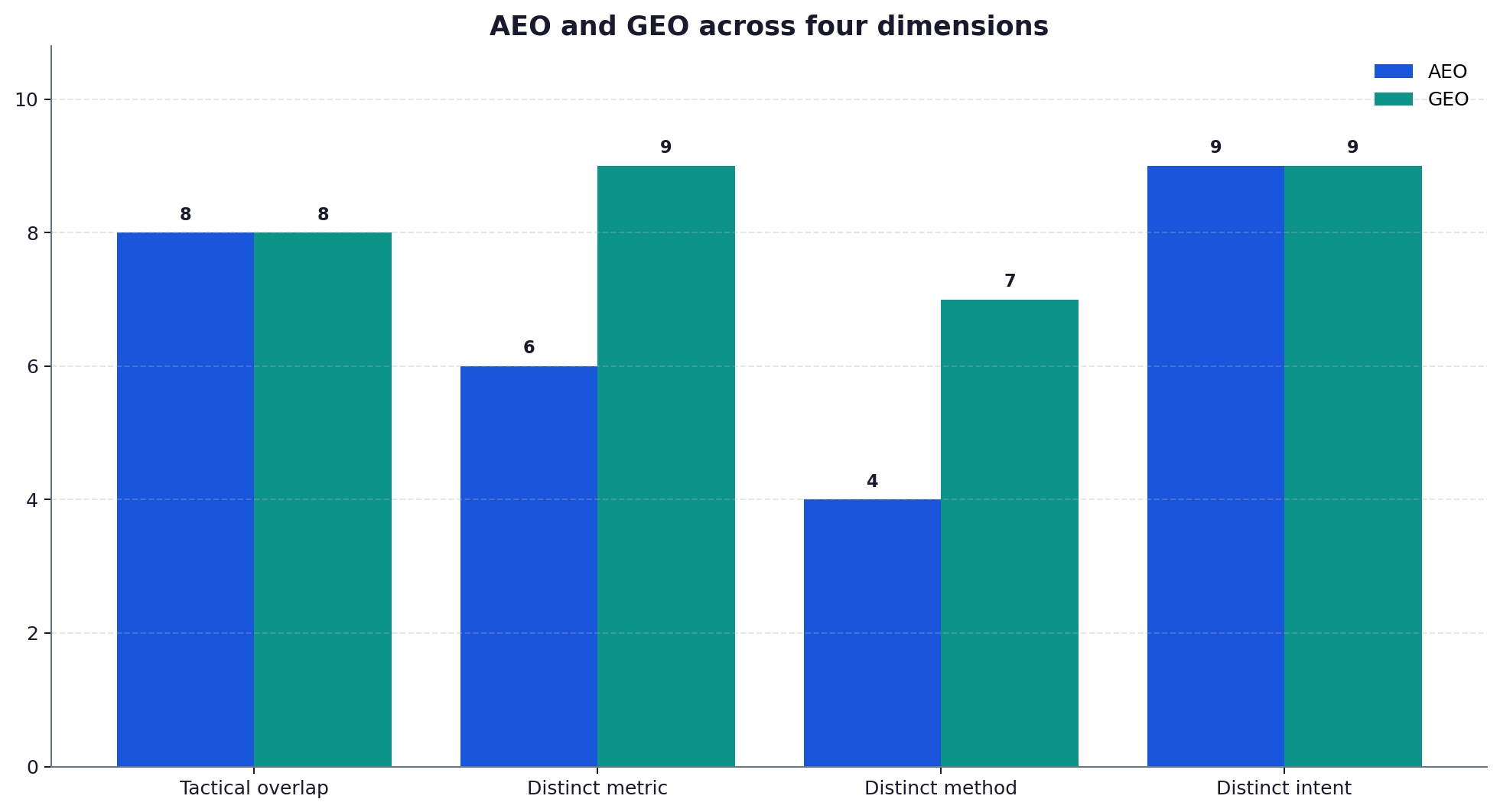
Three mis-sells are common. The first is rebadging: an agency renames its old featured-snippet service GEO and raises the price without changing the work. The second is conflation: a provider promises GEO citation outcomes but measures and reports only snippet ownership, so the metric never matches the promise. The third is scope inflation: selling a full GEO programme when the client’s queries are answered by simple AEO formatting that costs a fraction.
The vocabulary shift adds a fourth pattern worth watching for. As “generative engine optimization” declines and the AEO terms rise, expect the same service decks to be relabelled again, this time from GEO to AEO, with the price unchanged. The label a provider leads with tells you which search term they are chasing. What they measure tells you what they actually do.
The three-question audit
You can detect a mis-sell with three questions. First, surface: which surfaces will you optimise for, and can you show examples of citations versus answer ownership. Second, metric: will you report citation share, answer ownership, or both, and how do you measure each. Third, method: what specifically will you do that goes beyond formatting a snippet. A provider who understands the distinction answers all three crisply. One who is repackaging blurs them, because the blur is the product.
What to do with the distinction
For most brands the answer is all three, in proportion. Keep the SEO base sound, use AEO discipline to win the direct-answer slots where being the answer is achievable, and use GEO discipline to earn citations inside the broader generated answers where being one trusted source among several is the realistic goal. The labels matter less than the measurement. As long as you track rankings, answer ownership and citation share separately and buy the work each one requires, the AEO versus GEO debate becomes a question of emphasis rather than a reason to overpay.
The emphasis shifts by sector and by query type. A local service business answering well-defined how-to and near-me questions leans more on AEO discipline, because those queries still resolve to a single best answer. A considered B2B purchase, where buyers ask comparative and evaluative questions, leans more on GEO, because the engine composes a multi-source answer and citation share is the realistic prize. Map your own queries to that spectrum before you commit a budget, and the label a provider uses stops mattering, because you already know which work each query needs.
How we compiled the trend data
The figures in this post come from a single AiBoost pull of Google Ads keyword data through DataForSEO in August 2026. The location was set to the United Kingdom and the language to English, so the volumes describe UK demand rather than global demand.
Each term carries twelve months of monthly search volume. To describe direction rather than month-to-month noise, we took the average of the first three months in that window and compared it against the average of the latest three months, then expressed the change as a multiple or a percentage. The “current volume” figures quoted separately, such as roughly 140 searches a month for “aeo vs geo” and 320 for “answer engine optimization”, are Google’s own rolling twelve-month averages, which is why they sit below the latest three-month averages for terms that are climbing. Competition labels are Google’s advertiser competition bands, not a measure of organic difficulty.
No modelling, smoothing or third-party estimation was applied on top of the returned values. The terms were chosen because they are the vocabulary this post is about, along with the adjacent commercial queries a UK buyer would use when shopping for the service.
Limitations
Four caveats sit on these numbers, and they matter if you plan to act on them.
Google bands its volumes. Reported search volumes are bucketed rather than exact, so small absolute movements at low volume can be an artefact of banding rather than real change. The direction across a group of related terms is more reliable than any single figure.
Close variants are grouped. Google Ads data merges close variants, so a reported figure for one phrasing can absorb demand from spellings and word orders we did not query. British and American spellings of “optimisation” are the obvious case here.
The bare acronym is polluted. “aeo” on its own is dominated by brand searches for American Eagle Outfitters, so any volume attached to the bare acronym is unusable for this purpose. Only the qualified phrasings, such as “aeo vs geo” and “aeo seo”, are reliable, and those are the only ones quoted above.
One snapshot cannot separate category growth from vocabulary churn. A rise in “aeo vs geo” alongside a fall in “generative engine optimization” is consistent with the market renaming the same activity, and it is equally consistent with genuine growth in one area and decline in another. A single pull cannot tell those apart. Repeating the same pull over several quarters would, and that is the honest limit of what this data supports today.
Frequently asked questions
What is the difference between AEO and GEO?
Answer engine optimisation aims to make your content the direct answer, in formats like featured snippets, People Also Ask and voice results. Generative engine optimisation aims to make your content a cited source inside an AI-generated answer composed from many sources. The unit differs: AEO is about owning the answer, GEO is about being referenced within it. In 2026 the surfaces have largely merged, so the tactics overlap heavily, but the intent and the metric remain distinct, which is why the terms still both exist.
Have AEO and GEO merged into the same thing?
At the level of tactics, largely yes, because the answer surface is now a generative surface. Structured data, concise direct answers and clean extraction help with both. But the success metric has not merged. AEO measures answer ownership; GEO measures citation share, the proportion of relevant answers that cite you. You can be cited without being the headline recommendation, or recommended without a citation, so a programme that tracks only one of these will misreport the other. Treat them as converged in method but distinct in measurement.
Why do some agencies confuse or mis-sell them?
Because the convergence creates cover. Three patterns recur: rebadging old featured-snippet work as GEO at a higher price, conflating the two by promising citation outcomes while reporting only snippet ownership, and inflating scope by selling a full GEO programme where simple AEO formatting would do. None requires bad faith, but all leave the buyer paying for a label rather than the work. A clear provider separates the surface, the metric and the method; a repackager keeps them blurred.
How can I tell if a provider really understands GEO?
Ask three questions. Which surfaces will you optimise for, and can you show citations as well as answer ownership. Which metrics will you report, citation share, answer ownership or both, and how do you measure each. And what specifically will you do beyond formatting a snippet. A provider who understands the distinction answers all three precisely and shows examples. One who is repackaging gives vague, blended answers, because the blur between AEO and GEO is what the mis-sell depends on.
Do I need AEO, GEO or both?
Most brands need both, in proportion to their queries. Use AEO discipline to win direct-answer slots where being the answer is realistic, and GEO discipline to earn citations inside broader generated answers where being one trusted source among several is the achievable outcome. The right balance depends on how engines currently answer your specific queries, which an audit can show. The practical rule is to track answer ownership and citation share separately and buy the work each genuinely requires.
Is AEO obsolete now that GEO exists?
No. AEO discipline still wins the direct-answer formats that persist inside generative surfaces, and the structural skills it teaches, concise answers, clean extraction, strong schema, are exactly what GEO also rewards. Rather than one replacing the other, AEO has become the foundation layer and GEO the citation layer built on top. Declaring AEO obsolete is itself a sign of a provider chasing the newer label. The durable approach treats AEO as the base and GEO as the extension that the shared answer surface now demands.
Sources and references
- GEO: Generative Engine Optimization. arXiv (Aggarwal et al.), 2024
- Google Ads keyword volume data, UK, English (AiBoost pull, August 2026). DataForSEO, 2026
- What is generative engine optimization (GEO)?. Search Engine Land, 2026
- Answer engine optimisation explained. Search Engine Journal, 2026
- Featured snippets and answer formats. Schema.org, 2026
- Measuring brand presence across AI answers. Profound, 2026
- AI Overviews and citation patterns study. Ahrefs, 2026
Not sure whether you need SEO, AEO or GEO first? A free AI visibility report shows how AI engines answer and cite for your queries, which tells you where the work actually is.
Change log
- 2026-06-11: Initial publication.
- 2026-08-10: Extended from a two-way AEO versus GEO comparison to a three-way SEO, AEO and GEO comparison. Added UK search-demand trend data (AiBoost DataForSEO pull, August 2026), an investment-order section, and methodology and limitations sections.