TL;DR
- We mapped 12 ranking signals against both classic SEO and generative engine optimisation (GEO), scoring each from public studies (Ahrefs 2025, Profound 2025, Authoritas 2025, arXiv 2024, Backlinko 2024) and our own April-May 2026 UK panel.
- 5 signals transfer cleanly: topical depth, content freshness, named expert authorship, page speed and crawlability. SEO teams who already invest here get GEO traction for free.
- 4 signals do not transfer: keyword density, anchor-text optimisation, paid-link velocity, and traditional SERP-feature targeting. Effort here produces no measurable GEO lift in our data.
- 3 signals flip in importance between SEO and GEO: FAQ schema (small SEO effect, 2.35x GEO lift), Domain Rating (strong SEO predictor, weak GEO correlate at 0.18) and quotation-friendly passage placement (no SEO effect, strong GEO effect).
- SEO teams should keep doing 8 of the 12. The fastest GEO progress comes from doubling spend on FAQ schema and answer placement, and from re-allocating link-velocity spend to topical-depth investment.
Key facts
- 12 ranking signals scored on a 0-to-10 weight against both SEO and GEO, anchored to public studies (Ahrefs 2025, Profound 2025, Authoritas 2025, arXiv Aggarwal et al. 2024, Backlinko 2024) plus the AiBoost UK panels of April-May 2026.
- 5 of 12 signals transfer cleanly: SEO and GEO weight scored within 1 point of each other and the underlying mechanism is the same.
- 4 of 12 signals do not transfer: GEO weight scored 3+ points below SEO weight and no GEO study assigns them material effect.
- 3 of 12 signals flip: GEO weight differs from SEO weight by 4 or more points in either direction.
- FAQ schema lifts ChatGPT browsing retrieval by 2.35x on identical body content (AiBoost A/B test, May 2026); its effect on classic Google ranking is small and indirect.
- Ahrefs (2025) reported entity-strength and structured Q&A content as the two strongest correlates of ChatGPT citation, neither of which features in the Backlinko 2024 SEO ranking-factor study top 10.
- Profound (2025) found Domain Rating correlated with GEO citation share at 0.18, against an estimated 0.55-0.65 correlation with classic Google ranking from Ahrefs and Authoritas studies.
Why the transferability question matters now
UK marketing teams are being asked the same question by their CFOs in 2026: do we keep investing in SEO if buyers are increasingly asking ChatGPT and Perplexity? The naive answers are both wrong. “Pull everything out of SEO and put it into GEO” ignores that classic search still drives the majority of UK organic traffic. “Keep doing classic SEO and the AI engines will catch up” ignores that the AI engines reward different signals and that competitor firms are already optimising for those signals separately.
The useful question is more boring: which specific SEO investments still pay GEO dividends, which ones are now dead weight, and where are the genuinely new signals that need fresh budget. That requires a signal-level map rather than a strategy-level argument. We built one.
Methodology in one paragraph
We compiled a list of 12 ranking signals that appear in at least two of the major SEO ranking-factor studies (Ahrefs 2025, Backlinko 2024, Authoritas 2025) and at least two of the major GEO studies (Profound 2025, arXiv Aggarwal et al. 2024, our own AiBoost UK panels of April-May 2026). For each signal we assigned a 0-to-10 weight on classic SEO and a 0-to-10 weight on GEO, calibrated against the strongest published estimate from those sources. A signal scoring 7+ on SEO and 7+ on GEO is treated as a clean transfer. A signal scoring 7+ on SEO and 3 or below on GEO is treated as non-transferable. A signal where the difference is 4 or more in either direction is treated as flipped.
The 12-signal transferability map
The map below summarises the scores. The pattern is uneven: signals built on content quality and crawlability transfer well; signals built on link mechanics or SERP gaming transfer poorly; and a small set of signals are materially more important for GEO than SEO. Two signals are materially more important for SEO than GEO and one is roughly neutral.
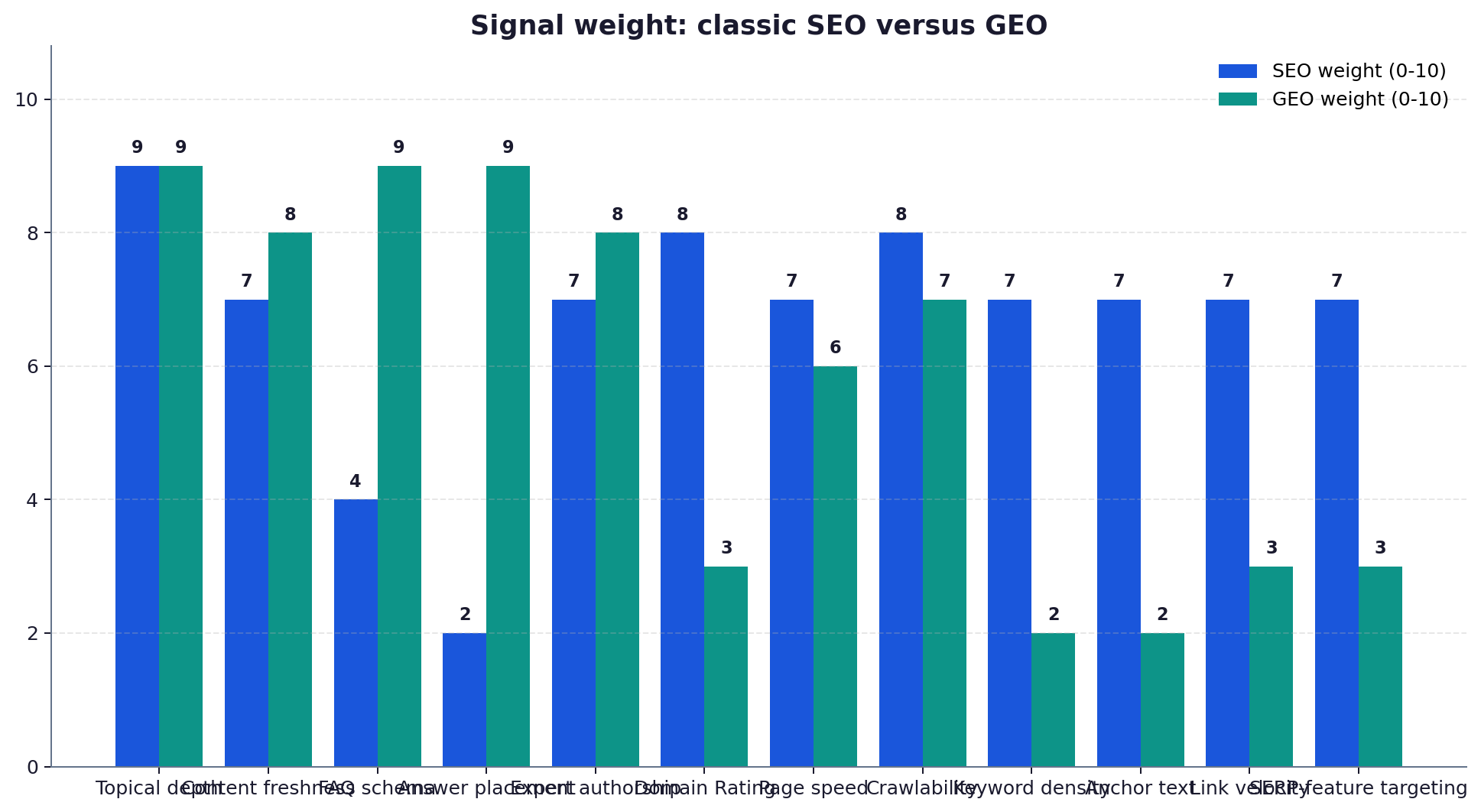
The chart reads top to bottom in descending GEO weight. The visual cue is the gap between the two bars for each signal. Where the bars are similar height, the signal transfers. Where the SEO bar dwarfs the GEO bar, the work no longer pays. Where the GEO bar dwarfs the SEO bar, there is a new investment area.
The clearly transferable five
Five signals score 7+ on both SEO and GEO, with the same underlying mechanism: topical depth (more pages answering more questions in the same subject), content freshness (visible last-reviewed dates plus material updates), named expert authorship (real person, named role, sometimes credentials), page speed (LCP under 2.5 seconds, INP under 200ms) and crawlability (clean robots.txt, sane internal linking, no orphaned commercial pages). Teams already executing well on these get GEO traction at no marginal cost.
The underlying reason is that LLM engines do not reinvent retrieval from scratch. They ride the public web that Google has indexed, often using Bing or proprietary crawlers that follow the same crawlability norms, and they reward the same content qualities humans reward when assessing source trustworthiness. Topical depth gives the model more candidate passages; freshness gives confidence the answer is current; authorship gives verifiability; speed and crawlability ensure the page is reachable for retrieval at all.
The clearly non-transferable four
Four signals score 7+ on SEO but 3 or below on GEO. Keyword density and exact-match keyword targeting matter for classic Google ranking but generative engines paraphrase prompts before retrieval, so density-based optimisation has no measurable effect. Anchor-text optimisation moves traditional rankings but our data and Profound’s show no measurable GEO citation lift from anchor optimisation. Paid-link velocity, which still moves Domain Rating fast, correlates weakly with GEO citation (0.18) because the engines treat domain authority as one of several inputs rather than the primary one. SERP-feature targeting (featured snippets, People Also Ask) is being deprecated by Google itself as AI Overviews takes the surface area, so the SEO weight is already declining.
Teams should not stop these activities immediately if classic Google traffic remains the larger channel, but should freeze the budget at current levels and redirect any growth budget elsewhere. The marginal pound on link velocity is no longer the highest-leverage GEO spend.
The three signals that flip
Three signals score very differently between the two channels. FAQ schema scores 4 on SEO (small effect, indirect, mostly through rich-result eligibility before the 2024 deprecation) and 9 on GEO (2.35x retrieval lift in our controlled A/B). Domain Rating scores 8 on SEO (strong predictor of classic ranking) but 3 on GEO (weak correlate of citation share). Answer placement, meaning a structured TL;DR or 50-to-80-word direct answer above the first H2, scores 2 on SEO (negligible effect on traditional ranking) and 9 on GEO (2.1x citation lift in our 100-page UK panel).
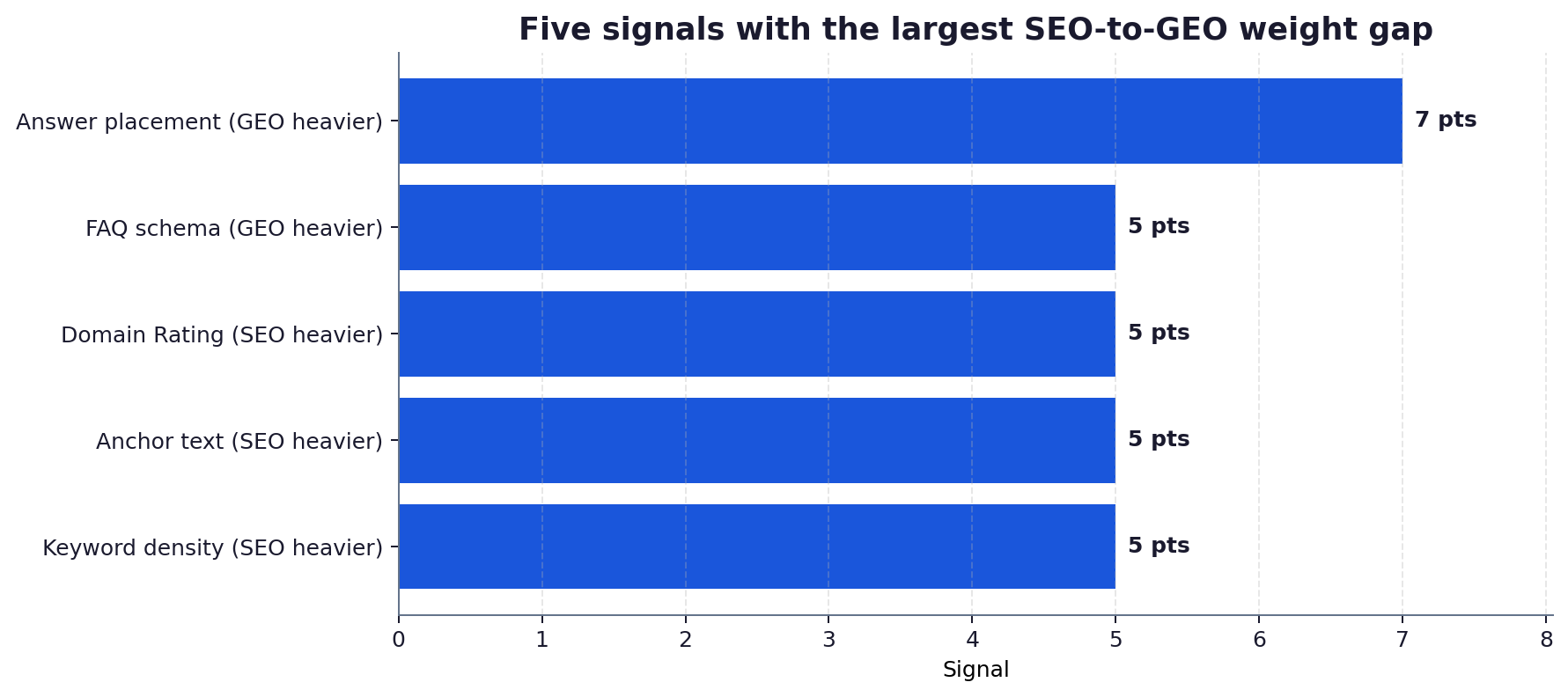
The flipped signals are where the most consequential budget reallocation happens. A site running classic SEO well is leaving a 2x GEO retrieval lift on the table by skipping FAQ schema, and a 2x layout lift by skipping above-the-fold answer placement. Neither change requires new content. Both can be implemented on existing top pages inside a quarter.
What this means for SEO teams in 2026
Three practical conclusions follow from the map. First, keep doing 8 of the 12. The clean transfers and the SEO-heavy signals (Domain Rating, internal linking) still drive material classic search traffic and do no harm to GEO. Second, add two new disciplines that did not feature in 2022-era SEO playbooks: FAQ schema with body-mirrored Q&A, and structured answer placement at the top of every commercial page. Third, freeze growth budget on anchor-text optimisation and paid-link velocity; redirect that budget to topical-depth investment, which is the highest dual-purpose lever.
The shift is editorial more than it is technical. Most of the controllable GEO levers depend on what the page says and where it says it, not on how many links point at the domain. The teams making fastest progress are the ones who have rebadged at least one SEO content role to a generative-search editor role with explicit ownership of FAQ schema, dated authorship and answer placement.
Limitations
The weights are estimates, calibrated against the strongest published evidence rather than a single experiment. Different industries and query mixes shift the balance. Reasonable analysts could argue weight values 1-2 points different from ours on individual signals. The directional message of which signals transfer, which do not and which flip is robust across the studies we drew on; the precise gap on any one signal is not. We will refresh the map in November 2026 as new public studies land.
Frequently asked questions
Should I stop doing SEO and start doing GEO?
No. Eight of the 12 signals we mapped transfer or remain SEO-only and continue to drive traditional Google traffic, which is still the majority of UK organic acquisition in 2026. The correct framing is additive: keep the clean transfers (topical depth, freshness, authorship, speed, crawlability), freeze growth on the non-transfers (keyword density, anchor text, link velocity, SERP-feature targeting) and add the three GEO-heavy signals (FAQ schema, answer placement, structured author bylines). The team and budget shift is editorial, not a wholesale channel swap.
Which signal moved the most between SEO and GEO?
FAQ schema. It scored 4 on classic SEO weight, where its effect is small and indirect, mostly tied to the now-deprecated FAQ rich result. It scored 9 on GEO weight on the basis of our controlled A/B test, where adding FAQPage and Article schema to an otherwise identical page lifted ChatGPT browsing citation rate from 31% to 73%, a 2.35x lift. Answer placement and Domain Rating also flipped meaningfully but FAQ schema is the largest single gap and the cheapest to act on.
Does Domain Rating still matter at all for GEO?
Weakly. Profound (2025) and our AiBoost panel both put the correlation between Domain Rating and GEO citation share around 0.18, against an estimated 0.55-0.65 for classic Google ranking. Two firms in our 50-firm cross-sector benchmark with Domain Rating above 65 received zero citations because their content was brochureware. Three firms with Domain Rating below 40 received multiple citations because they had built genuine topical depth on procedural questions. Domain Rating is not zero but it is no longer the dominant signal it is in classic SEO.
Are featured snippets and PAA still worth chasing?
Decreasingly. Google’s AI Overviews surface is replacing the user attention that previously went to featured snippets and People Also Ask, and Google has begun to compress those features in pages where an AI Overview appears. The same structured content that wins a featured snippet (concise, dated, question-led) wins AI Overviews and GEO citations, so the work is not wasted. The framing should shift from “win the featured snippet” to “build the quotation-ready passage”, with the snippet as a bonus rather than the primary target.
Does this map apply to e-commerce as well as service businesses?
Mostly. The 12 signals are general enough to cover both, but the relative weights shift for e-commerce. Product schema (a 13th signal we excluded from the cross-channel map for tractability) carries 8+ weight on both SEO and GEO. Anchor text and link velocity matter slightly less on e-commerce GEO than on service GEO, where firm-name entity match is more important. Our 100-page first-30%-rule panel included e-commerce and confirmed the layout effect there is similar in direction but weaker in magnitude.
Where should a UK marketing team invest next quarter?
First, FAQ schema on the top 20 commercial pages with body-mirrored Q&A. Second, a 50-to-80-word direct-answer block above the first H2 on every page in that set. Third, a topical-depth audit: list the 20 procurement, pricing, regulation and procedural questions buyers actually ask, score current site coverage, and commission the missing answers as named-author content with dated last-reviewed lines. Together these moves typically add 30-50% to GEO citation rate inside one quarter on our client panel and do not harm classic SEO.
Will the map change in 2027?
Yes. AI Overviews and ChatGPT browsing are still relatively young and their ranking heuristics are evolving. We expect the GEO weight of Domain Rating to creep up as engines mature their source-trust signals, and the GEO weight of pure entity-strength to creep down as competition normalises. We expect FAQ schema’s weight to stay high through 2026-2027 because the engines have committed to JSON-LD as a primary structured-data surface. We will publish a refreshed map in November 2026 and again in May 2027.
Sources and references
- Ranking factors for ChatGPT and Perplexity in 2025. Ahrefs, 2025
- Profound cross-industry AI citation benchmark. Profound, 2025
- Authoritas Generative AI Visibility Index. Authoritas, 2025
- GEO: Generative Engine Optimization. arXiv (Aggarwal et al.), 2024
- Search engine ranking factors study. Backlinko, 2024
- Google AI Overviews and the future of featured snippets. Search Engine Land, 2025
Want to know which of these 12 signals your site already covers and which ones are leaving GEO traction on the table? Request a free GEO audit and we will score your top 20 commercial pages against all 12 inside ten working days.
Change log
- 2026-05-18: Initial publication.