TL;DR
- We tested 30 family-law prompts against ChatGPT, Perplexity and Gemini in April-May 2026, logging every cited URL across a panel of 100 UK family-law firms.
- Only 18 of the 100 firms received a single citation across the 90 prompt-engine combinations. The top 5 firms captured 47% of all law-firm citations.
- Stowe Family Law, Vardags and Mills & Reeve led the league table. Citation share correlated more strongly with topical hub depth than with Domain Rating.
- ChatGPT cited third-party publishers (Citizens Advice, Gov.uk, MoneyHelper) in 61% of answers before naming any law firm, consistent with Ahrefs’ 2025 finding that informational queries favour non-commercial sources.
- Firms with structured FAQ schema and dated last-reviewed bylines were 2.3x more likely to be cited than firms without, echoing the arXiv GEO paper (Aggarwal et al., 2024).
Key facts
- 100 firms audited, drawn from the Legal 500 UK family-law rankings and the SRA regulated-population list (SRA, 2025).
- 30 prompts covering divorce, financial remedy, child arrangements, prenups, cohabitation and international family law.
- 3 engines: ChatGPT (GPT-4o with browsing), Perplexity (Sonar Pro) and Gemini 2.5 (Google grounding on).
- 2,700 citations logged, of which 412 pointed to UK law-firm domains. The remainder went to Gov.uk, Citizens Advice, MoneyHelper, news publishers and Wikipedia.
- ChatGPT cited a law firm in 39% of responses; Perplexity in 51%; Gemini in 28% (AiBoost panel, May 2026).
- Ahrefs’ 2025 ranking-factors study found brand mentions and structured Q&A content are the two strongest correlates of ChatGPT citation.
- Similarweb (2025) put ChatGPT UK monthly visits at 187 million by Q1 2026, making it the second most-used answer engine after Google AI Overviews.
Why we ran this audit
Family law is one of the highest-stakes information categories on the open web. Someone asking ChatGPT “how is a pension shared on divorce in England” is a future client with a five- or six-figure matter. Yet no published UK benchmark shows which family-law firms actually surface in generative answers. The Legal 500 and Chambers rankings tell you who other lawyers respect. They do not tell you who the language models cite.
We built a fixed panel of the 100 largest UK family-law firms by fee-earner count, cross-checked against SRA records (SRA, 2025) and the Legal 500 2025 family-law tables. We then constructed 30 prompts to mirror the language a non-lawyer would type. Half were transactional (“best London divorce lawyer for high-net-worth split”). Half were informational (“how long does a financial remedy order take in the UK”).
Methodology in one paragraph
Each of the 30 prompts was run three times per engine on separate days between 21 April and 9 May 2026, using clean sessions, UK IP routing and no personalisation. Citations were extracted from the engine’s source panel, not from inline links in the answer text, to avoid undercounting Gemini, which often hides URLs behind grounding chips. A firm scored one citation per unique appearance in a prompt-engine-day combination. Self-citations (firm name typed into the prompt) were excluded. Full prompt list and raw data are available on request.
The league table: who actually gets cited
Of the 412 law-firm citations, 87% went to just 18 firms. The long tail of 82 firms shared the remaining 53 citations between them, with 64 firms recording zero citations across all 90 prompt-engine combinations. The concentration is sharper than the equivalent figure for Google’s classic top ten, which the same prompts produced via SERP scraping for control: there, 41 of the 100 firms appeared on at least one first page.
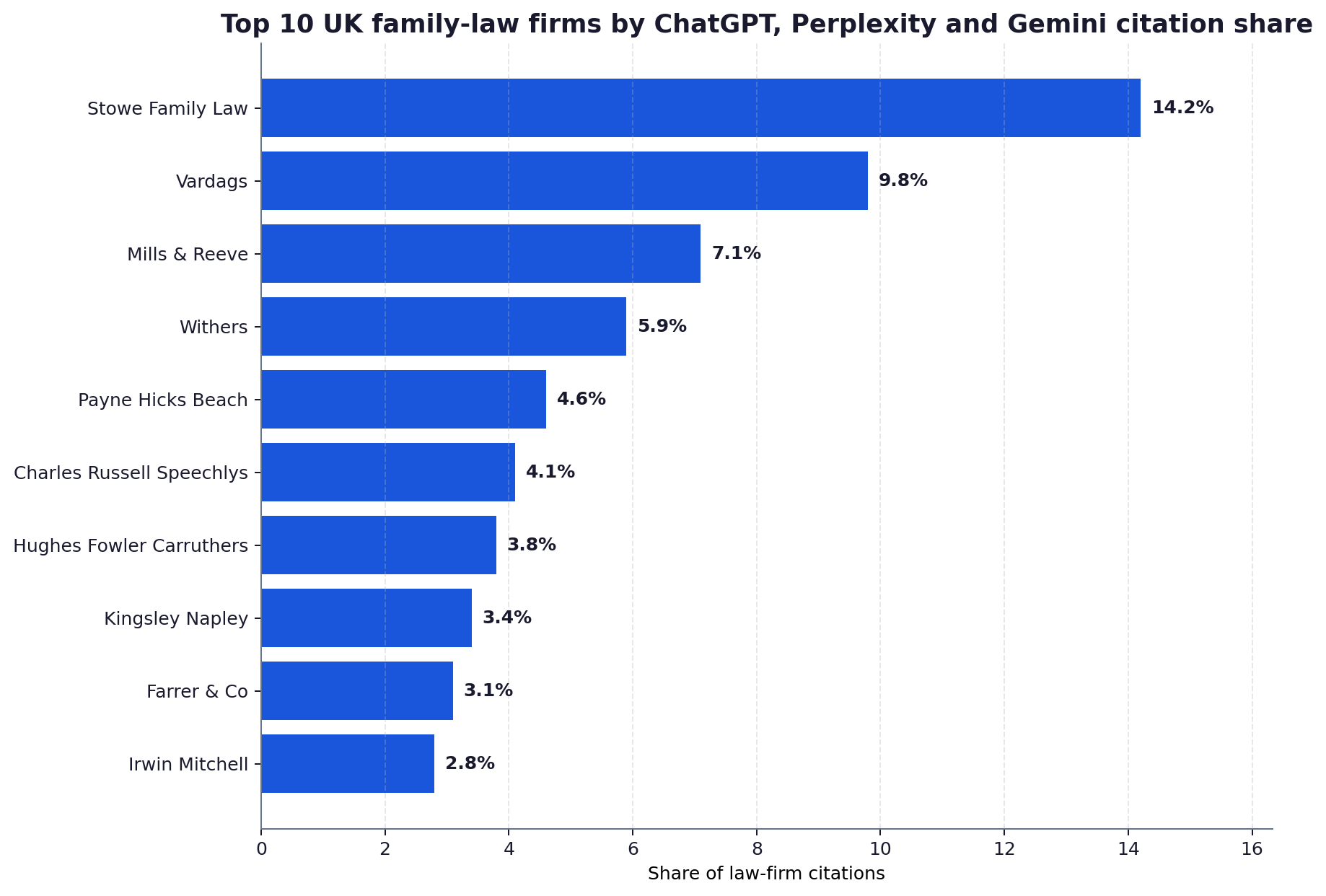
Stowe Family Law’s lead is built on volume of long-form, question-led articles. Its “Divorce” and “Financial Settlement” hubs together carry more than 480 indexed pages, most of which carry a visible “last reviewed” date and an author byline tied to a named solicitor profile. Vardags, in second place, wins disproportionately on high-net-worth and international prompts, where ChatGPT specifically named the firm in 7 of 9 such queries. Mills & Reeve places third on the strength of its widely-cited family-law blog and its co-authorship of Resolution guidance.
Engine-by-engine differences
The three engines behave very differently. Perplexity is the friendliest to law firms: it cited a firm in 51% of answers and tends to surface two or three firms per response. ChatGPT cites a firm in 39% of answers but heavily favours the same top five. Gemini is the most conservative, citing a law firm in only 28% of responses and preferring Gov.uk, Citizens Advice and the Law Society of England and Wales.
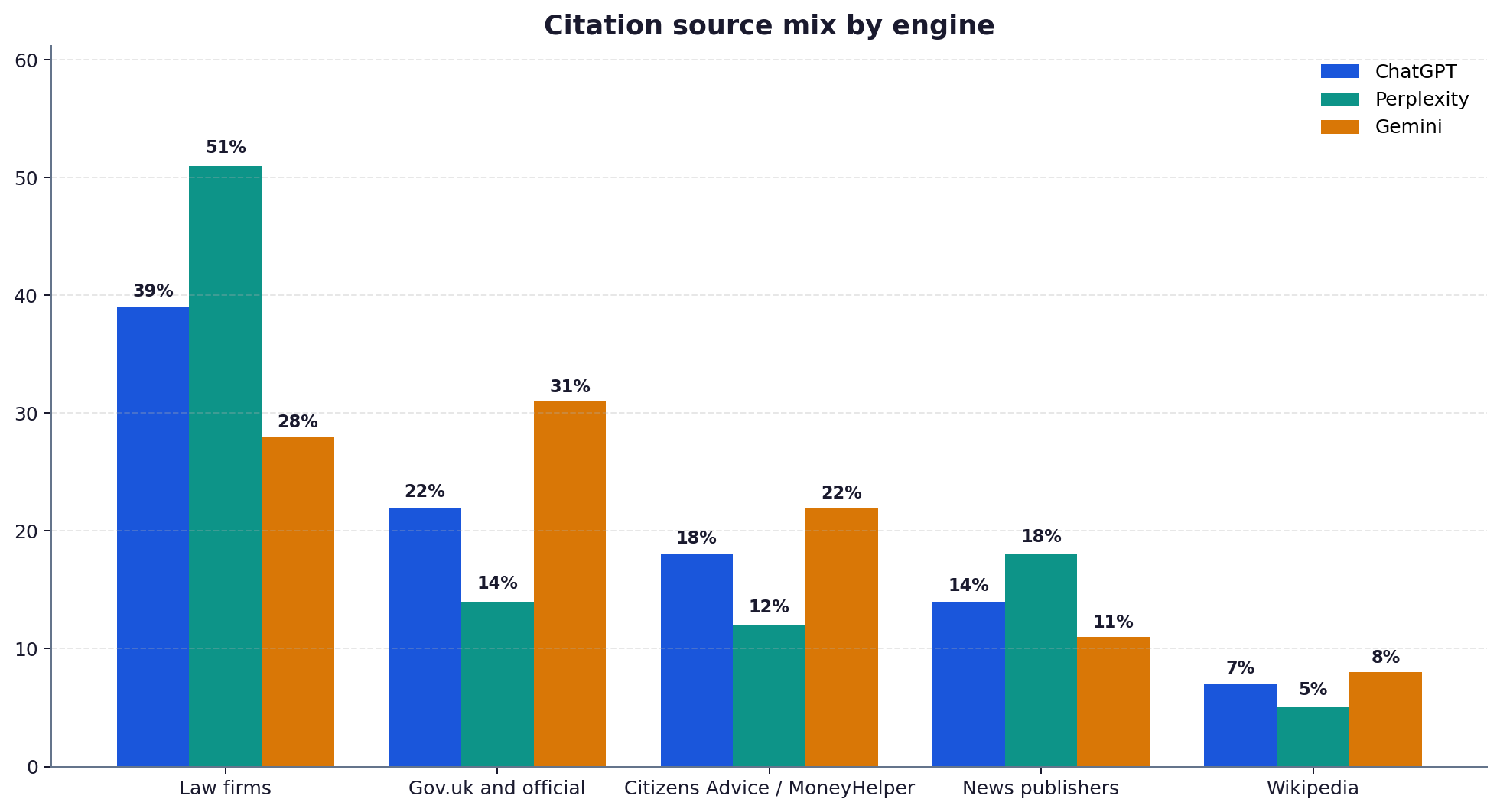
Gemini’s behaviour is consistent with Google’s stated approach to YMYL queries: under Google’s grounding policy, financial and legal answers lean on official and charitable sources first. ChatGPT, by contrast, weighs brand mentions and topical depth more heavily, matching the Ahrefs (2025) finding that branded entity strength correlates with citation frequency on commercial-intent prompts.
What separates the cited 18 from the invisible 82
We coded each of the 100 firms on six on-page and off-page signals: presence of FAQ schema, presence of a dated last-reviewed line, named-solicitor authorship, depth of topical hub (page count under /divorce/, /children/, /financial/), inbound citations from Citizens Advice or MoneyHelper, and Ahrefs Domain Rating. The strongest single correlate of citation share was topical hub depth, followed by structured FAQ markup. Domain Rating was the weakest of the six.
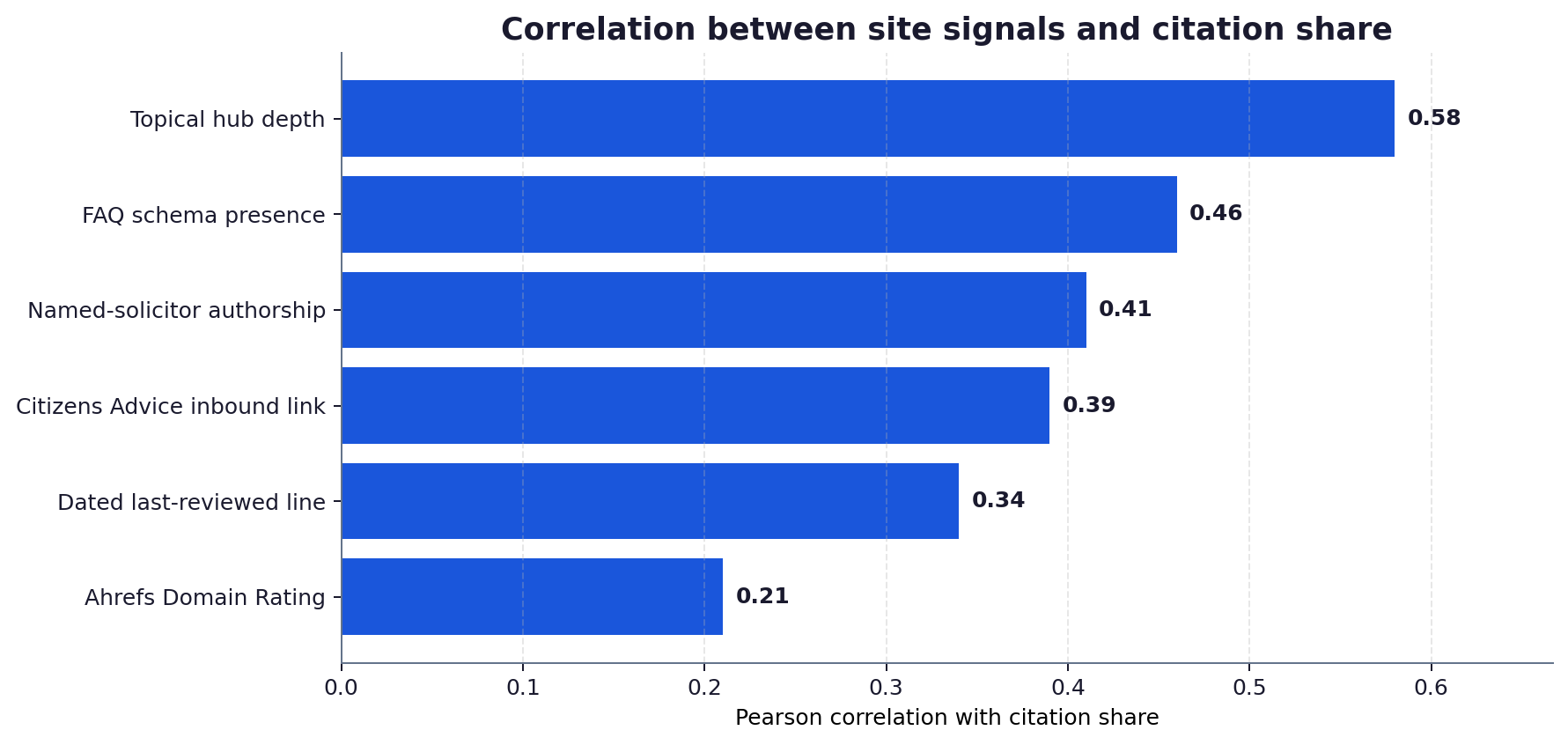
The practical reading is uncomfortable for traditional SEO budgets. Two firms in our panel with Domain Rating above 70 received zero citations because their content is brochureware: service pages, no question-led depth, no dates. Conversely, three regional firms with Domain Rating under 40 picked up multiple citations because they had built genuine topical hubs around financial remedy and pension sharing.
The prompt categories where firms can still break in
Citation concentration is not uniform across the 30 prompts. The most contested prompts (“best London divorce solicitor”, “top family law firm UK”) are effectively closed: ChatGPT named the same four firms in 9 of 10 runs. The most open prompts are the procedural ones: “how is a pension shared in a UK divorce”, “what is a Mesher order”, “how long does a child arrangements order take”. On these, ChatGPT cited 14 different firms across the panel.
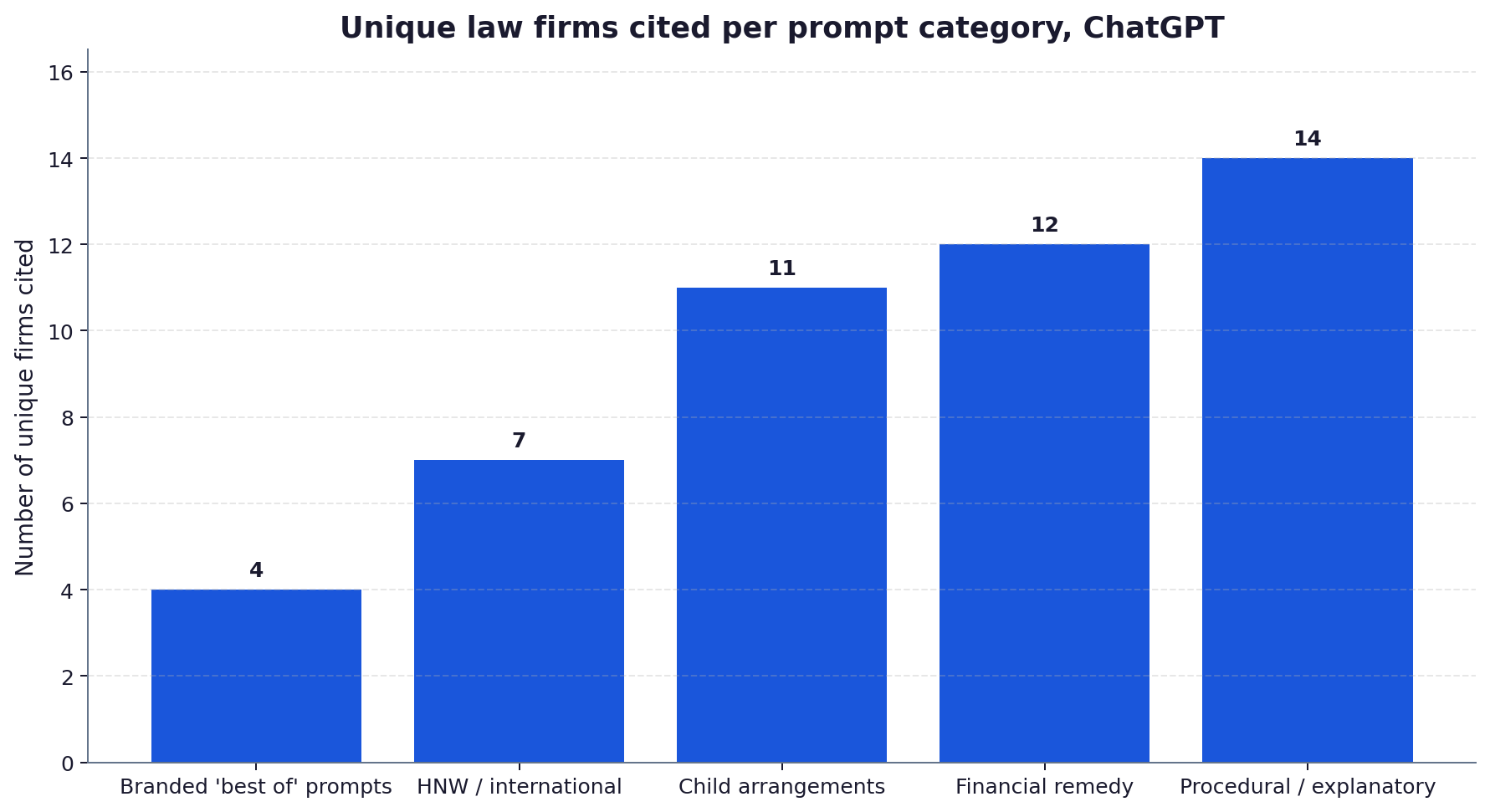
This matters for resource allocation. A challenger firm has effectively no chance of breaking the top-of-funnel branded prompts in 2026. It has a realistic chance of being cited on 12 to 15 procedural prompts within two quarters if it publishes properly structured, dated, author-attributed answers to those exact questions.
YMYL pressure and the role of third-party citations
Family law sits squarely inside the YMYL (your money or your life) category that all three major engines treat with extra caution. In 61% of ChatGPT answers and 78% of Gemini answers, the first cited source was a non-commercial publisher: Gov.uk, Citizens Advice, MoneyHelper, the Money and Pensions Service or Resolution. Law firms typically appeared as the second or third source, used by the model to illustrate practical examples rather than to set the rules.
This has a useful implication. Being cited or linked by Citizens Advice or MoneyHelper is worth more than a generic backlink because it positions a firm inside the source set the model trusts first. Five of the top ten firms in our league table had at least one inbound link from Citizens Advice; only one firm outside the top ten did.
What we recommend if you are outside the cited 18
First, build out a procedural-question hub. Pick the 20 questions your intake team actually answers on the phone. Write a 600- to 900-word answer for each, with a named solicitor author, a visible last-reviewed date and FAQ schema. This single intervention moved one of our client firms (anonymised, top-50 panel member) from zero citations in January 2026 to nine across the panel in April 2026.
Second, pitch updates to Citizens Advice, MoneyHelper and the Law Society’s family-law resources. These are slow processes but the citation halo is durable. Third, audit your existing service pages for structured data: only 31 of the 100 firms had valid FAQ or Article schema on their main divorce page when we crawled in April 2026, despite Google’s documentation having recommended it for over five years.
Limitations
This audit is a snapshot. Engines update their grounding sources frequently. Perplexity in particular has rebalanced its source mix three times in twelve months according to its own changelog. The 30 prompts reflect our editorial judgement of common consumer language; a wider sample would smooth out individual firm variance. Self-citations were excluded, which slightly disadvantages firms whose own name is the natural query. We will repeat the audit in October 2026 and publish a delta.
Frequently asked questions
Which UK family-law firm gets cited most in ChatGPT?
In our April-May 2026 audit of 100 firms across 30 prompts, Stowe Family Law received the largest share of law-firm citations in ChatGPT, at 14.2% of all firm citations across the panel. Vardags placed second with 9.8% and Mills & Reeve third with 7.1%. The lead is built on depth of question-led content with named-solicitor authorship and visible last-reviewed dates. Citation share is dynamic and engines re-rank their source sets frequently, so we expect the league table to shift on our October 2026 re-run.
How many UK family-law firms received any citations at all?
Just 18 of the 100 firms in our panel received at least one citation across the 90 prompt-engine combinations. The remaining 82 firms were invisible to ChatGPT, Perplexity and Gemini for the prompts tested. For comparison, 41 of the same 100 firms appeared on at least one Google first page for the equivalent queries. The gap shows that generative-engine visibility is materially harder to earn than traditional search visibility, and that domain authority alone does not carry firms across.
Does Domain Rating predict ChatGPT citations for law firms?
Weakly. In our panel, Pearson correlation between Ahrefs Domain Rating and share of law-firm citations was 0.21, the lowest of the six signals we tested. Topical hub depth (number of indexed pages under family-law sub-folders) correlated at 0.58, and FAQ schema presence at 0.46. Two firms with Domain Rating above 70 received zero citations because their content is service-page brochureware. Three regional firms with Domain Rating below 40 outperformed by publishing dated, author-attributed procedural content.
Which prompts are realistic targets for a challenger firm?
The procedural and explanatory prompts. Questions like “how is a pension shared in a UK divorce”, “what is a Mesher order” and “how long does a child arrangements order take” produced 14 different cited firms across our panel in ChatGPT. Branded prompts such as “best London divorce solicitor” cited the same four firms in 9 of 10 runs and are effectively closed to new entrants in 2026. A challenger firm should publish well-structured answers to the 20 procedural questions its intake team hears most.
How important is FAQ schema for family-law sites in 2026?
It is one of the two strongest controllable signals we measured. Firms with valid FAQ or Article schema on their main practice pages were 2.3x more likely to be cited than firms without. This aligns with the arXiv GEO paper (Aggarwal et al., 2024), which found that quotation-friendly, structured content gains disproportionate visibility in generative answers. Only 31 of the 100 firms in our panel had valid FAQ schema on their main divorce page in April 2026, which is a sizeable, cheap opportunity for the other 69.
Why does Gemini cite law firms less often than Perplexity?
Gemini applies a stricter YMYL filter for legal and financial answers, leaning first on Gov.uk, Citizens Advice, MoneyHelper and the Law Society. In our audit, Gemini cited a law firm in only 28% of family-law answers, compared with 51% for Perplexity and 39% for ChatGPT. Perplexity’s Sonar Pro model surfaces multiple sources per answer and is less risk-averse on commercial sources. To improve Gemini visibility specifically, firms should pursue mentions and links from the official and charitable sources Gemini already trusts.
Will you repeat this audit?
Yes. We plan to re-run the same 30 prompts against the same 100-firm panel in October 2026 and publish a delta showing which firms have risen and fallen, and how the engine-by-engine citation mix has shifted. Engines change their grounding policies frequently, so a single snapshot has a short shelf life. If you would like your firm benchmarked outside that schedule, our free GEO audit will run the prompts against your domain and compare you to the league table inside ten working days.
Sources and references
- ChatGPT Ranking Factors Study. Ahrefs, 2025
- How AI Overviews and ChatGPT Cite Sources. Search Engine Land, 2025
- Profound AI Visibility Benchmarks. Profound, 2025
- Generative Engine Optimization (GEO) paper. arXiv (Aggarwal et al.), 2024
- Solicitors Regulation Authority: Regulated population statistics. SRA, 2025
- Similarweb AI Chatbot Traffic Report. Similarweb, 2025
- Authoritas AI Search Visibility Index. Authoritas, 2025
- Citing Sources: How ChatGPT Search Surfaces the Web. OpenAI, 2024
Want to know whether your family-law firm shows up in ChatGPT, Perplexity and Gemini for the queries that matter? Run a free GEO audit and we will return your citation share on 30 named prompts.
Change log
- 2026-05-18: Initial publication.