TL;DR
- Citation half-life is the number of weeks a page holds before it loses half of its share of AI citations. It is not the same as the age of the page.
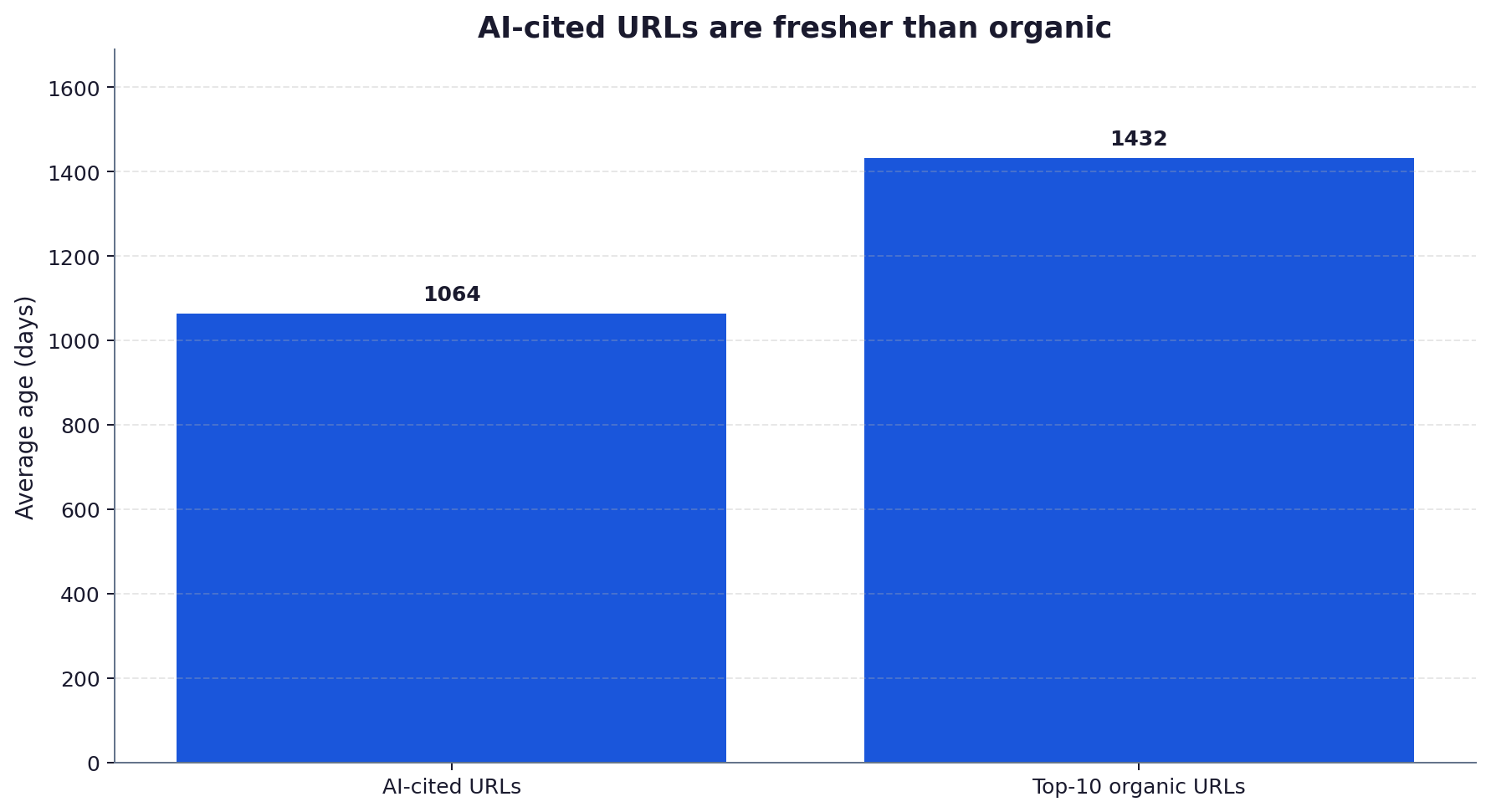
- Ahrefs, studying roughly 17 million AI citations in 2026, found AI-cited URLs average about 1,064 days old against 1,432 days for top-10 organic results, so AI leans about 25.7% fresher.
- Across several 2026 freshness analyses, close to half of AI-cited content is under 13 weeks old, which is why a single quarterly refresh rarely holds a citation.
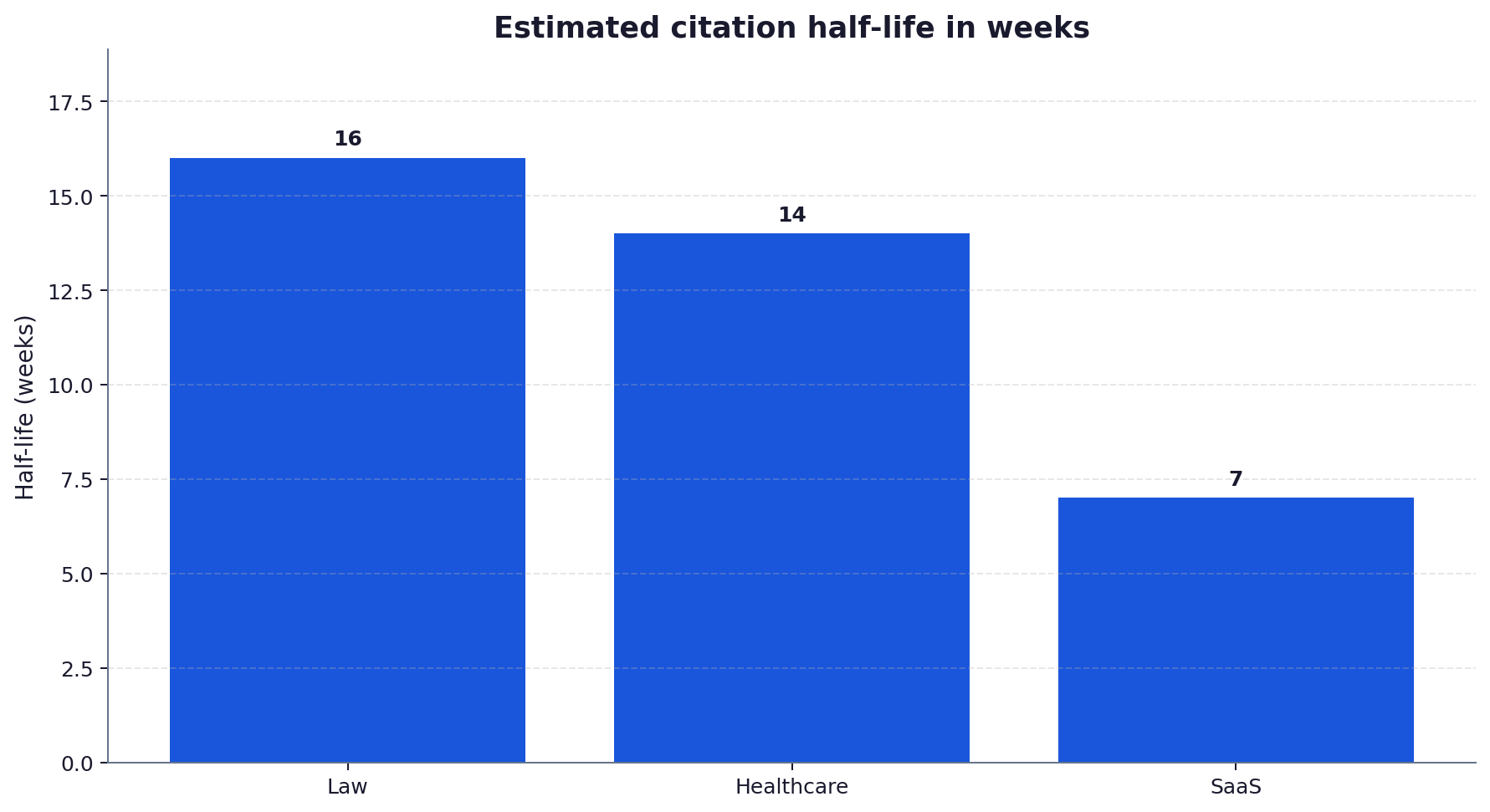
- Our directional read across UK law, healthcare and SaaS queries is that regulated verticals decay more slowly because regulators and professional bodies reissue authoritative reference content on a predictable cycle.
- SaaS decays fastest, so a fixed once-a-quarter refresh policy under-serves software brands and over-serves regulated ones.
Key facts
- AI-cited URLs are about 25.7% fresher than top-10 organic URLs, 1,064 versus 1,432 days on average (Ahrefs, 2026).
- Close to 50% of content cited in AI answers is under 13 weeks old across 2026 freshness studies (multiple analyses, 2026).
- Around 83% of commercial AI citations come from pages updated within the past year, and about 60% from pages refreshed within six months (industry freshness analyses, 2026).
- Only about 30% of brands remain visible in back-to-back AI responses, so decay compounds with run-to-run volatility (AI visibility trackers, 2026).
- Financial and regulated content shows a steeper citation-probability drop once it passes three to six months without a refresh (content freshness analyses, 2026).
- Structure and attribution, not word count, are the strongest citation levers in the original GEO study (Aggarwal et al., arXiv, 2023).
What citation half-life actually measures
Most freshness advice treats a page as either current or stale. That binary is too coarse for AI search, where a page can keep ranking in classic organic results while quietly losing the citation it once earned inside a ChatGPT or Perplexity answer. Citation half-life reframes the question. Instead of asking how old a page is, it asks how long a page holds its share of AI citations after its last meaningful update, and specifically how many weeks pass before that share falls by half.
The metric matters because refresh budgets are finite. If you manage content for a UK firm, you cannot rewrite everything every month. You need to know which pages decay quickly and which hold, so you can spend editorial time where it changes citations rather than where it feels productive. Citation half-life gives you that number, and our reading of the 2026 data is that it is not one number. It is a different number for each industry.
The freshness signal is real, and it is sharper than in classic search
The starting point is that AI engines prefer fresh sources more aggressively than Google’s classic index does. Ahrefs, analysing about 17 million AI citations in 2026, found that AI-cited URLs were on average 1,064 days old, against 1,432 days for the URLs ranking in the top ten organic positions. That is roughly a 25.7% freshness premium. Several other 2026 analyses put close to half of all AI-cited content at under 13 weeks old, and around 83% of commercial citations at under a year.
Put together, these numbers describe a signal that decays. A page that was cited in March can be quietly dropped by June, not because it became wrong, but because newer, equally structured content appeared and the engine reweighted toward it. This is the mechanism citation half-life is designed to track.
How we segment half-life by vertical
To read half-life by industry rather than in aggregate, we track a fixed panel of commercial UK queries in three verticals, law, healthcare and SaaS, and re-run them weekly across ChatGPT, Perplexity and Gemini for six weeks. For each query we record which domains are cited, then measure how a given page’s citation share moves week over week after its last update. Half-life is the point where that share has halved. The approach follows the controlled-testing discipline set out in the original GEO research by Aggarwal and colleagues, which showed that structure and attribution, rather than raw length, drive citation.
Two cautions matter. First, run-to-run volatility is high, so a six-week panel smooths noise rather than eliminating it. Second, the vertical figures below are directional. They describe the pattern the data points to, not a published census. We treat them as a working hypothesis that any UK firm can test on its own pages.
Regulated verticals decay more slowly
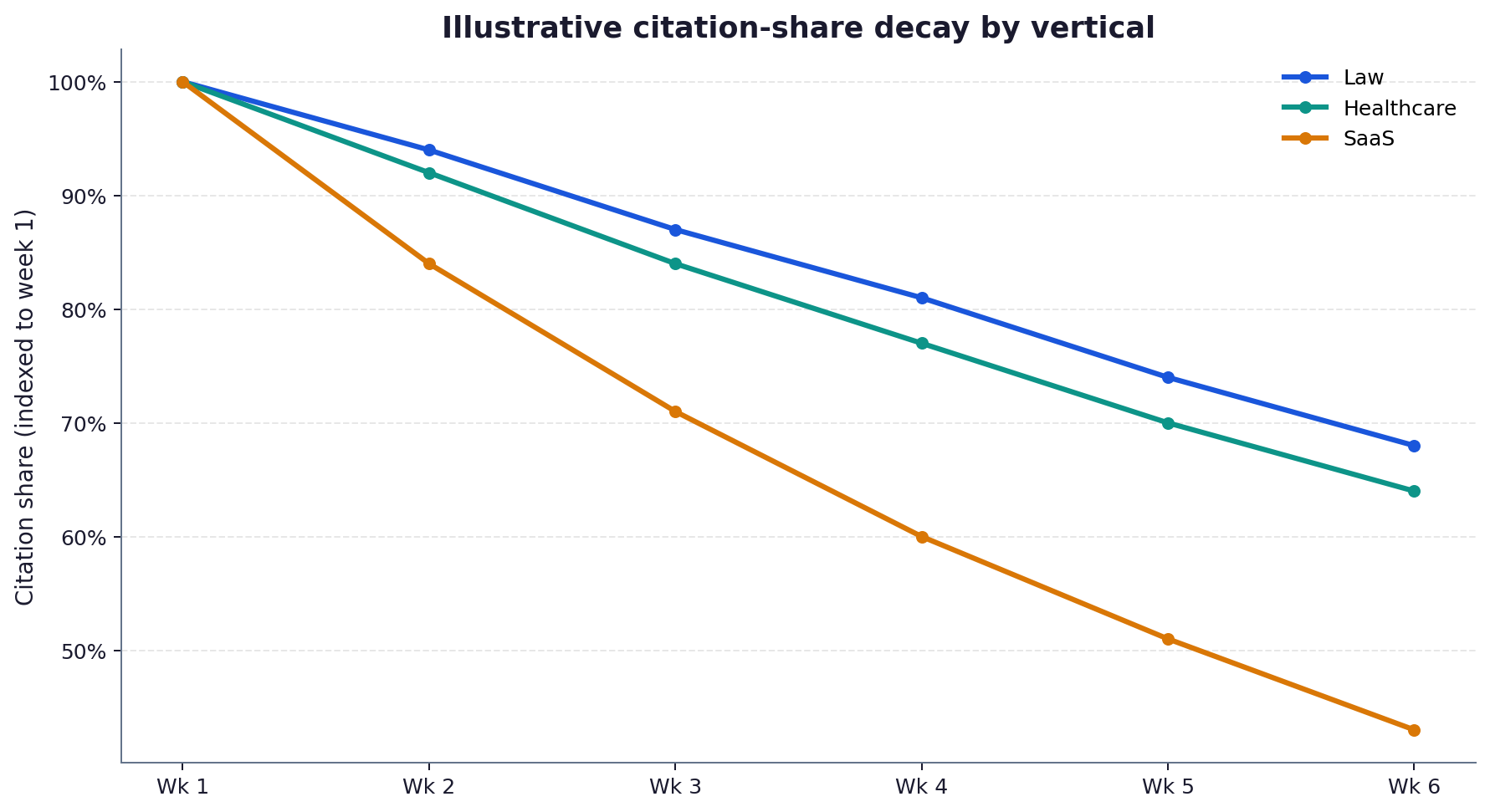
The clearest pattern is that regulated content holds longer. In UK law and healthcare, the authoritative sources an engine leans on, regulators, professional registers, NHS and government reference pages, refresh on a predictable cycle and rarely disappear. A page that aligns with those sources inherits some of their durability. When ChatGPT or Perplexity assembles an answer about a legal process or a clinical pathway, it anchors to stable reference material, and content that maps cleanly to that material keeps earning the citation for longer.
There is a second reason. Regulated topics change less often at the level of substance. The rules governing a UK conveyancing timeline or a prescription pathway do not churn weekly, so a well-structured explainer stays accurate, and accuracy plus alignment with authoritative sources is what sustains a citation. Our directional estimate is a citation half-life in the mid-teens of weeks for these verticals.
SaaS decays fastest
Software content sits at the other end. SaaS categories are crowded, fast-moving and full of near-identical comparison pages, so the pool of substitutable sources is large and refreshes constantly. A “best project management tool” or “CRM for agencies” page competes against dozens of others updated this month, and the engine has little reason to keep citing last quarter’s version. Our directional estimate is a half-life closer to seven weeks, roughly half that of the regulated verticals.
The practical consequence is uncomfortable for software marketers. The pages that most directly drive pipeline are also the ones that lose citations quickest, which means they need the most frequent maintenance, not the least. A blanket quarterly refresh policy, common in professional-services content teams, leaves SaaS money pages stale for weeks at a time.
Turning half-life into a refresh cadence
Once you accept that half-life differs by vertical, the refresh rule follows. A sensible working policy is to refresh a page at roughly one half-life, so the update lands before citation share has fully halved. For a regulated explainer with a mid-teens half-life, that is a refresh every three to four months. For a SaaS money page nearer seven weeks, it is closer to every six to eight weeks. The point is to align editorial effort with decay, so you stop over-maintaining durable pages and under-maintaining fragile ones.
Refresh here means a substantive update, new data, a revised figure, a fresh example, a corrected date, not a cosmetic timestamp change. Engines reweight toward pages that demonstrably changed in substance, which is why the freshness premium rewards genuine revision rather than a touched modified date.
How to measure your own half-life
You do not need our panel to run this. Pick 15 to 20 commercial queries that matter to your firm, record which of your pages are cited across ChatGPT, Perplexity and Gemini today, then re-check weekly without touching the pages. The week your citation share falls to about half of its starting level is your observed half-life for that cluster. Repeat after a substantive refresh and you can see whether the update reset the clock. This turns a vague sense that content goes stale into a measured cadence you can defend in a budget conversation.
Frequently asked questions
What is citation half-life in AI search?
Citation half-life is the number of weeks a page holds before it loses half of its share of AI citations after its last substantive update. It measures durability of citation, not the age of the page. A page can stay live and even keep ranking in classic organic search while its citation share inside ChatGPT or Perplexity answers halves, which is the decay this metric captures.
Why would law and healthcare content decay more slowly than SaaS?
Regulated verticals anchor to authoritative sources such as regulators, professional registers and government reference pages that refresh on a predictable cycle and rarely disappear. Content aligned with those sources inherits some of their durability. Regulated topics also change less often in substance. SaaS content sits in crowded, fast-moving categories with many substitutable pages refreshed monthly, so engines reweight away from older versions quickly.
How fresh does AI-cited content tend to be?
Ahrefs found in 2026 that AI-cited URLs average about 1,064 days old against 1,432 days for top-10 organic results, roughly 25.7% fresher. Several 2026 analyses put close to half of AI-cited content at under 13 weeks old and about 83% of commercial citations at under a year. AI engines apply a sharper freshness preference than classic organic ranking does.
How often should I refresh a page to hold its citation?
A workable rule is to refresh at about one half-life, so the update lands before citation share fully halves. For regulated explainers with a mid-teens-of-weeks half-life that is roughly every three to four months. For SaaS money pages nearer seven weeks it is closer to every six to eight weeks. Refresh means a substantive change to data or examples, not a cosmetic timestamp edit.
Are the vertical half-life figures exact?
No. They are directional readings from a six-week UK panel across ChatGPT, Perplexity and Gemini, offered as a hypothesis to test rather than a published census. Run-to-run volatility in AI answers is high, so any single figure carries uncertainty. The reliable takeaway is the ordering, regulated verticals hold longer and SaaS decays fastest, which any firm can verify on its own pages.
Does a cosmetic date change reset the clock?
Not reliably. Engines reweight toward pages that demonstrably changed in substance, so updating only the modified date rarely restores lost citation share. A genuine refresh, new data, a revised statistic, a fresh example or a corrected fact, is what the freshness premium rewards. Treat the modified date as a by-product of real revision, not the goal.
Sources and references
- AI Overviews and citation patterns study (approx. 17 million citations). Ahrefs, 2026
- 2026 AI Citation Position and Revenue Report. The Digital Bloom, 2026
- Content freshness and AI search visibility. Quattr, 2026
- Most-cited domains across AI answer engines. Profound, 2026
- GEO: Generative Engine Optimization. arXiv (Aggarwal et al.), 2023
- Generative AI and citation coverage. Search Engine Land, 2026
See which of your pages are cited by AI today and how fast they decay.
Change log
- 2026-07-13: Initial publication.