
TL;DR
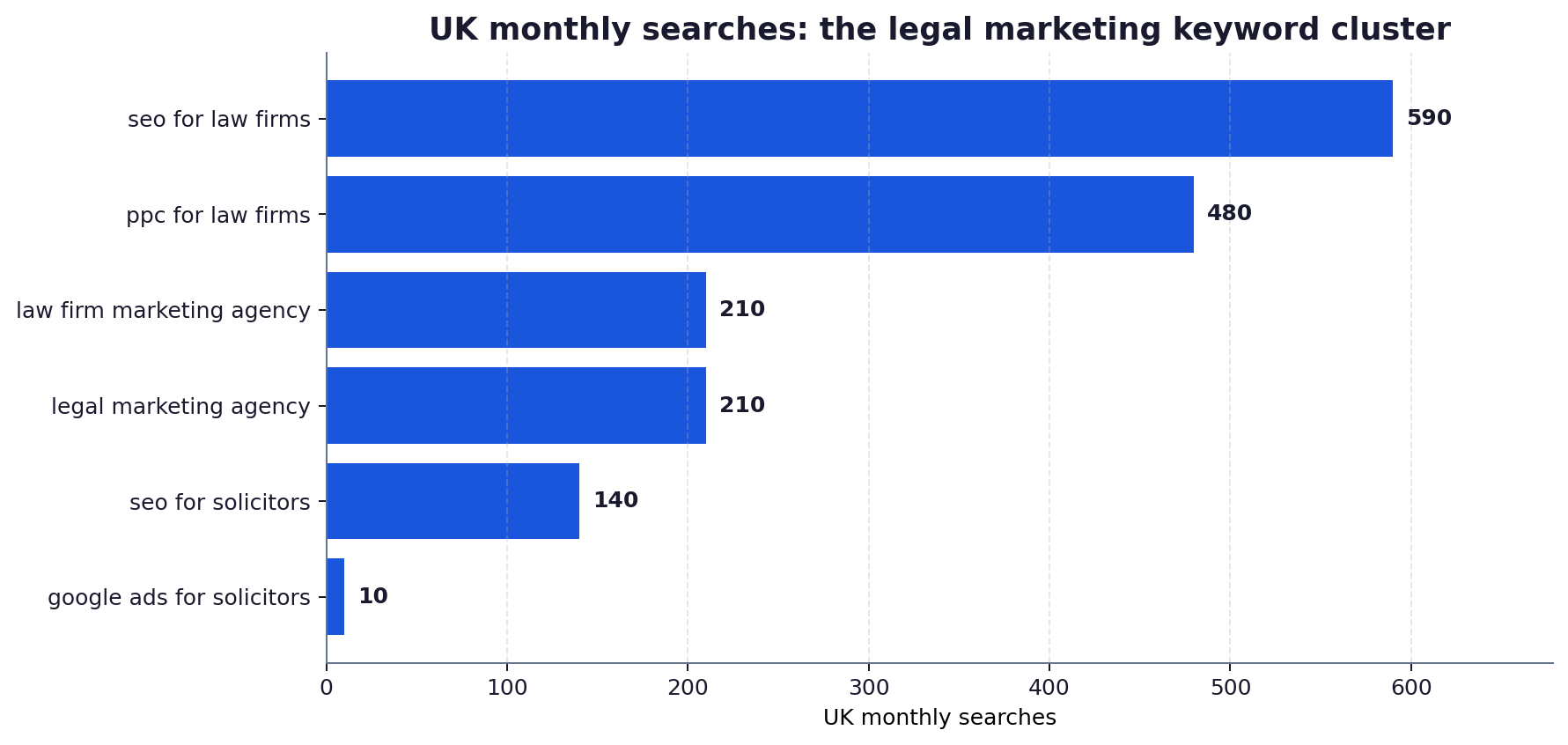
- UK demand for legal PPC help sits at 480 searches a month on ppc for law firms, against 10 a month on google ads for solicitors. The people researching this use American phrasing, and that is a clue about who is writing the advice they find.
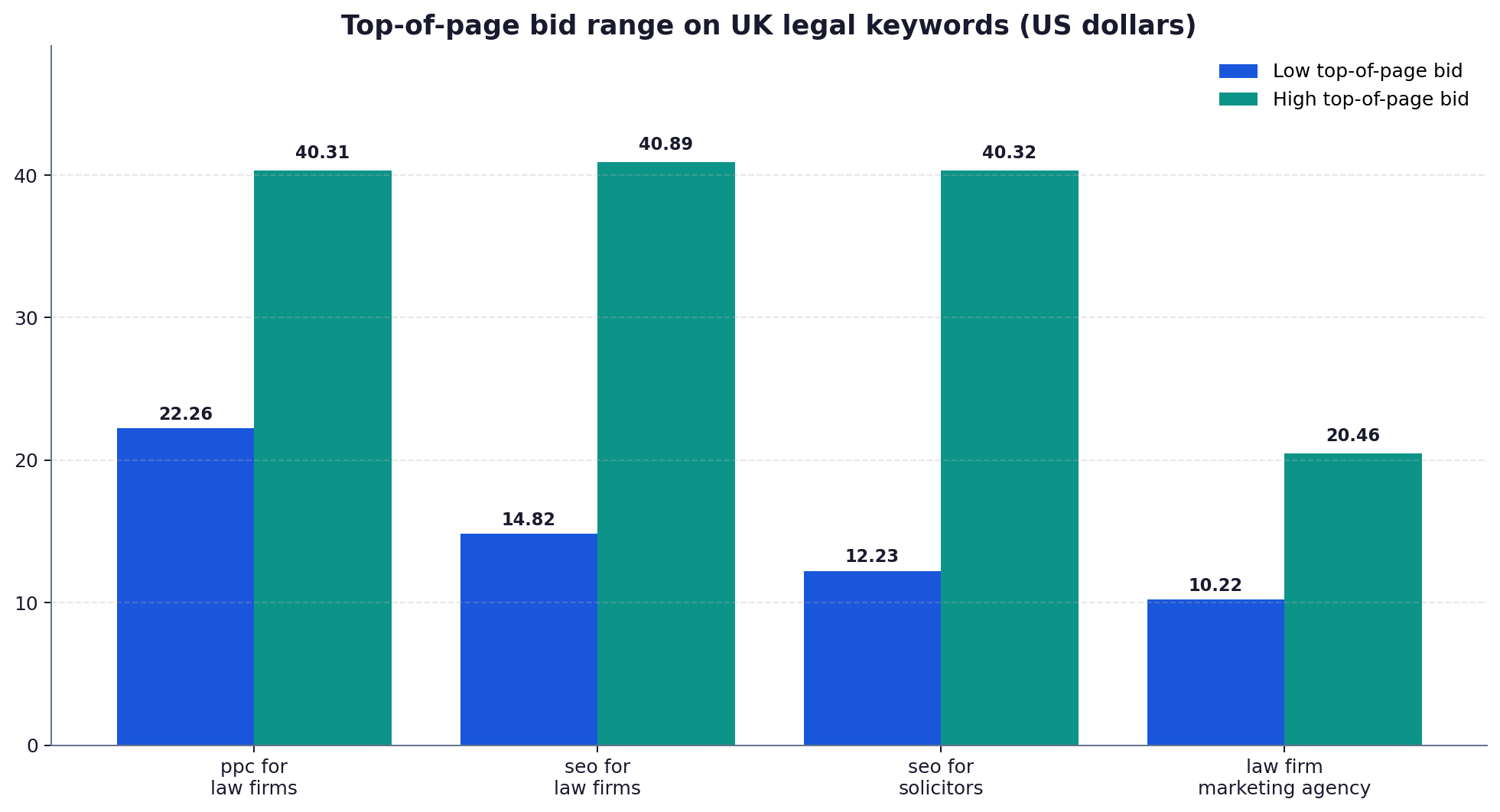
- The top-of-page bid range Google reports on ppc for law firms runs from $22.26 to $40.31, with a reported average CPC of $36.70, sitting near the top of that range rather than the middle.
- The headline 480 is carried almost entirely by one month. September 2025 recorded 3,600 searches. The other eleven months average 206.
- Paragraph 8.9 of the SRA Code of Conduct bars unsolicited approaches to members of the public to advertise legal services, with an exception for current and former clients. That rules out cold outreach, and it shapes what remarketing can safely do.
- The SRA Transparency Rules already force firms to publish prices for six individual services and three business services. Those pages are the highest-intent landing pages a legal Google Ads account has, and most firms never send a click to them.
- Budget leaks in legal accounts cluster in five places: broad match without negatives, practice-area-blind landing pages, untracked phone calls, brand bidding where organic already wins, and geography set wider than the firm can serve.
Key facts
- ppc for law firms: 480 UK searches a month, MEDIUM competition (index 40), reported CPC $36.70, top-of-page bids $22.26 to $40.31 (UK Google Ads search-volume pull via DataForSEO, 12 September 2026).
- google ads for solicitors: 10 UK searches a month, LOW competition (index 29). The UK phrasing barely registers.
- seo for solicitors: 140 a month, reported CPC $54.42, the highest of any legal term in the pull (11 September 2026 run).
- seo for law firms: 590 a month, the largest legal marketing term measured, top-of-page bids $14.82 to $40.89.
- SRA Code of Conduct paragraph 8.8: “You ensure that any publicity in relation to your practice is accurate and not misleading, including that relating to your charges and the circumstances in which interest is payable by or to clients.”
- SRA Transparency Rules 1.3 and 1.4 name nine service types where price publication is mandatory, including residential conveyancing, uncontested UK probate, immigration applications excluding asylum, summary road traffic representation, and employment tribunal unfair or wrongful dismissal claims.
What a legal click actually costs in the UK
The figure most advertisers quote is a single average. The more useful figure is the range around it. On ppc for law firms, the UK Google Ads pull reports a low top-of-page bid of $22.26 and a high of $40.31, with an average CPC of $36.70. That average sits about 80 per cent of the way up the range, which tells you something the average alone does not: the firms currently in this auction are bidding near the top, not hedging at the bottom.
Across the rest of the legal cluster the spread is wider. seo for law firms runs $14.82 to $40.89, almost a three-fold gap between a cheap click and an expensive one on the same keyword. seo for solicitors reports the highest average CPC in the whole legal set at $54.42, on only 140 searches a month. That combination, small volume and a very high clearing price, is what a niche commercial term looks like when a handful of specialist advertisers are willing to pay for it. These low and high figures are top-of-page bid estimates, meaning what advertisers are bidding to appear above the organic results. They are not a quote for any particular account, because what you actually pay is shaped by Quality Score, Google’s diagnostic rating of expected clickthrough rate, ad relevance and landing page experience.
One caveat matters before you plan a budget on any of this. These figures are what advertisers pay for clicks on keywords about legal marketing services, which is the market a firm enters when it hires an agency. They are not the click prices for personal injury solicitor Manchester or conveyancing quote, which is the auction a firm’s own campaign enters. What the cluster does show is how expensive the advice market around legal PPC has become, which is useful context when an agency quotes you.
The 3,600 problem: why the headline volume misleads
Pull the twelve-month series behind ppc for law firms and the headline collapses. September 2025 recorded 3,600 searches. October and November recorded 480 each. By June, July and August 2026 the term was running at 40, 20 and 30. Strip that single September reading and the remaining eleven months average 206, not 480.
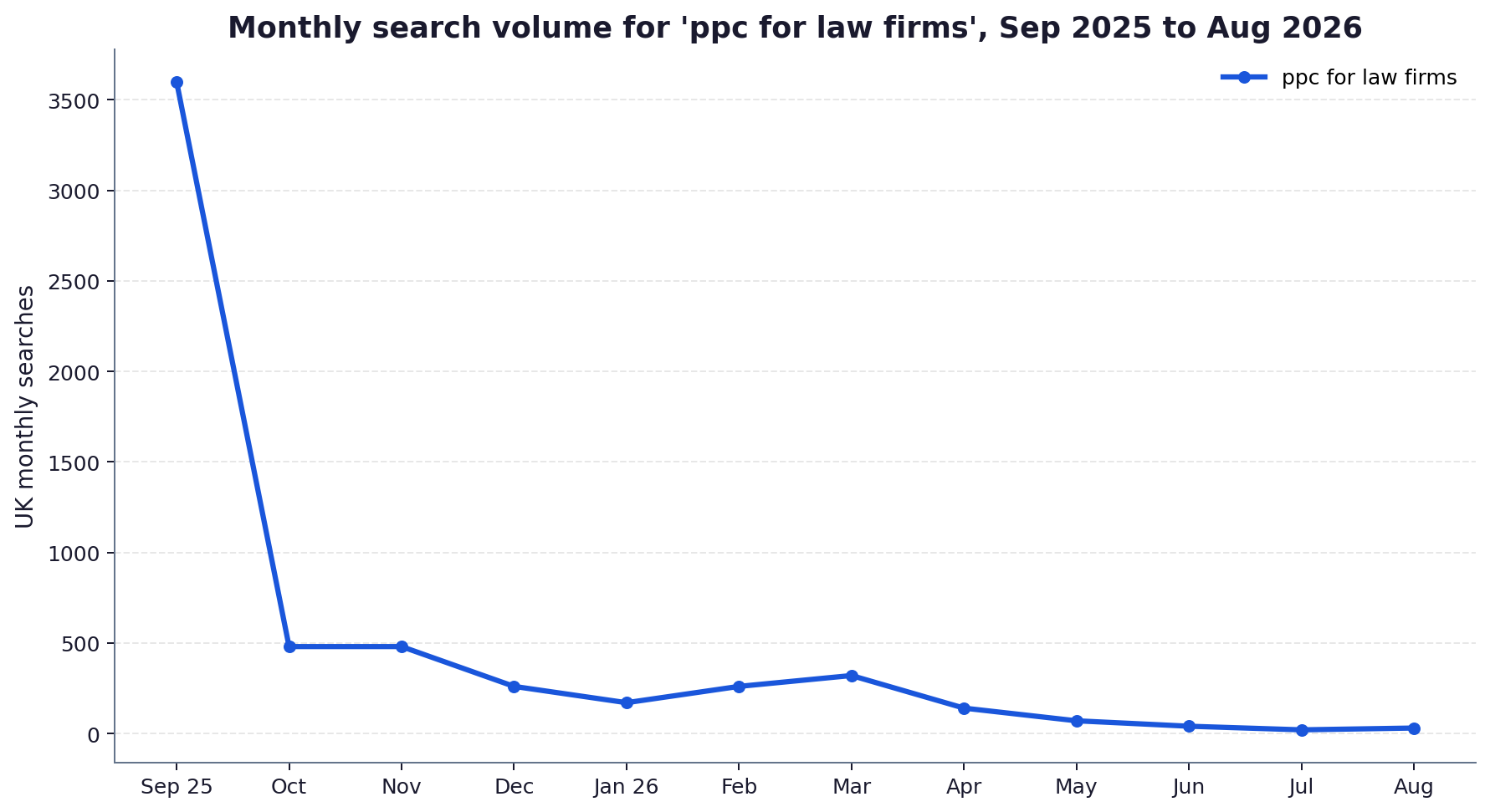
This pattern is not confined to legal. Of the 60 keywords in these pulls that carry a twelve-month series, 39 show a September 2025 reading at least three times the median of their other eleven months, across unrelated verticals. Ecommerce, healthcare, trades and legal terms all spike in the same month. That is the signature of a reporting artefact rather than a real market event, and it means annual averages across this whole dataset run high. We flag it rather than quietly using the number, because a budget built on 480 searches a month when the current run rate is 30 is a budget built on nothing.
Where the budget leaks in a legal Google Ads account
At $20 to $40 a click, a campaign does not need many wasted clicks to lose a month. Five leaks account for most of what we see when firms bring an account to our free paid ads audit.
Broad match with a thin negative list. Legal vocabulary is full of words that mean something entirely different outside law. A firm bidding broadly on settlement, claim, will or trust pays legal-grade prices for traffic that has nothing to do with legal services. The negative keyword list on a legal account should be longer than the keyword list.
Practice-area-blind landing pages. Sending an employment tribunal solicitor click to the firm’s homepage asks the visitor to find their own way to the right department. At these click prices that is expensive. One page per practice area, matched to the ad group, is the single change that moves conversion rate most, and it is the same discipline behind our landing page builds.
Phone calls that go untracked. Legal enquiries convert by phone more than by form. If calls are not tracked back to the campaign, the account optimises towards form fills and quietly starves the campaigns that are actually generating instructions.
Brand bidding where organic already holds position one. Some brand defence is sensible when a competitor bids on your name. Paying for every click on your own firm name when nobody is bidding against you converts free traffic into paid traffic. Check the auction insights before you fund it.
Geography wider than the firm can serve. A firm holding practising certificates and capacity for one region should not be paying for clicks from another. This is the leak that scales fastest, because it looks like growth in the impressions column.
What the SRA Code actually permits
Solicitor advertising in England and Wales is governed by the SRA Code of Conduct for Solicitors, RELs and RFLs, and three paragraphs bear directly on a paid media account.
Paragraph 8.8 requires that “any publicity in relation to your practice is accurate and not misleading, including that relating to your charges and the circumstances in which interest is payable by or to clients.” An ad headline promising a fixed fee that turns out to be a starting point is a publicity problem, not a marketing one.
Paragraph 8.9 is the one that surprises firms: “You do not make unsolicited approaches to members of the public, with the exception of current or former clients, in order to advertise legal services provided by you, or your business or employer.” Search advertising responds to a query the user typed, so it is not an unsolicited approach. Cold email and cold calling to members of the public is a different matter, and firms importing prospect lists into an ad platform should take advice before doing so.
Paragraph 8.10 requires that “clients understand whether and how the services you provide are regulated”, including not representing an unauthorised business as being regulated by the SRA. Where a firm runs a separate unregulated business, the ad and the landing page have to be clear about which entity the client is dealing with.
Your compliance pages are your best landing pages
The SRA Transparency Rules already made most firms build the exact pages a high-intent searcher wants. Rules 1.3 and 1.4 make price publication mandatory across nine service types: residential conveyancing, uncontested UK-based probate, immigration applications other than asylum, First-tier Tribunal immigration appeals, summary road traffic representation at the magistrates’ court, employment tribunal unfair and wrongful dismissal claims on both the employee and employer side, debt recovery up to £100,000, and business premises licensing applications.
Rule 1.5 then specifies what has to appear: “the total cost of the service or, where not practicable, the average cost or range”, the basis of charges, the experience and qualifications of the staff, disbursements, VAT treatment, and “details of what services are included in the price displayed, including the key stages of the matter”. Rule 1.6 requires it to be “clear and accessible and in a prominent place”, and Rule 4.1 requires the firm’s SRA number and the SRA’s digital badge on the website.
Read that as a landing page brief and it is close to perfect. Price, scope, stages, who does the work, and a regulatory trust signal, all on one page, for the nine service types where UK buyers most often search on price. A firm bidding on conveyancing quote and sending the click to a general property page is ignoring an asset the regulator already made it build. The same logic runs through our work on SEO for law firms, where those pages tend to be the strongest organic performers on a legal site as well.
Google Ads or Facebook for a UK law firm
These are different jobs and the demand data says so. Search catches somebody who has already decided they need a solicitor and is choosing one. Paid social puts a firm in front of people who were not looking, which works for services with a long consideration period and a clear trigger event, and works badly for urgent instructions.
Our earlier study of legal services advertising on Facebook covers the paid social half in detail, and it is the post on this site that holds the strongest position for UK solicitor paid-social terms. The practical split we recommend to firms running both: search budget goes to the practice areas with an urgent trigger, such as employment disputes and road traffic matters, while social budget goes to services people plan, such as wills, probate planning and family mediation. For firms just starting, our guide to how small law firms market online in the UK covers the sequencing, and what Google Ads cost in the UK in 2026 sets the wider benchmark. Firms with a specific practice focus will find more in our pieces on lead generation for personal injury lawyers, family law firm SEO, local SEO for immigration lawyers and our UK law firm SEO demand study.
One further channel is now worth a line in the plan. Prospective clients increasingly ask an assistant to shortlist firms before they search at all, which is a discovery step no ad account can bid on. Our citation audit of UK family law firms looked at which firms the engines name, and a free GEO audit will tell you what they currently say about yours. Paid search on Google Ads buys the click; being the firm the assistant names buys the shortlist place.
How we compiled these numbers
Every volume, competition index, CPC and bid figure in this post comes from UK Google Ads search-volume pulls run through DataForSEO on 11 and 12 September 2026, location United Kingdom, language English, saved in Prism/data/. The legal terms were captured alongside 50-plus other service verticals in the same two sessions, so the comparisons between legal and other sectors read across one consistent snapshot rather than numbers assembled from different tools on different dates. Twelve-month series were taken from the same response objects. The September 2025 anomaly was found by comparing each keyword’s September 2025 reading against the median of its other eleven months, across all 60 keywords in the pulls that carried a series. Regulatory statements were checked against the SRA’s own published Code of Conduct and Transparency Rules pages, and are quoted rather than paraphrased.
Limitations and caveats
Google Ads search volumes are rounded buckets, not counts, and they measure advertiser demand rather than organic ranking difficulty. A LOW competition label means few advertisers bidding, and says nothing about how hard the organic first page is to reach. Cost figures are reported by the source in US dollars, and we have not converted them, because applying a single exchange rate to a twelve-month average would add a false precision the underlying number does not carry. Top-of-page bid estimates are what Google reports advertisers bidding, not what any individual account pays after quality score. The September 2025 spike described above inflates annual averages across the dataset, and we have flagged it rather than corrected it, because we cannot tell from the data whether it is a reporting artefact or a real event. We did not model conversion rates, cost per enquiry or cost per instruction for any firm, because we hold no first-party legal conversion data and will not estimate it. Nothing in this post is regulatory advice; firms should read the SRA’s published rules and take their own compliance advice.
Frequently asked questions
How much does a Google Ads click cost for a UK law firm?
On the keyword ppc for law firms, the UK Google Ads data reports an average CPC of $36.70 inside a top-of-page bid range of $22.26 to $40.31 (September 2026 pull). That is the market for legal marketing services rather than for legal services themselves, so a firm bidding on its own practice area terms will see different numbers. The useful takeaway is the shape: legal clicks clear near the top of their reported range, so the average understates what a competitive position costs.
Does the SRA allow solicitors to advertise on Google?
Yes. The SRA Code of Conduct does not prohibit paid advertising. It requires under paragraph 8.8 that publicity is “accurate and not misleading, including that relating to your charges”, and under paragraph 8.10 that clients understand whether and how your services are regulated. Paragraph 8.9 separately bars unsolicited approaches to members of the public other than current or former clients. Search ads respond to a query the user typed, so they are not unsolicited approaches, but cold outreach built from purchased lists is a different question and warrants advice.
What should a law firm use as its Google Ads landing page?
In most cases, the price transparency page the SRA already requires. Rules 1.3 and 1.4 mandate published pricing for nine service types including conveyancing, uncontested probate, immigration applications and employment tribunal claims, and Rule 1.5 requires the total or range, the basis of charges, who does the work, disbursements, VAT treatment and the key stages. That is exactly what a price-motivated searcher wants. Sending those clicks to a general practice page instead wastes the asset.
Is SEO or Google Ads better value for a UK law firm?
The demand data shows firms researching both, with seo for law firms at 590 searches a month against 480 for ppc for law firms. The honest answer depends on the practice area. Urgent instructions such as road traffic matters or employment disputes justify paying for immediate visibility. Planned services such as wills and probate reward organic authority built over quarters. Most firms end up running both, and the mistake we see most often is paid budget defending terms the site could hold organically.
Why does the data show only 10 searches a month for “google ads for solicitors”?
Because the research vocabulary in this market is American. ppc for law firms records 480 a month while the UK phrasing records 10, which suggests most of the people researching legal paid media in the UK are reading advice written for United States firms. That matters, because United States legal advertising rules are set by state bar associations and differ substantially from the SRA Code. Advice on attorney advertising does not transfer to a solicitor in England and Wales.
How big does a legal Google Ads budget need to be?
Large enough that a single click is not a meaningful share of it. At $22 to $40 a click on the marketing terms measured here, a budget that buys a handful of clicks a day produces too little data to optimise on, and the account never leaves the learning phase. Rather than quote a monthly figure we do not have evidence for, work backwards: decide how many enquiries a month you need, apply your own historical enquiry-to-instruction rate, and check whether the resulting click volume is affordable at your practice area’s real click price.
Should a law firm bid on its own name?
Only when somebody else is. Check auction insights first. If a competitor or a claims aggregator is bidding on your firm name, defending it is cheap insurance because your quality score on your own brand will be high. If nobody is bidding against you and you already rank first organically, brand bidding mostly converts clicks you were getting free into clicks you are paying for.
Sources and references
- SRA Code of Conduct for Solicitors, RELs and RFLs. Solicitors Regulation Authority, 2026
- SRA Transparency Rules. Solicitors Regulation Authority, 2026
- About Quality Score for Search campaigns. Google Ads Help, 2026
- UK Google Ads search volume and cost data, September 2026 pulls. DataForSEO, 2026
- SRA Standards and Regulations. Solicitors Regulation Authority, 2026
If you are running a legal Google Ads account and cannot say which practice area is funding the others, our free paid ads audit will read the account against the market data in this post and report where the spend is going.
Change log
- 2026-09-25: Initial publication.