
TL;DR
- Google AI now sits in four places inside a normal account: Smart Bidding, Performance Max, AI Max for Search, and automatic asset generation. Each trades a different amount of reporting visibility for a different kind of gain.
- Smart Bidding is the best-evidenced of the four. Google defines it as strategies that “use Google AI to optimise for conversions or conversion value in every auction”, and it reports through bid strategy reports, simulators and experiments.
- What Smart Bidding removes is the bid itself. You set a target, you read the outcome, and the per-auction decision is not a number you can inspect.
- Performance Max gave back real reporting in 2026. The channel performance report now itemises Google Search, Display, YouTube, Discover, Maps, Gmail and Search partners, with impressions, clicks, interactions, conversions, conversion value and cost per channel.
- AI Max for Search adds a Source column to the search terms report, and it ships as an optional layer on an existing Search campaign with controls that switch off independently.
- The permanent blind spot is not an AI feature at all. Google omits low-volume search terms from the search terms report “in order to keep with our standards on data privacy”, and that predates every automation here.
- The rule that survives all four: turn on an automation only when you can still answer the question you would ask if performance dropped.
Key facts
- Google defines Smart Bidding as “bidding strategies that use Google AI to optimise for conversions or conversion value in every auction”, naming Target CPA, Target ROAS, Maximise conversions and Maximise conversion value.
- The Performance Max channel performance report covers Google Search, Google Display Network, YouTube, Discover, Maps, Gmail and Search partners, with impressions, clicks, interactions, conversions, conversion value and cost (Google Ads Help).
- AI Max for Search is an optional layer on an existing Search campaign. Search term matching is an ad group control; text customisation and final URL expansion are campaign controls, so each can be switched off on its own.
- AI Max reporting adds a Source column to the search terms report. Google notes that filtering by match type AI Max “may show lower numbers”, because the filter “doesn’t consider Other search terms”.
- The search terms report omits low-volume queries: “Some search terms that don’t have enough query activity are omitted from the search terms report in order to keep with our standards on data privacy” (Google Ads Help).
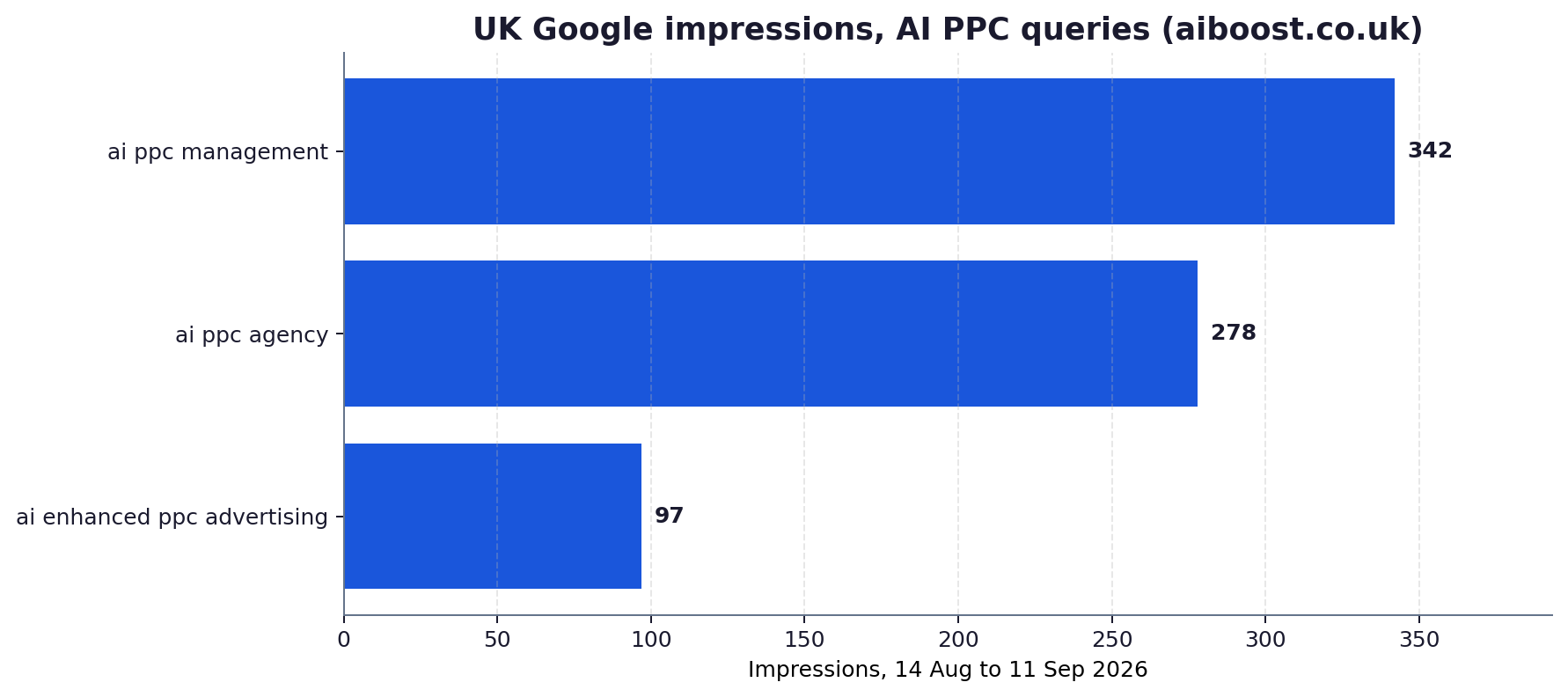
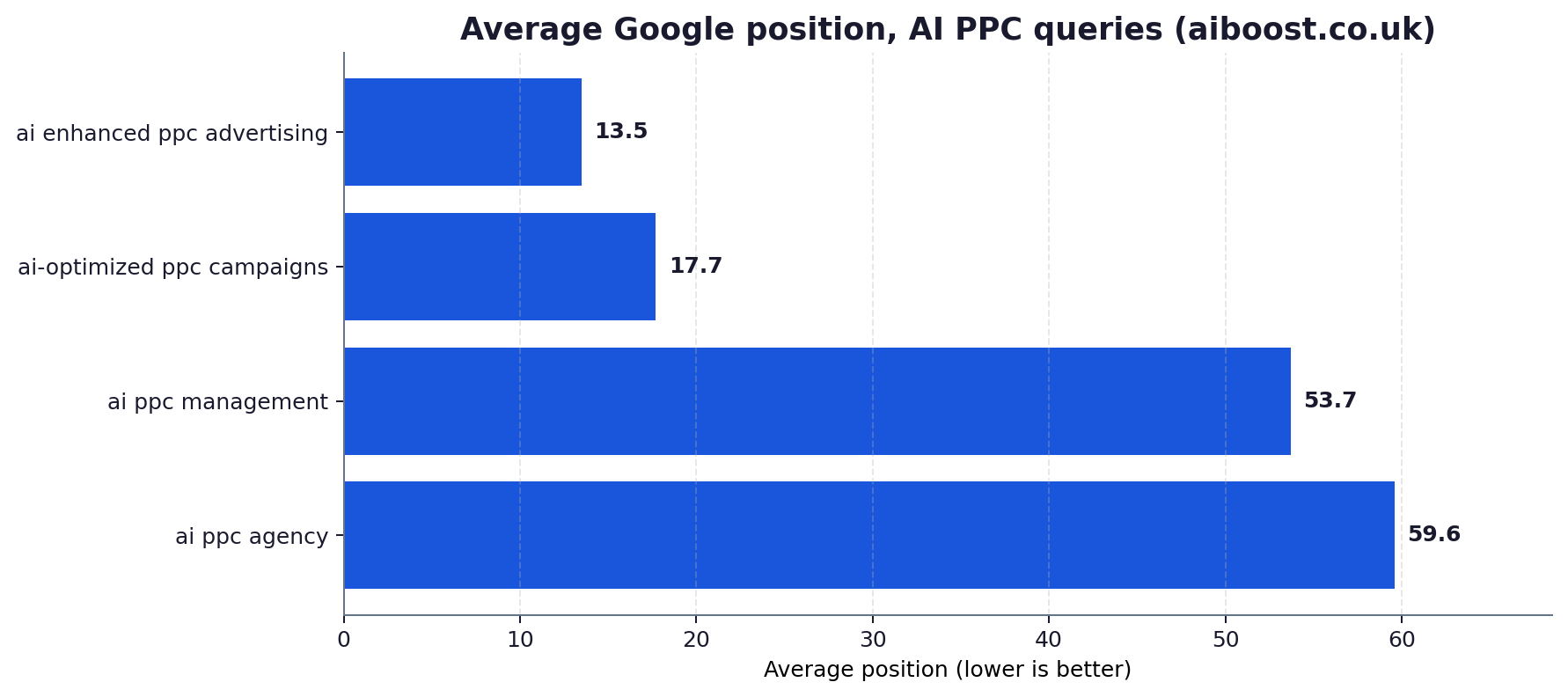
- UK demand for AI-run PPC is real and mostly unanswered: “ai ppc management” drew 342 impressions for aiboost.co.uk at average position 53.7 and “ai ppc agency” 278 at 59.6, while “ai enhanced ppc advertising” already sits at 13.5 (Google Search Console, 14 August to 11 September 2026).
The four places Google AI already sits in your account
The phrase “AI in Google Ads” covers four distinct products that behave very differently, and most arguments about automation are really arguments about which one is being discussed.
Smart Bidding sets the bid in each auction. Performance Max runs one campaign across Google’s whole inventory from a set of assets and a goal. AI Max for Search is a layer you switch on inside an existing Search campaign, which uses broad matching and keywordless technology to find queries your keyword list would miss. Automatic asset generation writes headlines, descriptions and images on your behalf from your landing pages and existing assets.
Two of those four mainly change how money is allocated. Two of them change what the customer actually sees. That distinction matters more than the marketing language, because a bidding decision leaves your ad and your landing page intact, and a generated headline does not. If you run Google Ads for a UK service business where claims are regulated or wording is contractual, that is not a small difference.
Smart Bidding: the strongest case, and the number you stop seeing
Smart Bidding is the automation with the least controversy attached, and the reporting loss is narrow and well understood. Google describes it as strategies that use Google AI to optimise for conversions or conversion value in every auction, across Target CPA, Target ROAS, Maximise conversions and Maximise conversion value. The mechanics of how automated bidding replaced manual control are covered in our earlier piece on PPC bidding automation. The signals it reads at auction time include device, physical location, location intent, time of day and weekday, remarketing list membership, browser, operating system and the actual search query.
The gain is that no human can price an auction on that many signals in the time available. The loss is the bid. Under manual CPC you knew the number you were willing to pay; under Smart Bidding you set a target and read the result. Google points to bid strategy reports, detailed statuses, campaign experiments, simulators and alerts as the reporting surface, and those are real, but none of them hands back a per-auction bid.
In practice that trade is worth making, with one precondition that is almost always the actual problem. Smart Bidding optimises towards the conversions you tell it about. If your conversion set counts a contact-form view, a phone click that never connected and a genuine enquiry as equal, the automation will efficiently buy the cheapest of the three. Fixing conversion tracking before changing bid strategy is the single highest-value hour in most accounts, and it is the same discipline behind any honest marketing ROI calculation.
Performance Max: the reporting that arrived, and what it means
Performance Max earned its reputation as a black box honestly. For its first years it took a budget, spent it across Search, Shopping, Display, YouTube, Discover, Gmail and Maps, and reported a single blended result.
That has genuinely changed. The channel performance report now breaks a campaign down by Google Search, Google Display Network, YouTube, Discover, Maps, Gmail and Search partners, reporting impressions, clicks, interactions, conversions, conversion value and cost for each. You can drill into specific channels and ad formats, including video and ads with product feeds. For anyone who spent 2024 arguing that Performance Max was unauditable, the honest position now is that the main objection has been answered.
Two caveats survive. Asset attribution across channels is imperfect by Google’s own account: image assets can appear in Discover, YouTube image ads and Search extensions, so image-driven conversions do not map cleanly onto the Display line. And search term visibility inside Performance Max remains a subset rather than the full query-level detail a Search campaign gives you. Run it where the inventory breadth is the point, not as a replacement for a Search campaign you understand, and audit it against the rest of the account rather than in isolation. That cross-channel view is what a paid ads audit is for.
AI Max for Search: broad matching with a Source column
AI Max is the newest of the four and the easiest to misread, because it is not a campaign type. It is an optional layer inside an existing Search campaign, which means you can test it without rebuilding anything.
It does three things, and each has its own switch. Search term matching uses broad match and keywordless technology to find queries your keywords would miss, and it is an ad group level control. Text customisation rewrites headlines against the query, and final URL expansion sends traffic to the page Google judges most relevant. Those last two are campaign level controls. Turning on search term matching while leaving text customisation off is a legitimate and conservative first test.
On reporting, Google added a Source column to the search terms report and a view that ties search terms to the headlines and landing pages that made up the journey, plus aggregate rows for AI Max expanded matches and AI Max landing page matches. It also documents the catch: filtering the search terms report by match type AI Max may show lower numbers, because that filter does not consider Other search terms. Read the totals, not the filtered view, if you want to know what the layer actually spent. The discipline is the same one that applies to negative keyword management, which gets more important as matching gets looser, not less.
The search terms you will never see, and why
Every discussion of AI hiding data eventually arrives at the search terms report, and the biggest gap there is not caused by AI at all. Google states that the report shows terms “that a significant number of people have used”, and that “some search terms that don’t have enough query activity are omitted from the search terms report in order to keep with our standards on data privacy”.
That omission predates Performance Max, AI Max and current Smart Bidding, and it applies to ordinary keyword campaigns too. It matters more now only because broader matching pushes a larger share of spend into the long tail, where terms are individually too rare to report. So the honest framing is not that AI hides your search terms. It is that AI increases the proportion of your budget spent in a part of the query space Google was already not showing you.
The workable response is to stop treating the search terms report as a complete record and to build controls that do not depend on it. Negative keyword lists applied at account level, brand exclusions, tight geographic settings and conversion values that reflect real revenue all constrain spend without needing to name every query. Landing page evidence helps too, since what happens after the click is measured on your own site rather than in Google’s report.
A reporting checklist before you switch anything on
The useful test is not whether an automation is good. It is whether you will still be able to diagnose a drop after you enable it. Five questions, answered in writing, before the toggle moves.
Which report will show me this feature’s effect, by name, and does it exist today? What is the control group, meaning either a campaign experiment or a comparable campaign left untouched? How long will I leave it, decided before I start rather than at the first bad week? Which conversion action is it optimising towards, and do I believe that conversion is real? And what will I turn off first if the answer is no?
Run one change at a time. Enabling Smart Bidding, Performance Max and asset generation in the same fortnight leaves you with a result and no way to attribute it, which is how accounts end up with automations nobody can justify and nobody dares remove. The reporting discipline is the same as the one that makes PPC testing worth doing, and it is why a structured underperformance analysis beats guessing.
What AI in Google Ads does not fix
Automation allocates a budget well. It does not create demand, and it does not repair a weak offer.
If your cost per lead is high because the market is expensive, better bidding compresses the problem rather than solving it, and the real numbers behind UK click costs are in our breakdown of what Google Ads costs in the UK in 2026. If your conversion rate is low because the landing page asks for too much too early, the automation will simply buy more of the same traffic more efficiently. And if the buyer never searches in the first place, no bidding strategy reaches them, which is the case for Meta advertising sitting alongside search rather than competing with it.
There is one more shift worth planning for. A growing share of buyers now start with an assistant rather than a search box, and that traffic is not biddable at all. Understanding performance marketing metrics in the AI traffic era and how to track AI-driven traffic is now part of the same job as running the ads, and generative engine optimisation is where that budget goes.
Frequently asked questions
Does Smart Bidding hide data from advertisers?
It removes one number and adds several. You no longer set or see a bid per auction, because Google optimises for conversions or conversion value at auction time using signals such as device, location, time of day, remarketing list membership and the query itself. In exchange Google provides bid strategy reports, detailed statuses, simulators, alerts and campaign experiments. The practical risk is not the missing bid. It is optimising towards a conversion action that does not represent real revenue, which produces cheap results that never reach the bank.
Can I see which channels Performance Max spent my budget on?
Yes, since the channel performance report. It reports Google Search, Google Display Network, YouTube, Discover, Maps, Gmail and Search partners, with impressions, clicks, interactions, conversions, conversion value and cost for each, and lets you drill into ad formats including video and product feed ads. Two limits remain: image assets can appear across several channels, so image-driven conversions do not map cleanly to one line, and search term detail inside Performance Max is a subset rather than the full query-level report a Search campaign gives you.
Is AI Max for Search a new campaign type?
No. It is an optional layer switched on inside an existing Search campaign, which is what makes it testable without a rebuild. Its three parts have separate controls: search term matching sits at ad group level, while text customisation and final URL expansion sit at campaign level. A cautious first test enables search term matching only, leaves your existing ad copy alone, and watches the Source column in the search terms report.
Why can’t I see all my search terms?
Because Google does not report them all, and has not for years. The search terms report shows terms that a significant number of people have used, and Google states that terms without enough query activity are omitted to keep with its data privacy standards. That is a privacy threshold, not an AI feature. Broader matching makes it more noticeable, since more of your spend lands on rare queries, so the answer is to control spend with negative keyword lists, brand exclusions and accurate conversion values rather than by policing a report that was never complete.
Should a small UK advertiser use Performance Max?
It depends on whether you have inventory breadth to gain from. Performance Max earns its place when you have products or services that suit Shopping, YouTube and Discover as well as Search, and when your conversion tracking is trustworthy enough to steer it. A small local service business with one page, one offer and a tight geography usually gets clearer results from a Search campaign it can read line by line, and can revisit Performance Max once the channel report has something to show.
Should I let Google generate my ad copy?
Hold that one back longest, particularly in regulated UK sectors. Automatically generated headlines and images change what the customer sees, which is a different order of risk from changing what you paid. In legal, healthcare, financial and any sector with claim rules, the wording is a compliance surface. If you do test it, test it on one campaign, keep your own assets running alongside, and check what actually served rather than assuming the generated version matched your intent.
How long should I leave an automation before judging it?
Decide before you switch it on, and write the date down. Bidding changes need enough conversions to learn from, so a campaign generating a handful of conversions a week needs longer than one generating fifty a day. The failure mode is reverting after one bad week and then re-enabling a fortnight later, which resets learning and leaves you with a period of data that means nothing. Use a campaign experiment where volume allows, so you have a control rather than a before-and-after.
Sources and references
- About Smart Bidding. Google Ads Help, 2026
- About the channel performance report for Performance Max. Google Ads Help, 2026
- About reporting in AI Max for Search campaigns. Google Ads Help, 2026
- About the search terms report. Google Ads Help, 2026
- How AI Max for Search campaigns works. Google Ads Help, 2026
If an automation went on and the numbers moved without an obvious reason, a second pair of eyes is usually faster than another week of theories. AiBoost reviews UK Google Ads accounts against the channel, query and conversion data you already have, and reports what is working, what is hidden, and what to switch off.
Change log
- 2026-10-07: Initial publication.