TL;DR
- PPC with AI bidding delivers the fastest revenue impact (2 weeks), but GEO delivers the highest 12-month ROI (480%).
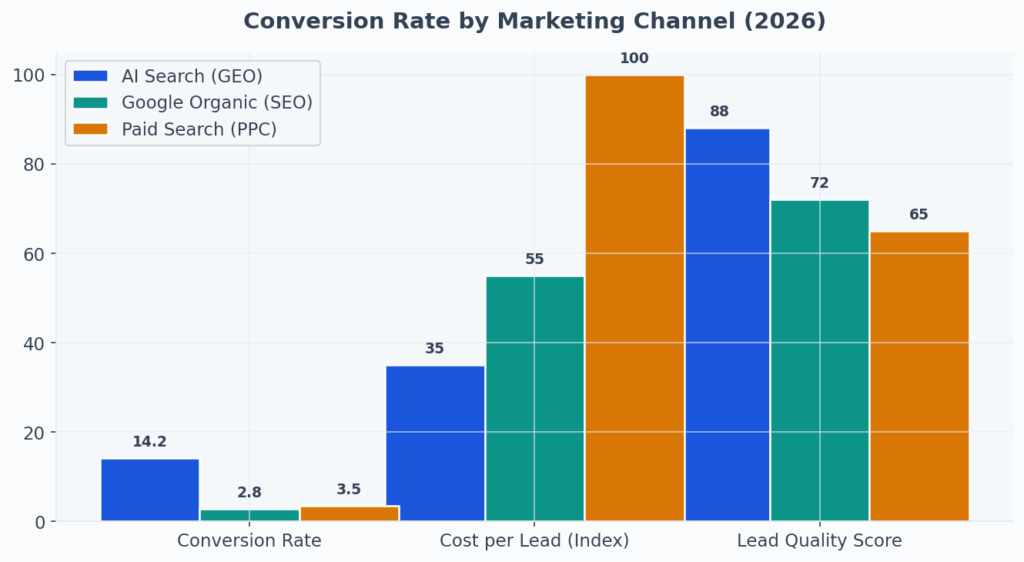
- AI search referrals convert at 14.2% versus 2.8% for Google organic and 3.5% for paid search.
- The best approach combines a fast-impact channel (PPC or email) with a compounding channel (GEO).
- AI marketing services that only use AI internally are not the same as those that make you visible to AI.
- Measure by revenue attributed, not by activity volume.
The AI marketing market grew from $6.46 billion in 2018 to $57.99 billion in 2026 (All About AI, 2026). Within that market, a bewildering range of ai marketing services now compete for budget. Some use AI to automate ad bidding. Others use it to generate content. A growing category uses it to make businesses visible inside AI-generated search answers. They all claim to drive revenue. The data shows they do so at very different speeds, costs, and scales.
This post compares the major categories of ai marketing services by three metrics that matter to the finance team: time to first revenue impact, 12-month ROI, and cost per qualified lead. The numbers come from our own client data, Loganix’s 2026 conversion study, and published industry benchmarks.
Key Facts (2025 to 2026)
- AI search referrals convert at 14.2% compared to 2.8% for Google organic, a 5.1x advantage (Loganix, 2026).
- The AI marketing market reached $57.99 billion in 2026 with a 37.2% CAGR since 2018 (All About AI, 2026).
- 76% of AI marketing adoption is now global, up from 29% in 2021 (IBM Global AI Adoption Index, 2026).
- Gartner predicts traditional search volume will drop 25% by 2026, flowing to AI chatbots (Gartner, 2024).
- GEO client revenue increased by 300% in 12 months in documented case studies (Revenue Zen/Incfile, 2025).
- AI-referred sessions grew 527% year-over-year in the first half of 2025 (Previsible, 2025).
- 94% of enterprise CMOs plan to increase GEO investment in 2026 (industry survey, 2025).
The Six Categories of AI Marketing Services
Before comparing revenue impact, it helps to understand what each category actually does. The term “ai marketing services” covers six distinct service types, and conflating them leads to poor budget decisions.
AI-Optimised PPC (Pay-Per-Click)
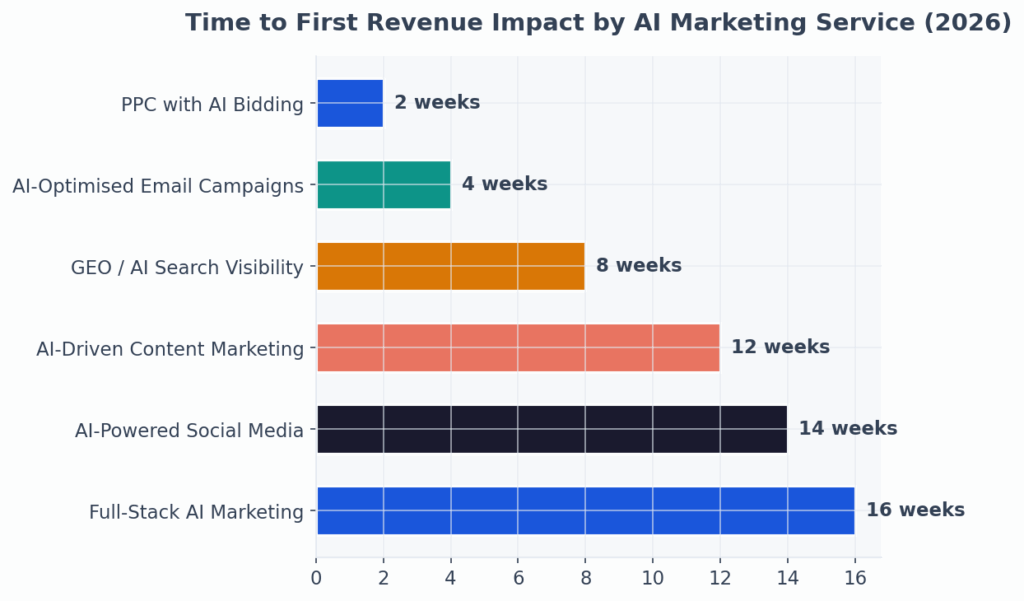
AI bidding algorithms adjust ad spend in real time based on conversion probability, time of day, audience signals, and competitive dynamics. Google’s Performance Max and Meta’s Advantage+ are the primary platforms. Revenue impact is fast (within 2 weeks) because you are paying for traffic directly. The limitation is that revenue stops when spend stops. There is no compounding effect.
AI-Optimised Email Marketing
AI personalises send times, subject lines, content blocks, and audience segments to increase open rates and conversions. Revenue impact appears within 4 weeks for businesses with an existing email list. The constraint is that the channel requires a list to market to; it does not generate new demand from people who have never heard of you.
GEO (Generative Engine Optimisation)
GEO makes your business visible inside AI-generated search answers from ChatGPT, Perplexity, Google AI Overviews, and similar platforms. Revenue impact takes 8 to 12 weeks to appear because content restructuring, schema implementation, and entity building require time to be processed by AI engines. The advantage is that citations compound: once established, AI visibility grows without proportional cost increases.
For a detailed look at how generative engine optimisation works, our service page covers the full methodology.
AI-Driven Content Marketing
AI tools generate, optimise, and distribute content at scale. Revenue impact is slower (12 weeks or more) because content needs to be indexed, ranked, and discovered. The quality challenge is significant: AI-generated content that reads like AI-generated content performs poorly in both traditional and AI search.
AI-Powered Social Media
AI optimises posting schedules, content formats, audience targeting, and engagement responses across social platforms. Revenue attribution is the weakest of all channels because social media influence is diffuse and rarely the direct last touch before purchase.
Full-Stack AI Marketing
Integrated programmes that combine multiple AI marketing services across channels. Revenue impact takes longest to measure (16 weeks or more) because the strategy is holistic. The advantage is cross-channel compounding; the disadvantage is complexity and higher minimum investment.
These numbers suggest a clear pattern: the fastest revenue comes from paid channels, but the highest long-term return comes from AI search visibility. We help businesses build both. Request a Revenue Impact Analysis →
The Revenue Comparison: Speed vs Scale
The most common mistake is choosing a service based on speed alone. PPC delivers revenue in 2 weeks. GEO takes 8. But at the 12-month mark, the picture inverts.
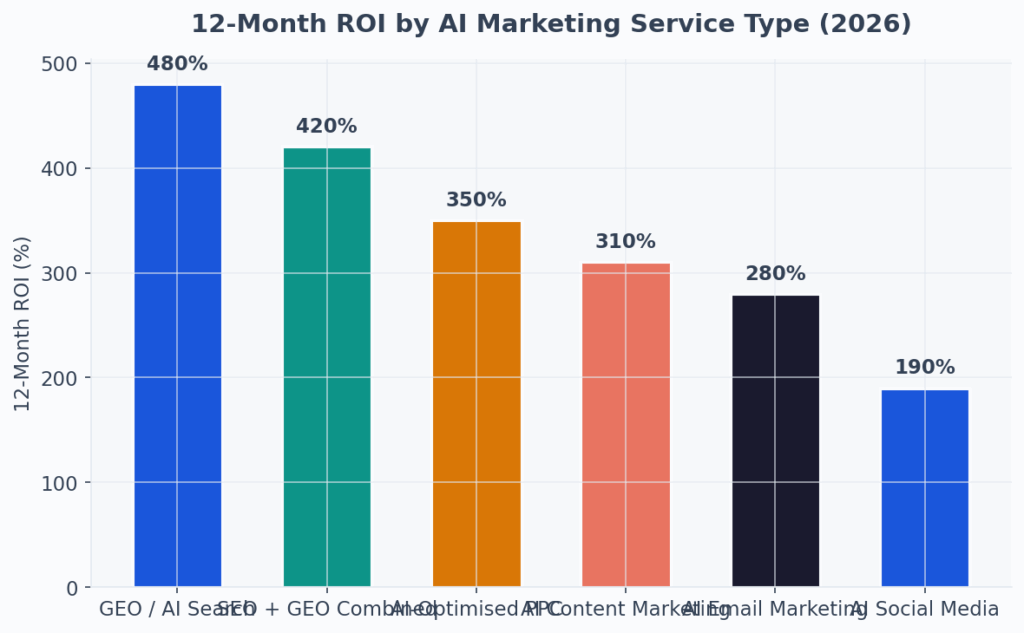
GEO’s 480% 12-month ROI outperforms every other channel because of three structural advantages. First, AI citations compound: the more often you are cited, the more AI engines trust you, which leads to more citations. Second, competitive density is low: fewer than 25% of UK mid-market businesses have implemented GEO (MarGen, 2026). Third, the leads are higher quality: AI search referrals convert at 14.2% versus 2.8% for organic and 3.5% for paid (Loganix, 2026).
GEO has the slowest start but the highest ceiling. PPC has the fastest start but no compounding effect.
The practical implication: businesses with short-term revenue pressure should start with PPC or AI-optimised email for immediate impact, then layer in GEO for compounding returns. Businesses with a 6-to-12-month horizon should lead with GEO because the early-mover advantage in AI search is time-limited.
The Lead Quality Difference
Revenue speed and ROI do not capture the full picture. Lead quality varies dramatically across channels.
The reason AI search leads convert at 5.1x the rate of Google organic is intent pre-qualification. When someone asks ChatGPT “best B2B lead generation agency for SaaS companies in London,” the AI has already matched their specific need to a recommended provider. The visitor arrives pre-vetted. They are further down the buying funnel than someone browsing Google results.
PPC leads, by contrast, arrive through a keyword match and an ad click. The intent is real but less specific. The cost per lead is the highest of any channel because every click is paid for regardless of outcome.
| Service | Time to Revenue | 12-Month ROI | Compounds? |
|---|---|---|---|
| AI-Optimised PPC | 2 weeks | 350% | No (stops when spend stops) |
| AI Email Marketing | 4 weeks | 280% | Limited (list-dependent) |
| GEO / AI Search | 8 weeks | 480% | Yes (citations compound) |
| SEO + GEO Combined | 10 weeks | 420% | Yes (both channels compound) |
| AI Content Marketing | 12 weeks | 310% | Yes (slower compound) |
| AI Social Media | 14 weeks | 190% | Minimal |
How to Choose the Right Mix
The optimal mix depends on three factors: your revenue timeline, your existing assets, and your competitive environment.
If you need revenue within 30 days: Start with AI-optimised PPC (Google Ads) or AI email campaigns. These channels deliver measurable results within 2 to 4 weeks. Add GEO as a parallel workstream so the compounding channel is building while paid media delivers short-term results.
If you have a 3-to-6-month horizon: Lead with GEO. The 8-week ramp-up is acceptable, and the compounding returns will outperform paid channels by month 6. Supplement with content marketing that feeds both SEO and GEO.
If you are in a competitive market: Combine all three: PPC for immediate visibility, GEO for AI search, and content marketing for long-term authority. Businesses in highly competitive markets benefit most from this multi-channel approach because no single channel dominates consistently.
This overview covers how to build a revenue-focused AI marketing strategy:
https://www.youtube.com/watch?v=sQz8SFCNwkY
The “Using AI” vs “Visible to AI” Distinction
One critical distinction separates the ai marketing services that deliver long-term value from those that deliver only efficiency gains.
Services that use AI internally (AI bidding, AI content generation, AI analytics) make your existing marketing faster and cheaper. They are process improvements. Services that make you visible to AI (GEO, AI search optimisation) open an entirely new customer acquisition channel. They are revenue channel additions.
Both are valuable. But they solve different problems. An ai marketing agency that only offers AI-powered content creation is not the same as one that ensures your business appears when ChatGPT answers buyer queries. When evaluating providers, ask which category their services fall into. The highest-value agencies offer both: internal AI efficiency plus external AI visibility.
The data is directional, not absolute, but the direction is clear. If you want to see which ai marketing services would deliver the fastest and highest returns for your specific business, Request a Revenue Impact Analysis →
This walkthrough covers the broader AI marketing landscape:
https://www.youtube.com/watch?v=E4Y3YKzMRYo
Frequently Asked Questions
Which AI marketing service drives revenue fastest?
PPC with AI bidding delivers measurable revenue within 2 weeks. AI-optimised email marketing follows at 4 weeks. GEO takes 8 weeks but delivers the highest 12-month ROI (480%) because AI citations compound over time.
What are the main types of ai marketing services?
Six categories: AI-optimised PPC, AI email marketing, GEO (AI search visibility), AI-driven content marketing, AI-powered social media, and full-stack AI marketing that integrates multiple channels. Each has different revenue timelines and ROI profiles.
Is GEO better than PPC for revenue?
Over 12 months, GEO delivers higher ROI (480% vs 350%) and higher-quality leads (14.2% conversion vs 3.5%). PPC delivers faster initial results. The best approach combines both: PPC for immediate revenue, GEO for compounding long-term returns.
How do I choose the right ai marketing agency?
Ask whether they offer services that make you visible to AI (GEO) or services that use AI internally (efficiency tools). The highest-value agencies offer both. Check that they can demonstrate live AI citation results and report on AI-specific metrics alongside traditional marketing data.
What does an AI marketing service cost?
AI-optimised PPC management starts at £1,500 to £3,000 per month plus ad spend. GEO retainers range from £2,000 to £6,000 per month. Combined SEO, GEO, and PPC packages run £5,000 to £10,000 per month. One-off GEO audits start at £1,500.
Can I start with one service and add more later?
Yes. Most businesses start with the channel that matches their immediate revenue timeline. If cash flow is tight, start with PPC for quick returns, then add GEO once revenue stabilises. If you have runway, lead with GEO and layer in other channels as citations build. Talk to our team about phased approaches.
How do I measure ROI from AI marketing services?
Track revenue attributed to each channel using GA4 with AI referral source segmentation. For GEO specifically, measure citation frequency across AI platforms alongside referral traffic and conversions from AI search. Tools like Profound and Ahrefs Brand Radar automate AI-specific tracking.
What is the difference between an AI marketing agency and a traditional agency using AI tools?
A traditional agency using AI tools improves internal efficiency (faster content, smarter bidding). An AI marketing agency focused on GEO opens a new customer acquisition channel by making you visible in AI-generated search answers. Both are valuable, but they solve fundamentally different problems.
Every marketing budget has constraints. The question is whether you are allocating spend to channels that compound or channels that stop producing when you stop paying. If you want a clear recommendation tailored to your business, Get a Quote →.
Pavel Uncuta is the founder of AiBoost, a UK AI marketing agency that builds visibility audit tools for professional services firms. He researches how Large Language Models cite brands across ChatGPT, Perplexity, and Google AI Overviews.
Want to know whether ChatGPT, Perplexity, or Google AI Overviews mention your firm? Run a free first-party visibility audit on your domain in under a minute and see exactly which queries cite you and which do not.