TL;DR
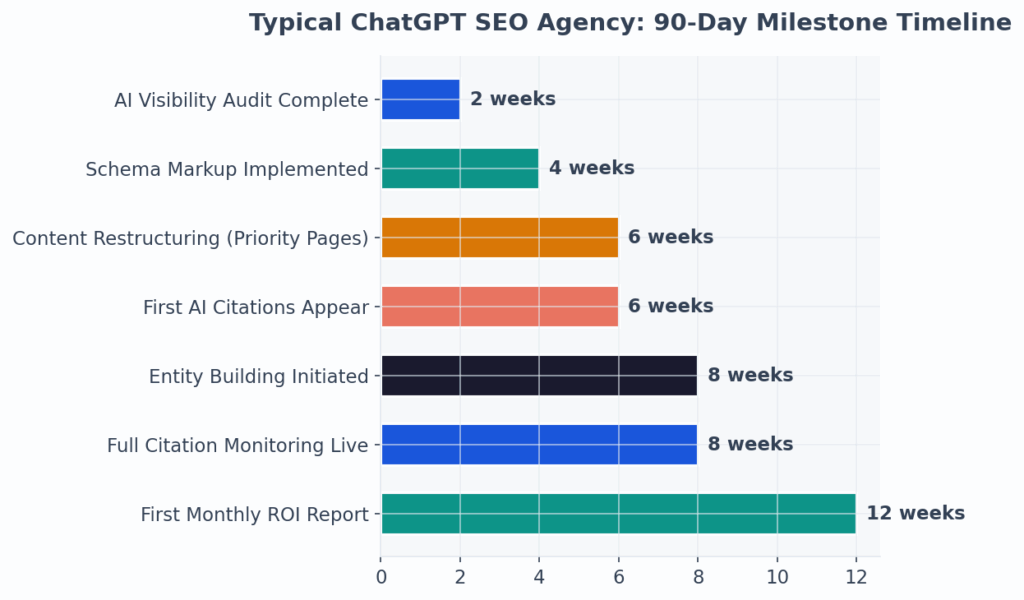
- Week 1 to 2: AI visibility audit across ChatGPT, Perplexity, and Google AI Overviews.
- Week 3 to 6: Schema implementation and content restructuring on priority pages.
- Week 6 to 8: First AI citations typically appear for restructured pages.
- Week 8 to 12: Full citation monitoring live, entity building underway, first ROI report.
- Do not expect overnight results. GEO compounds, and the first 90 days build the foundation.
You have signed with a chatgpt seo agency. The contract is in place, the kickoff call is scheduled, and you are wondering what actually happens next. If the agency is good, the answer is structured and predictable. If the answer is vague, you may have chosen the wrong partner.
This post walks through exactly what a competent chatgpt seo agency delivers in the first 90 days, what you should see at each milestone, and what questions to ask if things are not progressing. We built this timeline from our own onboarding process and the patterns we have seen across dozens of GEO engagements.
Key Facts (2025 to 2026)
- Only 15% of pages retrieved by ChatGPT actually earn a citation in its answers (Zyppy, 2025).
- AI search referrals convert at 14.2% compared to 2.8% for Google organic (Loganix, 2026).
- Pages with FAQ schema see a 28% increase in AI citation rates (Search Engine Land, 2026).
- Sites with comprehensive structured data see up to 44% AI citation rates (BrightEdge, 2025).
- ChatGPT uses a URL freshness score that creates recency bias in cited responses (Metehan Yeşilyurt, 2025).
- Fewer than 25% of UK mid-market businesses have implemented any GEO strategy (MarGen, 2026).
- AI-referred sessions grew 527% year-over-year in the first half of 2025 (Previsible, 2025).
Weeks 1 to 2: The AI Visibility Audit
The first deliverable from any competent chatgpt seo agency is a baseline audit. This is not a traditional SEO audit (although that should happen too). It is an AI-specific assessment of where your business currently appears, or does not appear, in AI-generated answers.
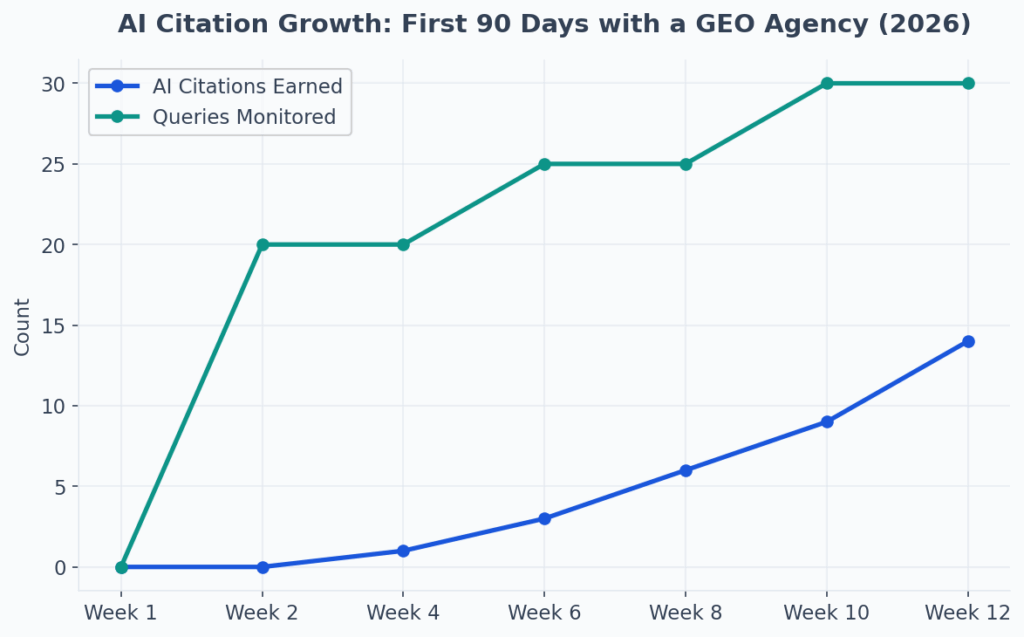
The agency will enter 20 to 35 queries into ChatGPT, Perplexity, Google AI Overviews, and Gemini. These queries represent the questions your ideal customers ask when researching providers like you. For a B2B software company, that might include “best project management tools for remote teams” or “how to choose a CRM for SaaS startups.” For a law firm, it might be “best employment solicitor in London” or “how much does an unfair dismissal case cost.”
The audit documents which queries return citations to your site, which cite competitors instead, and which show no relevant citations at all. This baseline is the reference point for every measurement that follows.
The audit tells you where you stand. Everything else in the first 90 days is about closing the gap between where you are and where you should be.
A good agency will also audit your technical readiness during this phase: checking whether AI crawlers (GPTBot, CCBot, PerplexityBot) can access your site, whether schema markup exists and validates correctly, and whether your content structure supports passage-level extraction.
Weeks 3 to 4: Schema Implementation and Technical Foundation
With the audit complete, the agency moves to technical implementation. This is the foundation that makes everything else work.
Organisation schema goes on your homepage, defining your business as a known entity with sameAs links to verified profiles. Article schema goes on every blog post with datePublished and dateModified fields. FAQPage schema goes on priority pages where visible questions and answers exist. Person schema goes on author and team pages to establish E-E-A-T signals.
The agency should validate every schema implementation using Google’s Rich Results Test and confirm that markup renders in raw HTML (not injected via JavaScript, which most AI crawlers cannot process).
By the end of week 4, your site should have a complete schema foundation that AI engines can parse reliably. If your agency has not touched schema by this point, ask why.
For context on why schema matters so much for AI visibility, our guide on how generative engine optimisation works covers the technical layer in detail.
Weeks 3 to 6: Content Restructuring
This is the highest-impact work in the first 90 days, and it runs parallel with schema implementation. The agency identifies your 10 to 15 highest-priority pages (based on the audit) and restructures them for AI extractability.
Restructuring means rewriting the opening of each section to deliver the answer in the first 30 words, followed by supporting evidence. It means breaking content into sections that function as standalone, quotable passages. It means adding FAQ sections with questions phrased the way real buyers ask them. It means placing inline citations next to every factual claim.
The difference matters. Only 15% of pages retrieved by ChatGPT actually earn a citation (Zyppy, 2025). The other 85% are read by the model but never referenced. Content restructuring moves your pages from the 85% to the 15%.
If you are evaluating agencies and want to see what a structured 90-day plan looks like for your business specifically, we walk through the process before you commit. Get Your Free GEO Assessment →
Weeks 6 to 8: First Citations and Entity Building
This is when the work starts producing visible results. Pages that were restructured in weeks 3 to 6 begin appearing as citations in AI-generated answers. The timing varies by industry competitiveness and existing domain authority, but week 6 is the typical threshold for first citations.
Simultaneously, the agency begins entity building: establishing your presence across the platforms that AI engines cite most frequently. This includes LinkedIn thought leadership from senior team members, YouTube videos answering top buyer questions, Google Business Profile optimisation, and review solicitation on relevant platforms.
Each third-party mention creates an independent data point that strengthens AI confidence in citing your website. Stacker’s research found that distributing content across publications can increase AI citations by up to 325% (Stacker, 2025).
For businesses already investing in PR, understanding how PR intersects with GEO helps coordinate these efforts for maximum AI visibility impact.
This overview covers GEO strategy and what to expect from implementation:https://www.youtube.com/watch?v=sQz8SFCNwkY
Weeks 8 to 12: Monitoring, Reporting, and Optimisation
By week 8, the agency should have full citation monitoring running across all target queries and AI platforms. This means weekly checks documenting which queries return citations, which competitors appear, and how AI answers are changing over time.
The first formal ROI report typically arrives at week 12. It should include citation count across AI platforms, competitor citation comparison, AI referral traffic to your site (tracked via GA4), content changes made and their measured impact, and recommendations for the next quarter.
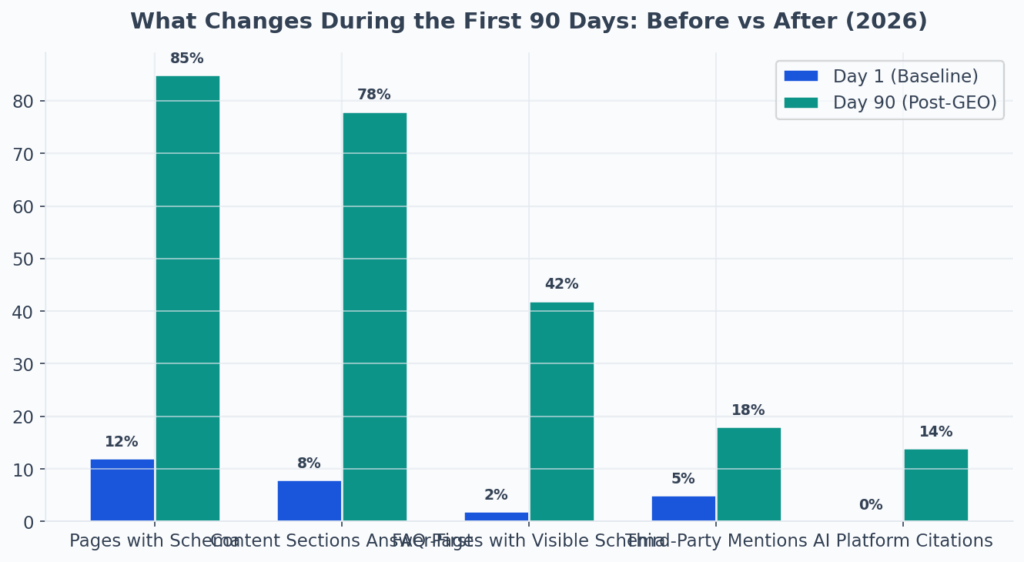
At the 90-day mark, you should have a clear understanding of your AI visibility trajectory. The citations earned in the first 90 days are the foundation; months 4 to 6 are where compounding begins and the volume of citations typically accelerates.
What to Ask If Progress Stalls
Not every engagement runs smoothly. Here are the questions to ask if you are not seeing progress at the expected milestones.
| If Stalled At | Ask This |
|---|---|
| No audit by week 3 | What is blocking the baseline audit and when will it be delivered? |
| No schema by week 5 | Is there a technical blocker with our CMS? What alternative implementation path exists? |
| No citations by week 10 | Are AI crawlers blocked by robots.txt? Is schema rendering in raw HTML or via JavaScript? |
| No monitoring by week 8 | Which tools are you using for citation tracking and when will weekly reports begin? |
| No ROI report by week 13 | What metrics are you tracking and how are you attributing AI referral traffic? |
For a broader framework on evaluating whether your agency is delivering, our comparison of ChatGPT SEO agencies: hype or real help covers the evaluation criteria in detail.
What Happens After 90 Days
The first 90 days build the infrastructure. Months 4 to 6 are where the return on that investment becomes measurable. Citations compound as AI engines build confidence in your content. New content published with GEO-ready structure earns citations faster because your entity is already established. The cost per citation decreases as the foundation matures.
Most businesses see their strongest citation growth between months 4 and 8. By month 12, the compounding effect means your AI visibility grows with less incremental effort than the initial setup required. This is why GEO delivers 480% 12-month ROI despite the slower start: the cost curve flattens while the citation curve steepens.
Understanding the cost-benefit of AI SEO over a full year helps set realistic expectations for the investment timeline.
The first 90 days set the trajectory. The agencies that deliver structured, milestone-driven onboarding build the foundation that compounds for years. If you want to see what that plan looks like for your business, Request a 90-Day Plan →.
This walkthrough covers the GEO implementation process agencies follow:https://www.youtube.com/watch?v=E4Y3YKzMRYo
Frequently Asked Questions
What should a chatgpt seo agency deliver in the first month?
A complete AI visibility audit across ChatGPT, Perplexity, Google AI Overviews, and Gemini, plus a technical readiness assessment covering schema, AI crawler access, and content structure. Schema implementation should begin by week 3.
How quickly will I see AI citations from a chatgpt seo agency?
First citations typically appear between week 4 and week 8, depending on industry competitiveness and existing domain authority. By the end of 90 days, most clients have 10 to 15 citations across their monitored queries.
What does chatgpt search optimisation involve?
Chatgpt search optimisation includes content restructuring for passage-level extraction, schema markup implementation, entity building across third-party platforms, and ongoing AI citation monitoring. The goal is to move your pages from the 85% that ChatGPT reads but does not cite to the 15% that earn citations.
How much does a ChatGPT SEO agency charge for the first 90 days?
Expect £6,000 to £18,000 GBP for the first 90 days, depending on scope. This typically includes a one-off audit (£1,500 to £5,000) plus 2 to 3 months of retainer work (£2,000 to £6,000 per month). Some agencies offer a fixed 90-day setup package.
What if I do not see any citations after 90 days?
Check three things: are AI crawlers blocked by robots.txt? Is schema rendering in raw HTML or via JavaScript? Has the agency actually restructured content, or only planned to? If all three foundations are in place and citations have not appeared, the agency should adjust its strategy and extend the timeline with clear next steps.
Can I do chatgpt search optimisation myself?
The basics (answer-first content, FAQ schema, visible dates) can be implemented by any competent team. The specialist work (citation tracking across platforms, entity graph building, technical schema validation) requires tools and methodology most in-house teams do not yet have. Many businesses handle the content side themselves and bring in an agency for technical and monitoring layers. Talk to our team about hybrid approaches.
How do I know if my ChatGPT SEO agency is any good?
Three signals: they deliver a structured audit within 2 weeks, they report on AI citation metrics (not just Google rankings), and they can show you live citation results for existing clients. If any of these are missing by week 4, escalate your concerns.
What is the difference between a ChatGPT SEO agency and a traditional SEO agency?
A traditional SEO agency optimises for Google rankings. A ChatGPT SEO agency optimises for citations inside AI-generated answers. The work differs in tools (citation tracking vs rank tracking), content approach (passage-level extraction vs keyword targeting), and technical implementation (full schema stack vs basic on-page SEO).
Whether you are 2 weeks or 2 months into an engagement, the milestones should be clear. If they are not, you deserve better. Get a Second Opinion →.
Pavel Uncuta is the founder of AiBoost, a UK AI marketing agency that builds visibility audit tools for professional services firms. He researches how Large Language Models cite brands across ChatGPT, Perplexity, and Google AI Overviews.
Want to know whether ChatGPT, Perplexity, or Google AI Overviews mention your firm? Run a free first-party visibility audit on your domain in under a minute and see exactly which queries cite you and which do not.