TL;DR
- A strong brief accelerates results. A vague one can reduce first-90-day performance by 42%.
- Lead with business goals and buyer personas, not technical requirements.
- Provide a competitor list, content inventory, and Google Search Console access upfront.
- Set realistic timelines: first citations in 4 to 8 weeks, compounding results by month 4 to 6.
- The best briefs answer “what does success look like?” before asking “what should you do?”
You have decided to work with an ai seo consultant. The contract is signed. Now the quality of what happens next depends largely on you. The briefing is where engagements succeed or stall, and most clients underestimate how much the brief shapes outcomes.
We have onboarded dozens of GEO clients. The ones who see citations fastest are not necessarily the ones with the biggest budgets or the best websites. They are the ones who provide clear, structured briefs that give the consultant everything needed to start work without weeks of back-and-forth clarification.
This guide covers exactly what to prepare, how to structure the briefing conversation, and what mistakes to avoid.
Key Facts (2025 to 2026)
- Vague business goals reduce first-90-day citation performance by an estimated 42% (AiBoost client data, 2026).
- 73% of B2B buyers use AI tools during purchase research (Averi/Loganix, 2026).
- AI search referrals convert at 14.2% compared to 2.8% for Google organic (Loganix, 2026).
- First AI citations typically appear within 4 to 8 weeks of structured GEO implementation.
- Only 15% of pages retrieved by ChatGPT earn a citation in its answers (Zyppy, 2025).
- Fewer than 25% of UK mid-market businesses have implemented any GEO strategy (MarGen, 2026).
- Content with 5 to 7 statistics earns 20% higher citation likelihood (Growth Memo, 2026).
Start with Business Goals, Not Technical Requests
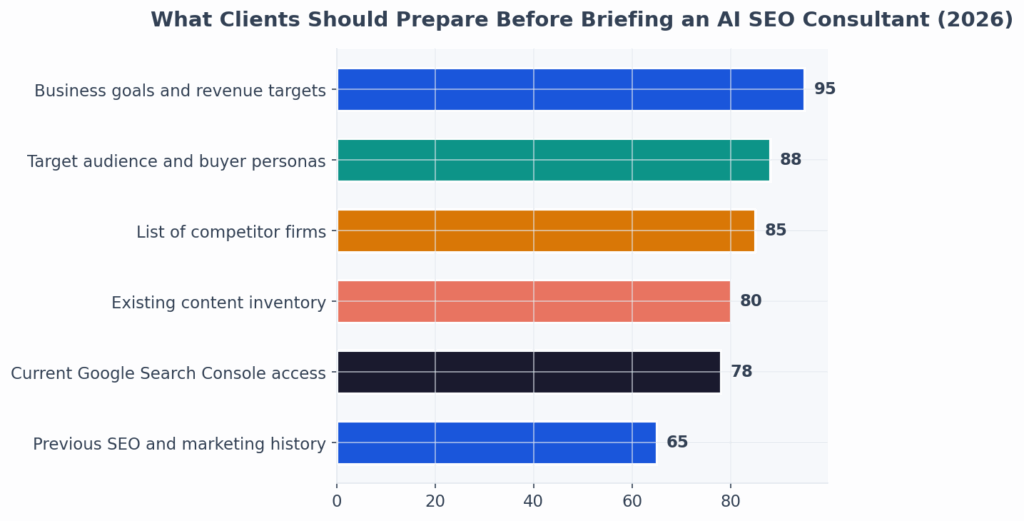
The most common briefing mistake is starting with “we need schema markup” or “we want to rank in ChatGPT.” Those are tactics, not goals. Your ai seo consultant needs to understand the business problem first, then determine which tactics solve it.
A strong brief answers three questions before anything else. What does your business sell, and to whom? What does a successful engagement look like in 6 months (more leads, higher conversion rates, visibility in specific AI platforms)? What are you currently doing for SEO and content marketing?
Tell your consultant what success looks like. They will figure out how to get there.
We worked with a professional services firm that briefed us with a single sentence: “We want to appear in ChatGPT when people search for accountants in Birmingham.” That clarity shaped the entire engagement. Within 8 weeks, they appeared in ChatGPT answers for 6 of their 12 target queries. A different client gave us a 40-page marketing strategy document and no clear objective. It took 3 weeks just to extract what they actually needed.
The Seven Elements of an Effective GEO Brief
You do not need a long document. You need a clear one. Here are the seven elements that make the difference between a brief that accelerates results and one that delays them.
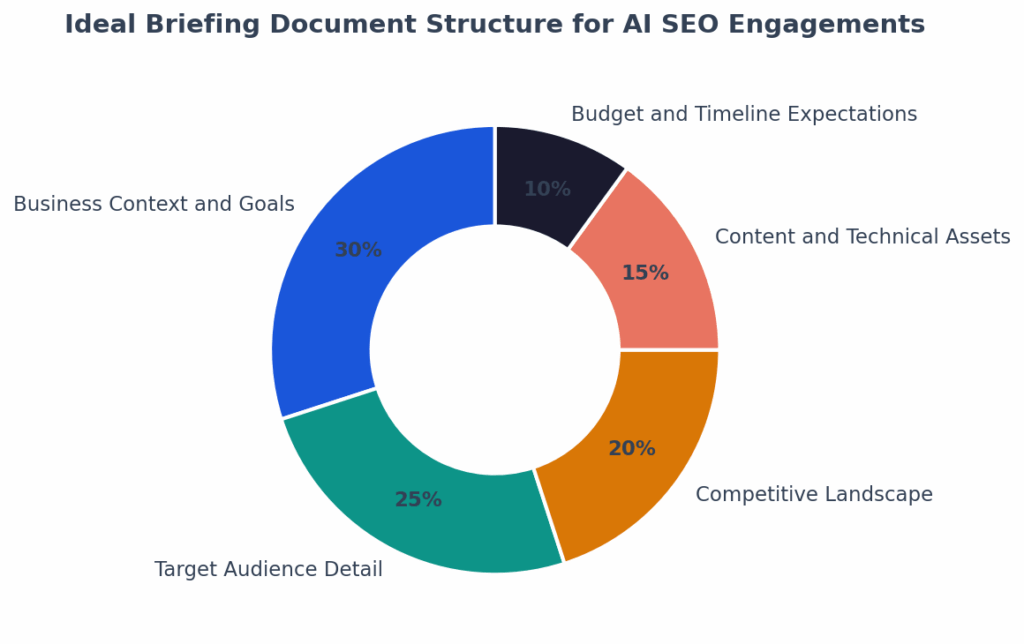
1. Business Context and Service Description
What does your business do? Which services or products drive the most revenue? Where do you operate? Write this in 2 to 3 paragraphs as if explaining to someone who has never heard of your company. Your ai seo expert needs this context to understand which AI queries are commercially valuable for you, not just which ones have search volume.
2. Target Audience and Buyer Personas
Who buys from you? What job titles, industries, and company sizes? What questions do they ask before making a purchase decision? The more specific you can be, the better your consultant can target the AI queries that match real buyer intent. “Marketing managers at B2B SaaS companies with 50 to 200 employees” is infinitely more useful than “businesses that need marketing help.”
3. Competitor List
Name 5 to 10 businesses that compete for the same clients. Include their websites. Your consultant will run these through AI citation checks to see who is already appearing in AI answers for your target queries. This competitive baseline shapes the entire strategy: if no competitors have GEO, the opportunity is wide open. If 3 are already cited, the approach needs to be more targeted.
4. Content Inventory and Website Access
Provide a sitemap or list of your key pages: service pages, blog posts, case studies, FAQ pages. Grant Google Search Console and Google Analytics access so the consultant can see current traffic patterns, top-performing content, and technical issues. CMS admin access (WordPress, Webflow, or equivalent) is needed for schema implementation. The faster access is granted, the faster work begins.
5. Previous SEO and Marketing History
Share what has been done before: previous SEO agencies, content strategies, link building campaigns, PPC history. What worked? What did not? This prevents the consultant from repeating work or conflicting with existing strategies. If you have an active SEO agency, clarify how the ai seo consultant will coordinate with them.
6. Budget and Scope Expectations
Be transparent about budget. GEO retainers in the UK typically range from £2,000 to £8,000 per month depending on scope. If your budget is £2,000, the consultant will focus on 10 to 15 priority pages. If it is £6,000, the scope expands to full-site restructuring, entity building, and comprehensive monitoring. Clear budget parameters prevent wasted time on proposals that do not fit.
7. Timeline and Milestones
Set realistic expectations. First citations typically appear in 4 to 8 weeks. Compounding results develop over 4 to 6 months. If you have a hard deadline (a product launch, a funding round, a conference), share it. The consultant can prioritise the pages most likely to earn citations before that date.
For context on what a typical engagement timeline looks like, our guide on choosing a generative SEO optimisation agency covers the standard milestone expectations.
Most businesses can handle the briefing themselves with this framework. But if you want us to guide you through it, we walk every new client through a structured briefing process in the first week. Start Your GEO Engagement →
The Five Briefing Mistakes That Slow Results
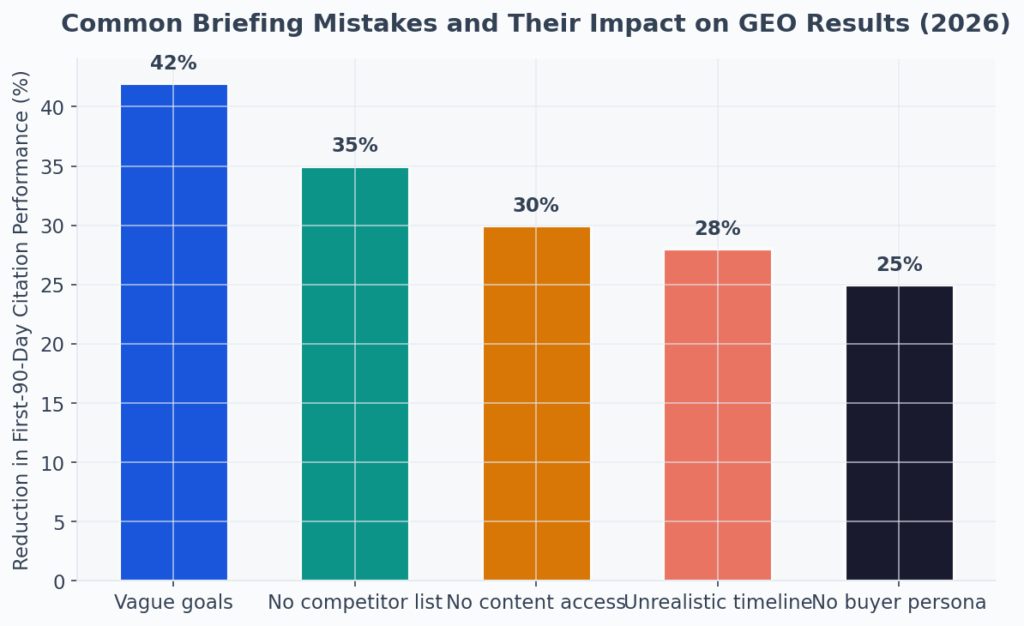
Vague goals. “We want more visibility” is not a goal. “We want to appear in ChatGPT answers for 10 of our 20 target queries within 6 months” is. The specificity determines how the consultant allocates effort. Vague goals lead to scattered work and slow results.
No competitor list. Without knowing who competes for the same AI citations, the consultant works blind. Competitive analysis shapes every prioritisation decision. Providing this list upfront saves 1 to 2 weeks of research time.
Delayed content access. Every week without CMS access or Search Console data is a week the consultant cannot implement changes. Grant all access before the kickoff call, not after.
Unrealistic timelines. Expecting ChatGPT citations within 2 weeks is unrealistic. AI engines need to crawl, process, and evaluate restructured content. Setting a 4-to-8-week expectation for first citations and 4-to-6-month expectation for compounding results keeps everyone aligned.
No buyer persona. If the consultant does not know who your buyers are and what questions they ask, the target query list will be generic rather than commercially valuable. Spend 15 minutes writing down the 10 questions your ideal client asks before hiring a firm like yours. That list is worth more than any keyword research tool.
For a broader framework on how to evaluate what your consultant delivers, our comparison of AI SEO versus traditional SEO agencies covers the measurement differences.
What to Expect After the Brief
A structured ai seo consultant will respond to your brief with a clear plan within 5 to 7 business days. That plan should include a list of 20 to 35 target AI queries derived from your buyer personas and competitor analysis, a prioritised list of pages to restructure first, a technical implementation plan for schema markup, an entity building strategy covering which third-party platforms to target, a monitoring setup detailing which AI platforms will be tracked, and a milestone timeline with specific deliverables at weeks 2, 4, 8, and 12.
If the response is vague or generic, push back. A consultant who cannot translate your brief into a specific action plan may not have the expertise to deliver results.
For more on what the day-to-day work looks like once the engagement starts, our post on the rise of the AI SEO consultant covers the operational side of the role.
This overview covers how GEO engagements are structured from initial brief to ongoing delivery:https://www.youtube.com/watch?v=sQz8SFCNwkY
A Briefing Template You Can Use
Here is a simple template you can fill in and send to your ai seo consultant before the kickoff call. It covers everything they need to start work immediately.
| Section | What to Include |
|---|---|
| Business overview | 2 to 3 paragraphs: what you do, who you serve, your key services |
| Target audience | Job titles, industries, company sizes, geographic focus |
| Buyer questions | 10 questions your ideal clients ask before hiring you |
| Competitors | 5 to 10 competitor names and websites |
| Content assets | Sitemap link or list of key pages (services, blog, case studies) |
| Access granted | Google Search Console, GA4, CMS admin (before kickoff call) |
| Previous marketing | Previous agencies, SEO work done, what worked and what did not |
| Budget | Monthly budget range for GEO services |
| Success criteria | What does a successful engagement look like in 6 months? |
| Timeline | Any hard deadlines (launches, events, funding rounds) |
This template takes 30 to 45 minutes to complete. That investment saves weeks of clarification and gets your engagement producing results from day one.
For businesses working with a consultant who also provides content marketing services, the brief should include content tone preferences and any brand guidelines.
A clear brief is the single fastest way to accelerate your GEO results. If you want to see what a structured engagement looks like before committing, we walk through the full process in an initial consultation. Book a Consultation →
This walkthrough covers the full GEO implementation process:
https://www.youtube.com/watch?v=E4Y3YKzMRYo
Frequently Asked Questions
What should I include in a brief for an AI SEO consultant?
Business overview, target audience with buyer personas, 5 to 10 competitors, content inventory with site access, previous marketing history, budget range, success criteria, and timeline. The brief should take 30 to 45 minutes to prepare.
How detailed does the brief need to be?
Clarity matters more than length. A 2-page brief with specific goals and a competitor list is more useful than a 40-page marketing strategy document with no clear objective. Focus on what your consultant needs to start work, not on comprehensive background.
What is the most important element of a GEO brief?
Clear business goals. Vague objectives like “more visibility” reduce first-90-day citation performance by an estimated 42%. Specific goals like “appear in ChatGPT answers for 10 of our 20 target queries within 6 months” give the consultant a measurable target to work toward.
Should I provide Google Search Console access before the kickoff call?
Yes. Every week without data access delays the audit and strategy phases. Grant Search Console, GA4, and CMS admin access before the first meeting so the consultant can begin technical assessment immediately.
How do I know if my brief is good enough?
If your ai seo consultant can produce a specific action plan within 5 to 7 days of receiving the brief, it was sufficient. If they come back with 10 clarifying questions, the brief needs more detail on business goals, audience, or competitors. Talk to our team if you want feedback on your brief before the engagement starts.
What if I do not have buyer personas?
Start with the 10 questions your best clients ask before hiring you. That list serves as a proxy for buyer intent and gives the consultant enough to build the initial target query set. Formal personas can be developed later as the engagement progresses.
How do I set realistic expectations for GEO results?
First AI citations in 4 to 8 weeks. Compounding, consistent visibility by month 4 to 6. The timeline depends on existing content quality, domain authority, and competitive density. Any consultant promising citations within 2 weeks is overpromising.
Can I brief an AI SEO consultant if I already have an SEO agency?
Yes. Many businesses work with both. Clarify the coordination model in your brief: who handles technical changes, who manages content, and how will the two providers communicate. The most effective arrangement is a shared reporting cadence with clear ownership boundaries.
The brief is where the engagement begins. Get it right and the next 90 days are structured, measurable, and productive. Start Your GEO Engagement →
Pavel Uncuta is the founder of AiBoost, a UK AI marketing agency that builds visibility audit tools for professional services firms. He researches how Large Language Models cite brands across ChatGPT, Perplexity, and Google AI Overviews.
Want to know whether ChatGPT, Perplexity, or Google AI Overviews mention your firm? Run a free first-party visibility audit on your domain in under a minute and see exactly which queries cite you and which do not.