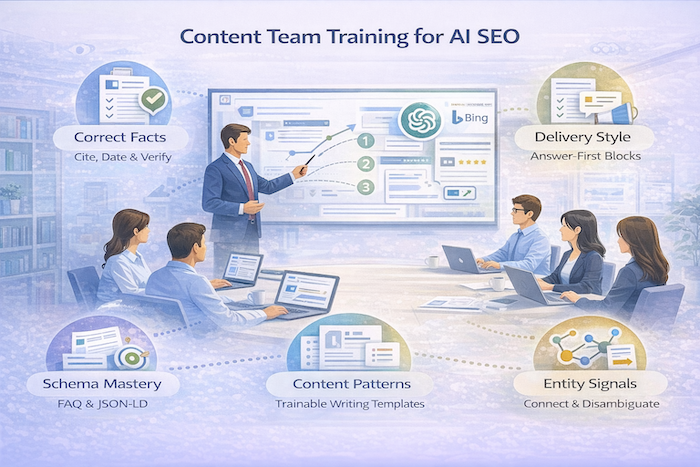
Generative search has fundamentally changed the way users find information. Instead of offering a list of links, AI search engines summarise content, answer questions and cite sources directly within the interface. As a result, traditional content habits — writing long, persuasion‑heavy articles that rank for keywords — no longer guarantee visibility. Training in‑house teams to produce answer‑first, machine‑readable content is faster and safer than relying solely on tools or agencies, because the knowledge remains within the organisation and adapts to evolving AI behaviour.
Why Traditional Content Training Is No Longer Enough
Ranking‑focused writing vs. answer‑focused writing
Classic SEO training teaches writers to include keywords, craft enticing headlines and create long‑form articles that satisfy human readers. AI‑driven search introduces a new requirement: explanation‑first content. Generative models extract snippets and facts from pages; they ignore vague language, opinionated fluff and marketing clichés. ToTheWeb’s AI training programme notes that marketers must rewrite key pages with clear, factual summaries at the top and remove overlapping content. The emphasis shifts from persuading humans to teaching both humans and machines.
Changing definition of “good content”
Good content in an AI era is concise, structured and trustworthy. It opens with direct answers, provides definitions and comparisons, and uses clear headings, lists and tables to help AI extract information. ToTheWeb advises adding FAQ and How‑To sections and using schema markup so generative engines can interpret content. Content that fails to meet these standards is likely to be ignored by AI.
The risk of being invisible to AI
Even if a page ranks highly in traditional search, it may not be cited or summarised by AI. Large language models retrieve only snippets rather than full pages. If key information is buried or ambiguous, AI will skip it. Thus, without proper training, teams may unknowingly produce content that AI cannot or will not reuse.
Core Mindset Shifts for Content Teams
Training content teams for AI SEO requires shifting from:
- Writing articles to teaching machines and humans: Writers must think like educators, ensuring that information is expressed clearly and can be understood by algorithms and readers alike.
- Persuasion‑first to explanation‑first: Instead of leading with marketing claims, start with factual answers and definitions. Opinion and promotional language should be clearly labelled as such.
- Volume to clarity, accuracy and structure: Generative engines prefer concise, well‑structured content. Focus on quality rather than quantity, and ensure each section has a clear purpose.
Understanding How AI Consumes Content
How AI scans, extracts and summarises information
AI search engines use retrieval‑augmented generation: they scan documents, extract relevant passages and then generate a response. Content must therefore include quotable, self‑contained sections. Vague or overly general language leaves nothing for AI to latch onto. ToTheWeb stresses that key messages should appear early in headings and summary blocks because generative engines often read only the first few sentences.
Characteristics of quotable content
To be reusable, content should be:
- Direct: Provide concise definitions, facts and answers.
- Structured: Use headings, lists and tables to delineate information.
- Trustworthy: Cite reputable sources and avoid unsupported claims; generative engines look for signals of credibility.
Training Writers to Write Answer‑First Content
Opening with direct, factual summaries
Train writers to start pages or sections with a summary paragraph that directly answers the primary question or explains the topic. ToTheWeb’s training suggests designing “answer‑first blocks” that AI can cite.
Definitions, explanations and comparisons
Encourage writers to define key terms and describe how products or services compare to alternatives. Use neutral language and avoid subjective adjectives. Breaking long content into shorter sections makes it easier for AI to extract specific answers.
Separating opinion, marketing and factual sections
Clearly label sections that contain opinions or marketing messages. Keep factual content distinct so AI can identify reliable information.
FAQs, Q&A and Conversational Structures
Writing FAQs that AI can reuse
FAQs are particularly useful because they mirror the question‑and‑answer format of AI search. Use real user questions gleaned from support logs, People Also Ask data and internal search queries. Provide concise answers (40–60 words) and include references when appropriate. Avoid shallow or salesy responses; generative engines may discount them.
When FAQs help — and when they don’t
FAQs are most effective when they address common, factual questions. They can become counterproductive if they repeat marketing slogans or if too many questions crowd the page and dilute focus. Use them strategically and ensure they add value.
Researching Questions AI Is Likely to Answer
AI learns from how users phrase questions in search, chat and other platforms. Writers should collaborate with SEO teams to analyse:
- Search data and People Also Ask queries to understand popular phrasing.
- Support logs and community forums for real customer language.
- Follow‑up questions that AI may combine into compound answers.
By anticipating these questions, writers can craft content that addresses them directly.
Schema and Structured Content Literacy for Non‑Technical Teams
Writers do not need to become developers, but they should understand the basics of schema markup, headings and HTML structure. ToTheWeb advises adding FAQ, How‑To and Article schemas to improve AI extraction and citation. Training should explain how headings (H1‑H3), lists, tables and metadata impact content parsing. Collaboration with technical SEO teams ensures markup is implemented correctly.
Responsible Use of AI Writing Assistants
AI as a drafting and ideation tool
Large language models can speed up outlining and brainstorming. However, as Search Engine Land notes, SEO specialists must learn how to prompt and collaborate with AI effectively. Writers should use AI for ideation, not as an authority.
Avoiding hallucinations and factual errors
AI can invent information; it is crucial to fact‑check and revise outputs. Editorial workflows should include human review and cross‑checking against trusted sources. Factual accuracy is essential because generative engines will propagate errors if they appear in the training data.
Editorial workflows for human review
Implement checklists to ensure that AI‑generated drafts are accurate, aligned with brand voice and structured for extraction. Avoid publishing AI output without editing — unchecked content poses a GEO risk, not a shortcut.
Maintaining Consistency and Entity Clarity
Consistency helps AI build correct associations. Training should emphasise:
- Consistent terminology: Use the same product names, job titles, and category descriptors across all content.
- Avoiding contradictions: Internal inconsistencies confuse AI and reduce trust.
- Aligning with brand, product and category definitions: Writers should refer to agreed‑upon definitions to strengthen entity recognition.
Training SEO Teams to Support Content for GEO
SEO teams must evolve from keyword‑checklists to interpretation and orchestration roles. Discovered Labs describes a technical content lead role responsible for writing answer‑focused content and collaborating on schema implementation. SEO specialists should review drafts for extractability, monitor AI answers and share insights with writers.
Collaboration Between Content, SEO and PR
Breaking silos
U of Digital highlights that AI optimisation hinges on merging SEO, PR, content and social strategies. Content teams should understand how PR coverage reinforces authority and provides third‑party validation. PR teams need to ensure that press releases and articles clearly describe the brand and its categories. A shared messaging framework ensures repetition across channels, enhancing AI learning.
Aligning messaging for AI
Hold joint workshops where content and PR teams review messaging pillars, keywords and entity definitions. This alignment ensures that AI receives consistent signals from both owned and earned media.
Workshops and Training Formats That Work Best
- Live workshops with real examples: Analyse existing content to show why AI would or would not use it.
- Content teardown sessions: Break down high‑performing AI citations and identify patterns.
- Playbooks and writing standards: Provide templates and checklists for answer‑first content, FAQs and schema requirements.
- Ongoing refresh sessions: AI behaviour evolves; schedule periodic updates to training materials.
Measuring Training Impact
Success should be measured through:
- Content quality and consistency improvements: Checklists and editorial reviews should show fewer inconsistencies and clearer structures.
- Increased AI citations or mentions: Monitor how often pages are cited in AI answers and whether brand mentions appear in generative search results.
- Internal confidence: Surveys and feedback can assess whether writers feel equipped to create AI‑ready content.
- Reduced guesswork and panic: Teams should be able to interpret traffic changes without resorting to speculation.
Common Training Mistakes to Avoid
- Overloading teams with AI theory: Focus on practical application rather than deep technical details.
- Tool‑centric training without editorial standards: Tools change quickly; foundational writing principles remain constant.
- Treating GEO as “SEO’s problem”: AI visibility is a shared responsibility across content, SEO, PR and product teams.
Long‑Term Value of Investing in Training
Investing in training yields lasting benefits. Teams become adaptable as AI systems evolve; they learn to interpret new formats and guidelines. Knowledge compounds internally instead of walking out the door with agencies or freelancers. Over time, GEO becomes a normal part of content operations rather than a special project. As the primaryposition guide notes, AI SEO specialists combine deep knowledge of search algorithms with hands‑on experience in AI tools and automation. Building this expertise within your organisation ensures you can control and update strategy as AI search continues to change.
Conclusion
AI‑driven search success depends more on people than on tools. Well‑trained content teams can write pages that AI trusts, reuses and recommends. This requires shifting mindsets from ranking‑centric to answer‑first, understanding how AI reads content, and collaborating across disciplines. Organisations that invest in training now will shape how machines and users learn about their brands — and will lead the narrative in the generative era.
Want to know whether ChatGPT, Perplexity, or Google AI Overviews mention your firm? Run a free first-party visibility audit on your domain in under a minute and see exactly which queries cite you and which do not.