
TL;DR
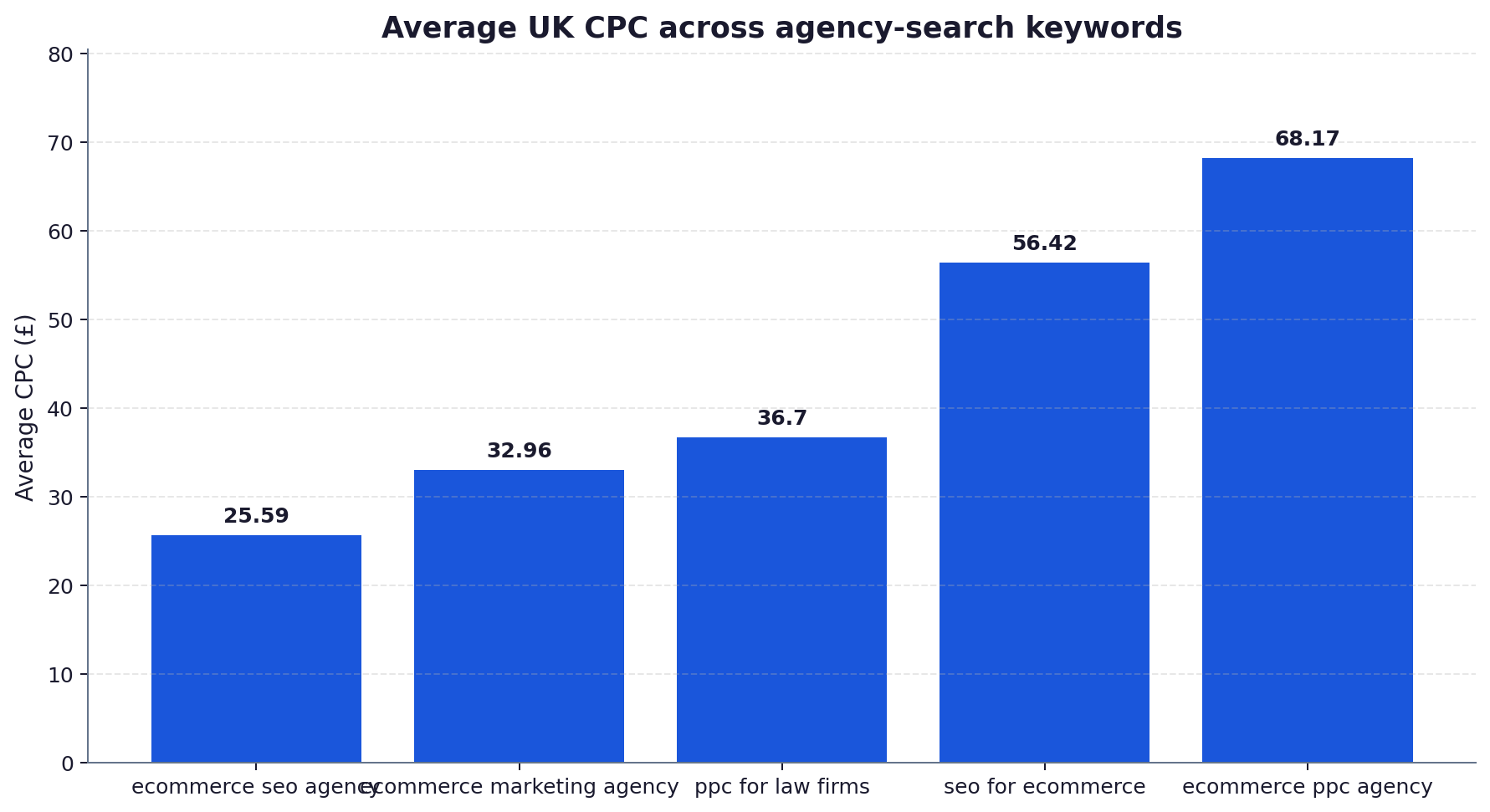
- ecommerce ppc agency is the most expensive keyword in the whole 48-term set AiBoost priced on 12 September 2026: 275 UK searches a month, MEDIUM competition, competition index 65, and a £68.17 average cost per click.
- That £68.17 is the price of reaching an ecommerce business, not the price of reaching a shopper. It is what agencies pay to win retail clients. Your product clicks are a different market entirely.
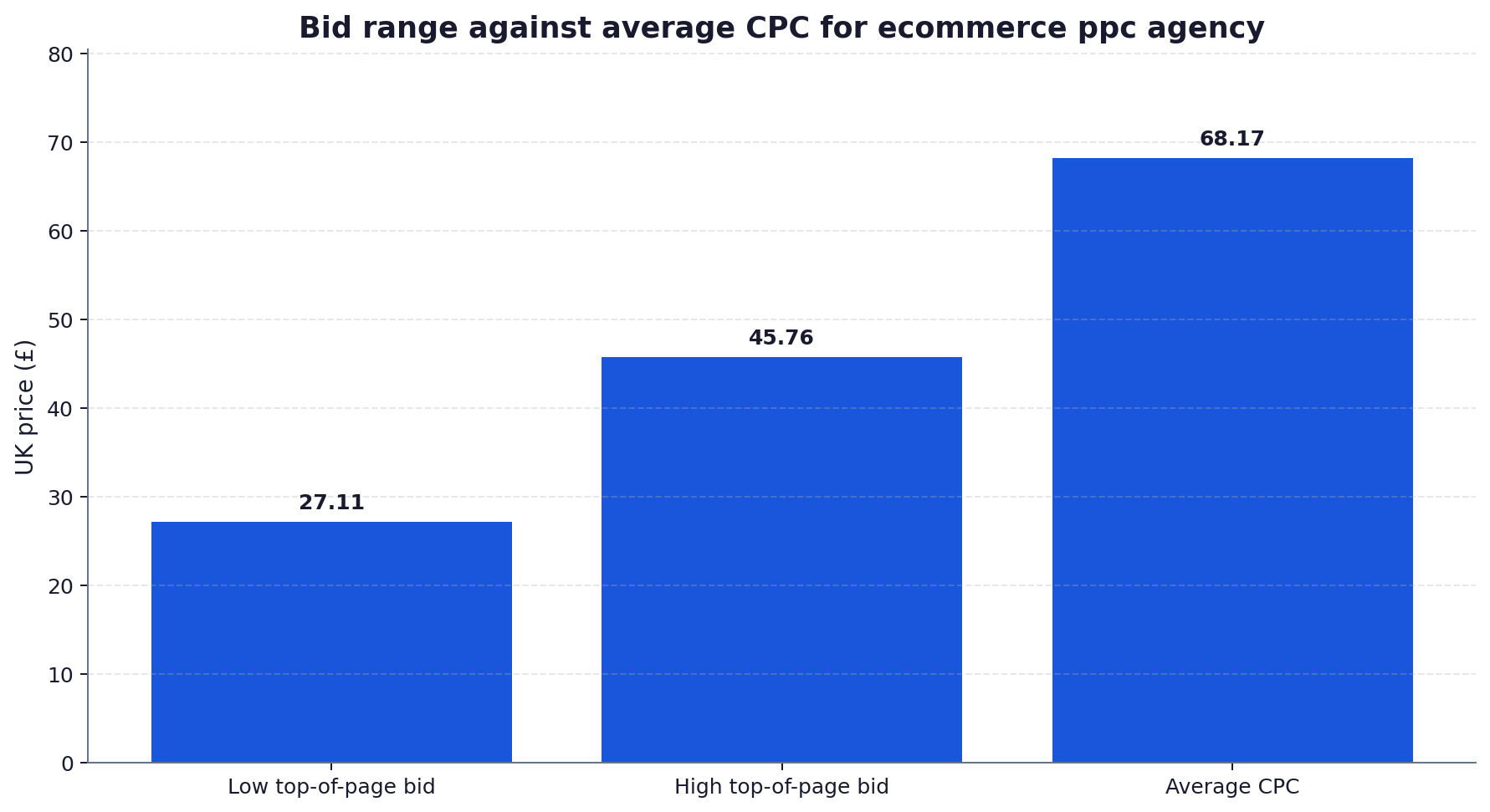
- The same record carries a top-of-page bid range of £27.11 to £45.76, which sits well below the headline CPC. A single average hides more than it tells you, so read the range.
- Retail advertisers on the same dataset can see the shape of the market around them: ecommerce marketing agency at £32.96, ecommerce seo agency at £25.59, seo for ecommerce at £56.42.
- An ecommerce PPC budget has three layers that get confused with each other constantly: media spend, management fee and the platform and feed cost of keeping products eligible to serve.
- Search volume for google shopping campaign setup is 7 a month in the UK. Almost nobody researches the setup step, which is a fair indication of where the mistakes are made.
Key facts
- ecommerce ppc agency: 275 UK searches a month, MEDIUM competition, competition index 65 of 100, £68.17 average CPC, top-of-page bids £27.11 to £45.76 (AiBoost analysis of DataForSEO Google Ads data, 12 September 2026).
- It is the highest CPC of the 48 keywords in that pull, above seo for ecommerce at £56.42 and ppc for law firms at £36.70.
- ecommerce marketing agency: 187 UK searches a month, MEDIUM, £32.96 CPC (companion 18-term run, 11 September 2026).
- ecommerce seo agency: 734 UK searches a month, LOW, £25.59 CPC. Same companion run.
- google shopping campaign setup: 7 UK searches a month. No competition or CPC figure was returned for it.
- The dataset contains no retail product-click CPCs. Nothing in this post should be read as what a shop pays per shopper.
The number everyone quotes, and what it actually measures
Ecommerce ppc agency carries a £68.17 average cost per click in the UK, on 275 searches a month, with MEDIUM competition and a competition index of 65 out of 100. In the 48-keyword pull AiBoost ran on 12 September 2026 it is the single most expensive term, ahead of seo for ecommerce at £56.42 and ppc for law firms at £36.70.
It is worth being precise about what that price is. It is the cost of a click from somebody searching for an agency to run their retail advertising. The advertisers bidding on it are agencies, and what they are buying is a lead that might turn into a retained client worth thousands of pounds a month. The price makes sense in that light and tells you almost nothing about what a click on a pair of trainers costs.
That distinction gets lost constantly, and it is how retailers end up with a budget model built on the wrong number. Your product clicks sit in a different auction, against different competitors, at prices set by your category, your margin and the season. What the agency term does tell you is the value the market places on a retail account, which is genuinely useful when you are reading a proposal.
Read the CPC as a range, not as a price
The same record that returns £68.17 also returns a top-of-page bid range of £27.11 at the low end and £45.76 at the high end. Both of those are below the headline average, which looks contradictory until you remember they measure different things. The bid range describes what advertisers are bidding to appear at the top of the page across the period; the average CPC is a modelled cost that reflects the whole auction, including the expensive tail.
For planning purposes the range is the more honest instrument. It gives you a band to sanity-check a proposal against instead of a single figure that will be wrong in both directions on any given day. Google’s own definition of actual cost per click is explicit that what you pay is usually less than your maximum bid, and Quality Score is one of the reasons two advertisers in the same auction pay different amounts for the same position.
Apply the same reading discipline to your own account. A monthly average CPC across a whole Shopping campaign averages your best-selling line together with the tail of products nobody clicks, and the average moves whenever the mix moves. Segment before you conclude anything, which is the same argument we made in what Google Ads costs in the UK in 2026.
The three layers of an ecommerce PPC budget
Media spend is the money that reaches the auction. Management is what the agency or in-house team costs to run it. The third layer is the one that gets left out of proposals: the platform, feed and data cost of keeping products eligible to serve at all.
That third layer is real. A product feed has to be generated, kept current on price and stock, and kept compliant with Shopping ads policies, which disapprove items for reasons ranging from a missing GTIN to a landing page price that disagrees with the feed. Every disapproved item is inventory that cannot be advertised regardless of how much media budget sits behind it. For a catalogue of any size that is an ongoing operational job, not a one-off setup.
Management fees vary in structure, and the structure matters more than the percentage. A fee taken as a share of spend rewards spending more. A flat retainer rewards efficiency but can leave a small account underserved. Neither is wrong, but you should know which incentive you have bought, and you should be able to see media spend and fee as separate lines on the invoice.
Where UK ecommerce budget leaks
The first leak is brand defence. Bidding on your own name is sometimes justified, often not, and almost never audited after the first month. If nobody is competing on your brand term and your organic result already owns the top of the page, that spend is buying clicks you would have received anyway.
The second is catalogue-wide bidding with no margin data attached. A Shopping campaign that treats a £12 accessory and a £400 flagship identically will spend most of its budget on the cheap item because it gets more clicks, and margin is the missing variable that would have stopped it. Splitting by margin band before splitting by category is the change that usually moves the account.
The third is paid budget defending terms the site could hold organically. The ecommerce SEO research cluster measured in the same pull is rated LOW competition across the board, which means those organic positions are winnable, and a click you earn once is a click you stop renting. That is the case for auditing both channels against one demand picture rather than reviewing them separately, and it is what our paid ads audit looks at first.
The fourth is measurement drift. If the conversion value in the ads platform disagrees with the order value in the shop, every automated bidding decision downstream inherits the error. Reconciling the two before changing bid strategy is dull and it is the highest-return hour in most retail accounts.
What to ask an ecommerce PPC agency before you sign
Ask which of your products carry enough margin to support a paid click at your category’s price, and expect them to want your margin data before answering. An agency that quotes a target return on ad spend without ever asking what you make on an order is quoting a number it cannot stand behind.
Ask how feed health will be monitored and who fixes disapprovals. Ask for media spend and management fee as separate lines. Ask what happens to the account if you leave, and who owns it. Ask which terms they intend to defend with paid budget that your own site might be able to hold organically, because the honest answer to that question is the fastest way to tell a media buyer from an adviser.
Then ask for the range rather than the number. Any market can be described as a band, and a firm that has actually looked at your category will give you one. The same test applies across verticals: we used it in what Facebook ads cost in the UK in 2026 and it separates the prepared from the confident every time. The broader case for running paid alongside organic rather than instead of it is set out in the benefits of PPC advertising for ecommerce, and the organic half of this particular market is covered in ecommerce SEO for UK online shops.
Almost nobody researches the setup step
One number in the pull is easy to skip past. Google shopping campaign setup records 7 UK searches a month, with no competition rating and no CPC returned. Google shopping ads uk returned no volume data at all.
Set that against 275 searches a month for ecommerce ppc agency and the picture is clear enough. UK retailers are researching who to hire, not how the thing works. That is a rational division of labour, and it also explains why so many accounts are inherited rather than designed: the setup decisions were made once, by someone else, and never revisited. If you have never opened the campaign structure you are paying for, that is a cheaper first move than changing agency. A practical starting point is our guide to keyword research for PPC campaigns, and for smaller budgets, running PPC on a small budget. Where automation helps and where it hides the data is covered in PPC bidding automation. If you want a specialist view of the organic side alongside it, an ecommerce SEO agency should be able to tell you which of your paid terms are winnable without spend.
How we ran the numbers
Every volume, competition label, competition index, cost per click and top-of-page bid figure in this post comes from a single AiBoost request to DataForSEO’s Google Ads search volume endpoint, run on 12 September 2026 in one session. The request covered 48 keywords with location set to United Kingdom and language set to English, and the raw response is retained. The comparison figures for ecommerce marketing agency, ecommerce seo agency and seo for ecommerce come from a companion 18-keyword run on 11 September 2026 using the same endpoint, location and language. Currency values are reported exactly as returned. Where the source returned no value we say so rather than estimating one. Search volumes in this dataset are twelve-month averages, and on half the keywords we checked the September 2025 reading runs at three times the median of the other eleven months or more, which inflates every headline average. Every volume quoted in this post is therefore the corrected mean of the eleven months excluding September 2025, not the figure the source reports as its headline.
Limitations
Google Ads search volumes are rounded buckets, not exact counts. They measure advertiser demand rather than organic difficulty, so a competition label describes the paid auction only. The cost per click values are modelled averages across a period and across all advertisers, which is why we publish the top-of-page bid range alongside them rather than presenting a single figure as a price. One September snapshot cannot show retail seasonality, and the fourth quarter is when ecommerce auction prices move most.
The September 2025 artefact deserves naming rather than burying. Google Ads twelve-month averages in this dataset are inflated by an anomalous September 2025 reading, so every volume here is quoted as a corrected mean excluding that month. On this post’s primary keyword the gap is the largest in the lane: the source reports 480 searches a month for ecommerce ppc agency against a corrected mean of 275, and the same correction takes the whole 18-term ecommerce cluster from 3,510 to roughly 2,580, a 26 per cent overstatement. Cost per click and competition figures are unaffected, because only the volume series carries the anomaly.
The most important limitation is one of scope. This dataset prices agency-search terms, not retail product clicks. We did not pull category-level shopping CPCs, we did not sample any UK retailer’s account, and we publish no return-on-ad-spend benchmarks because we have not measured any for this sector. Treat every figure here as a description of the market for ecommerce marketing services, and treat your own account data as the only valid source for what your shoppers cost.
Frequently asked questions
What does ecommerce PPC cost in the UK in 2026?
There is no single figure, because product clicks are priced per category and per auction. What is measurable is the market for ecommerce advertising services: the term ecommerce ppc agency records a £68.17 average cost per click in the UK on a corrected 275 searches a month, with a top-of-page bid range of £27.11 to £45.76 (AiBoost analysis of DataForSEO Google Ads data, 12 September 2026). That is the price of reaching a retail business, not a shopper.
Why is the average CPC higher than the top-of-page bid range?
They measure different things. The top-of-page bid range describes what advertisers bid to appear at the top of the results over the period. The average cost per click is a modelled figure across the whole auction, including the expensive tail that pulls the mean upward. For planning, the range is the more useful of the two, because it gives you a band to test a proposal against rather than a single number that will be wrong on most days.
How much of an ecommerce PPC budget goes to the agency?
It depends entirely on the fee structure, which is why media spend and management fee should appear as separate lines before you sign anything. A percentage-of-spend model rewards spending more; a flat retainer rewards efficiency but can under-serve a small account. Neither is inherently wrong. What matters is that you know which incentive you have bought and can see both numbers.
Is Google Shopping cheaper than search ads for a UK retailer?
Frequently, but not reliably, and the dataset behind this post does not measure it. Shopping ads are matched from a product feed rather than from keywords, which changes where the work sits: feed quality, product data accuracy and disapproval management replace much of the keyword labour. The cost consequence varies by category. Your own account is the only valid source for the comparison.
What is the biggest waste in a UK ecommerce ads account?
In our experience it is a tie between unexamined brand defence and catalogue-wide bidding with no margin data attached. The first buys clicks the organic result would have won anyway. The second spends most of the budget on cheap items because they attract more clicks, when margin is the variable that should have decided the split. Both are found by segmenting before averaging.
Should I run ecommerce SEO and PPC at the same time?
Yes, and against one demand picture rather than two plans. The ecommerce SEO research cluster in the same 12 September pull is rated LOW competition across every term, which means those organic positions are realistically winnable. Paid budget defending a term the site could hold organically is rented traffic you are paying for twice, and it is the first thing worth identifying when the two channels are audited together.
How often should a retail ads account be reviewed?
Structure quarterly, feed health continuously, and spend weekly during any trading peak. The continuous item is the one most often skipped: product disapprovals remove inventory from the auction silently, and a catalogue can lose a meaningful share of its eligible items without anyone noticing until revenue moves.
Does a high CPC mean a market is not worth entering?
No. A high click price is the market’s judgement about what a converted customer is worth, so it signals value as much as difficulty. The question it should trigger is whether your margin supports that price on the specific products you would advertise, which is answerable from your own data and not from any published benchmark.
Sources and references
- Google Ads search volume, competition and CPC data for 48 UK keywords, 12 September 2026. DataForSEO, 2026
- Actual cost-per-click (CPC): definition. Google Ads Help, 2026
- About Quality Score for Search campaigns. Google Ads Help, 2026
- Shopping ads policies. Google Merchant Center Help, 2026
- Manage your spend in Google Ads. Google Ads Help, 2026
AiBoost prices paid markets as a range, not a single blended number, and separates media spend from management fee so you can see what you are buying. Request a free paid ads audit and we will report what your category actually costs.
Change log
- 2026-09-21: Initial publication.
- 2026-09-12: Search volumes restated as corrected twelve-month means excluding an anomalous September 2025 reading in the source data. Cost per click and competition figures unchanged.