
TL;DR
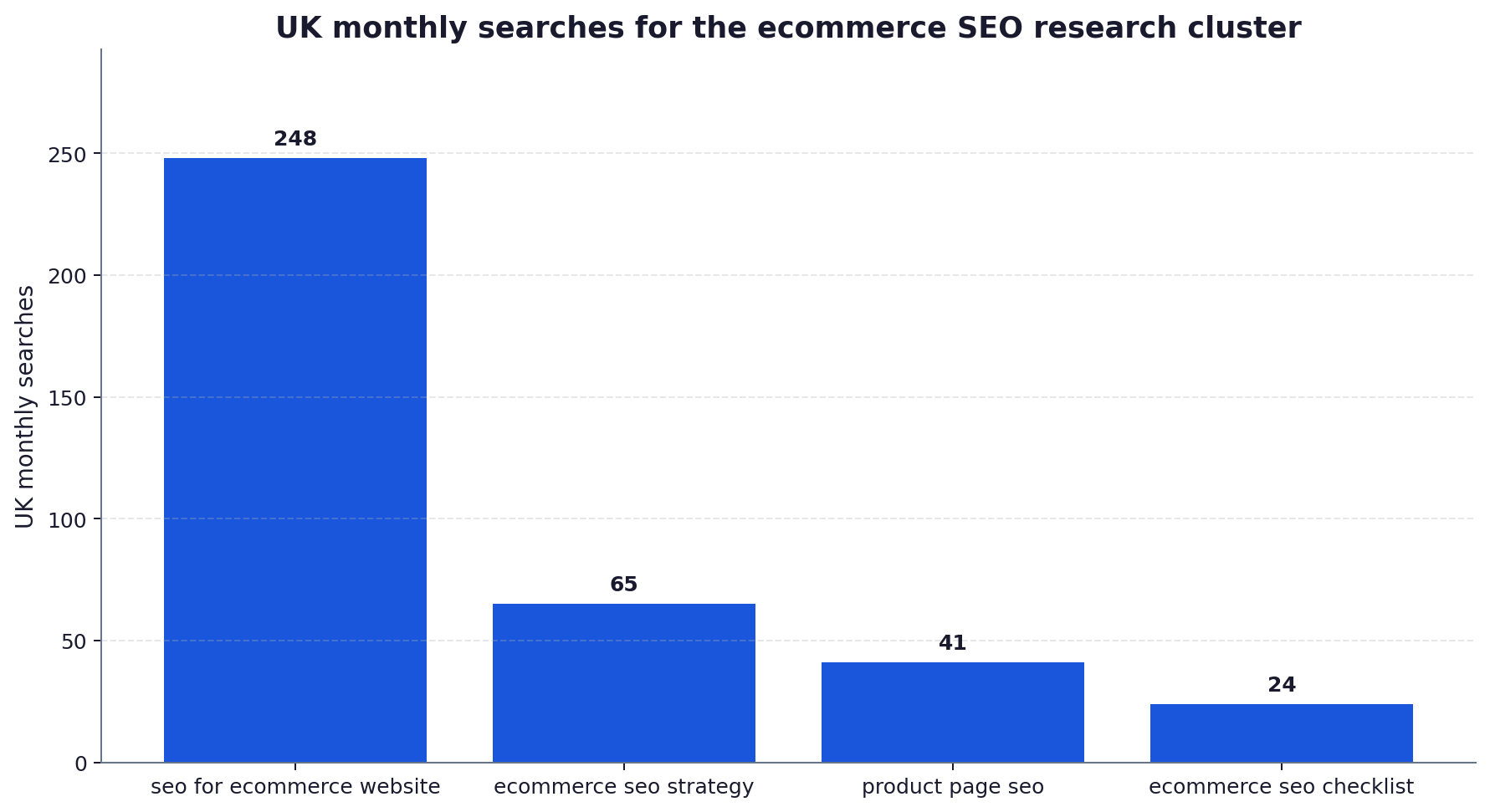
- The UK ecommerce SEO research cluster runs at roughly 380 searches a month across four terms, and every one of them is rated LOW competition (AiBoost analysis of DataForSEO Google Ads data, 12 September 2026).
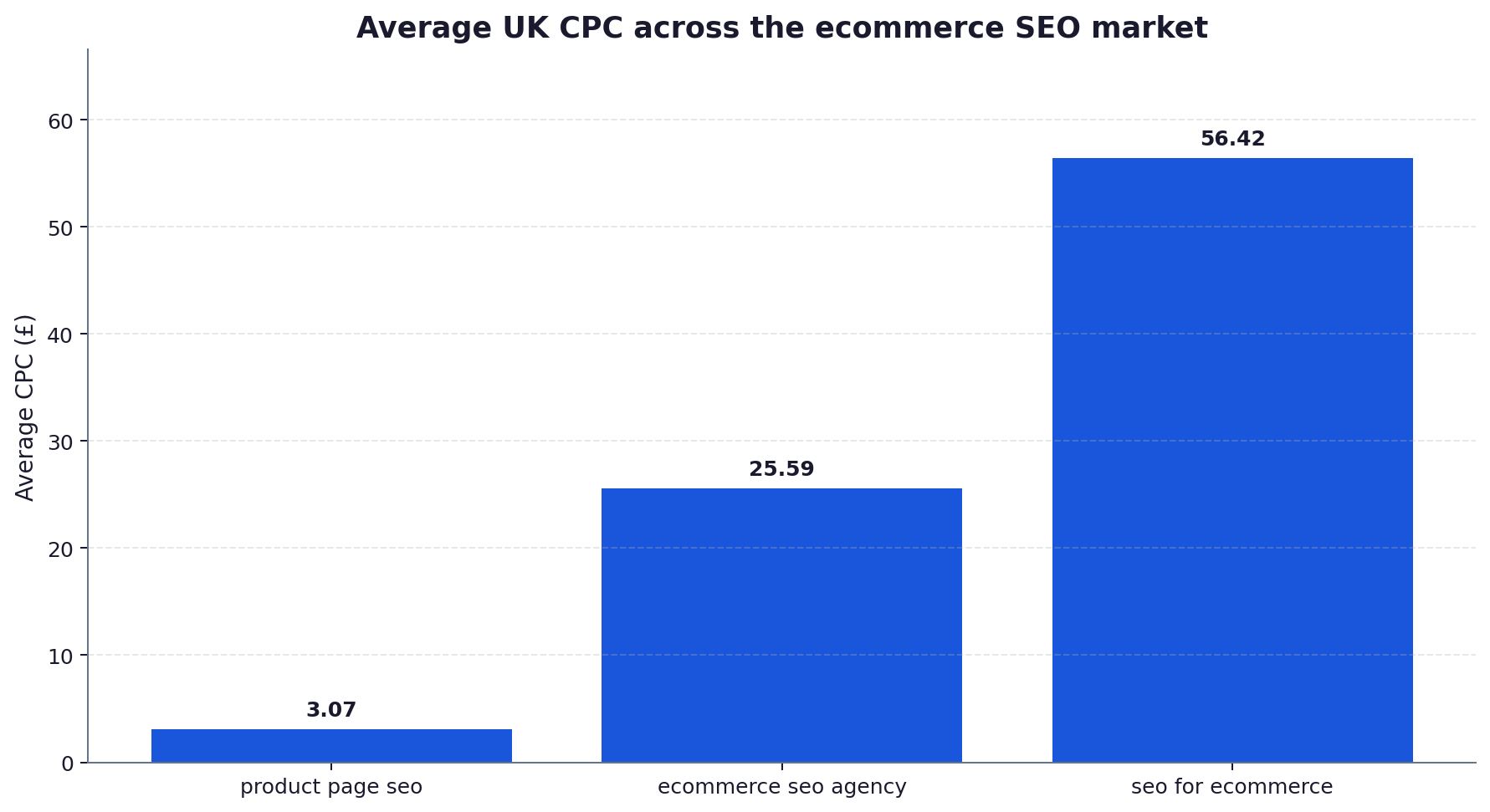
- Head demand is far larger and far more expensive. seo for ecommerce records 561 UK searches a month at a £56.42 cost per click, and ecommerce seo agency records 734 at £25.59, from the companion 11 September run.
- The gap between cheap, uncontested research terms and expensive head terms is the whole opportunity: the questions shop owners ask before they hire anyone are still barely answered.
- Start at the product page rather than the category page. It is the page that carries price, stock and specification, the three things every downstream system reads.
- Faceted navigation and variant URLs are the commonest technical cause of a large catalogue underperforming, because they turn one sellable item into dozens of competing addresses.
- Out-of-stock handling is a ranking decision as much as a merchandising one. Deleting a product page throws away every signal it earned.
Key facts
- seo for ecommerce website: 248 UK searches a month, LOW competition, competition index 11 of 100, top-of-page bids £14.16 to £23.31 (AiBoost analysis of DataForSEO Google Ads data, 12 September 2026).
- ecommerce seo strategy: 65 UK searches a month, LOW, competition index 28, bids £4.05 to £13.57. Same pull.
- product page seo: 41 UK searches a month, LOW, competition index 31, £3.07 CPC. Same pull.
- ecommerce seo checklist: 24 UK searches a month, LOW, competition index 14. Same pull.
- Head terms from the 11 September 2026 companion run: seo for ecommerce 561 a month at £56.42 CPC, ecommerce seo agency 734 at £25.59, both rated LOW.
- The full UK ecommerce marketing cluster across 18 terms totals roughly 2,580 searches a month, the largest segment in that run.
What UK shops search for when they want ecommerce SEO
In AiBoost’s keyword analysis of DataForSEO Google Ads data for the UK (12 September 2026), the research cluster splits four ways. Seo for ecommerce website draws 248 searches a month, ecommerce seo strategy 65, product page seo 41 and ecommerce seo checklist 24. That is roughly 380 monthly searches from people who have already decided the work matters and are trying to establish what it involves.
Every one of those four is rated LOW competition, with indices between 11 and 31 out of 100. The head of the same market behaves completely differently. Seo for ecommerce records 561 UK searches a month at £56.42 a click, and ecommerce seo agency records 734 at £25.59, both from the companion 11 September run. Advertisers are paying serious money to reach buyers at the hiring stage while leaving the research stage almost untouched.
That asymmetry is the argument for writing this at all. A shop owner searching ecommerce seo checklist is three steps from a purchase decision, the click costs almost nothing to earn organically, and the results currently answering that query are mostly recycled. If you sell to those people, being the page that answers properly is cheap. It is the same pattern we found in construction SEO, where research demand sat at LOW competition while the paid market priced the same buyers at thirty pounds a visit.
Why the product page, and not the category page
Most ecommerce SEO advice starts with category pages, because category pages map neatly onto head keywords. That is a reasonable ranking theory and a poor operating sequence. The product page is where price, stock state, specification, images and reviews actually live, and every system downstream reads those fields: classic search results, merchant listings, price comparison, and AI assistants assembling a shortlist.
A category page inherits its credibility from the products beneath it. If forty product pages carry manufacturer-copy descriptions, no specification table and a price rendered only by JavaScript, the category page above them has nothing to be authoritative about. Fix the template once and the fix multiplies across the catalogue; fix the category page first and you have improved one URL.
There is a commercial reason too. Product pages capture the long, specific queries that convert, the ones with a model number, a size, a material or a compatibility constraint attached. Those queries never appear in a keyword tool at meaningful volume because each one is tiny, but in aggregate they are where a mid-size catalogue earns its organic revenue. Building the plan around them is the core of how we approach ecommerce SEO engagements.
Four product-page failures that come up again and again
The first is the manufacturer description. If your text is the same paragraph twelve other retailers publish, there is nothing for an engine to prefer you on. Adding two or three sentences that only you can write, about fit, use case, or what the item is commonly bought alongside, changes the page from a duplicate to a source.
The second is an invisible price. Prices assembled client-side, held behind a login, or rendered only after a pricing service responds are not readable by anything that does not execute your JavaScript. Google’s own JavaScript SEO guidance is blunt about the risk, and the same limitation applies to every other crawler in the chain.
The third is a missing or mismatched review aggregate. Showing a site-wide seller rating on a product page answers a question nobody asked. Google’s Product structured data documentation expects a review count and an average that describe the same population, and so does every feed specification we have read.
The fourth is the specification gap. Dimensions, materials, compatibility, power ratings and care instructions are exactly the constraints buyers put into a conversational query. A page that states them in text can be matched against them. A page that shows them in an image cannot.
Faceted navigation and the duplicate URL problem
A shop with 500 products and a filter panel can generate tens of thousands of crawlable addresses. Colour, size, price band and sort order each multiply the URL space, and most of the combinations lead to a page that is either near-identical to another or nearly empty. That is the single most common reason a large UK catalogue crawls badly.
The decisions are not complicated, but they have to be made deliberately. Which filter combinations are genuinely a page someone would search for, and which are a view of an existing page? Search-worthy combinations get a real indexable URL with its own title and copy. Everything else gets consolidated with a canonical to the page it is a view of, and sort order and pagination parameters are kept out of the indexable set entirely.
Variants raise the same question one level down. A t-shirt in four colours and five sizes is twenty purchasable items and, usually, one page a buyer wants to land on. Pick the level you sell at, keep the identifiers stable across it, and make sure the selected variant is reflected in the URL where a buyer would reasonably expect to link to it. This is structural work rather than content work, and it belongs alongside a clear website structure rather than in a content calendar.
Out-of-stock, discontinued and seasonal products
Deleting a product page when the item sells out throws away every link, every impression and every piece of history that page accumulated. It also creates a 404 for anyone who bookmarked it. For a seasonal shop that repeats the same lines each year, it is close to self-harm.
Keep the page, mark the availability state accurately in the markup, and give the visitor somewhere to go: notify me when back, the closest current alternative, or the successor model named explicitly. When an item is genuinely discontinued with a direct replacement, redirect it to the replacement rather than to the category page, because a category redirect tells the engine the specific intent no longer has an answer.
Accurate availability matters more than it used to. Feed specifications and structured data both treat stock state as a controlled value, and an assistant recommending an item that cannot be bought is a failure the merchant gets blamed for. Stating it correctly is cheaper than any content investment on the same page.
Making a product page something an assistant can quote
The same template work that fixes classic rankings determines whether an AI assistant can use your page at all. Assistants quote facts, and a fact needs to be stated in text, attached to the right entity and consistent with whatever else exists about that product on the web. A page that says the item is “perfect for every occasion” has offered nothing quotable.
Three habits do most of the work. State the constraint in words, so “fits 13 to 14 inch laptops” rather than a dimensions diagram. State the differences between your variants explicitly, so a comparison can be made without guessing. And keep the description on your own domain consistent with the description on the marketplaces and resellers that list you, because contradiction between sources is what makes an engine reach for a competitor instead. Our post on getting products into AI recommendations goes further into the structured-data side, and our piece on ChatGPT shopping covers what the published product feed specifications actually ask for.
A sequence that works for a small UK shop
Month one is measurement and the template. Crawl the site, establish how many URLs are indexable against how many products you sell, and rebuild one product page properly as a reference. Month two is the rollout: apply the template across the best-selling lines first, because those are the pages already receiving traffic and the ones where a change shows up quickest.
Month three is structure. Resolve faceted navigation, variants and pagination, then build the category and buying-guide pages the fixed product pages can now support. Only after that does a content programme make sense, and when it does, tie it to real buying questions rather than volume for its own sake. The economics of that sequence for a smaller business are the ones we set out in whether SEO is worth it for small businesses, and the performance side belongs next to a sensible update cadence and Core Web Vitals rather than being treated as a separate project.
If paid search is already running alongside this, audit the two together. The commonest waste in a UK retail account is budget defending terms the same site could hold organically at LOW competition, which is exactly the situation this keyword cluster describes. Our older piece on PPC advertising for ecommerce covers where paid genuinely earns its place, and a specialist ecommerce SEO agency should be able to tell you which side of that line each of your top terms sits on.
How we compiled the numbers
Search volumes, competition labels, competition indices, cost per click and top-of-page bid ranges come from a single AiBoost request to DataForSEO’s Google Ads search volume endpoint on 12 September 2026, location United Kingdom, language English, covering 48 keywords in one session. The head-term figures for seo for ecommerce, ecommerce seo agency and the 2,580-search cluster total come from a companion 18-keyword run on 11 September 2026 using the same endpoint and the same location and language settings. Search volumes in this dataset are twelve-month averages, and on half the keywords we checked the September 2025 reading runs at three times the median of the other eleven months or more, which inflates every headline average. Every volume quoted in this post is therefore the corrected mean of the eleven months excluding September 2025, not the figure the source reports as its headline. Currency values are reported exactly as the source returned them. Technical guidance is referenced to the current published documentation from Google Search Central and web.dev rather than to third-party summaries.
Limitations
Google Ads search volumes are rounded buckets rather than exact counts, and they measure advertiser demand, not organic difficulty. A LOW competition label describes the paid auction; it is a useful signal that organic results may be thin, and it is not a measurement of how hard a position would be to win. Close variants are grouped by the source, so the four cluster terms are not fully independent of one another. One September snapshot cannot show retail seasonality, and the fourth quarter is the period that matters most to this sector. We did not crawl any specific UK retail site for this article, we publish no conversion or ranking benchmarks here because we have not measured any for this cluster, and the failure patterns described are drawn from engagement experience rather than from a counted sample.
Frequently asked questions
How many UK businesses search for ecommerce SEO help?
Roughly 380 a month across the research cluster, and considerably more at the hiring stage. In AiBoost’s analysis of DataForSEO Google Ads data (12 September 2026), seo for ecommerce website records 248 UK searches a month, ecommerce seo strategy 65, product page seo 41 and ecommerce seo checklist 24. The companion 11 September run puts seo for ecommerce at 561 a month and ecommerce seo agency at 734. All of those terms are rated LOW competition.
Should I optimise category pages or product pages first?
Product pages. They hold the price, stock state and specification that search engines, merchant listings and AI assistants all read, and a fixed template multiplies across the whole catalogue instead of improving a single URL. Category pages inherit credibility from the products beneath them, so they are worth building properly once those products carry real data. The exception is a shop with fewer than about twenty products, where the two jobs collapse into one.
What is the most common technical problem on a UK ecommerce site?
Duplicate and near-duplicate URLs generated by faceted navigation, variants, sort order and pagination. A catalogue of 500 products can easily expose tens of thousands of crawlable addresses, most of them views of a page that already exists. The fix is a deliberate decision about which filter combinations deserve an indexable page of their own, with everything else canonicalised to the page it is a view of.
Should I delete product pages for items I no longer sell?
Usually not. The page holds links, history and search impressions that vanish with it. Keep it, state the availability accurately in the markup, and offer the visitor a route forward: a back-in-stock option, the nearest current alternative, or the successor named directly. Where an item is discontinued with a genuine replacement, redirect to that replacement rather than to the category page.
Does writing my own product descriptions actually matter?
It matters most when you are one of several retailers publishing the manufacturer’s text. Identical copy gives an engine nothing to prefer you on, and it gives an assistant nothing to quote that is attributable to you. Two or three genuinely original sentences per product, covering fit, use case or what the item is bought alongside, is a small amount of work with a disproportionate effect on a catalogue that currently has none.
How long does ecommerce SEO take to show results?
No honest answer includes a fixed date. What can be said is that the whole research cluster measured here is rated LOW competition, which usually means thinner organic results to displace than in a market like legal or dental. The realistic variables are your starting technical state, catalogue size and domain history. A quarter of template and structural work before measurable movement is a reasonable expectation for an established shop.
Do I need structured data on every product page?
Yes, and it should be accurate rather than complete. Product markup that repeats a price the page no longer shows, or a review aggregate drawn from a different population, is worse than none. Google’s Product structured data documentation sets the expectations, and the same discipline carries over directly to the product feed formats AI assistants read.
How does ecommerce SEO relate to paid search for a UK shop?
They answer different moments and should be planned against the same demand picture. Paid buys immediate presence at prices that reach £56.42 a click on the head term in this market; organic earns the same visits repeatedly once a position is held. The waste to look for is paid budget defending terms the site could hold organically at LOW competition, which is why the two are worth auditing together rather than separately.
Sources and references
- Google Ads search volume, competition and CPC data for 48 UK keywords. DataForSEO, 2026
- Product (Product, Review, Offer) structured data. Google Search Central, 2026
- Canonicalization and consolidating duplicate URLs. Google Search Central, 2026
- JavaScript SEO basics. Google Search Central, 2026
- Web Vitals. web.dev, 2026
AiBoost has audited 250+ UK small businesses, and every ecommerce engagement starts with a crawl rather than a content calendar. Ask us to scope an ecommerce SEO plan against your catalogue size, platform and margin.
Change log
- 2026-09-18: Initial publication.
- 2026-09-12: Search volumes restated as corrected twelve-month means excluding an anomalous September 2025 reading in the source data. Cost per click and competition figures unchanged.