
TL;DR
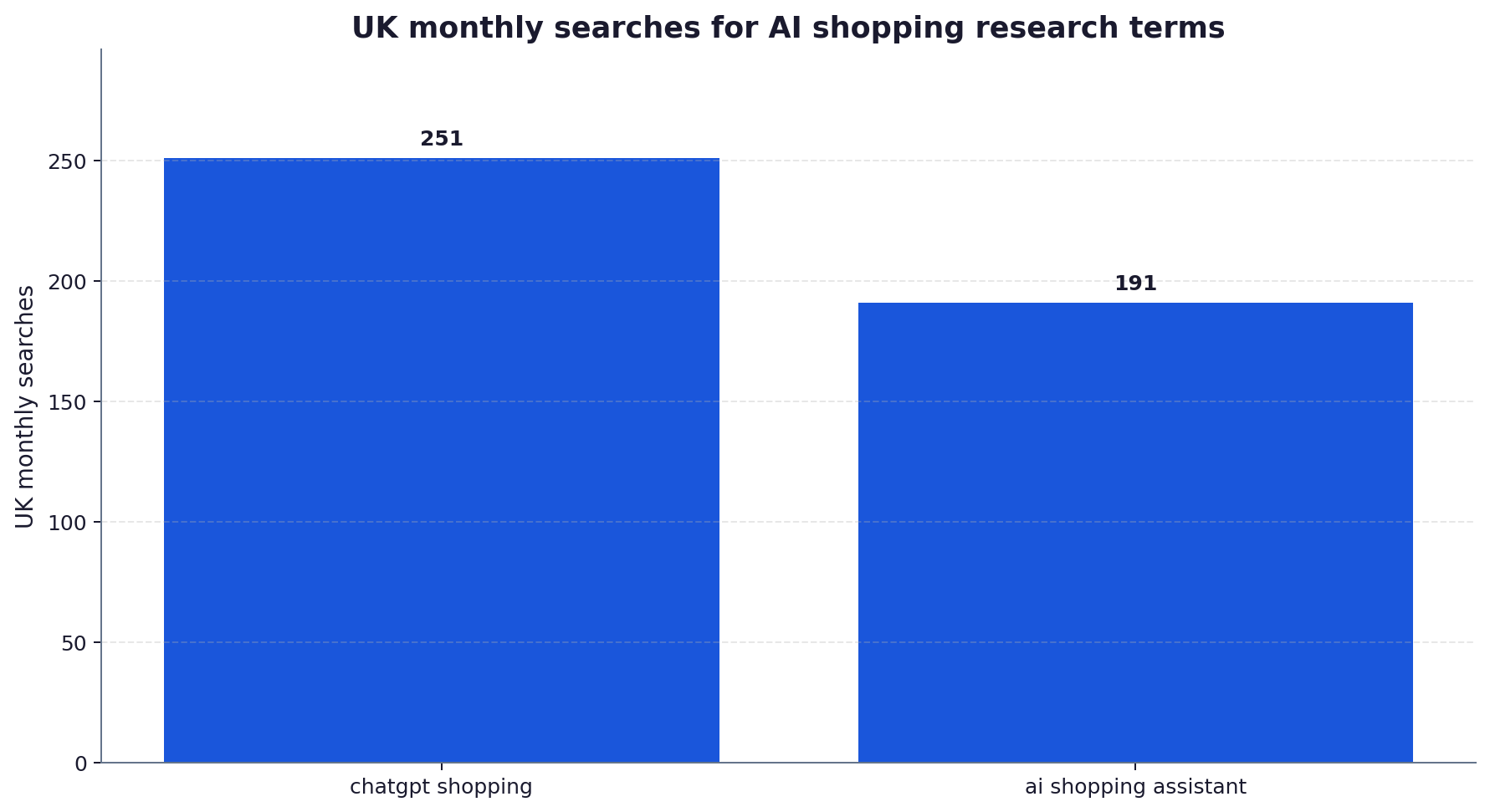
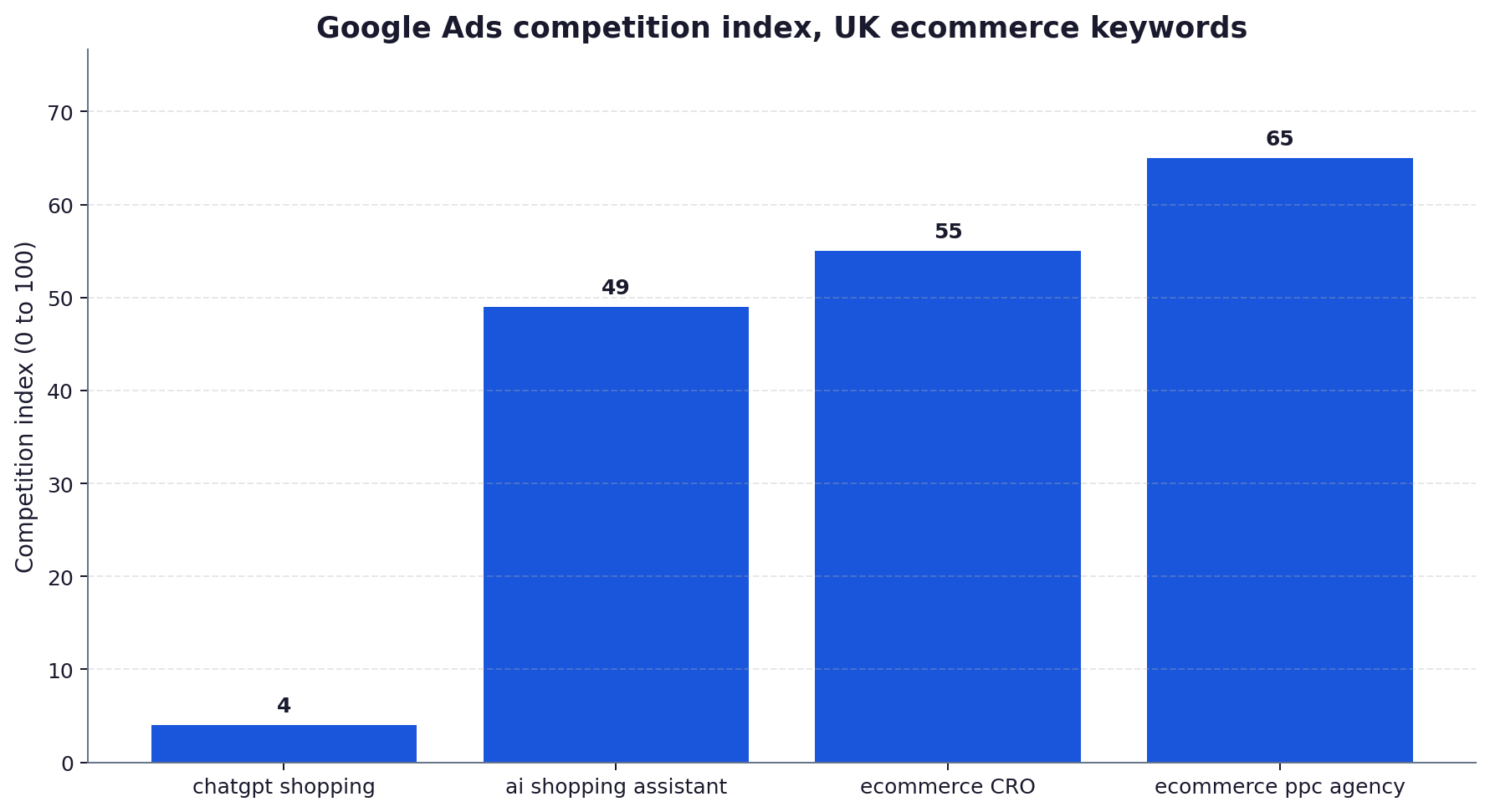
- UK searches for chatgpt shopping run at 251 a month with a competition index of 4 out of 100, the least contested term in the whole 48-keyword set AiBoost priced on 12 September 2026. Advertisers pay about £0.63 a click for it.
- OpenAI publishes a public product feed specification. It asks for nine required fields per item:
item_id,title,description,url,brand,seller_name,image_url,availabilityandprice. - The specification states plainly that the standard OpenAI-format upload currently targets the US, and the shared format represents US, CA and MX. A UK-only merchant has no standard feed route today.
- That leaves the open web as the UK route in: crawlable product pages, accurate Product structured data, and third-party sources that corroborate what your own site claims.
- Search eligibility and advertising eligibility are separate flags in the same feed, so a product appearing in an answer is not automatically a paid placement.
- The specification also says eligibility does not guarantee display. Nobody can promise placement, and any agency that does is selling something the spec itself contradicts.
Key facts
- chatgpt shopping: 251 UK searches a month, LOW competition, competition index 4 of 100, £0.63 CPC (AiBoost analysis of DataForSEO Google Ads data, 12 September 2026).
- ai shopping assistant: 191 UK searches a month, MEDIUM competition, competition index 49, £14.83 CPC. Same pull, roughly 24 times the click price of the ChatGPT term.
- The wider UK ecommerce marketing cluster AiBoost priced on 11 September 2026 totals roughly 2,580 searches a month across 18 terms, the largest segment in that run.
- OpenAI’s product feed reference lists nine required fields for a discovery feed, and a separate Google-compatible column set for merchants already running a Google Merchant Center feed (OpenAI Developers, 2026).
- The same reference states that standard uploads use
["US"]regardless of any market column supplied (OpenAI Developers, 2026). - The Agentic Commerce Protocol behind ChatGPT checkout is published under the Apache 2.0 licence, with the business remaining merchant of record (Agentic Commerce Protocol, 2026).
What UK shoppers mean when they search chatgpt shopping
The term has become a real query rather than a trade abbreviation. In AiBoost’s keyword analysis of DataForSEO Google Ads data for the UK (12 September 2026), chatgpt shopping records 251 searches a month. Its competition index is 4 out of 100, the lowest of the 48 keywords in that pull, and the top-of-page bid range runs from £0.09 to £0.65. Almost nobody is bidding on it.
Sitting beside it, ai shopping assistant records 191 searches a month at a competition index of 49 and a £14.83 cost per click. The two terms describe the same behaviour and the market prices them roughly 24 times apart, which tells you where commercial attention has landed and where it has not. Retailers are buying the generic phrase and ignoring the branded one.
The behaviour behind both is the same: a shopper describing a need in a sentence instead of typing two words into a search box, then reading back a shortlist that already has prices, availability and a link attached. That shortlist is assembled from data, and the question every UK shop should be asking is which data.
Two doors into an AI product answer
There are only two ways a product gets into an assistant’s recommendation. The first is a feed the merchant submits directly. The second is the open web: pages a crawler can fetch, parse and trust. Most published advice blurs the two, which is why so much of it is useless to a shop that cannot access the first door.
The feed route is now documented in public. OpenAI’s commerce product feed reference describes a product feed uploaded as a delimited file, one row per purchasable item or variant, with a defined vocabulary of fields. It is a structured contract, closer to a Google Merchant Center feed than to anything in classic SEO. Merchants already running a Merchant Center feed will recognise the compatibility path, which accepts a profile of Google’s own product data specification with lowercase, underscore-separated column names.
The open-web route is the one every UK shop already has. It runs on the same signals that make structured data improve AI search visibility: a product page a crawler can reach without executing a checkout script, a price and stock state expressed in markup rather than only in JavaScript, and a description written for a person deciding between two options. That is ordinary ecommerce SEO work, pointed at a new consumer.
The nine fields an AI product feed asks for
OpenAI’s feed reference lists nine required fields for a useful discovery feed: item_id, title, description, url, brand, seller_name, image_url, availability and price. Reading that list carefully is more instructive than any commentary about it.
Every one of those nine is something your product page should already state clearly and consistently. item_id must be stable and never reused for a different item, which is the feed equivalent of not recycling URLs when a product is discontinued. title is capped at 150 characters and description at 5,000, both in plain text. availability takes a controlled value such as in_stock or out_of_stock, so a page that communicates stock only through a greyed-out button has nothing to give. The specification is explicit that an omitted field means unknown, and that placeholder strings such as null or n/a are the wrong answer.
Optional fields are where differentiation lives: review aggregates (review_count and a star_rating on a 0 to 5 scale to two decimal places), return acceptance and return window in days, shipping charge, and a seller storefront URL. The rule the specification sets for reviews is worth copying into your own data discipline: the count and the rating must describe the same review population, and a shared cross-variant aggregate must not be summed again per row.
Why UK merchants are on the open-web route for now
This is the part the optimistic posts leave out. The feed specification’s geo-tagging section says the standard OpenAI-format upload currently targets the US, that the shared format represents US, CA and MX, and that standard uploads use ["US"] regardless of any market column a merchant supplies. Additional markets require OpenAI to confirm the integration and its allowed countries and currencies first.
For a UK-only shop that is a closed door today, and it would be dishonest to write a checklist that assumes otherwise. The honest position is that UK visibility inside AI shopping answers currently rests on the open web, and the work that earns it is the work that also earns organic positions: clean URLs, real product data in markup, pages that load and render without a browser session, and third-party corroboration your own site cannot manufacture.
That is not a consolation prize. Engines lean on corroboration heavily when nothing authoritative has been submitted, which is the same dynamic AiBoost recorded in its cross-sector benchmark of 50 UK service firms: the businesses assistants described accurately were those whose descriptions matched across their own site and independent sources.
Are AI product recommendations advertising?
The feed specification answers this more clearly than most commentary. Search eligibility is governed by is_eligible_search, which defaults to true when omitted. Advertising is governed by a separate field, is_ads_eligible, described as independent of search eligibility and disabled unless set. Checkout is a third thing again, requiring a separately enabled integration that an eligibility flag alone does not complete.
So a product surfacing in an answer is not by itself a paid placement, and the three routes are opt-ins a merchant controls individually. What the specification also says, in the same table, is that eligibility does not guarantee display. No feed, no schema and no agency can promise a placement. Anyone who does is contradicting the vendor’s own documentation, which is a useful test to apply when you are reading a pitch. The broader question of how paid and organic behave inside generated answers is one we covered in advertising in generative search results.
The checkout layer is built on the Agentic Commerce Protocol, an open standard published under the Apache 2.0 licence. Its stated design keeps the business as merchant of record, retaining control over which products can be sold, how they are presented and how orders are fulfilled. That matters commercially: it is a distribution channel, not a marketplace takeover.
What to fix on your product pages this quarter
Work backwards from the nine required fields and you have a specification for your own product template, whether or not you ever submit a feed. Each product needs a stable identifier, an accurate brand, a seller name, one main image per variant at a direct image URL, a price in major currency units, and a stock state that exists in the markup rather than only in a rendered button.
Then check that a crawler can actually see it. Product data injected after page load, prices assembled by a client-side pricing service, and variant selection that changes nothing in the HTML are the three commonest ways a UK shop hides its own catalogue. The same failure pattern damages classic rankings, which is why the fix belongs in the same sprint as a clear site structure rather than in a separate AI project.
Reviews deserve a specific mention. The feed contract wants a count and an average that describe the same population, and Google’s Product structured data documentation has the same expectation. Shops that display a site-wide seller rating on a product page are answering a different question from the one being asked, and the mismatch is visible to anything parsing the page. Our post on schema beyond FAQ and Article covers which types actually earn their place.
How to check what assistants say about your products today
Baseline before you build. Ask the assistants the questions your buyers ask, in the wording your buyers use, and write down which brands come back. Do it for a category term, a use-case description and a price-constrained request, because the three prompt shapes surface different sources. Then repeat it monthly so you have a trend rather than an anecdote, the approach set out in measuring GEO success beyond clicks and rankings.
Two things usually show up in that first baseline. One is that the assistant names a competitor whose product pages are thinner than yours but whose third-party footprint is heavier. The other is that it describes your own range inaccurately, usually from an outdated page or a reseller listing. Both are fixable, and neither is visible from inside your analytics, which is the case for running the check at all rather than inferring it from AI-driven traffic tracking alone. The wider pattern is covered in our post on getting your products into AI recommendations, which takes the structured-data and reviews angle in more depth than there is room for here.
How we compiled the numbers
Search volumes, competition indices, cost per click and top-of-page bid ranges come from a single AiBoost request to DataForSEO’s Google Ads search volume endpoint on 12 September 2026, location United Kingdom, language English, covering 48 keywords in one session. The wider 2,580-search ecommerce cluster figure comes from a companion 18-keyword run on 11 September 2026 using the same endpoint and settings. Search volumes in this dataset are twelve-month averages, and on half the keywords we checked the September 2025 reading runs at three times the median of the other eleven months or more, which inflates every headline average. Every volume quoted in this post is therefore the corrected mean of the eleven months excluding September 2025, not the figure the source reports as its headline. Currency figures are reported as the source returned them. The product feed field lists, required-field counts, market limitations and eligibility flag behaviour are quoted from OpenAI’s public commerce developer reference as published, with no inference added.
Limitations
Google Ads search volumes are rounded buckets, not exact counts, and they measure advertiser demand rather than organic difficulty, so a LOW competition label describes the paid auction and says nothing definitive about how hard an organic position would be to win. One September snapshot cannot show seasonality, and the fourth quarter is the one that matters most to retail. We did not test whether any specific product appears in ChatGPT answers, we did not run a citation panel for retail categories, and we publish no placement rates because we have not measured any. Vendor documentation changes, sometimes weekly, so treat every field name and market limitation here as accurate on the date of publication rather than permanently.
Frequently asked questions
What is ChatGPT shopping?
It is the product recommendation experience inside ChatGPT, where a shopper describes what they want in ordinary language and receives a shortlist with prices, availability and links rather than a page of blue links. In the UK the term draws 251 searches a month at a competition index of 4 out of 100 (AiBoost analysis of DataForSEO Google Ads data, 12 September 2026), which makes it one of the least contested commercial terms in retail search right now.
Can a UK shop submit a product feed to OpenAI?
Not through the standard route as the specification currently stands. OpenAI’s feed reference states that the standard OpenAI-format upload targets the US, that the shared format represents US, CA and MX, and that standard uploads use the US market regardless of any market column supplied. Additional markets need OpenAI to confirm the integration and its allowed countries and currencies. Until that changes, a UK-only merchant competes through crawlable product pages and third-party sources.
What fields does an AI product feed require?
OpenAI’s reference lists nine required fields for a discovery feed: item_id, title, description, url, brand, seller_name, image_url, availability and price. Optional fields cover variants, media, promotions, shipping, returns and review aggregates. Merchants already running a Google Merchant Center feed have a compatibility path that accepts a defined profile of Google’s product data specification, using lowercase underscore-separated column names rather than the g-prefixed XML names.
Are ChatGPT product recommendations paid placements?
Not inherently. The feed specification treats search eligibility, advertising eligibility and checkout as three separate opt-ins with separate fields, and advertising eligibility is disabled unless a merchant sets it. The same specification also states that eligibility does not guarantee display, so appearing is never contractual on either route. Treat any promise of guaranteed placement as a claim the vendor documentation does not support.
Does Product structured data help with AI shopping visibility?
It helps in the sense that it makes your claims machine-readable and consistent, which is what every parser downstream depends on. Google’s Product structured data documentation sets the expectations for price, availability and review aggregates, and the same discipline maps directly onto the fields an AI feed asks for. What it does not do is guarantee inclusion in an answer. AiBoost publishes no placement statistics for retail because we have not measured any.
How is this different from optimising for Google Shopping?
The data model is close enough that a Merchant Center feed is a genuine head start, and OpenAI documents a compatibility path for exactly that reason. The difference is the surface. Google Shopping places your item against a query; an assistant assembles a recommendation against a described situation, often with constraints such as budget, use case or delivery timing attached. Products that state those attributes explicitly on the page have more to be matched on.
How often should a UK retailer re-check what assistants say?
Monthly is enough to see a trend without generating noise. Run the same prompt set each time, keep the wording fixed, and record the brands named rather than only whether you appeared. The value is in the movement, not the single reading, and a fixed prompt set is the only way to tell a real change from a reworded question.
Where should an ecommerce team start if it has done none of this?
Start with the nine required fields as an audit of your own product template, because every one of them is a page-level fact you should already publish accurately. Fix anything a crawler cannot see without executing JavaScript. Then baseline what the assistants currently say about your category before spending anything on content, so the second reading has something to be compared against.
Sources and references
- Agentic Commerce Protocol: product feed reference. OpenAI Developers, 2026
- Agentic Commerce Protocol, an open standard for programmatic commerce flows. Agentic Commerce Protocol, 2026
- Product (Product, Review, Offer) structured data. Google Search Central, 2026
- Product data specification. Google Merchant Center Help, 2026
- Google Ads search volume, competition and CPC data for 48 UK keywords. DataForSEO, 2026
AiBoost has audited 250+ UK small businesses and runs a free GEO audit that reports what AI assistants currently say about a specific brand and its category. If you sell online and have never checked, that is the reading to take first.
Change log
- 2026-09-16: Initial publication.
- 2026-09-12: Search volumes restated as corrected twelve-month means excluding an anomalous September 2025 reading in the source data. Cost per click and competition figures unchanged.