
TL;DR
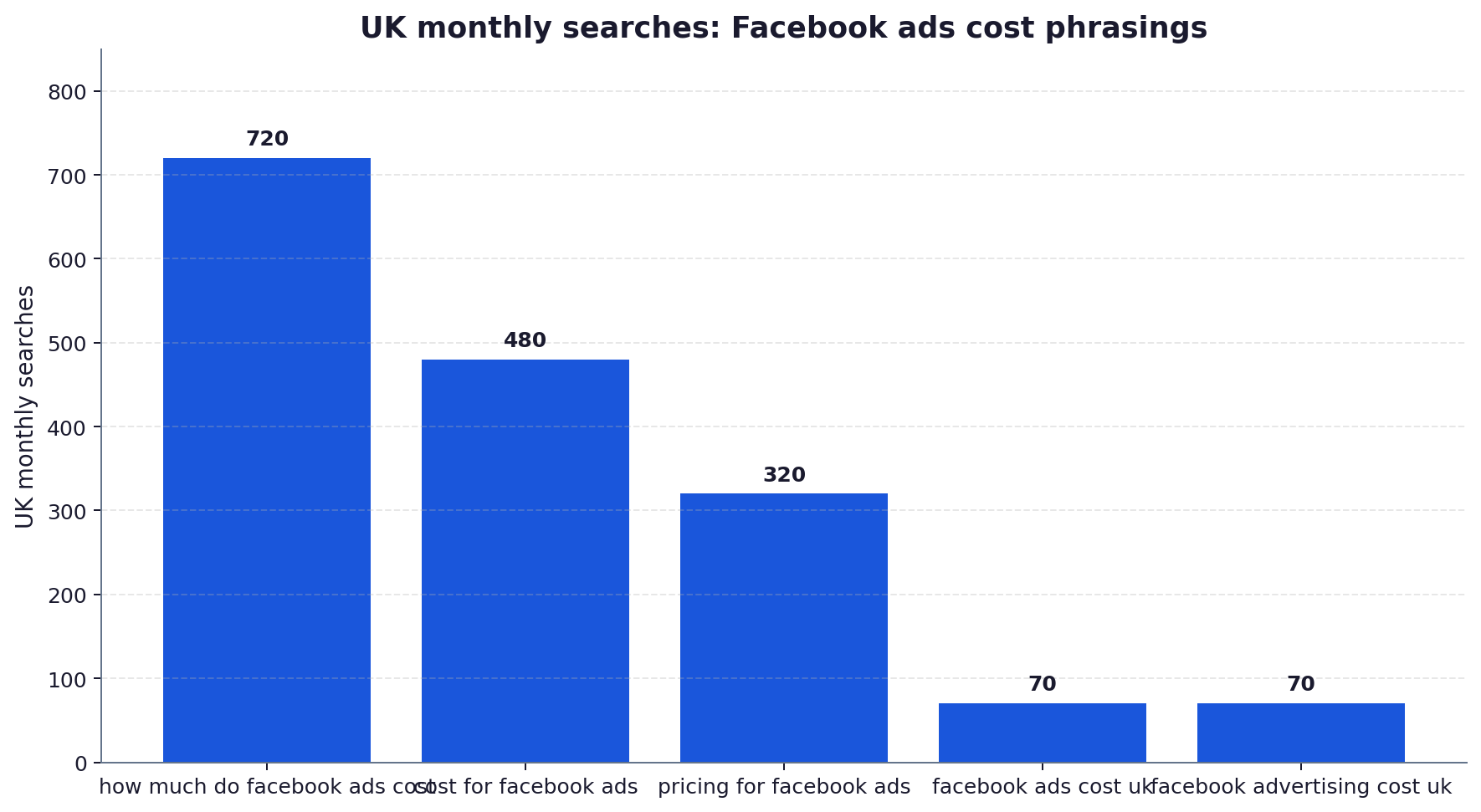
- 1,660 UK searches a month ask what Facebook ads cost; the head term “how much do facebook ads cost” carries 720 at keyword difficulty 7 (AiBoost keyword analysis of DataForSEO Google Ads data, August 2026).
- There is no fixed price for a Facebook ad. Meta’s documentation describes an auction where the winning ad has the highest total value: bid, estimated action rates and ad quality. Any flat CPM benchmark describes someone else’s auction.
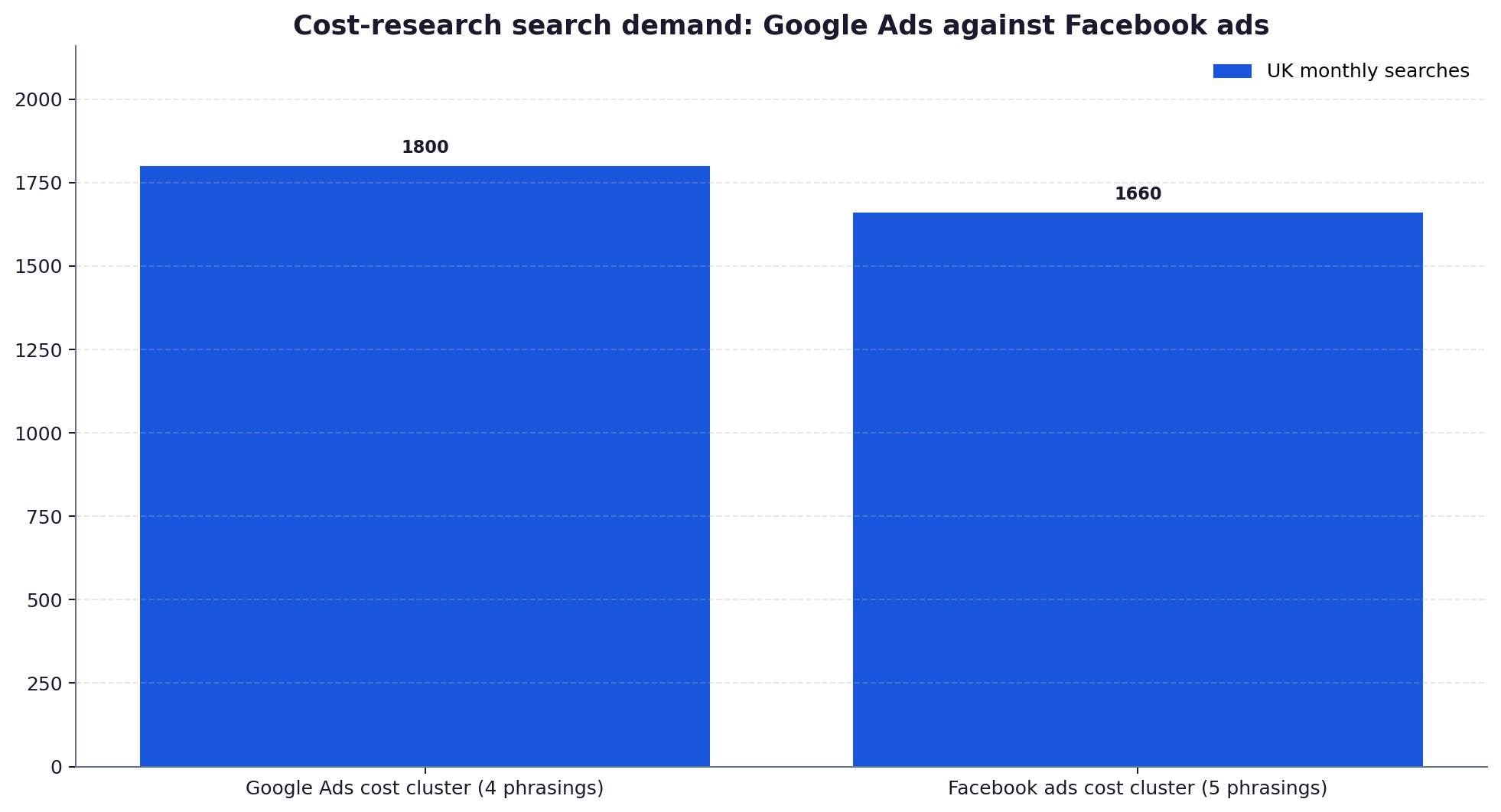
- The matching Google Ads cost-research cluster totals 1,800 monthly UK searches, 140 more than the Facebook cluster, roughly 8%. UK advertisers research the two platforms in near-equal volume.
- Advertisers pay Google £4.66 to £7.48 per click to intercept the UK-specific Facebook cost questions, questions Meta itself never answers with a number.
- £1,000 buys 37 Google search clicks at the law firm CPC of £26.91, 31 at construction’s £31.42 and 261 at the plumber’s £3.82. Judge a Meta budget against your vertical’s search click price, not a generic CPM table.
Key facts
- “how much do facebook ads cost” draws 720 UK searches a month at keyword difficulty 7 (AiBoost keyword analysis of DataForSEO Google Ads data, August 2026).
- The Facebook cost-research cluster totals roughly 1,660 UK monthly searches: 720 + 480 + 320 + 70 + 70 across five phrasings (DataForSEO, August 2026).
- “facebook advertising cost uk” costs advertisers £7.48 per Google click; “cost for facebook ads” £5.47; “facebook ads cost uk” £4.66 (DataForSEO, August 2026).
- The equivalent Google Ads cost cluster totals roughly 1,800 UK monthly searches: 1,000 + 390 + 320 + 90 (DataForSEO, August 2026).
- Meta Business Help documents the ad auction as ranking ads by total value: advertiser bid, estimated action rates and ad quality (Meta, 2026).
- UK service-sector Google CPCs in the same scan run from £3.82 (plumbers) to £86.44 (dental), a 22.6x spread (DataForSEO, August 2026).
- AiBoost has audited 250+ UK small businesses across search and paid channels.
What 1,660 monthly searches say about the question
Every month roughly 1,660 UK searches ask some version of the Facebook cost question. “How much do facebook ads cost” leads at 720 searches, followed by “cost for facebook ads” at 480 and “pricing for facebook ads” at 320. The UK-specific variants, “facebook ads cost uk” and “facebook advertising cost uk”, carry 70 each. The dominant phrasings are conversational questions, which tells you who is asking: owners and marketing managers at the start of a decision, not media buyers comparing rate cards. The same shape appears in the Google Ads cost data for UK SMEs: constant questions, no honest single-number answer.
The keyword difficulty of 7 on the head term is its own finding. Difficulty that low on a 720-volume commercial question means the pages ranking are weak, and tool vendors and agencies would rather buy the click than earn it. The click prices back that up: £5.47 for “cost for facebook ads” and £7.48 for “facebook advertising cost uk” is real money paid to intercept a cost question (AiBoost keyword analysis of DataForSEO Google Ads data, August 2026).
Why there is no fixed price for a Facebook ad
Meta does not publish a rate card because it does not sell inventory at fixed rates. Meta Business Help describes the mechanism plainly: when an impression becomes available, an auction runs among every ad targeting that person, and the ad with the highest total value wins. Total value combines the advertiser’s bid, the estimated action rate (Meta’s prediction of how likely this person is to take the action the campaign optimises for) and ad quality, which penalises clickbait traits.
Every input is specific to your account. Your audience changes the competition in the auction, your objective changes which action Meta predicts, your creative changes both the action estimate and the quality score. This is why we refuse to quote CPM or CPC benchmarks in client conversations: a benchmark averaged across industries and seasons describes nobody’s auction, and planning against it produces budgets that are confidently wrong. The number that matters is the one your own account produces in its first structured month.
The three levers Meta says decide your cost
Read as a practitioner, Meta’s three cost levers rank in a practical order. Creative quality comes first, because it feeds both the estimated action rate and the quality component, so a weak ad pays a penalty on every impression it wins. Audience definition comes second, because it decides which auctions you enter and how crowded they are. Bidding strategy comes last, because Meta’s delivery system already optimises spend within your budget.
The practical consequence is that Facebook ad costs are substantially self-inflicted or self-earned. Two UK firms in the same vertical, city and budget can see very different effective costs purely on creative standard and account structure. That is why cost complaints usually respond to an account review rather than a budget increase, a pattern we see repeatedly in paid ads audits across both Meta and Google accounts.
Google and Meta: cost research in near-equal volume
The comparison worth publishing is demand-side, built from measured data rather than invented benchmarks. The Google Ads cost-research cluster totals roughly 1,800 UK searches a month across four phrasings; the Facebook cluster totals roughly 1,660 across five. The gap is 140 searches, about 8%. UK businesses research the cost of the two platforms in near-equal volume, which undercuts the assumption that Google is the default first paid channel for SMEs.
Search interest is not spend share; it is research demand. But that demand is the top of the platform-choice funnel, and near-parity means the “which platform” decision is genuinely open for the average UK SME. How to measure paid outcomes as AI assistants absorb more of the discovery journey is covered in our piece on performance marketing metrics in the AI-traffic era.
Budget arithmetic without invented benchmarks
Think about a Meta budget using only measured numbers. The August 2026 DataForSEO scan prices Google search clicks in UK service verticals from £3.82 (plumbers) to £86.44 (dental), with law firms at £26.91, construction at £31.42 and “google ads agency” itself at £58.00. Those are declared-intent clicks, the honest benchmark for what qualified attention costs in your vertical.
The arithmetic is transparent. £1,000 of media buys 37 Google search clicks at the law firm CPC (1,000 divided by 26.91), 31 at the construction CPC and 261 at the plumber CPC. Meta sells targeted attention earlier in the journey, so its clicks generally price below the search benchmark and convert on a longer path. The correct question is not “what is a good CPM” but “does this account produce qualified enquiries at a better all-in cost than 37 search clicks per thousand pounds”. If yes, scale it. If no, the search benchmark wins the budget.
The 22.6x spread between plumber and dental clicks makes a second point: vertical economics dominate platform economics. Lifetime customer value is what makes a dental click worth £86, and that same value logic follows the advertiser onto Meta.
When Meta beats Google for a UK vertical
Meta wins when the audience is identifiable but not yet searching. Legal services show the pattern clearly: nobody searches for a personal injury solicitor before the injury, but the life circumstances that precede legal need are targetable. We unpack this in our analysis of Facebook advertising for legal services and how personal injury lawyers generate leads online. At a £26.91 search CPC, a Meta funnel that warms an audience before it searches does not need to be dramatically cheap to lower blended acquisition cost.
Construction is the second worked example. With Google clicks at £31.42, our UK construction Meta ads study found the visual nature of the work, before and after imagery, timelapses, local proof, gives Meta a creative advantage search text ads cannot match. The counter-case is equally clear: where search demand is cheap and specific, plumber clicks at £3.82, declared intent usually wins outright and Meta is a brand-building supplement at most.
Management fees and the media split
The second half of “what do Facebook ads cost” is what you pay a person or agency to run them, and this is where published pricing gets least honest. We will not quote industry-average fee percentages because the sample behind such figures is never disclosed. Structurally, management pricing takes three forms: flat monthly fees, percentage of ad spend, and performance-linked hybrids. Percentage models scale the fee with the media budget whether or not the workload scales. Flat fees are predictable, but check what is included, because creative production is the largest recurring workload in Meta accounts and is frequently scoped out.
Whatever the model, insist that media money and fee money stay visible as separate lines. An all-in monthly figure hides the only ratio that lets you judge value: how much of your budget reaches the auction.
Run the first month as paid research
Meta’s entry minimums are low, documented in Meta Business Help, so the barrier to starting is not cash, it is statistical honesty. A first month should be sized to produce enough conversion events for Meta’s delivery system to optimise against and enough data to judge cost per enquiry against your vertical’s search benchmark. Set up conversion measurement before the first pound is spent, and read results alongside SEO analytics in an AI world, because paid, organic and AI-driven traffic shifts now move the same enquiry numbers.
The auction model itself is spreading. Generative engines are beginning to test advertising in generative search results, and the same discipline, measured benchmarks over quoted averages, will apply there too. If you want the arithmetic run on your own numbers, talk to us and we will price the test month against your vertical’s real click costs.
How we compiled the demand data
The search demand figures for cost-related queries come from one AiBoost pull of DataForSEO’s Google Ads data in August 2026, UK location, English. The Google versus Meta comparison chart counts research demand for each platform’s cost queries from that same snapshot, so both bars share a method. Auction mechanics are described from Meta’s own business documentation rather than third-party benchmark round-ups.
Limitations
This article reports what UK businesses search for and what Meta’s documentation says drives price; it deliberately quotes no CPM or CPC benchmark for Meta because auction outcomes vary by audience, creative and season more than any published average survives. Google Ads volume banding applies to every demand figure, and one month’s snapshot cannot capture Q4 auction inflation, which is real and material.
Frequently asked questions
How much do Facebook ads cost in the UK in 2026?
There is no fixed price. Meta sells impressions through an auction, so cost depends on who you target, which action you optimise for and how your creative performs. You set a daily or lifetime budget and Meta will not exceed it. The honest published numbers are demand-side: 1,660 UK searches a month ask about Facebook ads cost, and advertisers pay Google £4.66 to £7.48 per click to intercept the UK-specific phrasings (DataForSEO, August 2026).
Why can nobody quote a fixed CPM or CPC for Facebook ads?
Because the price is set at auction each time an impression becomes available. Meta’s documentation describes the winning ad as the one with the highest total value: the advertiser’s bid, the estimated likelihood the viewer takes the optimised action, and ad quality. All three change with audience, season, objective and creative, so any published CPM benchmark describes someone else’s auction, not yours. We build cost expectations from your first month of structured data instead.
Are Facebook ads cheaper than Google Ads?
They price different moments. Google search clicks price declared intent and in some UK verticals cost serious money: £26.91 for law firm terms, £31.42 for construction and £58.00 for “google ads agency” itself (DataForSEO, August 2026). Meta reaches people before they search, so its clicks usually price lower but convert on a longer path. The test is arithmetic: if £1,000 buys 37 declared-intent Google clicks in your vertical, Meta earns its budget by beating that all-in cost.
Is there a minimum budget for Facebook ads?
Meta enforces low daily minimums that vary by currency and ad set type, documented in Meta Business Help, so entry cost is not the barrier. The real minimum is statistical: the budget has to generate enough conversion events for the delivery system to optimise against, and enough data to judge cost per enquiry. Three clicks prove nothing. We treat the first month as paid research and size it to reach a conclusion.
What decides how much I pay in the Meta auction?
Three inputs, per Meta’s documentation: your bid, the estimated action rate (how likely the person is to take the action you optimise for) and ad quality. In practice, audience choice, campaign objective and creative standard move costs more than bid adjustments. A poor ad shown to a broad audience pays a quality penalty on every impression it wins. Improving creative and tightening account structure is usually the cheapest cost reduction available.
When do Meta ads beat Google Ads for a UK business?
When the audience is identifiable but not yet searching. Legal services and construction are the worked examples in our published analyses: life-event or visual buying triggers give Meta’s targeting and creative formats an advantage search ads cannot match. At Google CPCs of £26.91 for law firms and £31.42 for construction (DataForSEO, August 2026), a Meta funnel that warms audiences before they search lowers blended acquisition cost. Where search demand is cheap and specific, declared intent usually wins.
Sources and references
- DataForSEO Google Ads keyword and CPC data. DataForSEO, 2026
- Meta Business Help Centre. Meta, 2026
- Google Ads Help. Google, 2026
Running Meta or Google ads without a benchmark means guessing. Send us your account and we will show you where the spend leaks and what qualified attention should cost in your vertical.
Change log
- 2026-08-10: Initial publication.