
TL;DR
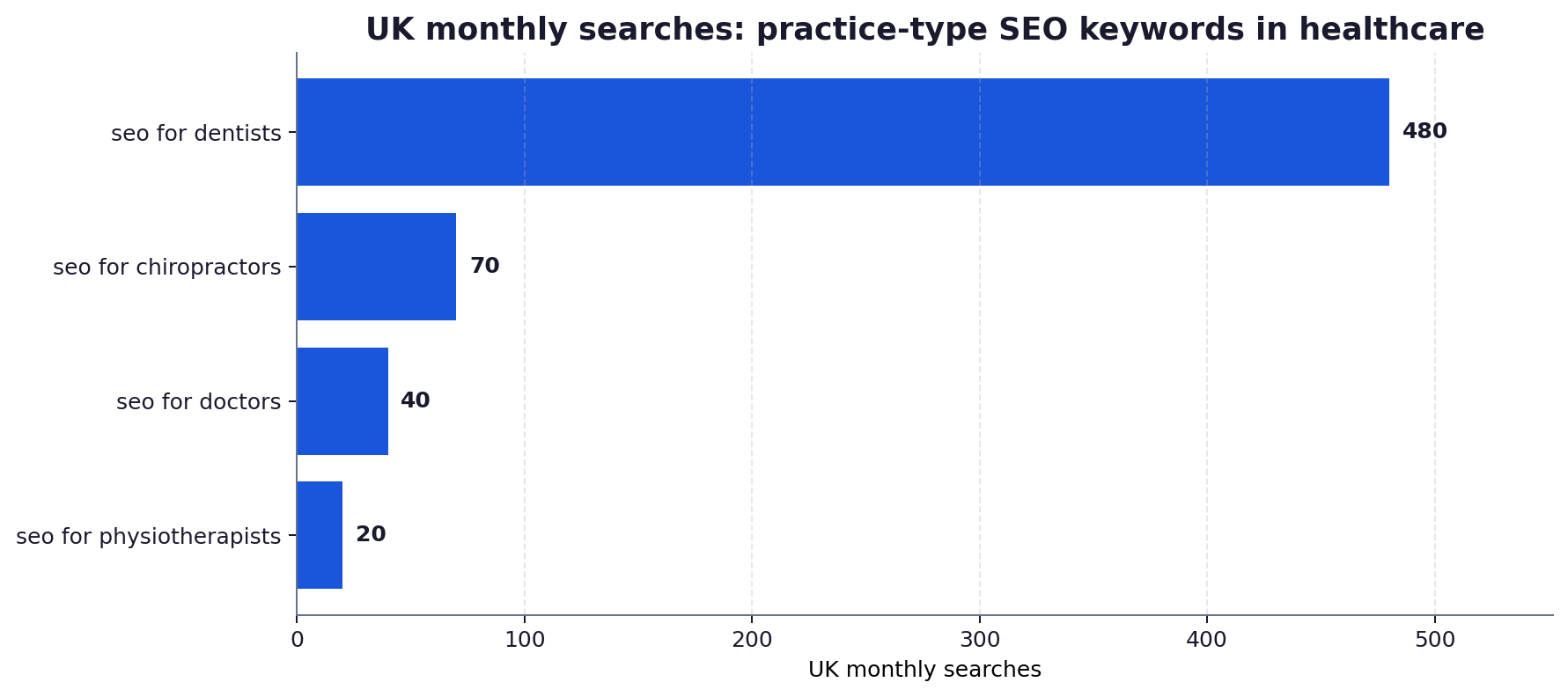
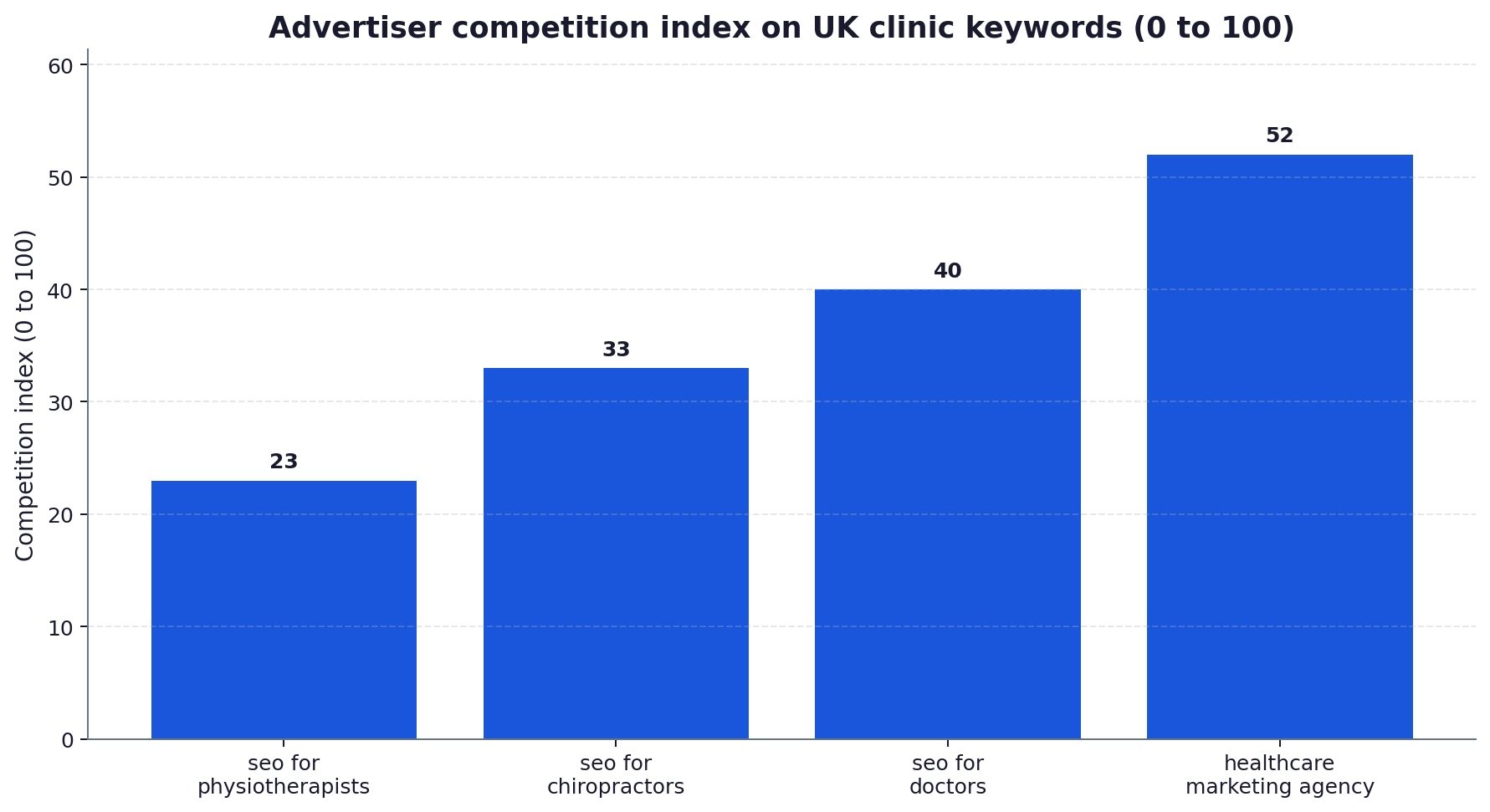
- seo for chiropractors draws 70 UK searches a month and seo for physiotherapists draws 20, both rated LOW competition, with competition indices of 33 and 23 (UK Google Ads pulls, 11 and 12 September 2026).
- These are small terms next to seo for dentists at 480. Small and uncontested is a different proposition from small and crowded, and for a single-site clinic it is the better one.
- The structural problem this fixes: one AiBoost post, local SEO for healthcare and private doctors, currently absorbs the whole clinic cluster on its own, holding queries like private clinic seo at position 46.7, seo for clinics at 63.3 and doctor seo services at 63.9 in Google Search Console. One page cannot be the best answer for three different practice types.
- The CAP Code, not your keyword tool, sets the boundary of a chiropractic content plan. The ASA accepts a defined list of conditions including general, acute and chronic backache and cervicogenic headache. Anything beyond that list needs clinical evidence before it can go on a page.
- “Chiropractor” is a protected title under section 32 of the Chiropractors Act 1994. “Physiotherapist” and “physical therapist” are both protected titles under HCPC regulation. Those registrations are entity signals, and most clinic sites bury them in a footer.
- Twelve months of data show demand for seo for chiropractors moving between 20 and 140 a month, so any single-month reading of this term is close to meaningless.
Key facts
- seo for chiropractors: 70 UK searches a month, LOW competition (index 33), top-of-page bids $3.08 to $12.28 (UK Google Ads pull via DataForSEO, 12 September 2026).
- seo for physiotherapists: 20 UK searches a month, LOW competition (index 23), no reported bid range.
- seo for doctors: 40 a month, MEDIUM competition (index 40). seo for dentists: 480 a month, MEDIUM (index 37).
- healthcare marketing agency: 720 a month, MEDIUM competition (index 52), reported CPC $14.93. The agency term is 10 times the size of the practice-type terms combined.
- Section 32 of the Chiropractors Act 1994 makes it an offence for an unregistered person to describe themselves “as a chiropractor, chiropractic practitioner, chiropractitioner, chiropractic physician, or any other kind of chiropractor”, expressly or by implication.
- The HCPC regulates 16 professions. For physiotherapy, both “Physiotherapist” and “Physical therapist” are protected titles in law.
Small demand, and why that is the point
Nobody should publish a physiotherapy SEO page expecting traffic at the scale of dentistry. The UK Google Ads data puts seo for chiropractors at 70 searches a month and seo for physiotherapists at 20, against 480 for seo for dentists. Those are long-tail numbers.
What makes them worth writing for is the competition index sitting behind them. Google rates seo for physiotherapists at 23 and seo for chiropractors at 33 on its 0 to 100 advertiser competition scale, both inside the LOW band, while healthcare marketing agency sits at 52. A small term nobody is contesting is reachable. A small term in a crowded auction is not. For a clinic with one site and a defined catchment, reachable beats large.
The twelve-month series adds a caution. seo for chiropractors moved between 20 and 140 searches a month over the year to August 2026, with the same volume appearing in February, March and September. A seven-fold swing between the quietest and busiest months means no single monthly reading tells you anything. Plan against the annual shape, not the current number.
Why one page cannot serve physios, chiropractors and private GPs
AiBoost has a healthcare post that has been doing too much work. Local SEO for healthcare and private doctors currently absorbs the entire clinic cluster on its own. In Google Search Console it collects private clinic seo on 139 impressions at an average position of 46.7, seo for clinics on 149 impressions at 63.3, doctor seo services on 143 at 63.9, and roughly twenty further clinic and doctor queries at similar depths.
Read those positions carefully. They are not near misses. A page sitting at position 46 to 64 across twenty related queries is a page that Google considers topically relevant to all of them and authoritative for none. That is the classic signature of one URL trying to be the answer for several distinct intents at once.
The fix is not to rewrite the page harder. It is to give each practice type its own page and let the original narrow to what it does best, which for that post is private GP practice. A physiotherapist searching for help with their clinic’s visibility and a private GP doing the same have different regulators, different referral patterns, different local competitors and different patient questions. A single page written to satisfy both satisfies neither, and this post exists to take the physiotherapy and chiropractic half of that load. Our wider healthcare marketing agency work follows the same principle: build per practice type, not per sector.
The ASA condition list is the boundary of a chiropractic content plan
This is the part of clinic SEO that has no equivalent in most industries. For chiropractic in particular, what a page is allowed to claim is decided by the CAP Code and by the ASA’s 2017 evidence review, not by what patients search for.
CAP’s advice on advertising chiropractic lists the conditions the ASA and CAP accept chiropractors may claim to treat. They include “Ankle sprain (short term management)”, “Headache arising from the neck (cervicogenic)”, “General, acute & chronic backache, back pain” and “Sciatica (General references, as opposed to pain reduction claims)”. The advice then states that “any conditions that are not reflected above or which go beyond the specific conditions as described above would need to be supported by robust clinical evidence to support their claims”.
There is a further restriction that clinics routinely miss. On babies, children and pregnant women, CAP advises that “references to treatment for symptoms and conditions that are likely to be understood to be specific to babies, children or pregnant women are unlikely to be acceptable unless the marketer holds a robust body of evidence”. Colic and infant sleep pages are a common source of complaints for exactly this reason.
The practical consequence for SEO is direct. A keyword tool will happily hand you a list of condition searches with real volume behind them. Some of those conditions cannot lawfully become pages on a chiropractic site. Run the condition list past the CAP advice before it becomes a content calendar, because the cost of getting this wrong is an ASA ruling published under your clinic’s name, which then becomes a search result of its own.
Physiotherapy sits differently. Physiotherapists are not subject to a published condition list of this kind, so the constraint is the general CAP requirement that claims be substantiated. That difference is itself a reason the two practice types need separate pages rather than one shared clinic page.
Protected titles are entity signals, and clinics bury them
Both professions are regulated, and both registrations are the kind of verifiable, named detail that search engines and AI assistants use to work out what an organisation is.
For chiropractic the protection is statutory. Section 32 of the Chiropractors Act 1994 makes it an offence, punishable by a fine up to level five on the standard scale, for an unregistered person to describe themselves as a chiropractor, chiropractic practitioner, chiropractitioner, chiropractic physician or any other kind of chiropractor, whether expressly or by implication. Registration sits with the General Chiropractic Council.
For physiotherapy, the Health and Care Professions Council regulates 16 professions, and both “Physiotherapist” and “Physical therapist” are protected titles that only registrants may use.
Most clinic websites treat this as small print. A registration number appears once in a footer, or not at all. That is a wasted signal. Put the practitioner’s registration number, regulator and qualification on the practitioner’s own page, in visible text rather than an image, alongside the conditions they treat and the clinic’s address. That is the same evidence structure a search engine uses to connect a named person to an organisation to a place, and it is the structure that generative engine optimisation depends on, because assistants asked to recommend a clinic are looking for exactly these verifiable attributes.
Local SEO mechanics for a single-site clinic
Most physiotherapy and chiropractic demand is local and urgent. Somebody with back pain searches for a clinic near them and books within days. That makes the map pack, not the blue links, the main battleground, and it puts three things ahead of everything else.
One page per condition you actually treat, per location you actually serve. Not a single services page listing twelve conditions. A clinic with two sites should have two location pages with genuinely different content, not the same page with the town name swapped.
Practitioner pages as first-class content. Patients choose a person as much as a clinic. Each practitioner needs a page with their registration, their qualification, what they treat and how to book with them specifically.
Consistent details everywhere. Name, address, phone and opening hours identical across the site, the Google Business Profile and every directory. Assistants and search engines both treat inconsistency as uncertainty, which is one of the themes in our piece on local SEO in the age of AI assistants.
The economics work for a clinic because the catchment is small. You are not trying to rank nationally. You are trying to be the obvious answer within a few miles, and the number of clinics contesting that is usually in single figures. That is the situation where SEO is worth it for a small business, because the cost of winning the position is low relative to what a course of treatment is worth.
When a patient asks an assistant for a physio
A growing share of local discovery starts with a question to an assistant rather than a search box. “Who is a good physio near me for a running injury” is a prompt, and the answer is assembled from whatever the engine can verify about the clinics in that area.
We do not publish AI citation figures for physiotherapy or chiropractic, because we have not run a citation panel for either profession and will not present an estimate as a measurement. What our cross-sector benchmark of 50 UK service firms did show is which attributes travel: named people, dated content, consistent descriptions across the site and third-party sources, and a clear statement of what the organisation does and where. Clinics that already meet their regulator’s disclosure requirements are closer to this than they realise, which is why the registration detail belongs on the page rather than in the footer.
The wider shift is covered in our piece on how AI search is changing professional services marketing, and it applies to a two-practitioner clinic as much as to a national brand. For clinics weighing paid channels alongside this, our analyses of private clinics and Google Ads and private patient acquisition through Facebook ads cover the paid half, and growing a private clinic with digital marketing covers sequencing. The organic comparison point for a larger practice type is our UK dental SEO study, and our general SEO services page sets out how we work.
How we compiled these numbers
Search volumes, competition indices and top-of-page bid estimates come from UK Google Ads search-volume pulls run through DataForSEO on 11 and 12 September 2026, location United Kingdom, language English, saved in Prism/data/. Clinic terms were captured in the same two sessions as 50-plus other service verticals, so the comparison between practice types reads across one consistent snapshot. Twelve-month series come from the same response objects. The position and impression figures for post 10682 come from Google Search Console for aiboost.co.uk covering 14 August to 11 September 2026. Regulatory statements were checked against the primary source and quoted rather than paraphrased: the Chiropractors Act 1994 on legislation.gov.uk, the HCPC’s published list of regulated professions and protected titles, and CAP’s published advice on advertising chiropractic.
Limitations and caveats
Google Ads search volumes are rounded buckets rather than counts, and they measure advertiser demand, not organic ranking difficulty. A LOW competition label means few advertisers bidding and says nothing about how contested the organic first page is. At volumes of 20 to 70 a month the rounding is proportionally large, so treat these figures as order-of-magnitude rather than precise. Across the 60 keywords in these pulls carrying a twelve-month series, 39 show a September 2025 reading at least three times the median of their other eleven months, which spans unrelated verticals and looks like a reporting artefact rather than a real event; annual averages in this dataset therefore run high. Cost figures are reported by the source in US dollars and we have not converted them. We did not run an AI citation panel for either profession and publish no citation statistics here. Nothing in this post is regulatory advice; clinics should read the CAP advice, their regulator’s standards and their indemnity provider’s guidance, and take their own advice before publishing condition claims.
Frequently asked questions
How much search demand is there for chiropractic and physiotherapy SEO in the UK?
seo for chiropractors records 70 UK searches a month and seo for physiotherapists records 20, both rated LOW competition with indices of 33 and 23 (September 2026 UK Google Ads pulls). For comparison, seo for dentists records 480. These are long-tail terms, and the case for targeting them is that almost nobody is contesting them, not that the volume is large. For a clinic serving one catchment, an uncontested small term is worth more than a contested large one.
Which conditions can a chiropractic website claim to treat?
CAP’s published advice lists the conditions the ASA and CAP accept, including short-term management of ankle sprain, headache arising from the neck, general acute and chronic backache and back pain, and general references to sciatica. Claims beyond that list “would need to be supported by robust clinical evidence”. There is an additional restriction on babies, children and pregnant women, where treatment claims for symptoms specific to those groups are unlikely to be acceptable without a body of evidence. Check any condition against the CAP advice before it becomes a page.
Do the same advertising rules apply to physiotherapists?
Not in the same form. Physiotherapy is not subject to a published accepted-conditions list of the kind that applies to chiropractic, so the governing requirement is the general CAP obligation to hold evidence for claims made. That difference is one practical reason to write separate pages for the two professions rather than a shared clinic page: the content rules genuinely differ, and a page written to satisfy both ends up vaguer than either needs.
Why split practice types into separate pages instead of one clinic page?
Because a single page competing for several intents tends to rank for all of them badly. AiBoost’s own healthcare post demonstrates it: covering the whole cluster alone, it holds private clinic seo at position 46.7, seo for clinics at 63.3 and doctor seo services at 63.9, plus around twenty more clinic queries at similar depths. Positions in the 40s and 60s across twenty related queries indicate topical relevance without authority on any one of them. Separate pages per practice type give each intent a page that can be the best answer.
Is “chiropractor” a protected title in the UK?
Yes. Section 32 of the Chiropractors Act 1994 makes it an offence for an unregistered person to describe themselves as a chiropractor, chiropractic practitioner, chiropractitioner, chiropractic physician or any other kind of chiropractor, whether expressly or by implication, with a fine up to level five on the standard scale on summary conviction. Registration is with the General Chiropractic Council. For physiotherapy, both “Physiotherapist” and “Physical therapist” are protected titles under HCPC regulation.
What matters most for a clinic with one location?
Three things, in order. A page for each condition you genuinely treat and each location you genuinely serve, rather than one services page listing everything. A proper page for each practitioner, carrying their regulator, registration number and qualification in visible text, because patients choose a person. And identical name, address, phone and opening hours across your site, your Google Business Profile and every directory listing, because inconsistency reads as uncertainty to both search engines and AI assistants.
Should a clinic invest in SEO or paid ads first?
For a single-site clinic with a defined catchment, organic and map visibility usually pays back longer than paid, because the competitor count within a few miles is small and the position, once won, keeps working. Paid search earns its place when you need appointments this month, when a new site has no authority yet, or when a specific treatment has a seasonal window. The two channels also share the same foundations: the landing page, the practitioner information and the booking path have to work before either channel is worth funding.
Sources and references
- Advertising advice: Health, chiropractic. Advertising Standards Authority and CAP, 2026
- Chiropractors Act 1994, section 32: protection of title. legislation.gov.uk, 1994
- The professions we regulate and protected titles. Health and Care Professions Council, 2026
- General Chiropractic Council. General Chiropractic Council, 2026
- UK Google Ads search volume data, September 2026 pulls. DataForSEO, 2026
If you run a physiotherapy or chiropractic clinic and want to know what search engines and AI assistants currently say about it, our free GEO audit tests that directly and reports which competitors get named instead.
Change log
- 2026-09-30: Initial publication.