TL;DR
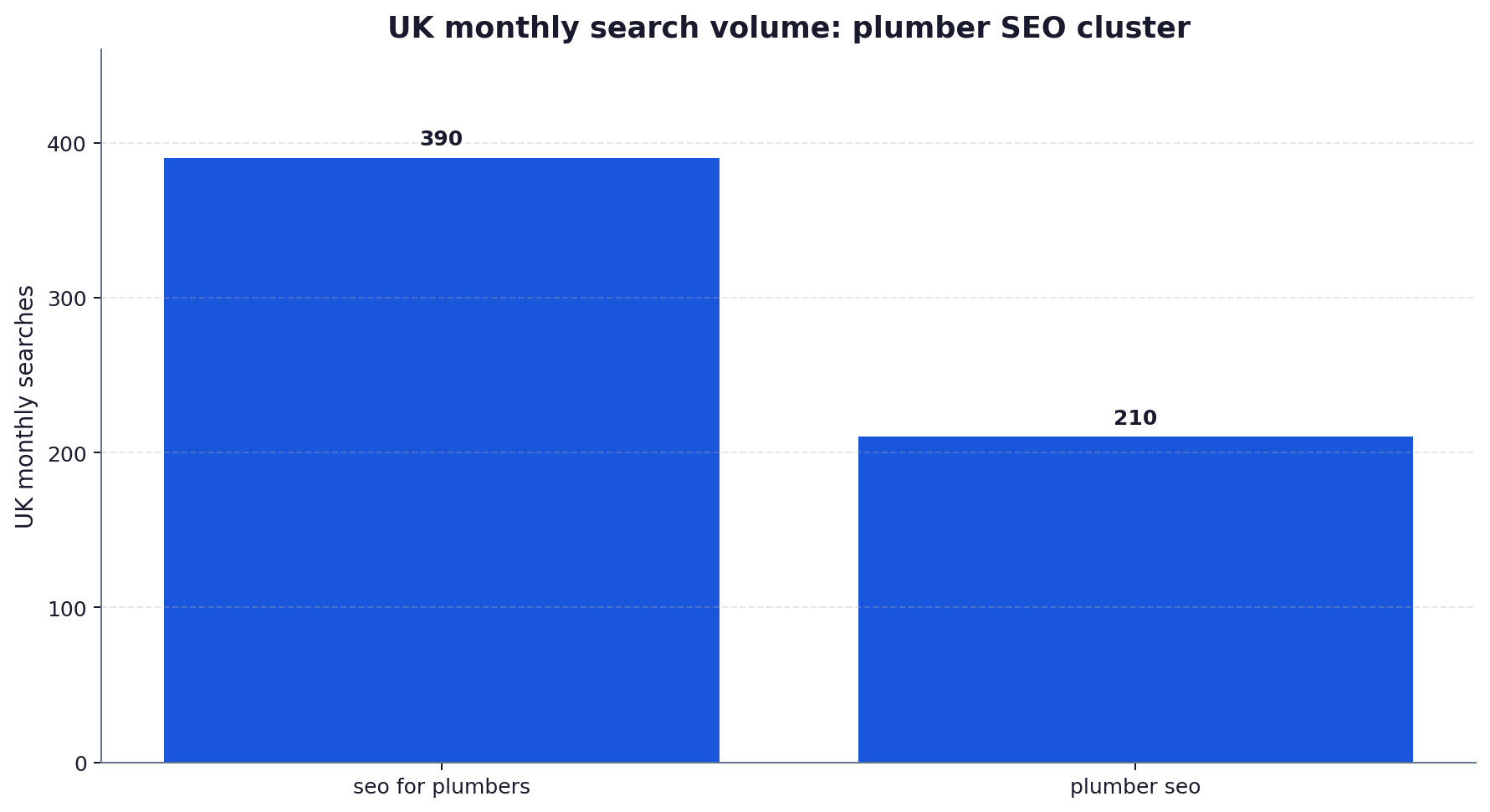
- seo for plumbers” draws 390 UK searches a month and “plumber seo” another 210, a cluster of roughly 600 monthly searches (AiBoost keyword analysis of DataForSEO Google Ads data, August 2026).
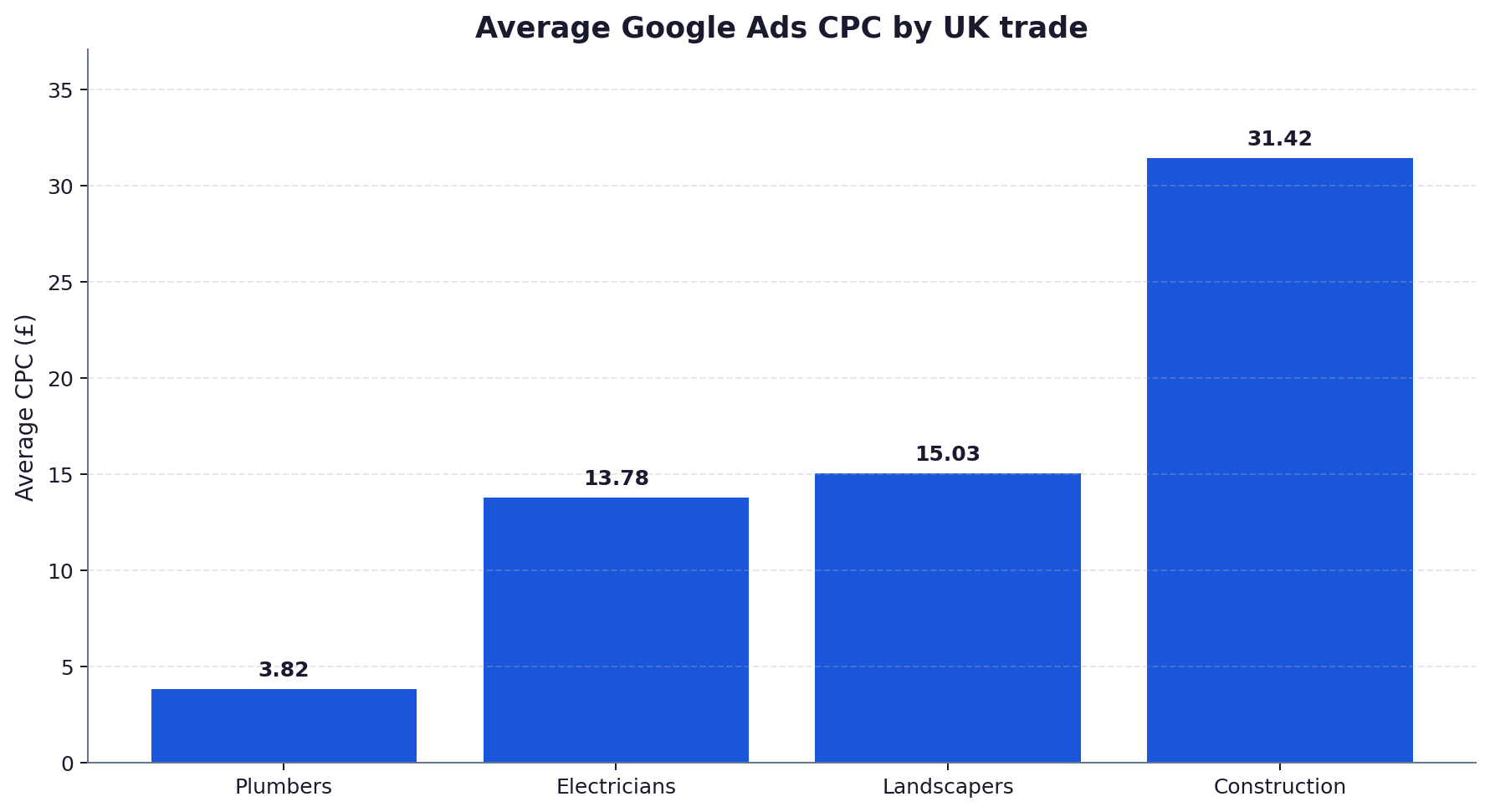
- A plumber SEO click costs £3.82 on Google Ads, the cheapest trade we measured: electricians pay £13.78, landscapers £15.03 and construction firms £31.42.
- Dental SEO clicks cost £86.44, about 23 times the plumber price, which tells you the plumbing ad market is still uncrowded rather than unprofitable.
- £1,000 of ad budget buys about 261 plumber SEO clicks at £3.82. The same £1,000 buys fewer than 12 dental clicks.
- Competition across the 600-search cluster is rated LOW, so a one-van business can still win its postcode without an agency-scale budget.
- AiBoost has audited 250+ UK small businesses. For trades the pattern holds: local pack first, service pages second, AI visibility third.
Key facts
- “seo for plumbers”: 390 UK monthly searches, £3.82 CPC, LOW competition (AiBoost keyword analysis of DataForSEO Google Ads data, August 2026).
- “plumber seo”: 210 UK monthly searches in the same August 2026 DataForSEO dataset.
- Combined plumber SEO cluster: roughly 600 UK searches a month (DataForSEO, 2026).
- Trades CPC ladder: plumbers £3.82, electricians £13.78, landscapers £15.03, construction £31.42 (DataForSEO, August 2026).
- Dental SEO is the most expensive vertical click in AiBoost’s 30-vertical August 2026 scan at £86.44.
- AiBoost has audited 250+ UK small businesses through its free GEO audit and SEO review work (AiBoost, 2026).
What 600 monthly searches say about the plumber SEO market
The demand side of this market is easy to state. In AiBoost’s keyword analysis of DataForSEO Google Ads data from August 2026, “seo for plumbers” records 390 UK searches a month and “plumber seo” records 210. Together that is a cluster of roughly 600 monthly searches from plumbing firms actively researching search marketing. Both phrasings carry a LOW competition rating, which is unusual for a service keyword with real volume and a sign that suppliers have not yet crowded in.
“seo for plumbers” reads as an owner describing their own trade; “plumber seo” reads as a comparison query typed mid-research. Either way, around 600 firms a month are asking the question this article answers, and most of their competitors are not. That gap is the entire opportunity, and it is the same gap we examine in our piece on whether SEO is worth it for small businesses.
Emergency intent and planned work are two different markets
Plumbing demand splits into two intents that behave nothing alike. Emergency intent is a burst pipe at 11pm: the searcher wants a phone number, a response time and proof you cover their postcode, and they will call the first credible result. Planned work is a bathroom refit or a boiler replacement researched over weeks, where the searcher compares portfolios, reviews and quotes before contacting anyone.
The practical consequence is that one generic “services” page serves neither intent well. Emergency call-out deserves its own page with the phone number at the top, the response promise stated plainly and the coverage area named. Planned work deserves pages built for comparison: photographs of finished jobs, price guidance where you can give it, and reviews. Separate the two and each page matches one intent instead of diluting both.
Why a plumber click costs £3.82 when a dental click costs £86.44
The advertising market prices a click against the value of the job behind it and the number of bidders chasing it. Plumbing sits at the bottom of the trades ladder at £3.82. Electricians pay £13.78, about 3.6 times more, reflecting rewiring and EV-charger jobs with higher invoices. Landscapers pay £15.03. Construction companies pay £31.42, because a single commercial contract can carry a five or six figure value. Dental, the most expensive vertical in our 30-vertical August 2026 scan, reaches £86.44 on the strength of high lifetime patient values.
A cheap click is not a verdict on the plumbing trade. It is a measure of how few plumbing firms are bidding. For an owner with a limited budget, £3.82 means visibility is inexpensive to buy, and the same low competition makes it comparatively inexpensive to earn organically.
The local pack decides who gets the emergency call
For trades, the map results at the top of a local search carry the decision. A homeowner with water coming through the ceiling picks from the three businesses in the local pack, reads the star ratings, and calls. Few emergency searchers scroll further, and almost none reach page two.
The inputs to local pack placement are mundane and controllable: a complete Google Business Profile with accurate categories, service areas that match where you actually work, a steady flow of reviews with replies, and a website that repeats the same name, address and phone details the profile carries. None of this requires an agency. The map surface is also changing as assistants take over more local queries, a shift we track in Local SEO in the Age of AI Assistants.
Budget arithmetic for a one-van business
The £3.82 click makes plumbing one of the few markets where a very small paid budget produces a meaningful sample. £500 a month buys about 130 clicks at the measured CPC. £1,000 buys about 261. One month of that against an emergency call-out page tells you your real enquiry rate and cost per job before any organic campaign has moved. For contrast, the same £1,000 buys fewer than 12 clicks in the dental market at £86.44.
The honest way to read this arithmetic is as a sequencing argument. Paid clicks buy data and fill the diary now. Organic work, of the kind we set out on our SEO services page, compounds over months and eventually makes each enquiry cheaper than any auction can. At plumbing’s click prices you can afford to run both, which is rarely true in the £30-plus verticals.
Doing it yourself against hiring an agency
A plumbing firm can do the highest-value work without paying anyone. Claiming and completing the Google Business Profile, asking every satisfied customer for a review, naming your towns on your pages and keeping hours current are evening jobs, and they drive most local pack movement. Any agency that charges a retainer for only those tasks is overcharging.
Where an agency earns its fee is the repetitive and technical layer: building a page for each service in each area without producing thin duplicates, fixing site speed on a template that fights back, adding structured data, keeping content current on the cadence we set out in how often you should update content, and measuring which pages actually produce calls. The deciding factor for a one-van business is rarely capability. It is hours in the week.
What happens when a homeowner asks ChatGPT for a plumber
A growing share of local discovery now starts as a conversation: “find me an emergency plumber in Leeds” typed into ChatGPT, Perplexity or Gemini. The assistant answers from what it knows about businesses in that area and, increasingly, from a live web search it runs on the spot. It tends to name firms whose details are consistent everywhere they appear: a complete business profile, directory listings that agree with each other, reviews, and a crawlable website that states plainly what the firm does and where.
We do not publish citation percentages for this behaviour because assistants change too often for a fixed number to stay honest. What we can do is test it. AiBoost’s free GEO audit runs a panel of awareness, consideration and decision prompts against the main assistants and records whether your firm is mentioned, and our GEO Pulse tracker repeats the exercise weekly for clients. Our 50-firm UK service benchmark and our review of how AI search is changing professional services marketing show the same pattern across sectors: most small firms are invisible to assistants, and the fixes belong to the same discipline we describe on our generative engine optimisation page.
Gas Safe, reviews and the website behind them
Trust signals close plumbing enquiries, and for gas work the first one is regulatory. Displaying your registration and linking it to the Gas Safe Register gives both a nervous homeowner and a cautious AI assistant a verifiable fact to anchor on. Reviews that name a town and a job type do more work than star counts alone, because they read as evidence rather than decoration.
All of it lives or dies on the website. A site that loads slowly on a phone, hides the phone number or describes services in vague trade language wastes every click the search work wins. If yours was built years ago and fights every change, our websites team builds fast, plainly structured sites designed to convert exactly this kind of local, urgent traffic.
How we compiled the numbers
Demand and cost figures come from a single AiBoost pull of DataForSEO’s Google Ads data in August 2026, UK location, English, captured in one session across 30 service verticals. That shared snapshot is what lets a plumber’s £3.82 click sit directly against dental’s £86.44 as a like-for-like reading. Cluster totals sum the phrasings Google reports separately.
Limitations
Google’s volume bands and close-variant grouping make the 390 and 210 figures bands rather than counts, and advertiser CPC measures bidding pressure rather than what an emergency call-out is worth to a firm. August is not a representative month for boiler work; winter demand looks different and the article flags rather than quantifies that swing. Conversion rates from local pack visibility are discussed qualitatively only.
Frequently asked questions
Why are plumber SEO clicks so cheap compared with other trades?
The ad market prices a click against the value of the job behind it and the number of bidders competing for it. Plumbing has thousands of small local firms, most spending little or nothing on ads, so auction pressure stays low and the measured cost per click sits at £3.82. Construction firms chase contracts worth far more, which supports a £31.42 click, and dental practices pursue high lifetime-value patients, which supports £86.44. A cheap click is not a weak market. It is a signal that visibility in plumbing is still inexpensive to buy and, by extension, inexpensive to earn organically.
How many people search for plumber SEO services in the UK?
AiBoost’s keyword analysis of DataForSEO Google Ads data from August 2026 measured 390 UK searches a month for “seo for plumbers” and 210 for “plumber seo”, a combined cluster of roughly 600 monthly searches. That figure describes plumbers researching SEO as a service, not homeowners searching for plumbers, which is a far larger pool spread across thousands of local and emergency phrasings. The 600 figure matters because it shows a meaningful number of plumbing firms shopping for search help each month, while LOW competition ratings across the cluster show most of the industry has not yet moved.
Should a plumber do SEO themselves or hire an agency?
Start with the jobs you can do in an evening: claim and complete the Google Business Profile, gather reviews after every job, list accurate services and service areas, and keep opening hours current. Those actions drive most local pack movement and cost nothing but time. An agency earns its fee when the work turns technical or repetitive, such as building service-by-area pages, fixing site speed, adding structured data and measuring which pages produce calls. At £3.82 a click, paid ads are also a reasonable stopgap while organic work matures. The honest deciding factor is workload, since a one-van business rarely has spare hours in the week.
What should a plumbing website include for local SEO?
One page per core service, written in plain language, with the towns or postcodes you cover named in headings and body text. Emergency call-out deserves its own page because the intent and urgency differ from planned bathroom or boiler work. Add your Gas Safe registration where relevant, photographs of real jobs, and reviews that mention locations. Technically, the site needs to load fast on a phone, present a tappable phone number, and carry LocalBusiness structured data so search engines and AI assistants can read your services and trading area without guessing.
Can ChatGPT recommend my plumbing business?
AI assistants answer requests like “find me a plumber near me” by drawing on what they know about businesses in an area and, increasingly, by running live web searches. If your business has a complete Google Business Profile, consistent name and address details across directories, reviews, and a crawlable website that states plainly what you do and where, you are eligible to appear. If those signals are thin, the assistant recommends someone else. AiBoost’s free GEO audit tests a panel of local prompts against the main assistants and records whether your firm is mentioned, which makes the gap measurable rather than hypothetical.
How long does SEO take to work for a plumbing business?
Local pack improvements from a completed Google Business Profile and a steady flow of reviews tend to appear faster than sitewide organic rankings, and paid clicks at £3.82 can fill the diary from day one while the slower work compounds. Beyond that, honest answers are ranges rather than promises, because timelines depend on your starting point, your review base and how many competitors in your postcode are doing the same work. The LOW competition rating across the plumber SEO cluster is the encouraging part, since it means the effort required to stand out is lower than in the dental, legal or construction markets.
Sources and references
- Google Ads search volume and CPC data. DataForSEO, 2026
- Gas Safe Register. Gas Safe Register, 2026
- Google Ads Help. Google, 2026
- Google Search Central documentation. Google, 2026
Get this analysis run on your own postcode, services and competitors instead of national averages. We will map the queries your next customers actually type and price the work honestly.
Change log
- 2026-08-10: Initial publication.