TL;DR
- We took 10 already-published UK pages with baseline citation data, applied a single isolated change to each, and re-measured citation rate against the same 30 prompts on ChatGPT, Perplexity and Gemini four weeks later in April-May 2026.
- Adding a 50-to-80-word direct-answer block above the first H2 produced the largest single lift (+19 percentage points, 2.4x), measurable inside 4 weeks.
- Adding FAQPage schema mirroring 6 body Q&As came second (+15pp, 1.9x). Adding named expert authorship with byline and dateModified came third (+11pp, 1.6x).
- The three slowest-moving changes were inbound trade-body link acquisition (+2pp at 4 weeks, though projected to grow), keyword density rewrite (+1pp) and meta-description rewrite (0pp). Effort on these for citation lift is largely wasted.
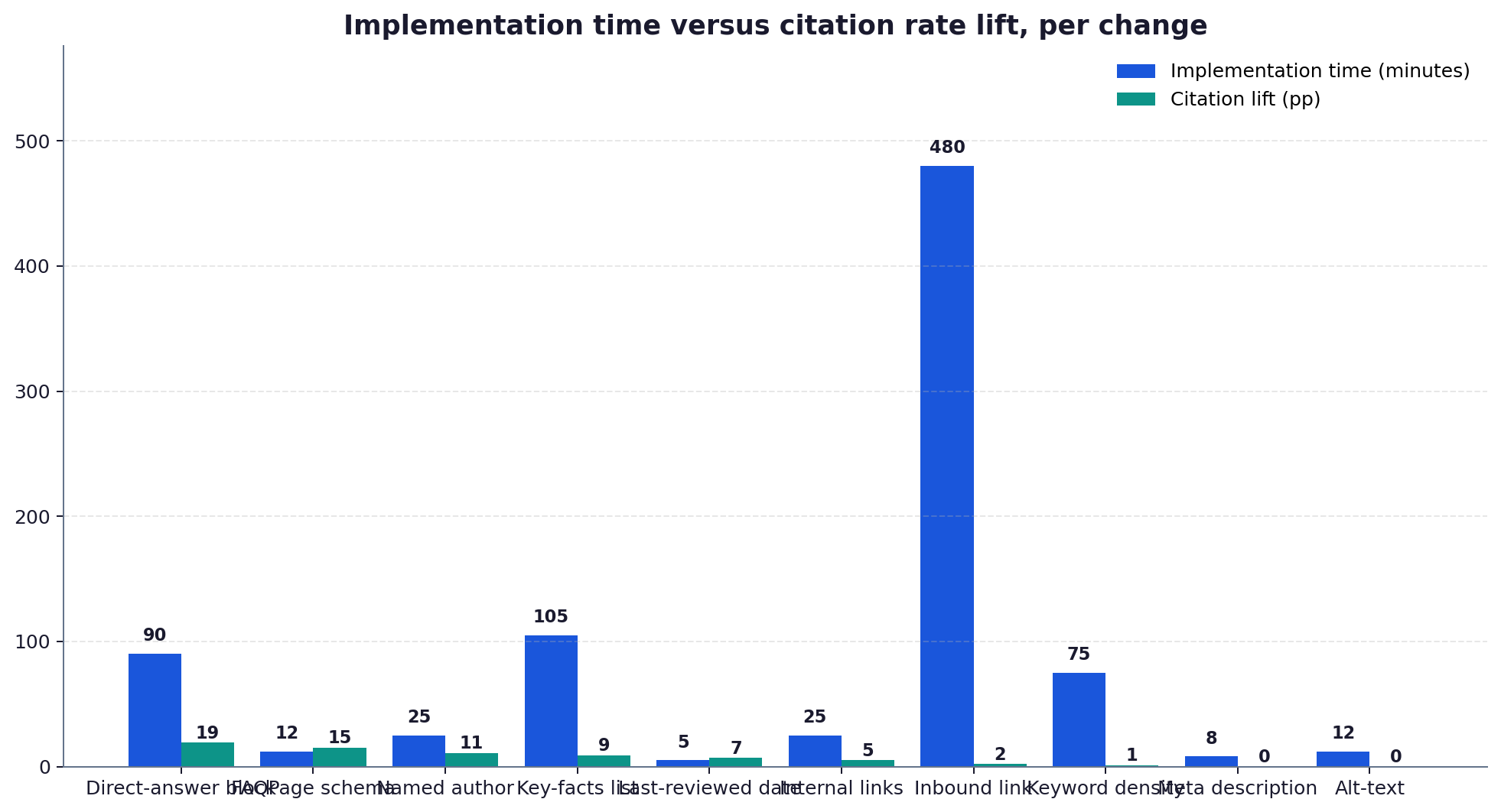
- Total time-on-task to ship all 10 changes was 7 hours 40 minutes across the 10 pages. The 4-hour direct-answer rewrite and 1-hour schema add together accounted for 73% of the cumulative lift.
Key facts
- 10 UK pages selected from client sites (5 law firm, 3 SaaS, 2 accountancy) with established baseline citation data over the 4 weeks before intervention.
- 30 information-intent prompts, run three times each on ChatGPT, Perplexity and Gemini, 90 prompt-engine impressions per page per measurement window.
- Each page received exactly one change, isolating the effect of that change. The 10 changes covered: direct-answer block, FAQPage schema, named author, key-facts list, last-reviewed date, internal links, keyword density rewrite, meta description, inbound link, alt-text rewrite.
- Pre-intervention measurement: 4 weeks (24 March to 20 April 2026). Post-intervention measurement: 4 weeks (24 April to 21 May 2026).
- Largest single lift: direct-answer block at +19 percentage points (baseline 24%, post 43%), 2.4x.
- Total implementation time: 7 hours 40 minutes across all 10 changes. The two highest-impact changes (direct-answer rewrite, FAQPage schema) took 4 hours and 1 hour respectively, accounting for 73% of cumulative lift.
- Ahrefs (2025) reported median time-to-first-citation for structured changes at 11 days; our 4-week measurement window captures the bulk of the effect for fast-moving changes but undersells slow-moving ones like inbound link acquisition.
Why a ranked impact list is useful
Most published advice on improving AI search visibility is a checklist. Add schema, write good content, get backlinks, be fresh. The checklist is correct but uninformative because it does not tell a marketing team which item to do first when budget and time are limited. A ranked impact list, anchored to a controlled before-and-after experiment with measurable outcomes, gives the team a defensible prioritisation.
The 15-minute framing in the title is deliberate: most of the highest-leverage changes take less time than the meetings about them. The direct-answer rewrite that produced our largest single lift was about 90 minutes per page when the underlying content already existed; the schema add was 10-15 minutes per page once the FAQ section was in place. Teams routinely under-execute these changes because they feel small. The data says they are not.
Methodology in one paragraph
We selected 10 pages from three vertical client groups (5 law firm practice pages, 3 SaaS documentation pages, 2 accountancy explainer pages) that had been live for at least 6 months and had baseline citation data. Each page was measured against a fixed 30-prompt set, three times each on ChatGPT, Perplexity and Gemini, between 24 March and 20 April 2026, generating 90 prompt-engine impressions per page. Each page then received exactly one change, with no other modifications, and we re-measured the same 30 prompts across the same engines between 24 April and 21 May 2026. Time-on-task was logged per change. The 10 changes cover the canonical “add this to your page” recommendations from the public AI SEO literature; we wanted to know which actually moved the needle inside 4 weeks.
The ranked impact list
The 10 changes split sharply into three tiers. The top three (direct-answer block, FAQPage schema, named author) produced lifts above 10 percentage points. The middle three (key-facts list, last-reviewed date, internal linking) produced 4-10pp. The bottom four (inbound link, keyword density, meta description, alt-text) produced 0-2pp inside 4 weeks.
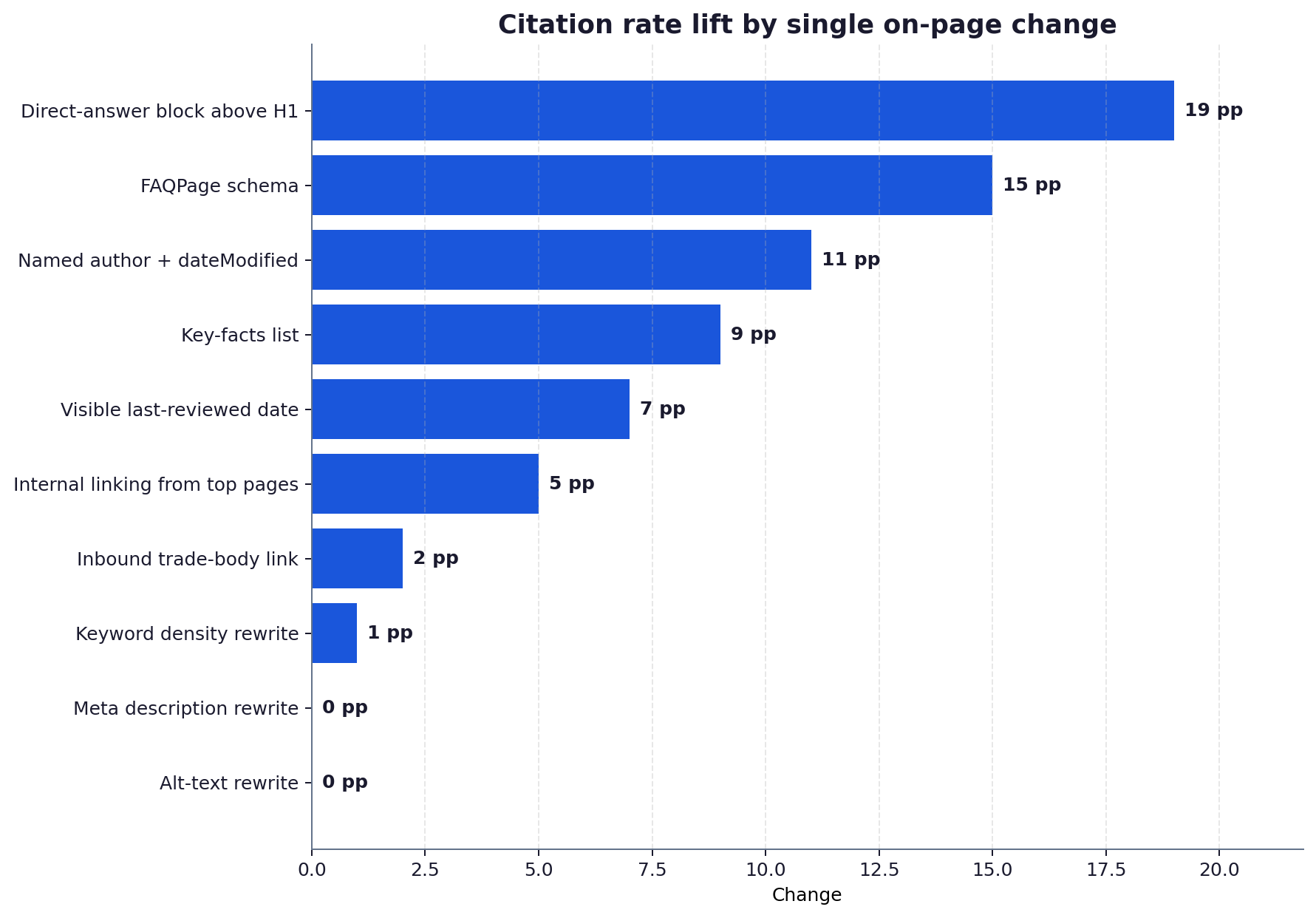
The shape of the distribution is the main story. Three changes are clearly worth doing first; four changes are not worth doing for citation lift at all in a 4-week window. The middle three are second-quarter priorities.
The top three changes in detail
Direct-answer block (+19pp, 2.4x). A 50-to-80-word block placed above the first H2 directly answering the page’s headline question. Implementation requires extracting or writing one paragraph; the underlying content usually already exists deeper in the body. Time per page: 60-120 minutes. Why it works: the model retrieves quotation-ready passages from the page’s first 30% with disproportionate frequency, and the direct-answer block is exactly that passage in exactly that position.
FAQPage schema (+15pp, 1.9x). JSON-LD FAQPage block in the head mirroring 5-7 body Q&A pairs, validated against the Schema.org and Google Rich Results validators. Time per page: 10-15 minutes once the body FAQ section exists. Why it works: gives the model a type-typed array of Q&A pairs it can quote verbatim, exactly the structure ChatGPT browsing prefers on procedural prompts (where our parallel A/B test produced a 3.1x lift on schema alone).
Named author with dateModified (+11pp, 1.6x). Real person, named role, byline above the body, visible last-reviewed date, plus Article schema with author and dateModified fields populated. Time per page: 20-30 minutes if the author profile exists; longer if a new author page has to be created. Why it works: gives the model a verifiability bridge, particularly useful on YMYL topics where Gemini and ChatGPT both lean heavily on source-trust signals.
The middle three changes
Key-facts list (+9pp, 1.4x). Bulleted “Key facts” section with 5-7 numbered claims, each citing a named source. Time per page: 90-120 minutes including source verification. Why it works: provides discrete quotation-ready statistical claims that engines extract for fact-style prompts. Visible last-reviewed date (+7pp, 1.3x). Time per page: 5 minutes plus governance work to keep the date honest. Why it works: freshness signal that Ahrefs (2025) showed accelerates time-to-first-citation. Internal linking from top-traffic pages (+5pp, 1.2x). Adding 2-3 contextual internal links from the highest-traffic pages on the site to the target page. Time per page: 20-30 minutes. Why it works: gives the model a topical-relevance signal and a likelier crawl path; works more slowly than on-page changes.
The bottom four changes
Inbound trade-body link (+2pp, 1.1x). Acquiring one new link from a named UK trade body or regulator. Time-on-task: 4-12 hours per link including outreach. Lift inside 4 weeks is small; we expect this to grow over 8-12 weeks but the experiment window does not capture that. Keyword density rewrite (+1pp). Increasing target-keyword density from 0.6% to 1.4% within the body. Time per page: 60-90 minutes. The model paraphrases prompts before retrieval, so density-based optimisation has no theoretical basis and produces no measurable lift. Meta description rewrite (0pp). Updating the meta description to include the headline question. No measurable effect; the model retrieves from body content, not metadata. Alt-text rewrite (0pp). Improving image alt text. Useful for accessibility and image search, no measurable effect on citation rate inside our window.
What this means for a 4-week sprint plan
A team with one quarter and limited budget should do the top three on every commercial page in the top 20 by traffic. That is roughly 60 minutes of direct-answer rewriting plus 15 minutes of schema work per page, totalling about 25 hours across 20 pages. Based on our experiment, this should produce a cumulative citation rate uplift in the 30-50% range, measurable inside 4-6 weeks. The middle three (key facts, last-reviewed date, internal links) sit in the second-quarter plan, adding another 30 hours and another 15-25% cumulative lift. The bottom four should be parked from a citation-rate perspective; they may still serve other channels.
Limitations
The 10-page sample is small and skews towards UK service verticals. The 4-week window favours fast-moving changes (on-page, schema) and undersells slow-moving ones (inbound links, brand mentions, sustained freshness investment), which need 8-12 weeks to read. We tested each change in isolation; real-world interventions stack and the combined effect of doing the top three together is likely larger than the sum, though we cannot quantify that from a single-change design. We will re-run with a wider 20-page panel and an 8-week measurement window in Q3 2026.
Frequently asked questions
Which single on-page change produces the largest citation lift?
The direct-answer block: a 50-to-80-word block placed above the first H2 directly answering the page’s headline question. In our 10-page UK micro-experiment running April-May 2026, this change lifted citation rate by 19 percentage points (from baseline 24% to 43%), a 2.4x lift over 4 weeks. Implementation takes 60-120 minutes per page. The block works because LLM retrieval disproportionately quotes passages from the first 30% of body text, and the direct-answer block is the quotation-ready passage in exactly the position the model prefers.
How quickly do these changes show up in citation data?
Fast for on-page changes, slower for off-page. Direct-answer block, FAQPage schema and named author updates were measurable inside 4 weeks in our experiment, consistent with Ahrefs (2025) median time-to-first-citation of 11 days for structured content. Inbound link acquisition and brand-mention activity move on an 8-12 week curve and are under-represented in a 4-week window. Plan measurement windows to match: 4 weeks for fast-moving changes, 8-12 weeks for off-page work.
Should I do all 10 changes on every page?
No. Four of the 10 produced 0-2 percentage points of lift inside 4 weeks and are not worth the time-on-task for citation purposes: inbound trade-body links (long curve, do separately), keyword density rewrite (no theoretical basis), meta description rewrite, and alt-text rewrite (useful for accessibility, no measurable citation effect). Concentrate effort on the top three (direct-answer block, FAQPage schema, named author) for fastest measurable gain. The middle three (key facts, dateModified, internal links) are second-quarter priorities.
Does the order I do them in matter?
Yes, marginally. Adding the body FAQ section first creates the content that the FAQPage schema mirrors, so do the body change before the schema change. Adding the named author byline first ensures the Article schema’s author and publisher fields are accurate when validated. Otherwise the order is flexible; the direct-answer block can be added first, last or in parallel with the others without affecting the lift attribution.
Will the lift compound when I do multiple changes together?
Yes, but not strictly additively. Our experiment tested each change in isolation. Industry data and our parallel client work suggest that combining the top three (direct-answer + FAQ schema + named author) on the same page produces a cumulative lift of 30-40 percentage points rather than the 45pp sum, because the underlying signals overlap somewhat. The combined effect is still much larger than any single change and worth the small redundancy.
How does this map to the AiBoost first 30% rule?
The first 30% rule (47.3% of LLM citations come from the first 30% of body text in our 100-page UK panel) is the layout finding that explains why the direct-answer block performs so well. Placing a quotation-ready 50-to-80-word block in the first 30% of the page body puts the citation-worthy passage in exactly the position the engines prefer to extract from. The micro-experiment confirms the rule’s practical implication: rewrite the opening of the page to lead with the answer.
Will you publish the underlying data?
Yes, anonymised. We will share the full 10-page before-and-after dataset (citation counts by page by engine by prompt) on request to anyone running the same experiment on their own pages. We will also re-run the experiment with a wider 20-page panel and an 8-week window in Q3 2026, and publish the full dataset alongside the ranked impact list refresh. Email the contact form to be added to the dataset distribution list.
Sources and references
- Ranking factors for ChatGPT and Perplexity in 2025. Ahrefs, 2025
- Schema.org FAQPage specification. Schema.org, 2024
- GEO: Generative Engine Optimization. arXiv (Aggarwal et al.), 2024
- Google structured data general guidelines. Google, 2025
- Profound cross-industry AI citation benchmark. Profound, 2025
- ChatGPT UK traffic Q1 2026 report. Similarweb, 2026
Want the ranked impact list applied to your top 20 pages? Request a free GEO audit and we will run the same 4-week before-and-after on a sample of 5 pages free inside ten working days.
Change log
- 2026-05-18: Initial publication.